Living
Which is bigger?
The German Wirehaired Pointer, at 60-70 lbs versus the Shiba's 17-23 lbs.

Quick answer
Which is bigger?
The German Wirehaired Pointer, at 60-70 lbs versus the Shiba's 17-23 lbs.
German Wirehaired Pointer or Shiba Inu? On paper they differ most on apartment suitability, and on the scales German Wirehaired Pointer is the heavier at 60–70 lbs. Here is how the two compare on everything that shapes an ordinary week.
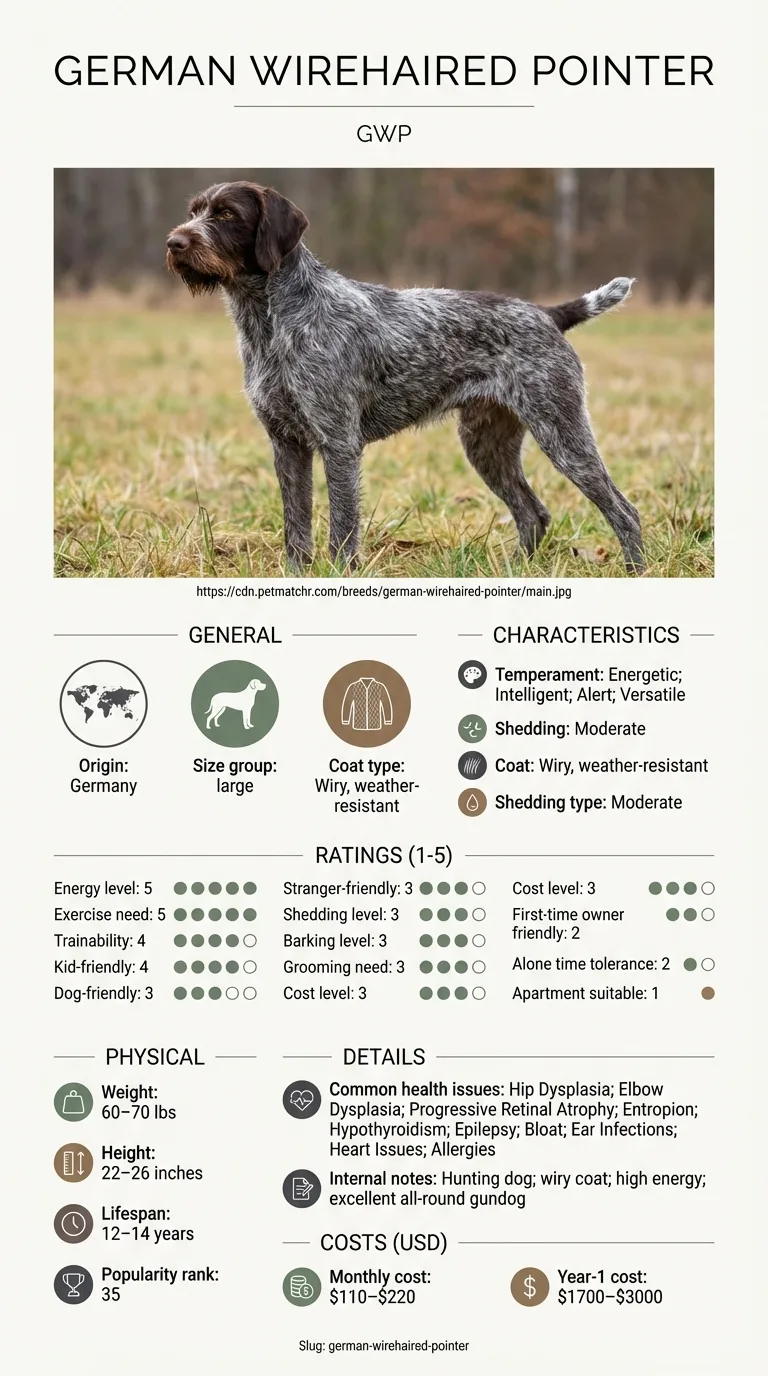
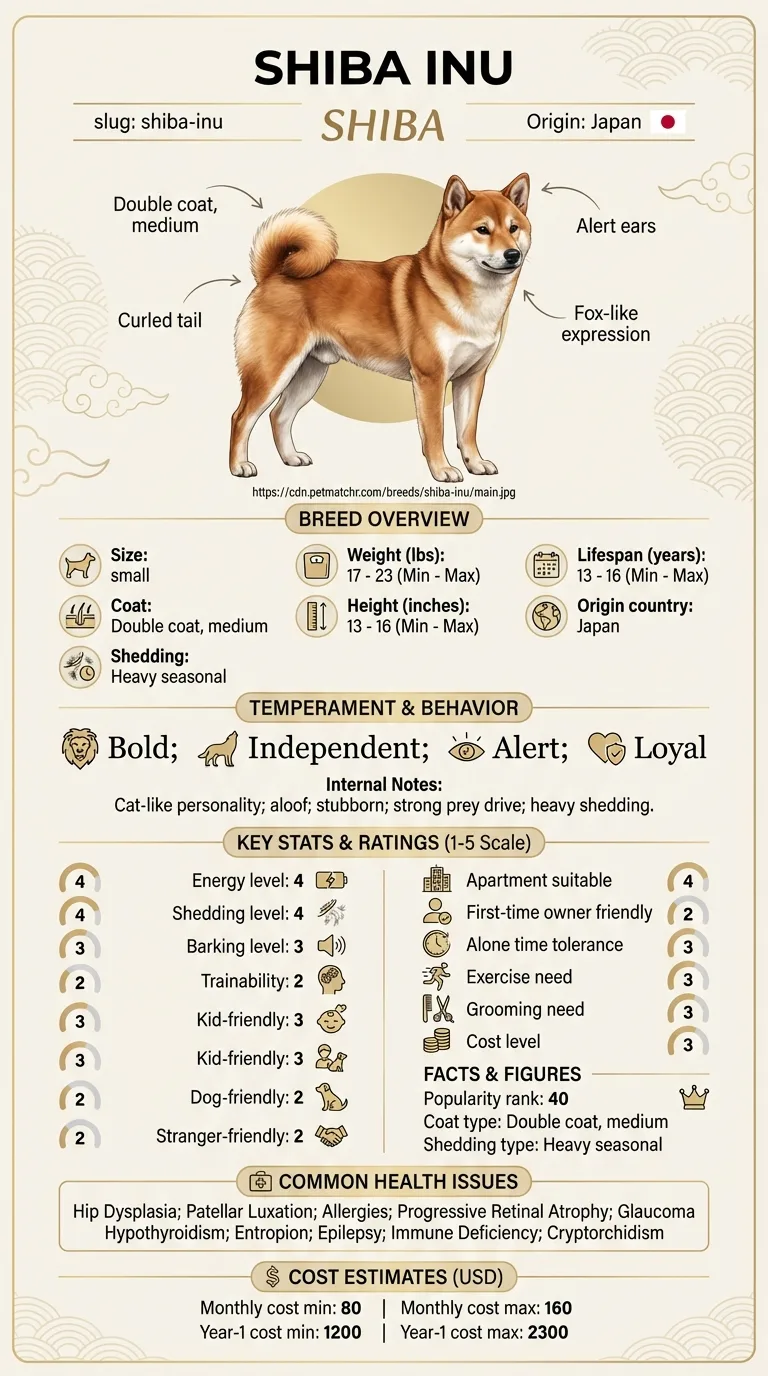
This is for someone already down to German Wirehaired Pointer and Shiba Inu and deciding between them. For this pair the decision usually turns on apartment suitability and exercise need, so those are covered first and in most detail. Anyone choosing from a flat has a clear answer here: Shiba Inu rates 4/5 against 1/5. It is written for the decision rather than the breed history.
Between German Wirehaired Pointer and Shiba Inu, apartment suitability is what separates them, and Shiba Inu is the lower-effort dog of the two to keep.
Choose German Wirehaired Pointer if shedding is a problem in your house, there are young children at home and you already have another dog.
Choose Shiba Inu if you are in a flat or a smaller home, your walking routine is modest and the dog will be alone during the working day.
| Feature | german wirehaired pointer | shiba inu | Winner |
|---|---|---|---|
| Size class | large | small | Equal |
| Weight | 60–70 lbs | 17–23 lbs | Equal |
| Height | 22–26 in | 13–16 in | Equal |
| Lifespan | 12–14 years | 13–16 years | shiba inu |
| Exercise need | Very high (5/5) | Moderate (3/5) | shiba inu |
| Grooming need | Moderate (3/5) | Moderate (3/5) | Equal |
| Shedding | Moderate (3/5) | High (4/5) | german wirehaired pointer |
| Energy level | Very high (5/5) | High (4/5) | Equal |
| Barking | Moderate (3/5) | Moderate (3/5) | Equal |
| Apartment suitability | Very low (1/5) | High (4/5) | shiba inu |
| Good for first-time owners | Low (2/5) | Low (2/5) | Equal |
| Tolerates being alone | Low (2/5) | Moderate (3/5) | shiba inu |
| Trainability | High (4/5) | Low (2/5) | german wirehaired pointer |
| Good with kids | High (4/5) | Moderate (3/5) | german wirehaired pointer |
| Good with other dogs | Moderate (3/5) | Low (2/5) | german wirehaired pointer |
| Friendly to strangers | Moderate (3/5) | Low (2/5) | german wirehaired pointer |
| Cost level | Moderate (3/5) | Moderate (3/5) | Equal |
| Coat | Wiry, weather-resistant | Double coat, medium | Equal |
| Origin | Germany | Japan | Equal |
| Typical monthly cost | $110–$220 | $80–$160 | Equal |
| Typical first-year cost | $1,700–$3,000 | $1,200–$2,300 | Equal |
The Shiba Inu is a small breed, 17-23 lbs and 13-16 inches, well under the GWP's large 60-70 lbs and 22-26 inch frame -- a GWP typically outweighs a Shiba by three times or more. Both hail from hunting backgrounds, though continents apart (Germany versus Japan), and both carry an alert, independent-minded build suited to their original work. The size gap here is significant enough that most of the practical ownership differences -- space needed, strength on leash, feeding costs -- will trace directly back to it.
The GWP needs considerably more exercise, very high (5/5) against the Shiba's moderate (3/5), though energy levels sit closer (5/5 vs 4/5, called a tie) -- the Shiba is a genuinely spirited, active small dog even if its formal exercise need rates lower. Bold and independent by temperament, the Shiba often self-regulates its activity level more than a GWP does, but that same independence means it won't automatically match a GWP's drive for structured, sustained exercise like field retrieving or long-distance running.
Grooming ties at moderate (3/5) for both breeds, but shedding favors the GWP: moderate (3/5) against the Shiba's high (4/5). The Shiba's medium double coat blows out seasonally with notable volume despite requiring similar routine brushing time to the GWP's wiry coat. Owners drawn to the Shiba's fox-like appearance should budget for a couple of intense shedding seasons per year on top of the regular moderate grooming both breeds share, when loose undercoat can come out in handfuls over a week or two and daily brushing becomes worthwhile rather than optional.
Apartment suitability favors the Shiba clearly, high (4/5) against the GWP's very low (1/5), making it a far more realistic fit for smaller homes. Barking ties at moderate (3/5) for both. Tolerance for being alone favors the Shiba too, moderate (3/5) against the GWP's low (2/5) -- its bold, independent temperament genuinely handles solo time better than the intensely people-oriented GWP, a meaningful advantage for owners with less flexible schedules or smaller living spaces.
Trainability strongly favors the GWP here, high (4/5) against the Shiba's low (2/5) -- one of the widest trainability gaps in this comparison. Both breeds rate low (2/5) for first-time owner suitability, though, meaning neither is genuinely easy for a novice, just difficult in different ways: the GWP needs an owner ready to channel intense hunting drive, while the Shiba's bold, independent nature makes it notoriously resistant to typical obedience methods regardless of experience level. Shiba owners often describe a cat-like independence that simply doesn't respond to training the way a GWP does.
The GWP edges ahead across the board here: high (4/5) with kids against the Shiba's moderate (3/5), moderate (3/5) with other dogs against the Shiba's low (2/5), and moderate (3/5) friendliness to strangers against the Shiba's low (2/5). The Shiba's bold, independent, loyal temperament tends toward a one-family, reserved-with-outsiders disposition, while the GWP's more alert-but-versatile nature adapts somewhat more readily to busier households. Families who host often or have multiple pets may find the GWP the more socially flexible of the two.
The Shiba holds a modest lifespan edge, 13-16 years against the GWP's 12-14. Shared risks include hip dysplasia, progressive retinal atrophy, hypothyroidism, entropion, and epilepsy across both ten-item lists. Beyond that overlap, the Shiba's list adds patellar luxation, allergies, glaucoma, immune deficiency, and cryptorchidism, while the GWP's includes elbow dysplasia, bloat, ear infections, and heart issues. The eye-related overlap -- PRA and entropion appearing on both lists -- makes regular ophthalmic screening worth prioritizing for either breed.
Cost level ties at moderate (3/5) for both breeds, and monthly costs land close: $110-$220 for the GWP versus $80-$160 for the Shiba, with first-year costs of $1,700-$3,000 against $1,200-$2,300. The Shiba's smaller size keeps routine costs lower, and it doesn't carry the higher grooming surcharge seen with some small breeds since its grooming need ties with the GWP's at moderate. Overall the Shiba remains the more budget-friendly pick, largely a function of its considerably smaller frame, though owners of either breed should still set aside a cushion for the unplanned vet visits that come with any of the eye and joint conditions on their respective health lists.
German Wirehaired Pointer weighs 60–70 lbs and lives 12–14 years; Shiba Inu weighs 17–23 lbs and lives 13–16 years. The two diverge most on apartment suitability, exercise need and trainability. They are level on barking, cost level and good for first-time owners, so those cannot decide it. In the table, a "winner" means easier for an ordinary household — not better. Size, coat and origin are recorded without a verdict. Because both breeds are scored the same way, the gaps are reliable even where the absolute numbers are rough.

The German Wirehaired Pointer, by a wide margin -- high (4/5) trainability versus the Shiba's low (2/5); Shibas are known for independent, cat-like resistance to typical training methods.
The Shiba Inu, rating high (4/5) apartment suitability against the GWP's very low (1/5).
The Shiba Inu, rating moderate (3/5) versus the GWP's low (2/5) -- its bold, independent temperament handles solo time more comfortably.
No -- both rate low (2/5) for first-time owner suitability, though for different reasons: the GWP's exercise drive and the Shiba's independent streak.
The Shiba Inu, rating high (4/5) shedding against the GWP's moderate (3/5), especially during its seasonal coat blows.
The Shiba Inu, typically 13-16 years, slightly ahead of the GWP's 12-14 years.
The GWP, rating moderate (3/5) on both measures versus the Shiba's low (2/5) on both -- the Shiba tends toward a more reserved, one-family temperament.
The German Wirehaired Pointer, at 60-70 lbs versus the Shiba's 17-23 lbs.
The Shiba Inu, described as bold and independent by temperament.
The Shiba Inu, rating moderate (3/5) versus the GWP's very high (5/5).
The Shiba Inu, with a first-year cost of $1,200-$2,300 versus the GWP's $1,700-$3,000.
Secure checkout on Stripe. We never see your card.
7-day money-back guarantee. Instant access.
Health information here is general and is not veterinary advice. If your dog shows pain, sudden behaviour change, or worsening symptoms, consult a licensed veterinarian.
Some links on this site are affiliate links. We may earn a commission at no extra cost to you, and we only suggest products we believe are helpful for dog owners.
We research and check what we publish, but we do not warrant that any figure, date, price, or statement is accurate, complete, or current, and we accept no liability for any loss, cost, injury, or other harm arising from the use of this site. Use it as one reference among several. You remain responsible for your own decisions and for your dog's care - confirm anything that matters with a licensed veterinarian or another qualified professional before you act on it. Full disclaimer.
Match your lifestyle to the right dog.
Take quizNot sure which breed is right for you? Take our 2-minute quiz to find out.
Take the quiz