Living
Which is taller?
The GWP, standing 22-26 inches versus the Corgi's 10-12 inches.

Quick answer
Which is taller?
The GWP, standing 22-26 inches versus the Corgi's 10-12 inches.
German Wirehaired Pointer or Pembroke Welsh Corgi? On paper they differ most on apartment suitability, and on the scales German Wirehaired Pointer is the heavier at 60–70 lbs. Here is how the two compare on everything that shapes an ordinary week.
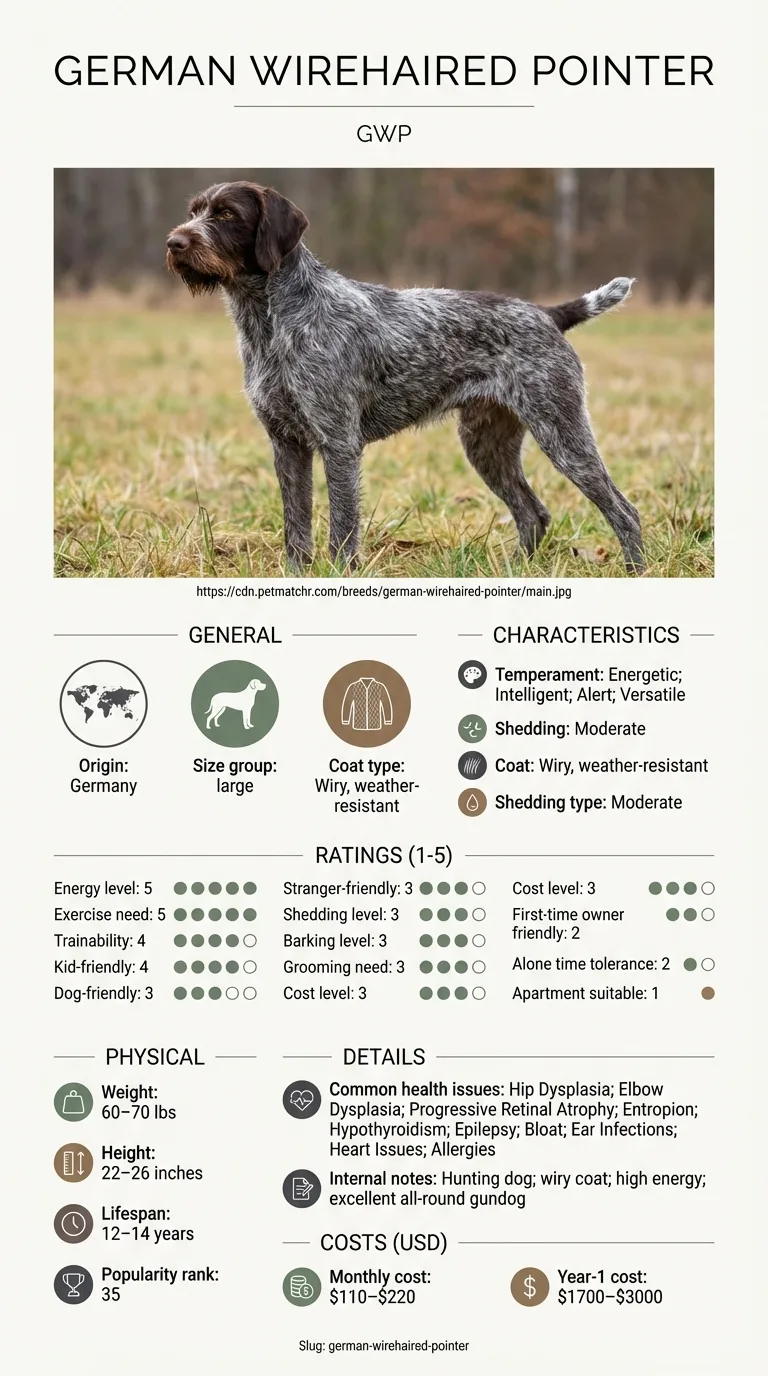
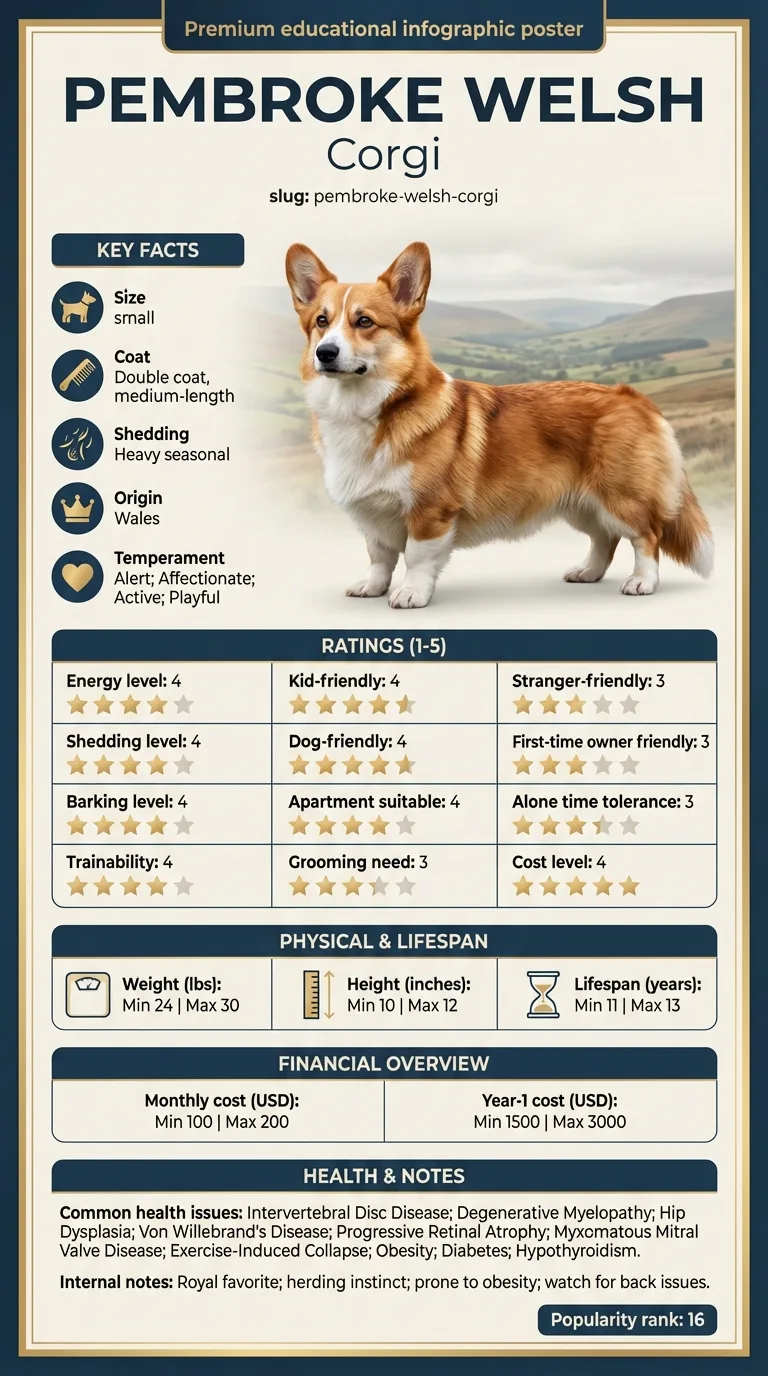
This is for someone already down to German Wirehaired Pointer and Pembroke Welsh Corgi and deciding between them. For this pair the decision usually turns on apartment suitability, so those are covered first and in most detail. Anyone choosing from a flat has a clear answer here: Pembroke Welsh Corgi rates 4/5 against 1/5. Breed history is left out; what follows is what you will actually live with.
Between German Wirehaired Pointer and Pembroke Welsh Corgi, apartment suitability is what separates them, and Pembroke Welsh Corgi is the lower-effort dog of the two to keep.
Choose German Wirehaired Pointer if shedding is a problem in your house and you want a dog that can keep up with an active routine.
Choose Pembroke Welsh Corgi if you are in a flat or a smaller home, this is your first dog and your walking routine is modest.
| Feature | german wirehaired pointer | pembroke welsh corgi | Winner |
|---|---|---|---|
| Size class | large | small | Equal |
| Weight | 60–70 lbs | 24–30 lbs | Equal |
| Height | 22–26 in | 10–12 in | Equal |
| Lifespan | 12–14 years | 11–13 years | german wirehaired pointer |
| Exercise need | Very high (5/5) | High (4/5) | pembroke welsh corgi |
| Grooming need | Moderate (3/5) | Moderate (3/5) | Equal |
| Shedding | Moderate (3/5) | High (4/5) | german wirehaired pointer |
| Energy level | Very high (5/5) | High (4/5) | Equal |
| Barking | Moderate (3/5) | High (4/5) | german wirehaired pointer |
| Apartment suitability | Very low (1/5) | High (4/5) | pembroke welsh corgi |
| Good for first-time owners | Low (2/5) | Moderate (3/5) | pembroke welsh corgi |
| Tolerates being alone | Low (2/5) | Moderate (3/5) | pembroke welsh corgi |
| Trainability | High (4/5) | High (4/5) | Equal |
| Good with kids | High (4/5) | High (4/5) | Equal |
| Good with other dogs | Moderate (3/5) | High (4/5) | pembroke welsh corgi |
| Friendly to strangers | Moderate (3/5) | Moderate (3/5) | Equal |
| Cost level | Moderate (3/5) | High (4/5) | german wirehaired pointer |
| Coat | Wiry, weather-resistant | Double coat, medium-length | Equal |
| Origin | Germany | Wales | Equal |
| Typical monthly cost | $110–$220 | $100–$200 | Equal |
| Typical first-year cost | $1,700–$3,000 | $1,500–$3,000 | Equal |
The size gap here is mostly about height, not just weight: the Pembroke Welsh Corgi weighs a respectable 24-30 pounds but stands only 10-12 inches tall on its short, low-slung legs, against the GWP's 22-26 inches and 60-70 pounds. That long-backed, short-legged build is a defining Corgi trait tied directly to its herding-dog history and its listed risk of intervertebral disc disease. The GWP's frame is proportionally athletic top to bottom, built for covering ground rather than working low to control livestock. Anyone picturing these two together should note the Corgi's unusual proportions as much as its smaller overall size.
Both breeds bring real drive: exercise need rates Very high (5/5) for the GWP against High (4/5) for the Corgi, and energy level ties at essentially the same top-tier range for both. Corgis were bred to herd cattle all day despite their short legs, so their exercise needs are closer to the GWP's than most small breeds -- this isn't a low-key lapdog pairing. Still, the GWP edges out as needing marginally more, and its higher exercise ceiling suits owners wanting a running or hiking partner. Corgi owners should also watch exercise intensity given the breed's exercise-induced collapse and IVDD risks, favoring controlled activity over jumping or rough play.
Grooming ties at Moderate (3/5) for both breeds, but shedding favors the GWP, Moderate (3/5) against the Corgi's High (4/5) -- Corgis are famous for their heavy double coat and notorious seasonal shedding, often described by owners as producing a near-constant trail of fur. The GWP's wiry coat sheds moderately but consistently rather than in dramatic seasonal bursts. Anyone choosing between these two purely on coat-care time should expect similar brushing frequency, but should brace for noticeably more loose hair around the house with a Corgi, especially during its biannual coat blow.
Apartment suitability strongly favors the Corgi, High (4/5) against the GWP's Very low (1/5), a testament to how well Corgis adapt to smaller spaces despite their high exercise needs. Barking favors the GWP, though: Moderate (3/5) versus the Corgi's High (4/5) -- Corgis are known for being vocal, alert dogs that bark readily at sounds and passersby, a herding instinct that doesn't switch off indoors. Tolerating time alone also favors the Corgi, Moderate (3/5) against the GWP's Low (2/5). Altogether, the Corgi handles compact living better on the space and alone-time fronts, but its barking tendency is worth planning for in close quarters.
Trainability ties at High (4/5) for both breeds, but first-time-owner suitability favors the Corgi, Moderate (3/5) against the GWP's Low (2/5). Temperament lists explain some of this: alert, affectionate, active and playful for the Corgi versus energetic, intelligent, alert and versatile for the GWP -- both alert and active, but the Corgi's affectionate, playful streak reads as more approachable for a novice than the GWP's working-dog versatility. Neither breed is a pushover, though; Corgis have an independent, sometimes stubborn herding-dog streak of their own, so "better for beginners" here is relative rather than an indication that either breed trains itself.
Good with kids ties at High (4/5) for both breeds, and friendly to strangers ties at Moderate (3/5) as well -- these two are more evenly matched on family fit than the raw size difference might suggest. Good with other dogs favors the Corgi, High (4/5) against the GWP's Moderate (3/5), consistent with its playful, affectionate temperament. Families should still factor in the Corgi's herding instinct, which can show up as gentle nipping at heels during play with kids -- a trait worth managing through early training regardless of the strong compatibility ratings otherwise. Overall, both breeds present as solid, if different, family options.
Lifespan favors the GWP, 12-14 years against the Corgi's 11-13. The Corgi's health list is notably longer and more specific: intervertebral disc disease, degenerative myelopathy, hip dysplasia, von Willebrand's disease, progressive retinal atrophy, myxomatous mitral valve disease, exercise-induced collapse, obesity, diabetes and hypothyroidism -- ten conditions, several tied directly to its unusually long spine and short legs, like IVDD and degenerative myelopathy. The GWP's ten-condition list skews toward large-breed joint and organ issues instead. Both share hip dysplasia, PRA and hypothyroidism risk. Corgi owners in particular should manage weight carefully given the breed's obesity and diabetes risk compounding its back-health vulnerabilities.
Cost level favors the GWP, Moderate (3/5) against the Corgi's High (4/5), though the dollar ranges land close: $100-200 monthly and $1,500-3,000 first-year for the Corgi versus $110-220 monthly and $1,700-3,000 for the GWP. The Corgi's higher cost rating likely reflects its extensive health-monitoring needs -- orthopedic and cardiac screening in particular -- given its ten-item health list touching spine, heart, and metabolic conditions. The GWP's costs lean more toward food volume and field-related gear. Anyone budgeting for a Corgi should factor in potential veterinary costs tied to its back and joint vulnerabilities alongside routine expenses.
German Wirehaired Pointer weighs 60–70 lbs and lives 12–14 years; Pembroke Welsh Corgi weighs 24–30 lbs and lives 11–13 years. The two diverge most on apartment suitability. They are level on grooming need, good with kids and friendly to strangers, so those cannot decide it. The comparison marks an easier option only where one exists. Facts like weight and country of origin are not scored. Both dogs are rated from the same dataset, which is what makes the numbers comparable with each other even though any individual dog sits somewhere inside its breed's range.

The Corgi, rated High (4/5) for apartment suitability versus the GWP's Very low (1/5), though its High (4/5) barking rating matters for close neighbors.
Almost -- Corgis rate High (4/5) for exercise need, just below the GWP's Very high (5/5), reflecting their herding-dog stamina.
The Corgi's list is longer and includes spine-related risks like intervertebral disc disease and degenerative myelopathy, tied to its long back and short legs.
The Corgi, rated High (4/5) versus the GWP's Moderate (3/5) -- expect a heavier seasonal coat blow.
The Corgi, rated High (4/5) versus the GWP's Moderate (3/5).
Reasonably, rated Moderate (3/5) for first-time owners versus the GWP's Low (2/5), though its herding instincts still require training attention.
The GWP, at 12-14 years versus the Corgi's 11-13 years.
The GWP, standing 22-26 inches versus the Corgi's 10-12 inches.
The Corgi, rated High (4/5) versus the GWP's Moderate (3/5).
The Corgi, rated High (4/5) apartment suitability versus the GWP's Very low (1/5).
The Corgi, rated High (4/5) versus the GWP's Very high (5/5), though only slightly.
Secure checkout on Stripe. We never see your card.
7-day money-back guarantee. Instant access.

Health information here is general and is not veterinary advice. If your dog shows pain, sudden behaviour change, or worsening symptoms, consult a licensed veterinarian.
Some links on this site are affiliate links. We may earn a commission at no extra cost to you, and we only suggest products we believe are helpful for dog owners.
We research and check what we publish, but we do not warrant that any figure, date, price, or statement is accurate, complete, or current, and we accept no liability for any loss, cost, injury, or other harm arising from the use of this site. Use it as one reference among several. You remain responsible for your own decisions and for your dog's care - confirm anything that matters with a licensed veterinarian or another qualified professional before you act on it. Full disclaimer.
Match your lifestyle to the right dog.
Take quizNot sure which breed is right for you? Take our 2-minute quiz to find out.
Take the quiz