Training
Which breed is more trainable?
The German Shorthaired Pointer, rated very high (5/5), against the Rottweiler mix's high (4/5).

Quick answer
Which breed is more trainable?
The German Shorthaired Pointer, rated very high (5/5), against the Rottweiler mix's high (4/5).
German Shorthaired Pointer or Rottweiler Mix? On paper they differ most on energy level, and on the scales Rottweiler Mix is the heavier at 80–135 lbs. Here is how the two compare on everything that shapes an ordinary week.
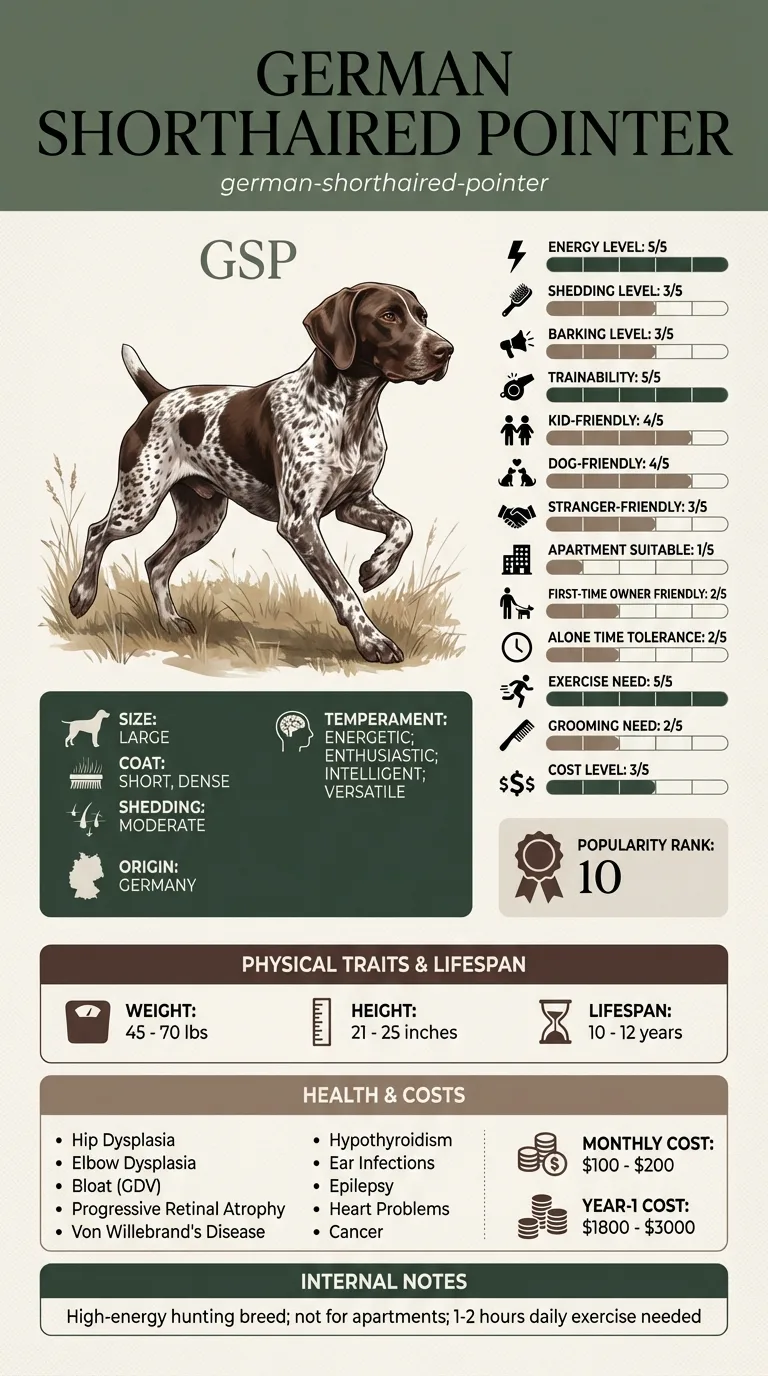
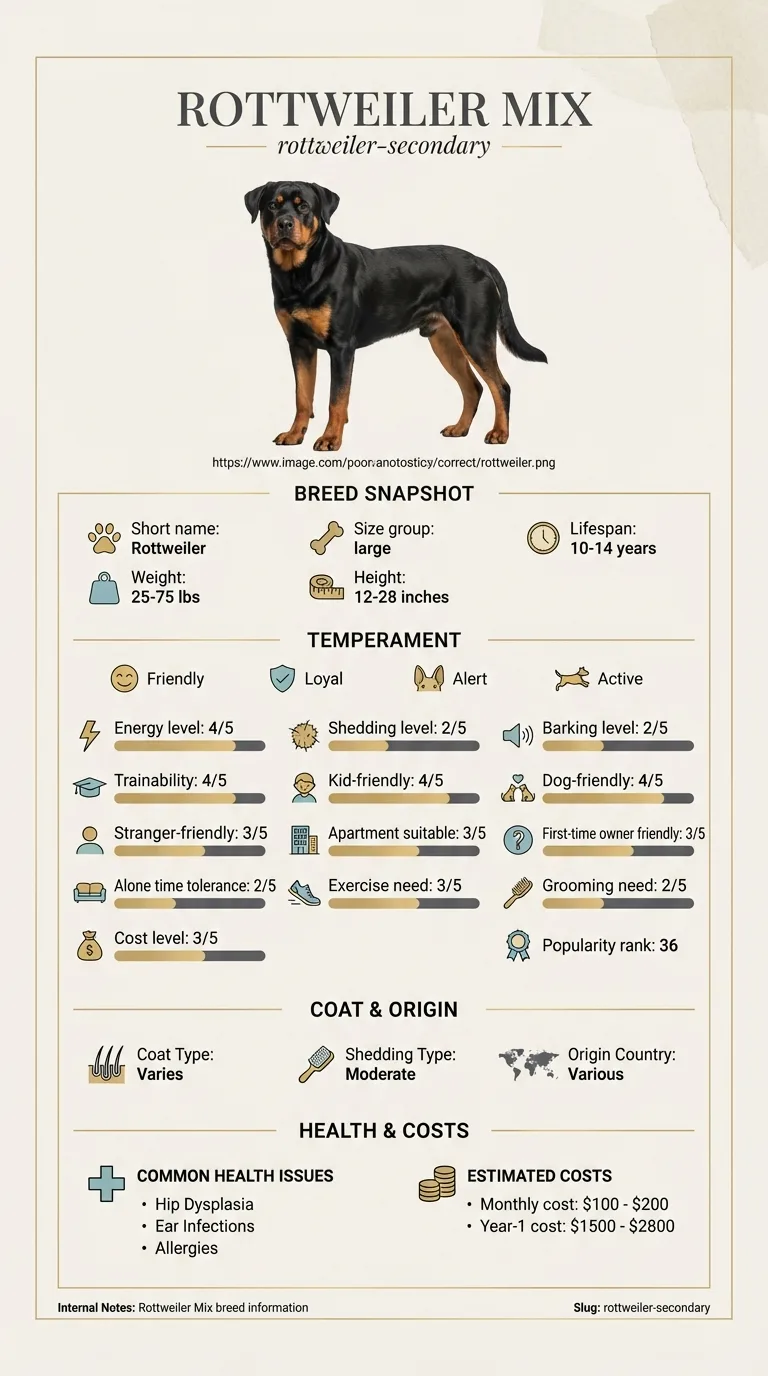
This is for someone already down to German Shorthaired Pointer and Rottweiler Mix and deciding between them. For this pair the decision usually turns on energy level and good with other dogs, so those are covered first and in most detail. Anyone choosing from a flat has a clear answer here: Rottweiler Mix rates 2/5 against 1/5. There is no origin story here — only what changes about your week.
Between German Shorthaired Pointer and Rottweiler Mix, energy level is what separates them, and Rottweiler Mix is the lower-effort dog of the two to keep.
Choose German Shorthaired Pointer if there are young children at home, you already have another dog and you want a dog that picks up training quickly.
Choose Rottweiler Mix if your walking routine is modest, the dog will be alone during the working day and you want a dog that is more watchful with visitors.
| Feature | german shorthaired pointer | rottweiler secondary | Winner |
|---|---|---|---|
| Size class | large | large | Equal |
| Weight | 45–70 lbs | 80–135 lbs | Equal |
| Height | 21–25 in | 22–27 in | Equal |
| Lifespan | 10–12 years | 9–10 years | german shorthaired pointer |
| Exercise need | Very high (5/5) | High (4/5) | rottweiler secondary |
| Grooming need | Low (2/5) | Low (2/5) | Equal |
| Shedding | Moderate (3/5) | Moderate (3/5) | Equal |
| Energy level | Very high (5/5) | Moderate (3/5) | Equal |
| Barking | Moderate (3/5) | Low (2/5) | rottweiler secondary |
| Apartment suitability | Very low (1/5) | Low (2/5) | rottweiler secondary |
| Good for first-time owners | Low (2/5) | Low (2/5) | Equal |
| Tolerates being alone | Low (2/5) | Moderate (3/5) | rottweiler secondary |
| Trainability | Very high (5/5) | High (4/5) | german shorthaired pointer |
| Good with kids | High (4/5) | Moderate (3/5) | german shorthaired pointer |
| Good with other dogs | High (4/5) | Low (2/5) | german shorthaired pointer |
| Friendly to strangers | Moderate (3/5) | Low (2/5) | german shorthaired pointer |
| Cost level | Moderate (3/5) | High (4/5) | german shorthaired pointer |
| Coat | Short, dense | Short, dense double coat | Equal |
| Origin | Germany | Various | Equal |
| Typical monthly cost | $100–$200 | $110–$240 | Equal |
| Typical first-year cost | $1,800–$3,000 | $1,700–$3,200 | Equal |
Rottweiler Mix dogs in the 80-to-135-pound range dwarf the German Shorthaired Pointer's 45-to-70-pound frame, even though the height gap is modest — 22 to 27 inches versus 21 to 25. That closeness in height with a big gap in weight tells you something: the Rottweiler mix carries dramatically more bone and muscle mass on a similarly tall frame, giving it a blocky, powerful build compared to the Pointer's lean, athletic lines. Both wear a short, dense coat, though the Rottweiler mix's is typically a double coat adding some bulk to its silhouette. A GSP reads as built for covering ground fast; a Rottweiler mix reads as built for stopping something in its tracks.
Exercise need registers very high (5/5) for the German Shorthaired Pointer and high (4/5) for the Rottweiler mix — both want serious daily activity, but the Pointer's is relentless. Bred to point and retrieve across long hunting days, a GSP left under-exercised becomes anxious and destructive fast; hour-long runs or structured field work suit it better than a casual walk ever will. The Rottweiler mix's energy runs steadier and more moderate day to day despite the high exercise rating, often expressed through purposeful activity like structured training or working tasks rather than nonstop motion. A tired GSP and a tired Rottweiler mix look different at the end of the day — one is finally calm, the other never quite stopped needing a job.
Grooming ties at low (2/5) and shedding ties at moderate (3/5) between these two, so upkeep on the coat itself is nearly identical — a weekly brush handles both breeds' short, dense coats without much fuss. Where the practical difference shows up is scale: a Rottweiler mix carries more surface area and often more bulk, so even moderate shedding from a bigger body means more hair accumulating around the house than the same rating produces on a GSP. Neither breed needs professional grooming, baths beyond occasional cleanup, or coat trimming, which keeps both of them on the lower-maintenance end of this comparison relative to feathered or long-coated breeds.
Both breeds rate poorly for apartment life — very low (1/5) for the GSP, low (2/5) for the Rottweiler mix — reflecting size and exercise needs more than temperament. Barking favors the Rottweiler mix, low (2/5) against the GSP's moderate (3/5); a Pointer's vocal, enthusiastic nature tends to show up as barking at activity outside, while a watchful Rottweiler mix is more likely to stay silently alert. Tolerating time alone also tips toward the Rottweiler mix, moderate (3/5) versus the GSP's low (2/5), a small but meaningful gap for anyone working long hours. Neither breed is a realistic pick for a small apartment without a serious daily exercise commitment attached.
Trainability rates very high (5/5) for the GSP and high (4/5) for the Rottweiler mix, both strong scores reflecting genuine working intelligence — versatile and enthusiastic describe the Pointer's approach, while confident and steady describe the Rottweiler mix's. Neither, however, suits a first-time owner well: both rate low (2/5) on that measure. A GSP's relentless drive can overwhelm an inexperienced handler even as the dog learns commands quickly, and a Rottweiler mix's size and watchful temperament call for confident, consistent leadership from day one. Both breeds do best with owners who have handled a strong-willed working dog before and can commit to real structure early.
Good with kids favors the GSP, high (4/5) against the Rottweiler mix's moderate (3/5), and the gap widens further with other dogs — high (4/5) versus a notably low (2/5) for the Rottweiler mix. Friendliness to strangers follows the same direction, moderate (3/5) for the GSP against low (2/5) for the Rottweiler mix, consistent with its watchful, guarding-oriented temperament. None of this makes the Rottweiler mix unsuitable for families — loyal and steady are core traits — but it does mean earlier, more deliberate socialization work around other dogs and unfamiliar visitors matters more here than it does for the naturally outgoing, enthusiastic GSP.
A GSP's expected 10 to 12 years edges out the Rottweiler mix's 9 to 10, though both share hip dysplasia and elbow dysplasia as baseline orthopedic concerns. Beyond that overlap, the two lists diverge: the Rottweiler mix carries osteosarcoma, an aggressive bone cancer disproportionately common in large and giant breeds, subaortic stenosis, and cruciate ligament tears, an injury risk tied to its heavier build putting more stress on the knees. The GSP's list runs longer and covers different territory — bloat (GDV), Von Willebrand's Disease, epilepsy, hypothyroidism, and cancer more broadly, alongside heart problems and progressive retinal atrophy. Ten listed conditions for the GSP against five for the Rottweiler mix doesn't necessarily mean a rougher health outlook, just a more varied one.
Cost level rates moderate for the GSP and high for the Rottweiler mix, though the dollar figures land closer together than that gap suggests — $1,800-$3,000 first-year for the GSP against $1,700-$3,200 for the Rottweiler mix, with monthly costs of $100-$200 versus $110-$240. The Rottweiler mix's larger body drives up food volume and medication dosing, and osteosarcoma screening or treatment, should it ever be needed, is a genuinely expensive proposition for a large-breed cancer. The GSP's costs spread more evenly across its longer health list — cardiac workups, epilepsy management, and standard orthopedic screening for hip and elbow dysplasia all factor in over a working lifetime.
German Shorthaired Pointer weighs 45–70 lbs and lives 10–12 years; Rottweiler Mix weighs 80–135 lbs and lives 9–10 years. The two diverge most on energy level and good with other dogs. They are level on good for first-time owners, grooming need and shedding, so those cannot decide it. Where the table declares a winner it means less work for the owner, nothing more; descriptive rows are left as ties on purpose. The value here is in the differences between the two columns; treat any single score as approximate.

Not especially — it rates low (2/5) for compatibility with other dogs, notably lower than the German Shorthaired Pointer's high (4/5), so early socialization matters more here.
Neither is low-energy, but the Rottweiler mix rates slightly easier at high (4/5) exercise need versus the GSP's very high (5/5).
Yes, it's listed on the breed's health profile — an aggressive bone cancer more common in large and giant breeds due to their skeletal growth rate.
The German Shorthaired Pointer, rated moderate (3/5), against the Rottweiler mix's low (2/5), consistent with the latter's watchful, guarding temperament.
Not ideally — both rate low (2/5) for first-time-owner suitability and need experienced, consistent handling.
They're close, but the Rottweiler mix edges slightly higher, up to $3,200 versus the GSP's $3,000 ceiling, though the GSP's monthly baseline is a bit lower too.
The German Shorthaired Pointer, rated very high (5/5), against the Rottweiler mix's high (4/5).
The German Shorthaired Pointer, averaging 10-12 years compared to the Rottweiler mix's 9-10.
The Rottweiler mix, rated low (2/5) versus the GSP's moderate (3/5).
The Rottweiler mix, rated moderate (3/5), compared to the GSP's low (2/5).
Secure checkout on Stripe. We never see your card.
7-day money-back guarantee. Instant access.
Health information here is general and is not veterinary advice. If your dog shows pain, sudden behaviour change, or worsening symptoms, consult a licensed veterinarian.
Some links on this site are affiliate links. We may earn a commission at no extra cost to you, and we only suggest products we believe are helpful for dog owners.
We research and check what we publish, but we do not warrant that any figure, date, price, or statement is accurate, complete, or current, and we accept no liability for any loss, cost, injury, or other harm arising from the use of this site. Use it as one reference among several. You remain responsible for your own decisions and for your dog's care - confirm anything that matters with a licensed veterinarian or another qualified professional before you act on it. Full disclaimer.
Match your lifestyle to the right dog.
Take quizNot sure which breed is right for you? Take our 2-minute quiz to find out.
Take the quiz