Behavior
Which is the better overall choice?
If longevity matters most to you, the German Wirehaired Pointer's 12-14 year lifespan is hard to beat; if you want an easier first dog with less barking and more sociability, go with the French Spaniel.

Quick answer
Which is the better overall choice?
If longevity matters most to you, the German Wirehaired Pointer's 12-14 year lifespan is hard to beat; if you want an easier first dog with less barking and more sociability, go with the French Spaniel.
French Spaniel or German Wirehaired Pointer? On paper they differ most on energy level, and on the scales German Wirehaired Pointer is the heavier at 60–70 lbs. Here is how the two compare on everything that shapes an ordinary week.
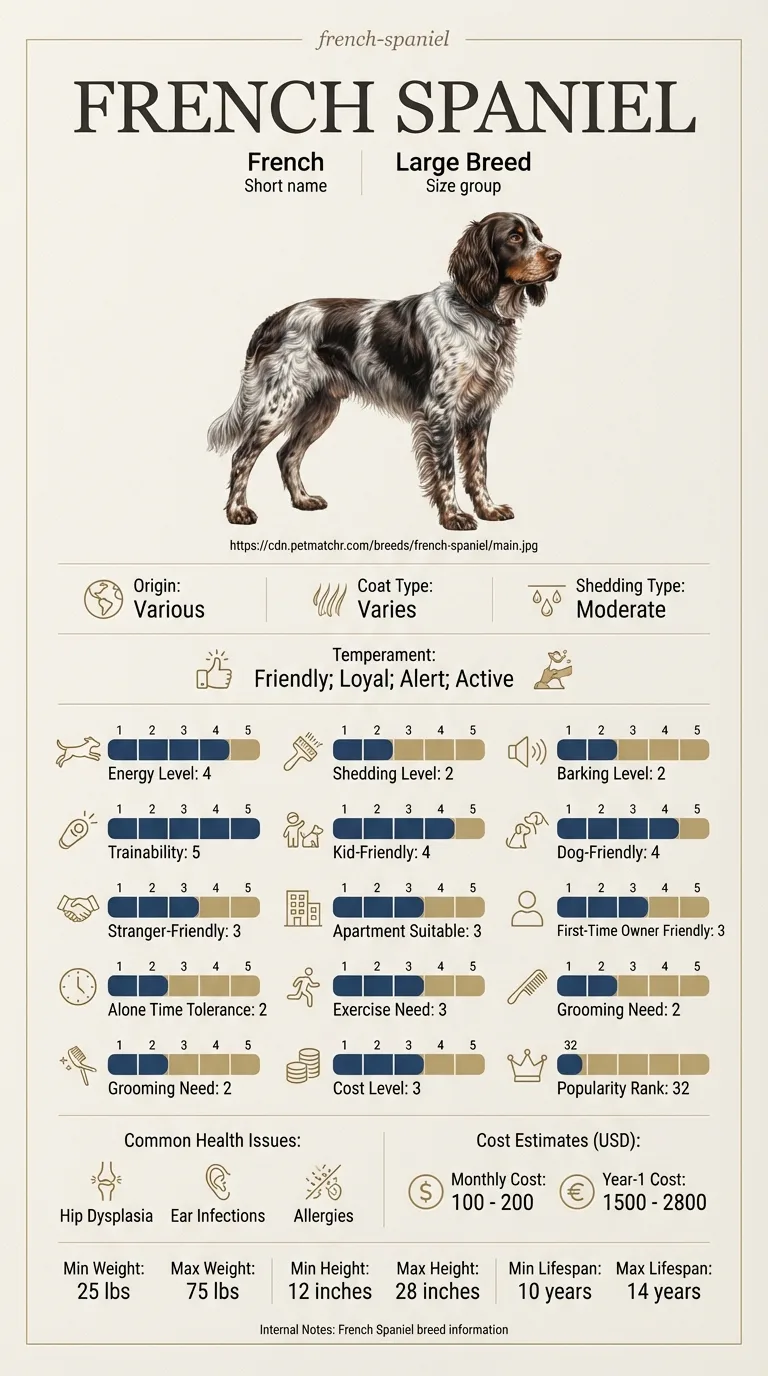
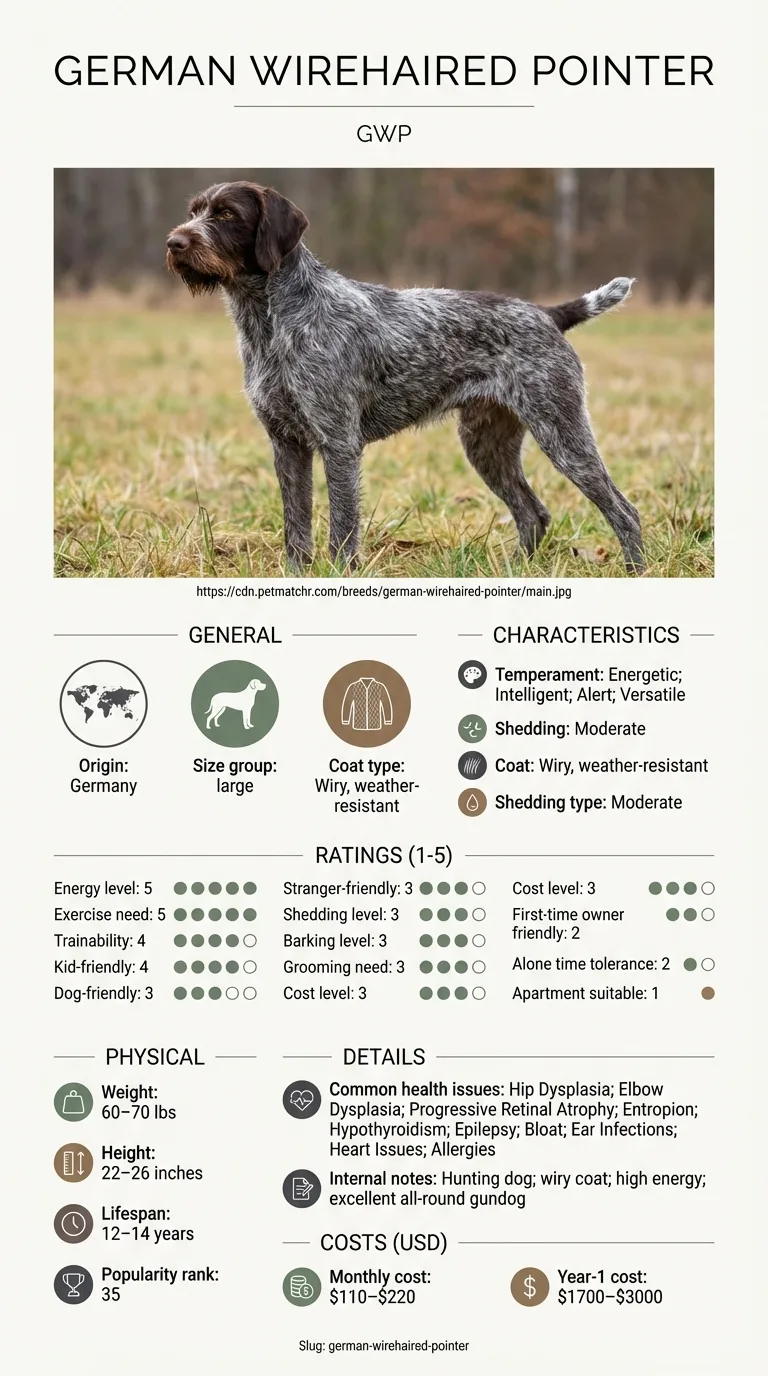
This is for someone already down to French Spaniel and German Wirehaired Pointer and deciding between them. Because the two are so evenly matched, the page works through every axis rather than leading with one. Anyone choosing from a flat has a clear answer here: French Spaniel rates 2/5 against 1/5. The focus throughout is on daily consequences rather than breed background.
Between French Spaniel and German Wirehaired Pointer, they are closer than most pairings, and the choice comes down to temperament, and French Spaniel is the lower-effort dog of the two to keep.
Choose French Spaniel if this is your first dog, you already have another dog and a smaller dog suits your car, your home or your back.
Choose German Wirehaired Pointer if you want a dog that is more watchful with visitors.
| Feature | french spaniel | german wirehaired pointer | Winner |
|---|---|---|---|
| Size class | medium | large | Equal |
| Weight | 45–60 lbs | 60–70 lbs | Equal |
| Height | 21–24 in | 22–26 in | Equal |
| Lifespan | 10–12 years | 12–14 years | german wirehaired pointer |
| Exercise need | Very high (5/5) | Very high (5/5) | Equal |
| Grooming need | Moderate (3/5) | Moderate (3/5) | Equal |
| Shedding | Moderate (3/5) | Moderate (3/5) | Equal |
| Energy level | High (4/5) | Very high (5/5) | Equal |
| Barking | Low (2/5) | Moderate (3/5) | french spaniel |
| Apartment suitability | Low (2/5) | Very low (1/5) | french spaniel |
| Good for first-time owners | Moderate (3/5) | Low (2/5) | french spaniel |
| Tolerates being alone | Low (2/5) | Low (2/5) | Equal |
| Trainability | High (4/5) | High (4/5) | Equal |
| Good with kids | High (4/5) | High (4/5) | Equal |
| Good with other dogs | High (4/5) | Moderate (3/5) | french spaniel |
| Friendly to strangers | High (4/5) | Moderate (3/5) | french spaniel |
| Cost level | Moderate (3/5) | Moderate (3/5) | Equal |
| Coat | Medium, flat and feathered | Wiry, weather-resistant | Equal |
| Origin | Various | Germany | Equal |
| Typical monthly cost | $100–$200 | $110–$220 | Equal |
| Typical first-year cost | $1,400–$2,900 | $1,700–$3,000 | Equal |
Weight is where the German Wirehaired Pointer pulls ahead most clearly, 60 to 70 lbs against the French Spaniel's 45 to 60 — a real gap even though height only differs by about an inch at the top end (26 in versus 24 in). Both are solidly built, working-bred dogs, but the Wirehaired Pointer carries noticeably more mass at a similar frame length.
Exercise need is tied at 5 out of 5 for both breeds, and the energy-level numbers, 4 for the Spaniel and 5 for the Wirehaired Pointer, still land in the same practical bucket: plan for long daily activity, not a stroll. Neither breed was bred to lounge, and boredom in either one shows up as destruction rather than quiet sulking.
Grooming and shedding both tie at 3 out of 5 across the board here — despite very different coat textures, a wiry, weather-resistant coat for the Pointer versus a flat, feathered one for the Spaniel, the actual upkeep works out about the same. Expect regular brushing for both, with the Wirehaired Pointer occasionally needing hand-stripping to keep the coat's texture right.
Both dogs are poor apartment candidates, but the Wirehaired Pointer rates worse, 1 out of 5 against the Spaniel's 2 out of 5, and barks more too — 3 out of 5 versus 2 out of 5. If you're renting or sharing walls, the Spaniel is the less disruptive of the two, though neither is a natural fit for compact living.
Trainability ties at 4 out of 5, so neither dog has a clear edge in the training department. The gap shows up instead in first-time-owner suitability: 3 out of 5 for the Spaniel against 2 out of 5 for the Wirehaired Pointer, which tracks with the Pointer's stronger hunting drive needing more experienced direction to channel well.
Both breeds score 4 out of 5 with kids, but the Spaniel pulls ahead with other dogs (4 versus 3) and with strangers (4 versus 3). If your household includes another dog already, or you expect a lot of unfamiliar visitors, that consistent half-step advantage for the Spaniel is worth noting. Neither dog is a poor fit here — the Wirehaired Pointer's numbers are still solidly moderate — but a social household edges toward the Spaniel.
This is the one category where the numbers clearly favor a single breed: the Wirehaired Pointer's 12-to-14-year lifespan beats the Spaniel's 10-to-12 outright. Its health list is longer, though — ten conditions including bloat, entropion and heart issues against the Spaniel's five, with hip dysplasia, epilepsy and ear infections shared by both. That combination, a longer life alongside a broader risk list, is common in working-bred pointers, so budget for routine hip and eye screening from the start.
Monthly costs sit close, $100-$200 for the Spaniel against $110-$220 for the Wirehaired Pointer, and first-year totals follow the same pattern — $1,400-$2,900 versus $1,700-$3,000. Neither number is dramatically different from the other; the Pointer's longer lifespan means those costs get spread over more years, worth factoring into a lifetime-cost estimate rather than just the first-year figure.
French Spaniel weighs 45–60 lbs and lives 10–12 years; German Wirehaired Pointer weighs 60–70 lbs and lives 12–14 years. No rated axis separates them by more than a single point, which makes this one of the closer pairings on the site. They are level on tolerates being alone, cost level and exercise need, so those cannot decide it. The table below marks a winner only where one breed is genuinely easier for a typical owner; size and origin are facts rather than merits and stay level. Ratings come from one source applied to both breeds, so they are meaningful against each other rather than as absolute scores.

The German Wirehaired Pointer, by a clear margin — 12 to 14 years against the French Spaniel's 10 to 12.
Despite looking very different, wiry versus feathered, both grooming and shedding tie at 3 out of 5. The Wirehaired Pointer occasionally needs hand-stripping to maintain its coat texture, which the Spaniel doesn't require.
The French Spaniel is the friendlier option at 3 out of 5 versus the Wirehaired Pointer's 2 out of 5 — the Pointer's stronger hunting drive asks more of a handler.
The French Spaniel, rated 2 out of 5 for barking against the Wirehaired Pointer's 3 out of 5.
$100-$200 for the Spaniel, $110-$220 for the Wirehaired Pointer — close enough that cost alone shouldn't decide it.
Yes — hip dysplasia, epilepsy and ear infections appear on both lists. The Wirehaired Pointer's full list runs to ten conditions, twice the Spaniel's five.
The French Spaniel, at 4 out of 5 on both counts against the Wirehaired Pointer's 3 out of 5 on each.
If longevity matters most to you, the German Wirehaired Pointer's 12-14 year lifespan is hard to beat; if you want an easier first dog with less barking and more sociability, go with the French Spaniel.
$100-$200 for the Spaniel versus $110-$220 for the Wirehaired Pointer — a small gap either way.
Both are 5 out of 5 on exercise need; treat either as a daily hour-plus commitment, not an occasional-walk dog.
10-12 years for the French Spaniel, 12-14 for the German Wirehaired Pointer.
Secure checkout on Stripe. We never see your card.
7-day money-back guarantee. Instant access.

Health information here is general and is not veterinary advice. If your dog shows pain, sudden behaviour change, or worsening symptoms, consult a licensed veterinarian.
Some links on this site are affiliate links. We may earn a commission at no extra cost to you, and we only suggest products we believe are helpful for dog owners.
We research and check what we publish, but we do not warrant that any figure, date, price, or statement is accurate, complete, or current, and we accept no liability for any loss, cost, injury, or other harm arising from the use of this site. Use it as one reference among several. You remain responsible for your own decisions and for your dog's care - confirm anything that matters with a licensed veterinarian or another qualified professional before you act on it. Full disclaimer.
Match your lifestyle to the right dog.
Take quizNot sure which breed is right for you? Take our 2-minute quiz to find out.
Take the quiz