Living
Which should you pick overall?
The Frenchie for nearly any first-time or low-activity household; the Husky only if you can commit to serious daily exercise and won't leave it alone for long stretches.

Quick answer
Which should you pick overall?
The Frenchie for nearly any first-time or low-activity household; the Husky only if you can commit to serious daily exercise and won't leave it alone for long stretches.
French Bulldog or Siberian Husky? On paper they differ most on apartment suitability, and on the scales Siberian Husky is the heavier at 45–60 lbs. Here is how the two compare on everything that shapes an ordinary week.
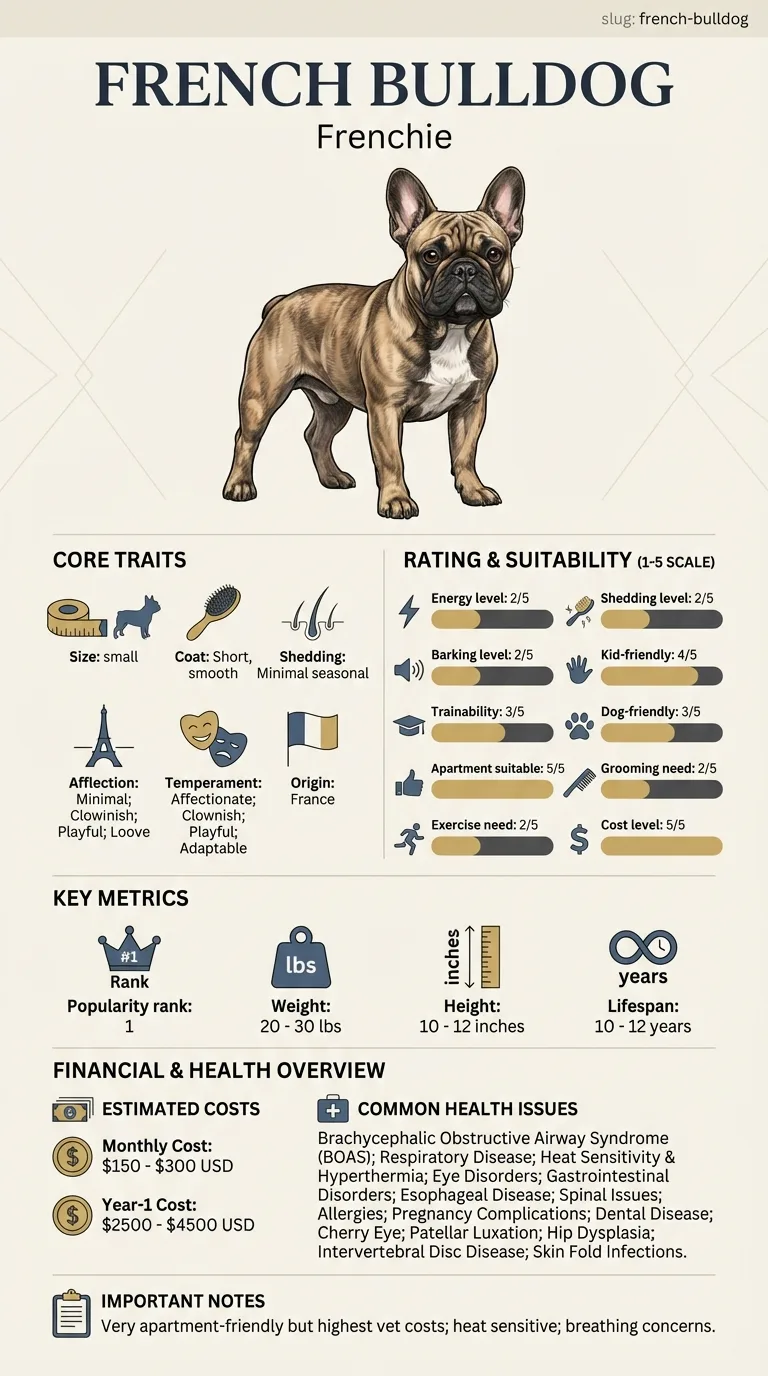
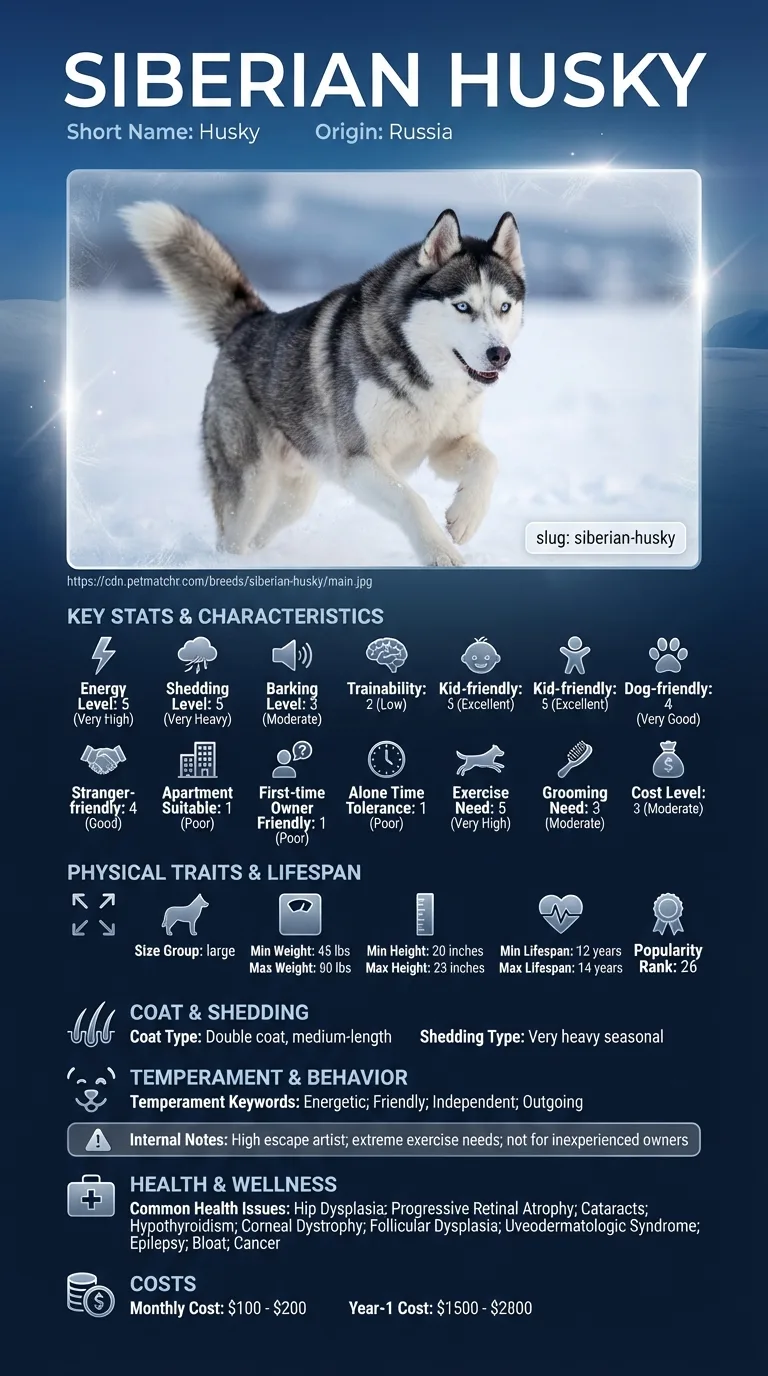
This is for someone already down to French Bulldog and Siberian Husky and deciding between them. For this pair the decision usually turns on apartment suitability and good for first-time owners, so those are covered first and in most detail. Anyone choosing from a flat has a clear answer here: French Bulldog rates 5/5 against 1/5. There is no origin story here — only what changes about your week.
Between French Bulldog and Siberian Husky, apartment suitability is what separates them, and French Bulldog is the lower-effort dog of the two to keep.
Choose French Bulldog if you are in a flat or a smaller home, this is your first dog and you do not want a standing grooming appointment.
Choose Siberian Husky if there are young children at home, you already have another dog and you want a dog that can keep up with an active routine.
| Feature | french bulldog | siberian husky | Winner |
|---|---|---|---|
| Size class | small | large | Equal |
| Weight | 20–30 lbs | 45–60 lbs | Equal |
| Height | 10–12 in | 20–23 in | Equal |
| Lifespan | 10–12 years | 12–14 years | siberian husky |
| Exercise need | Low (2/5) | Very high (5/5) | french bulldog |
| Grooming need | Low (2/5) | Moderate (3/5) | french bulldog |
| Shedding | Low (2/5) | Very high (5/5) | french bulldog |
| Energy level | Low (2/5) | Very high (5/5) | Equal |
| Barking | Low (2/5) | Moderate (3/5) | french bulldog |
| Apartment suitability | Very high (5/5) | Very low (1/5) | french bulldog |
| Good for first-time owners | Very high (5/5) | Very low (1/5) | french bulldog |
| Tolerates being alone | Very high (5/5) | Very low (1/5) | french bulldog |
| Trainability | Moderate (3/5) | Low (2/5) | french bulldog |
| Good with kids | High (4/5) | Very high (5/5) | siberian husky |
| Good with other dogs | Moderate (3/5) | High (4/5) | siberian husky |
| Friendly to strangers | Moderate (3/5) | High (4/5) | siberian husky |
| Cost level | Very high (5/5) | Moderate (3/5) | siberian husky |
| Coat | Short, smooth | Double coat, medium-length | Equal |
| Origin | France | Russia | Equal |
| Typical monthly cost | $150–$300 | $100–$200 | Equal |
| Typical first-year cost | $2,500–$4,500 | $1,500–$2,800 | Equal |
The Siberian Husky outweighs the Frenchie by roughly double and stands nearly a foot taller at the shoulder — 45-60 lbs and 20-23 in, against the Frenchie's 20-30 lbs and 10-12 in. Built for endurance rather than bursts of energy, the Husky's lean, wolf-like frame has essentially nothing in common with the Frenchie's stocky, low build. That endurance-built frame is also why a Husky can comfortably cover distances that would leave a Frenchie overheated and struggling to breathe.
This is the widest exercise gap in the whole batch: very high (5/5) need for the Husky against a low 2/5 for the Frenchie. Bred to pull sleds for hours, a Husky's energy doesn't taper off with a short walk — it needs sustained, vigorous activity daily, or that energy turns into digging, howling, or an escape attempt. A tired Husky is a manageable Husky; an under-exercised one will find its own entertainment, and it's rarely entertainment you'll appreciate.
Grooming need is moderate (3/5) for the Husky against low (2/5) for the Frenchie, but shedding is where the real difference shows: very high (5/5) for the Husky, which blows its undercoat seasonally in dramatic volume, against the Frenchie's low (2/5). If shedding volume is a dealbreaker, this pair makes the case clearly. Twice a year, expect tufts of undercoat coming loose in handfuls — a daily brush during blowout season isn't optional if you want to keep it off the furniture.
Barking is low-to-moderate for both (2/5 vs. 3/5), but everything else tilts hard toward the Frenchie. Apartment suitability is 5/5 versus a very low 1/5 for the Husky — one of the widest gaps in this comparison set. Alone tolerance follows the same pattern: 5/5 for the Frenchie against a very low 1/5 for the Husky, a breed known for vocal distress and escape attempts when left alone too long.
This is the Frenchie's strongest showing in the whole batch: 5/5 for first-time owners against a very low 1/5 for the Husky. Trainability tells the same story in miniature — moderate (3/5) for the Frenchie against low (2/5) for the Husky, an independent-minded breed that was bred to think for itself on the trail, not to take orders on cue.
The Husky edges ahead here on paper: very high (5/5) with kids against the Frenchie's high (4/5), high (4/5) with other dogs against moderate (3/5), and high (4/5) with strangers against moderate (3/5). Its pack-oriented, famously non-territorial temperament shows up directly in these numbers, even as its independence makes it harder to manage day-to-day. That same friendliness cuts both ways for security-minded owners — a Husky is unlikely to guard the house, since its instinct leans toward welcoming strangers rather than warning you about them.
The Husky's 12-14 year lifespan beats the Frenchie's 10-12. Its ten-item health list is largely eye- and hormone-related — PRA, cataracts, hypothyroidism, corneal dystrophy — plus epilepsy, bloat, and cancer. The Frenchie's fifteen-item list stays centered on its flat face and spine. The two lists share no conditions in common. Regular eye screenings are especially worthwhile for a Husky given how many of its listed conditions affect vision over time.
The Husky is the cheaper dog to keep despite its larger size: $100-200 monthly and $1,500-2,800 in year one, against the Frenchie's $150-300 and $2,500-4,500. Cost level backs this up — moderate (3/5) for the Husky, very high (5/5) for the Frenchie, whose ongoing brachycephalic-related care is the main driver of that gap. Food costs will run higher for the Husky given its size, but that's outweighed by the Frenchie's recurring vet bills tied to its breathing and spine.
French Bulldog weighs 20–30 lbs and lives 10–12 years; Siberian Husky weighs 45–60 lbs and lives 12–14 years. The two diverge most on apartment suitability, good for first-time owners and tolerates being alone and 4 other rated axes. Almost every rated axis separates them at least slightly. Where the table declares a winner it means less work for the owner, nothing more; descriptive rows are left as ties on purpose. The value here is in the differences between the two columns; treat any single score as approximate.

A lot more — very high (5/5) need against the Frenchie's low (2/5), the widest exercise gap anywhere in this comparison batch. Huskies were bred to run for hours, not stroll around the block.
Not really — it rates a very low 1/5, the lowest score of any breed compared to the Frenchie in this batch, against the Frenchie's own 5/5.
Yes, rated very high (5/5) with dramatic seasonal blowouts, against the Frenchie's low (2/5).
Not well — a very low 1/5 rating, tied for the worst in this batch, against the Frenchie's 5/5. Huskies are prone to vocalizing and even escaping when left alone too long.
Very — a 5/5 rating, actually ahead of the Frenchie's 4/5, thanks to its famously friendly, non-territorial pack temperament.
No overlap. The Husky's risks are eye- and hormone-related (PRA, hypothyroidism, corneal dystrophy); the Frenchie's are respiratory and spinal.
The Husky, at $1,500-2,800 in year one against the Frenchie's $2,500-4,500, despite being the larger, more active dog.
The Frenchie for nearly any first-time or low-activity household; the Husky only if you can commit to serious daily exercise and won't leave it alone for long stretches.
The Husky is cheaper at $100-200 versus the Frenchie's $150-300, despite its much larger size.
The Husky, and by a wide margin — very high (5/5) need against the Frenchie's low (2/5).
The Husky, typically 12-14 years against the Frenchie's 10-12.
Secure checkout on Stripe. We never see your card.
7-day money-back guarantee. Instant access.

Health information here is general and is not veterinary advice. If your dog shows pain, sudden behaviour change, or worsening symptoms, consult a licensed veterinarian.
Some links on this site are affiliate links. We may earn a commission at no extra cost to you, and we only suggest products we believe are helpful for dog owners.
We research and check what we publish, but we do not warrant that any figure, date, price, or statement is accurate, complete, or current, and we accept no liability for any loss, cost, injury, or other harm arising from the use of this site. Use it as one reference among several. You remain responsible for your own decisions and for your dog's care - confirm anything that matters with a licensed veterinarian or another qualified professional before you act on it. Full disclaimer.
Match your lifestyle to the right dog.
Take quizNot sure which breed is right for you? Take our 2-minute quiz to find out.
Take the quiz