Living
Springer or Pomeranian overall?
For a social, active household the Springer wins clearly on multiple fronts; for tight living space and a lower budget, the Pomeranian fits better.

Quick answer
Springer or Pomeranian overall?
For a social, active household the Springer wins clearly on multiple fronts; for tight living space and a lower budget, the Pomeranian fits better.
English Springer Spaniel or Pomeranian? On paper they differ most on apartment suitability, and on the scales English Springer Spaniel is the heavier at 40–50 lbs. Here is how the two compare on everything that shapes an ordinary week.
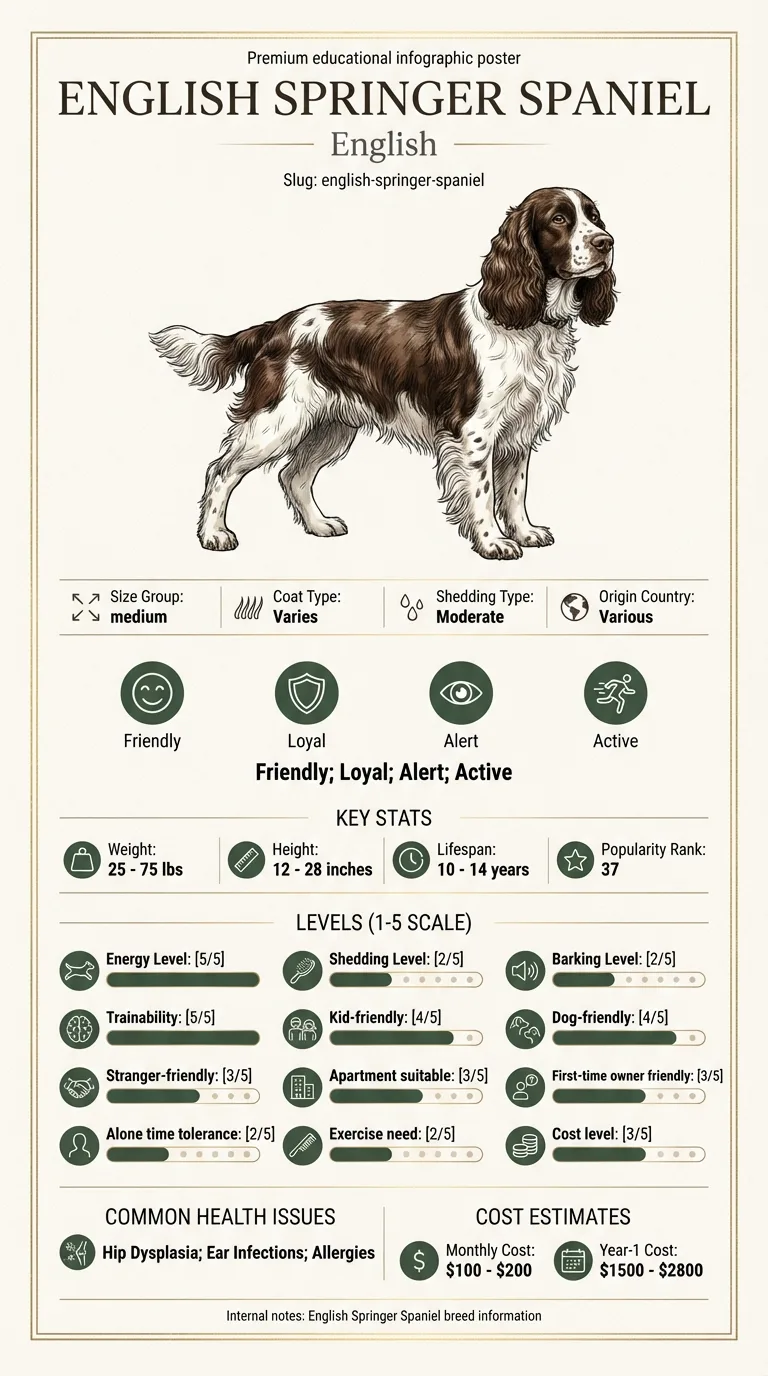
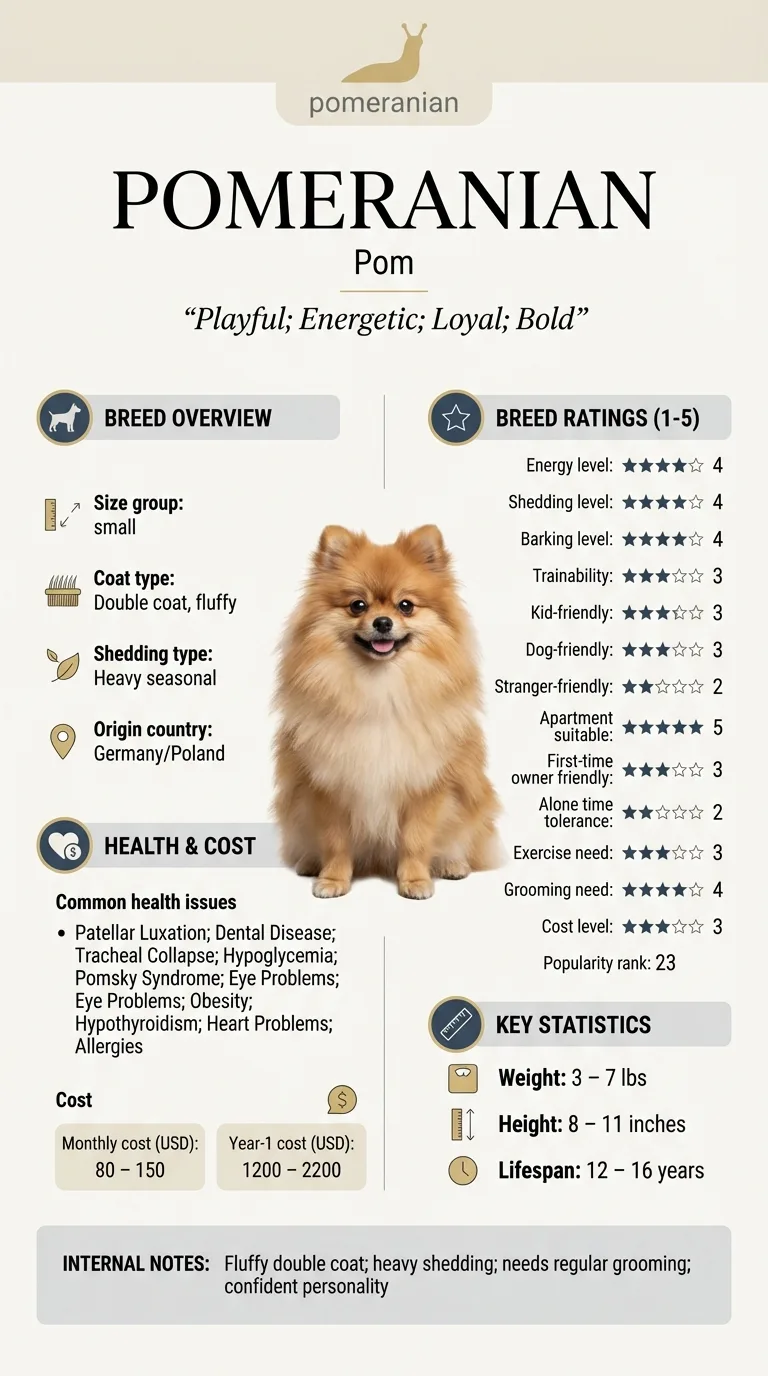
This is for someone already down to English Springer Spaniel and Pomeranian and deciding between them. For this pair the decision usually turns on apartment suitability and exercise need, so those are covered first and in most detail. Anyone choosing from a flat has a clear answer here: Pomeranian rates 5/5 against 2/5. There is no origin story here — only what changes about your week.
Between English Springer Spaniel and Pomeranian, apartment suitability is what separates them, and Pomeranian is the lower-effort dog of the two to keep.
Choose English Springer Spaniel if shedding is a problem in your house, there are young children at home and you already have another dog.
Choose Pomeranian if you are in a flat or a smaller home, your walking routine is modest and a smaller dog suits your car, your home or your back.
| Feature | english springer spaniel | pomeranian | Winner |
|---|---|---|---|
| Size class | medium | small | Equal |
| Weight | 40–50 lbs | 3–7 lbs | Equal |
| Height | 19–20 in | 8–11 in | Equal |
| Lifespan | 12–14 years | 12–16 years | pomeranian |
| Exercise need | Very high (5/5) | Moderate (3/5) | pomeranian |
| Grooming need | High (4/5) | High (4/5) | Equal |
| Shedding | Moderate (3/5) | High (4/5) | english springer spaniel |
| Energy level | Very high (5/5) | High (4/5) | Equal |
| Barking | Moderate (3/5) | High (4/5) | english springer spaniel |
| Apartment suitability | Low (2/5) | Very high (5/5) | pomeranian |
| Good for first-time owners | Moderate (3/5) | Moderate (3/5) | Equal |
| Tolerates being alone | Low (2/5) | Low (2/5) | Equal |
| Trainability | Very high (5/5) | Moderate (3/5) | english springer spaniel |
| Good with kids | Very high (5/5) | Moderate (3/5) | english springer spaniel |
| Good with other dogs | High (4/5) | Moderate (3/5) | english springer spaniel |
| Friendly to strangers | High (4/5) | Low (2/5) | english springer spaniel |
| Cost level | Moderate (3/5) | Moderate (3/5) | Equal |
| Coat | Medium, feathered double coat | Double coat, fluffy | Equal |
| Origin | Various | Germany/Poland | Equal |
| Typical monthly cost | $100–$200 | $80–$150 | Equal |
| Typical first-year cost | $1,400–$2,900 | $1,200–$2,200 | Equal |
This is a sporting breed against a toy breed with almost nothing in common physically, 40-50 lbs and 19-20 inches for the Springer against 3-7 lbs and 8-11 inches for the Pomeranian. A Pomeranian is closer in size to a Springer's head than to the dog as a whole. Everything downstream of size, food cost, exercise capacity, even injury risk from rough handling, follows from this gap.
The Springer needs very high (5/5) exercise against the Pomeranian's moderate (3/5), though the Pomeranian's energy level still rates high (4/5), a small dog with a genuinely big personality, just not big exercise capacity to match it. Short, engaged play sessions suit a Pomeranian better than the long outdoor sessions a Springer needs to stay settled.
Grooming ties at high (4/5) for both, but the Pomeranian actually sheds more, high (4/5) against the Springer's moderate (3/5), which surprises people who assume a tiny dog means a small shedding problem. That fluffy double coat blows out seasonally regardless of the dog's overall size, so don't budget less cleanup time just because the dog is smaller.
The Pomeranian fits small spaces far better, very high (5/5) apartment suitability against the Springer's low (2/5), but it's also the louder of the two, rated high (4/5) for barking against moderate (3/5). Both tolerate being alone poorly (2/5 each), so a Pomeranian's small size doesn't buy any independence the Springer doesn't also lack, and a neighbor sharing a wall will hear both dogs eventually.
The Springer clearly outperforms here, very high (5/5) trainability against the Pomeranian's moderate (3/5), and first-time-owner scores tie at moderate (3/5) for both. Pomeranians are intelligent but notoriously independent-minded for their size, and that shows up in the lower trainability number even though owning one doesn't require any more experience than owning a Springer, per this data.
The Springer pulls ahead across the board here: very high (5/5) with kids against moderate (3/5), high (4/5) with other dogs against moderate (3/5), and high (4/5) with strangers against the Pomeranian's low (2/5), one of the bigger gaps in this whole comparison. If a highly social, kid-friendly household is the goal, the data points firmly toward the Springer.
The Pomeranian lives longer, 12-16 years against the Springer's tighter 12-14 range. Its health list runs to ten conditions, though, including tracheal collapse, hypoglycemia, and heart problems, well beyond the Springer's five-item list of joint and eye conditions. A longer potential lifespan comes paired with more items to monitor along the way, at least according to this data.
Cost level ties at moderate (3/5), but the dollar figures favor the Pomeranian: $80-$150 monthly against the Springer's $100-$200, and $1,200-$2,200 in year one against $1,400-$2,900. As with most size comparisons in this dataset, the smaller dog costs less to feed and generally less to manage day to day, even with tied grooming demands eating into that gap somewhat.
English Springer Spaniel weighs 40–50 lbs and lives 12–14 years; Pomeranian weighs 3–7 lbs and lives 12–16 years. The two diverge most on apartment suitability, exercise need and good with kids and 2 other rated axes. They are level on tolerates being alone, cost level and good for first-time owners, so those cannot decide it. Where the table declares a winner it means less work for the owner, nothing more; descriptive rows are left as ties on purpose. The value here is in the differences between the two columns; treat any single score as approximate.

Dramatically, 3-7 lbs against 40-50 lbs, one of the widest size gaps in this whole comparison set.
No, somewhat counterintuitively, it sheds high (4/5) against the Springer's moderate (3/5), thanks to its fluffy double coat.
The Springer, clearly, high (4/5) against the Pomeranian's low (2/5), one of the larger gaps anywhere in this data.
The Pomeranian, very high (5/5) suitability against the Springer's low (2/5), though it barks more, rated high (4/5) against moderate (3/5).
The Pomeranian, $80-$150 monthly versus $100-$200 for the Springer, and roughly $200-$700 less across a first year.
Barely, the lists don't share a single condition in this data. The Springer's risks center on joints and eyes; the Pomeranian's center on airway, dental, and endocrine issues.
The Pomeranian, at 12-16 years against the Springer's 12-14, though it carries a longer list of health conditions to watch.
For a social, active household the Springer wins clearly on multiple fronts; for tight living space and a lower budget, the Pomeranian fits better.
$80-$150 for the Pomeranian versus $100-$200 for the Springer.
Moderate (3/5), well below the Springer's very high (5/5), despite a lively high (4/5) energy level.
The Pomeranian, at 12-16 years versus the Springer's 12-14.
Secure checkout on Stripe. We never see your card.
7-day money-back guarantee. Instant access.
Health information here is general and is not veterinary advice. If your dog shows pain, sudden behaviour change, or worsening symptoms, consult a licensed veterinarian.
Some links on this site are affiliate links. We may earn a commission at no extra cost to you, and we only suggest products we believe are helpful for dog owners.
We research and check what we publish, but we do not warrant that any figure, date, price, or statement is accurate, complete, or current, and we accept no liability for any loss, cost, injury, or other harm arising from the use of this site. Use it as one reference among several. You remain responsible for your own decisions and for your dog's care - confirm anything that matters with a licensed veterinarian or another qualified professional before you act on it. Full disclaimer.
Match your lifestyle to the right dog.
Take quizNot sure which breed is right for you? Take our 2-minute quiz to find out.
Take the quiz