Living
Are these two breeds similar in size?
Very close -- both are large breeds around 22-27 inches and 45-75 pounds, one of the tightest size matchups on this site.

Quick answer
Are these two breeds similar in size?
Very close -- both are large breeds around 22-27 inches and 45-75 pounds, one of the tightest size matchups on this site.
Collie (Rough Collie) or Poodle (Standard)? On paper they differ most on shedding, and on the scales Collie (Rough Collie) is the heavier at 50–75 lbs. Here is how the two compare on everything that shapes an ordinary week.
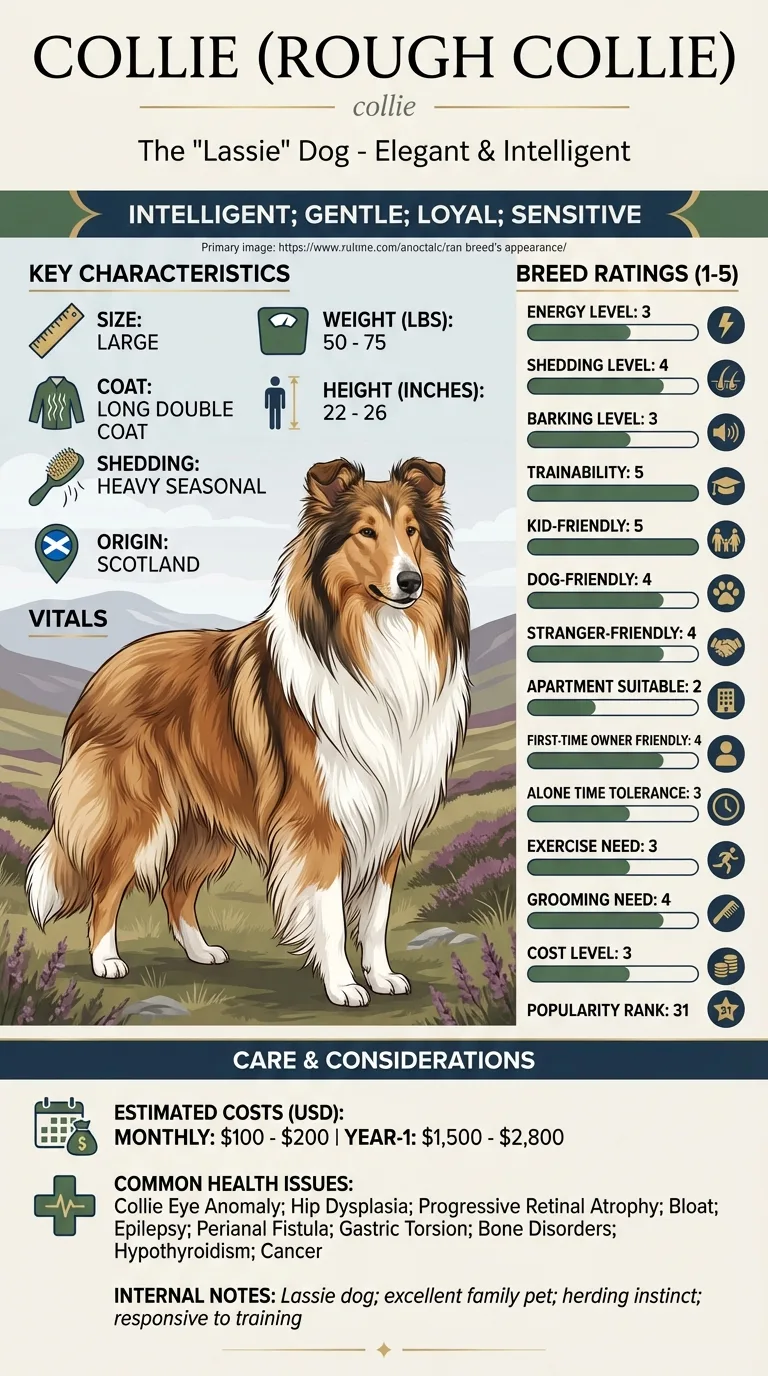
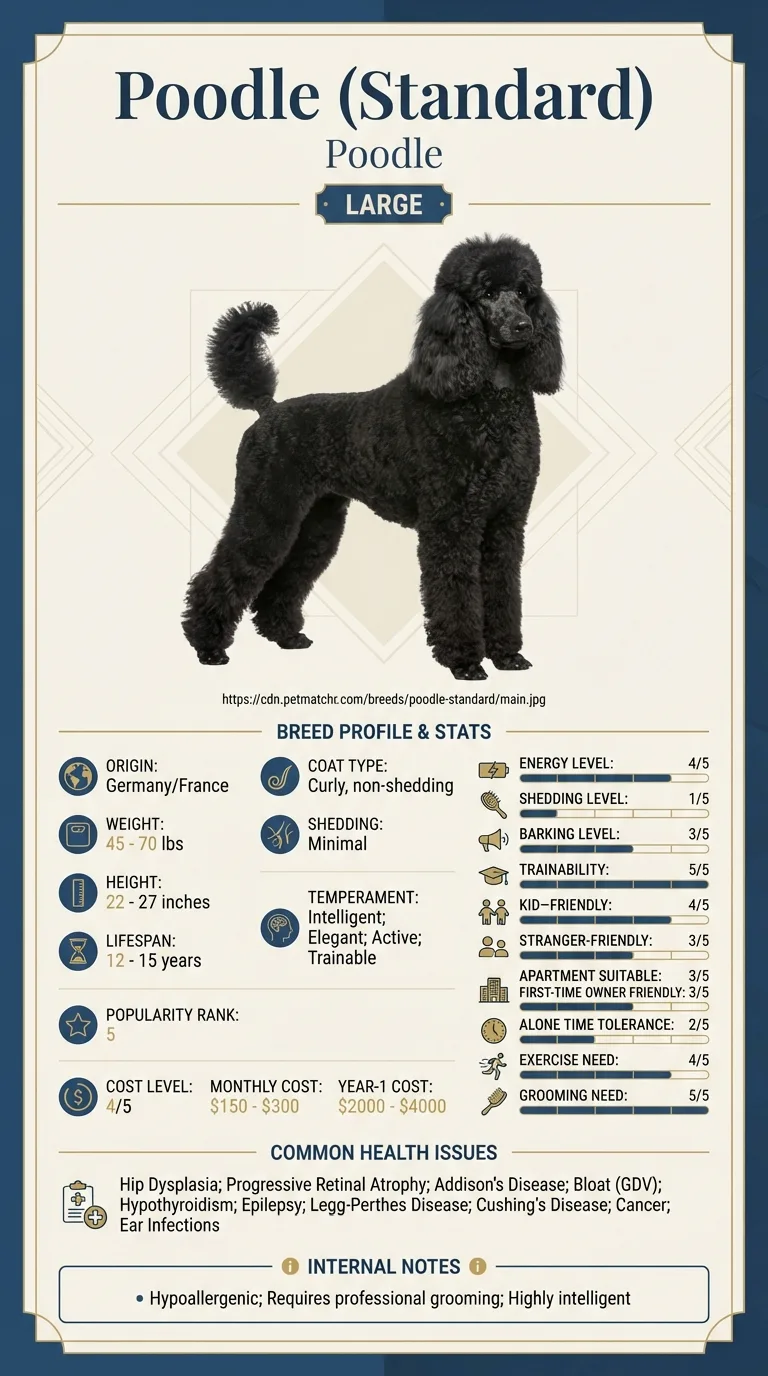
This is for someone already down to Collie (Rough Collie) and Poodle (Standard) and deciding between them. For this pair the decision usually turns on shedding, so those are covered first and in most detail. Anyone choosing from a flat has a clear answer here: Poodle (Standard) rates 3/5 against 2/5. It is written for the decision rather than the breed history.
Between Collie (Rough Collie) and Poodle (Standard), shedding is what separates them, and Collie (Rough Collie) is the lower-effort dog of the two to keep.
Choose Collie (Rough Collie) if this is your first dog, you do not want a standing grooming appointment and your walking routine is modest.
Choose Poodle (Standard) if you are in a flat or a smaller home, shedding is a problem in your house and a smaller dog suits your car, your home or your back.
| Feature | collie | poodle standard | Winner |
|---|---|---|---|
| Size class | large | large | Equal |
| Weight | 50–75 lbs | 45–70 lbs | Equal |
| Height | 22–26 in | 22–27 in | Equal |
| Lifespan | 11–14 years | 12–15 years | poodle standard |
| Exercise need | Moderate (3/5) | High (4/5) | collie |
| Grooming need | High (4/5) | Very high (5/5) | collie |
| Shedding | High (4/5) | Very low (1/5) | poodle standard |
| Energy level | Moderate (3/5) | High (4/5) | Equal |
| Barking | Moderate (3/5) | Moderate (3/5) | Equal |
| Apartment suitability | Low (2/5) | Moderate (3/5) | poodle standard |
| Good for first-time owners | High (4/5) | Moderate (3/5) | collie |
| Tolerates being alone | Moderate (3/5) | Low (2/5) | collie |
| Trainability | Very high (5/5) | Very high (5/5) | Equal |
| Good with kids | Very high (5/5) | High (4/5) | collie |
| Good with other dogs | High (4/5) | High (4/5) | Equal |
| Friendly to strangers | High (4/5) | Moderate (3/5) | collie |
| Cost level | Moderate (3/5) | High (4/5) | collie |
| Coat | Long double coat | Curly, non-shedding | Equal |
| Origin | Scotland | Germany/France | Equal |
| Typical monthly cost | $100–$200 | $150–$300 | Equal |
| Typical first-year cost | $1,500–$2,800 | $2,000–$4,000 | Equal |
This is the closest size matchup in the whole Collie comparison set. The Standard Poodle weighs 45-70 pounds and stands 22-27 inches; the Collie weighs 50-75 pounds and stands 22-26 inches. Both are classified as large breeds, and on paper you'd struggle to tell them apart by the numbers alone -- this decision comes down to coat, energy, and cost, not size. If you liked the idea of a big dog but don't want size itself to be the deciding factor, this pairing removes it from the equation.
The Standard Poodle rates high (4/5) for exercise need against the Collie's moderate (3/5) -- a real gap despite their similar size. Poodles were bred as active retrieving dogs and it shows; expect to commit to daily vigorous exercise, not just walks, if you go that direction. The Collie's moderate rating is more forgiving of a quieter daily routine, and is the more realistic fit if your schedule doesn't allow for an hour of real activity most days.
The Standard Poodle rates very high (5/5) for grooming, a step above the Collie's high (4/5), and its curly coat generally needs a professional groomer's attention. In exchange, shedding drops to very low (1/5) versus the Collie's high (4/5) -- the classic tradeoff of a poodle-type coat. If allergies or shedding are the concern, the Standard Poodle is worth the extra grooming cost.
Neither breed is a natural apartment dog, but the Standard Poodle rates moderate (3/5) for apartment suitability against the Collie's low (2/5) -- its higher trainability and lower shedding help offset its size indoors. Barking ties at moderate (3/5) for both. If you're set on either breed in a small space, plan for serious daily exercise regardless of which one you choose; a tired large dog is a quiet large dog.
Trainability ties at very high (5/5), and Standard Poodles are frequently used as service and working dogs for exactly that reason. The Collie edges ahead on first-time-owner suitability, high (4/5) versus moderate (3/5) -- the Poodle's higher exercise and grooming demands make it a slightly bigger commitment for a novice. Both are intelligent enough to pick up commands quickly once you're consistent.
The Collie rates very high (5/5) with kids against the Standard Poodle's high (4/5), and the two tie at high (4/5) for compatibility with other dogs. Friendliness to strangers favors the Collie, high (4/5) versus the Poodle's moderate (3/5). Both are solid family dogs; the Collie's numbers are just slightly warmer across the board, and neither breed shows any red flags for a busy household.
Lifespan favors the Standard Poodle, 12-15 years against the Collie's 11-14. Health overlap is significant: hip dysplasia, PRA, bloat, hypothyroidism, epilepsy, and cancer all appear on both ten-condition lists -- six shared risks. Both breeds are also prone to bloat specifically, so learn the warning signs regardless of which you choose. The Poodle's list additionally flags Addison's disease and Cushing's disease, endocrine risks not noted for the Collie.
The Standard Poodle costs noticeably more to keep: high (4/5) overall cost level against the Collie's moderate (3/5), $150-$300 monthly against $100-$200, and $2,000-$4,000 in the first year against $1,500-$2,800. Most of that gap comes from professional grooming, which the Collie's coat doesn't require. Over a decade of ownership, that grooming difference adds up to real money.
Collie (Rough Collie) weighs 50–75 lbs and lives 11–14 years; Poodle (Standard) weighs 45–70 lbs and lives 12–15 years. The two diverge most on shedding. They are level on barking, good with other dogs and trainability, so those cannot decide it. In the table, a "winner" means easier for an ordinary household — not better. Size, coat and origin are recorded without a verdict. Because both breeds are scored the same way, the gaps are reliable even where the absolute numbers are rough.

Yes, closer than almost any other pairing on this site -- 50-75 pounds and 22-26 inches for the Collie versus 45-70 pounds and 22-27 inches for the Poodle. Size shouldn't be the deciding factor between these two.
Much less -- very low (1/5) against the Collie's high (4/5). It costs more to groom, though, rating very high (5/5) on grooming demand versus the Collie's high (4/5).
The Standard Poodle, rating high (4/5) on exercise need against the Collie's moderate (3/5). It was bred as an active retrieving dog and generally needs more than a casual daily walk.
Not ideally, though the Poodle does better -- moderate (3/5) versus the Collie's low (2/5). Both need real daily exercise to stay manageable indoors.
The Standard Poodle by a clear margin -- $150-$300 monthly and $2,000-$4,000 in year one, against $100-$200 and $1,500-$2,800 for the Collie. Grooming is the main driver.
Yes, six conditions overlap: hip dysplasia, PRA, bloat, hypothyroidism, epilepsy, and cancer. Both are also prone to bloat, so it's worth learning the emergency signs no matter which breed you pick.
The Collie rates high (4/5) against the Poodle's moderate (3/5), mainly because the Poodle demands more exercise and grooming commitment, not because it's harder to train -- trainability ties at very high (5/5) for both.
Very close -- both are large breeds around 22-27 inches and 45-75 pounds, one of the tightest size matchups on this site.
The Collie, by a real margin -- $100-$200 monthly against the Poodle's $150-$300, mostly due to the Poodle's professional grooming needs.
The Standard Poodle, rating high (4/5) against the Collie's moderate (3/5) -- it needs genuine daily activity, not just a walk around the block.
The Standard Poodle, typically 12-15 years against the Collie's 11-14, though both share a meaningful list of overlapping health risks including bloat.
Secure checkout on Stripe. We never see your card.
7-day money-back guarantee. Instant access.
Health information here is general and is not veterinary advice. If your dog shows pain, sudden behaviour change, or worsening symptoms, consult a licensed veterinarian.
Some links on this site are affiliate links. We may earn a commission at no extra cost to you, and we only suggest products we believe are helpful for dog owners.
We research and check what we publish, but we do not warrant that any figure, date, price, or statement is accurate, complete, or current, and we accept no liability for any loss, cost, injury, or other harm arising from the use of this site. Use it as one reference among several. You remain responsible for your own decisions and for your dog's care - confirm anything that matters with a licensed veterinarian or another qualified professional before you act on it. Full disclaimer.
Match your lifestyle to the right dog.
Take quizNot sure which breed is right for you? Take our 2-minute quiz to find out.
Take the quiz