Living
Which should you pick overall?
The Sheltie suits far more owners on paper - better with apartments, first-timers, kids, and cost - but its very high barking score is a real trade-off; the Corso is a specialist choice for experienced owners.

Quick answer
Which should you pick overall?
The Sheltie suits far more owners on paper - better with apartments, first-timers, kids, and cost - but its very high barking score is a real trade-off; the Corso is a specialist choice for experienced owners.
Cane Corso or Shetland Sheepdog? On paper they differ most on good for first-time owners, and on the scales Cane Corso is the heavier at 90–110 lbs. Here is how the two compare on everything that shapes an ordinary week.
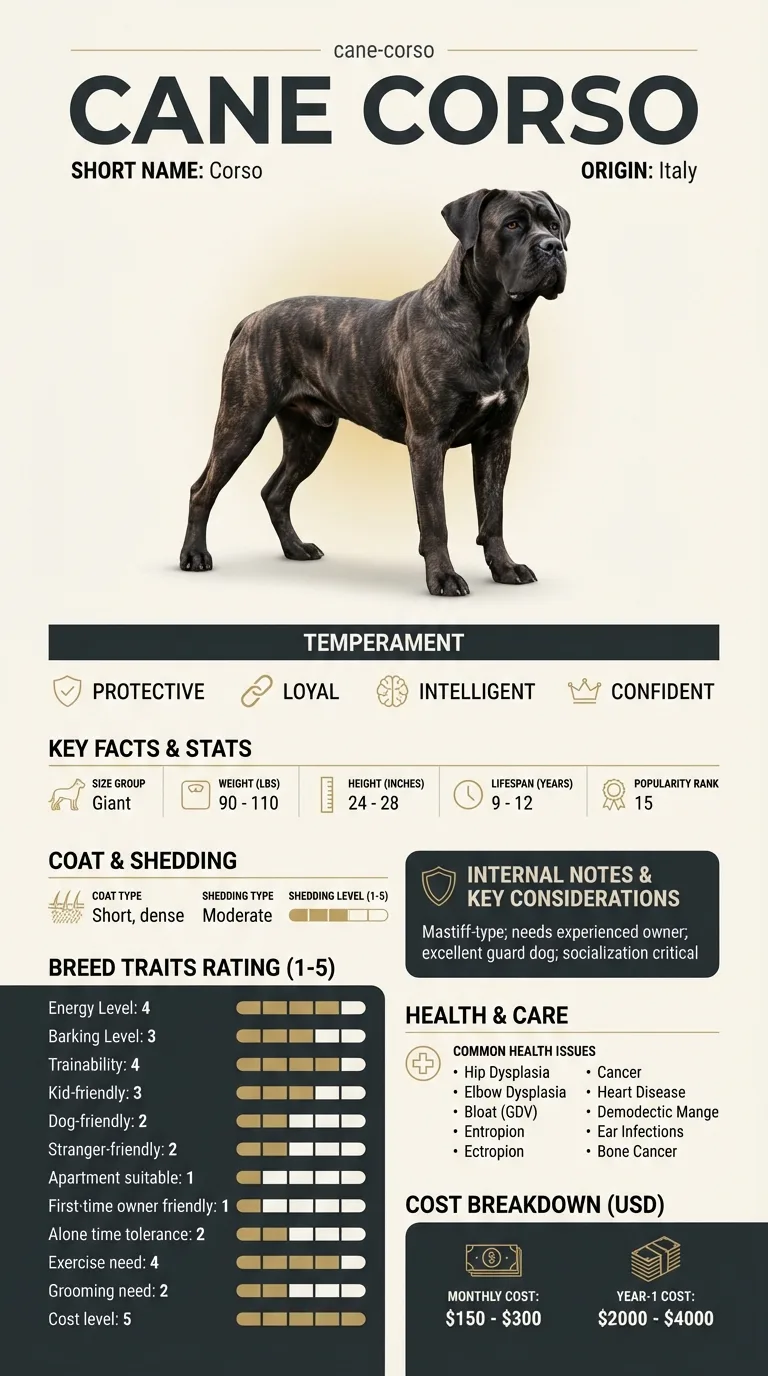
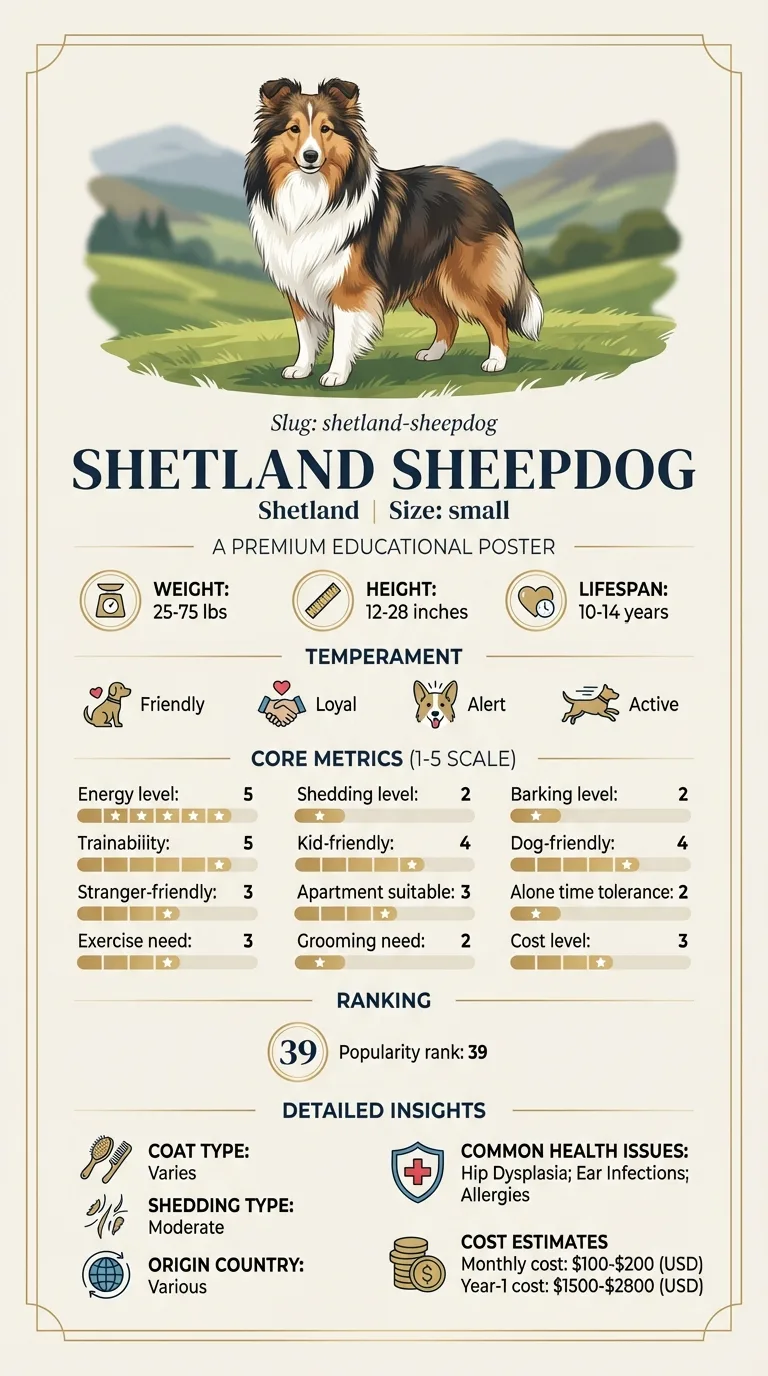
This is for someone already down to Cane Corso and Shetland Sheepdog and deciding between them. For this pair the decision usually turns on good for first-time owners and grooming need, so those are covered first and in most detail. Anyone choosing from a flat has a clear answer here: Shetland Sheepdog rates 3/5 against 1/5. Breed history is left out; what follows is what you will actually live with.
Between Cane Corso and Shetland Sheepdog, good for first-time owners is what separates them, and Shetland Sheepdog is the lower-effort dog of the two to keep.
Choose Cane Corso if you do not want a standing grooming appointment and shedding is a problem in your house.
Choose Shetland Sheepdog if you are in a flat or a smaller home, this is your first dog and there are young children at home.
| Feature | cane corso | shetland sheepdog | Winner |
|---|---|---|---|
| Size class | giant | small | Equal |
| Weight | 90–110 lbs | 15–25 lbs | Equal |
| Height | 24–28 in | 13–16 in | Equal |
| Lifespan | 9–12 years | 12–14 years | shetland sheepdog |
| Exercise need | High (4/5) | High (4/5) | Equal |
| Grooming need | Low (2/5) | High (4/5) | cane corso |
| Shedding | Moderate (3/5) | High (4/5) | cane corso |
| Energy level | High (4/5) | High (4/5) | Equal |
| Barking | Moderate (3/5) | Very high (5/5) | cane corso |
| Apartment suitability | Very low (1/5) | Moderate (3/5) | shetland sheepdog |
| Good for first-time owners | Very low (1/5) | High (4/5) | shetland sheepdog |
| Tolerates being alone | Low (2/5) | Low (2/5) | Equal |
| Trainability | High (4/5) | Very high (5/5) | shetland sheepdog |
| Good with kids | Moderate (3/5) | High (4/5) | shetland sheepdog |
| Good with other dogs | Low (2/5) | High (4/5) | shetland sheepdog |
| Friendly to strangers | Low (2/5) | Low (2/5) | Equal |
| Cost level | Very high (5/5) | Moderate (3/5) | shetland sheepdog |
| Coat | Short, dense | Long, dense double coat | Equal |
| Origin | Italy | Various | Equal |
| Typical monthly cost | $150–$300 | $80–$150 | Equal |
| Typical first-year cost | $2,000–$4,000 | $1,100–$2,300 | Equal |
A full-grown Cane Corso can outweigh a Shetland Sheepdog four or five times over - 90-110 lbs against 15-25 lbs, with close to a foot of height between them at the shoulder (24-28 in vs 13-16 in). These aren't two versions of the same dog; they're opposite ends of the size spectrum, and that alone should drive a lot of the rest of this comparison, from space needed to strength managed on leash.
Surprisingly, both rate high energy (4/5) and high exercise need (4/5) despite the size gap. The Sheltie's energy shows up as herding instinct and quick, repetitive movement rather than raw physical output, but the daily requirement is genuinely comparable to the Corso's. Neither breed does well with a single short walk and nothing else.
The Corso is the low-maintenance coat here - grooming low (2/5), shedding moderate (3/5). The Sheltie flips that: grooming high (4/5) for its long double coat, and shedding high (4/5) too, meaning more brushing and more loose hair despite being the much smaller dog.
Barking is the Sheltie's weak spot - very high (5/5), tied to its herding instincts, against the Corso's moderate (3/5). Apartment suitability still favors the Sheltie overall, moderate (3/5) versus the Corso's very low (1/5), but a vocal small dog in a thin-walled building brings its own problems. Alone tolerance is a rare tie here - both rate low (2/5).
The Sheltie edges out the Corso on trainability, very high (5/5) against high (4/5), and is dramatically more beginner-friendly - high (4/5) for first-time owners versus the Corso's very low (1/5). If this is your first dog, the data points hard toward the Sheltie.
Kids and other dogs both favor the Sheltie - high (4/5) with kids against the Corso's moderate (3/5), and high (4/5) with other dogs against the Corso's low (2/5). Neither breed rates well with strangers, both sitting at low (2/5), so don't expect an instantly friendly greeting from either dog at the door.
The Sheltie's 12-14 year lifespan beats the Corso's 9-12, and unlike some pairings, these two share no listed health conditions at all. The Corso carries the longer list - hip and elbow dysplasia, bloat, entropion, ectropion, cancer, heart disease, demodectic mange, ear infections, and bone cancer - while the Sheltie's risks are collie eye anomaly, MDR1 drug sensitivity, dermatomyositis, hypothyroidism, and patellar luxation.
Cost splits clearly by size: the Corso rates very high (5/5) at $150-$300 a month, the Sheltie moderate (3/5) at $80-$150. First-year totals show the same gap - $2,000-$4,000 for the Corso against $1,100-$2,300 for the Sheltie - so the smaller dog is meaningfully cheaper across the board.
Cane Corso weighs 90–110 lbs and lives 9–12 years; Shetland Sheepdog weighs 15–25 lbs and lives 12–14 years. The two diverge most on good for first-time owners, grooming need and apartment suitability and 3 other rated axes. They are level on tolerates being alone, energy level and exercise need, so those cannot decide it. The comparison marks an easier option only where one exists. Facts like weight and country of origin are not scored. Both dogs are rated from the same dataset, which is what makes the numbers comparable with each other even though any individual dog sits somewhere inside its breed's range.

Considerably - the Corso runs 90-110 lbs and 24-28 inches, the Sheltie just 15-25 lbs and 13-16 inches. You're comparing a giant breed to a small one.
The Sheltie, rated very high (5/5) for barking against the Corso's moderate (3/5) - a well-known trait tied to its herding background.
The Sheltie is clearly the better pick, high (4/5) for first-time owners against the Corso's very low (1/5), and it also trains slightly easier, very high (5/5) versus high (4/5).
The Sheltie fits better on paper, moderate (3/5) against the Corso's very low (1/5), but its high barking score is worth weighing against thin walls or close neighbors.
Substantial - the Sheltie runs moderate (3/5) at $80-$150 a month, while the Corso is very high (5/5) at $150-$300.
No - based on this data, the two lists don't overlap at all. The Corso's risks include hip and elbow dysplasia, bloat, entropion, ectropion, cancer, heart disease, demodectic mange, ear infections, and bone cancer, while the Sheltie's are collie eye anomaly, MDR1 drug sensitivity, dermatomyositis, hypothyroidism, and patellar luxation.
The Corso is protective, loyal, intelligent, and confident. The Sheltie is bright, sensitive, vocal, and devoted - a more reactive, people-focused temperament that lines up with its higher barking score.
The Sheltie suits far more owners on paper - better with apartments, first-timers, kids, and cost - but its very high barking score is a real trade-off; the Corso is a specialist choice for experienced owners.
$80-$150 for the Sheltie, $150-$300 for the Corso.
Both rate high exercise need (4/5) despite the huge size gap.
The Sheltie, 12-14 years against the Corso's 9-12.
Secure checkout on Stripe. We never see your card.
7-day money-back guarantee. Instant access.
Health information here is general and is not veterinary advice. If your dog shows pain, sudden behaviour change, or worsening symptoms, consult a licensed veterinarian.
Some links on this site are affiliate links. We may earn a commission at no extra cost to you, and we only suggest products we believe are helpful for dog owners.
We research and check what we publish, but we do not warrant that any figure, date, price, or statement is accurate, complete, or current, and we accept no liability for any loss, cost, injury, or other harm arising from the use of this site. Use it as one reference among several. You remain responsible for your own decisions and for your dog's care - confirm anything that matters with a licensed veterinarian or another qualified professional before you act on it. Full disclaimer.
Match your lifestyle to the right dog.
Take quizNot sure which breed is right for you? Take our 2-minute quiz to find out.
Take the quiz