Living
Which breed fits most households better?
The Collie -- higher scores with kids, other dogs, and first-time owners make it the easier all-around fit; the Corso suits a narrower, more experienced household.

Quick answer
Which breed fits most households better?
The Collie -- higher scores with kids, other dogs, and first-time owners make it the easier all-around fit; the Corso suits a narrower, more experienced household.
Cane Corso or Collie (Rough Collie)? On paper they differ most on good for first-time owners, and on the scales Cane Corso is the heavier at 90–110 lbs. Here is how the two compare on everything that shapes an ordinary week.
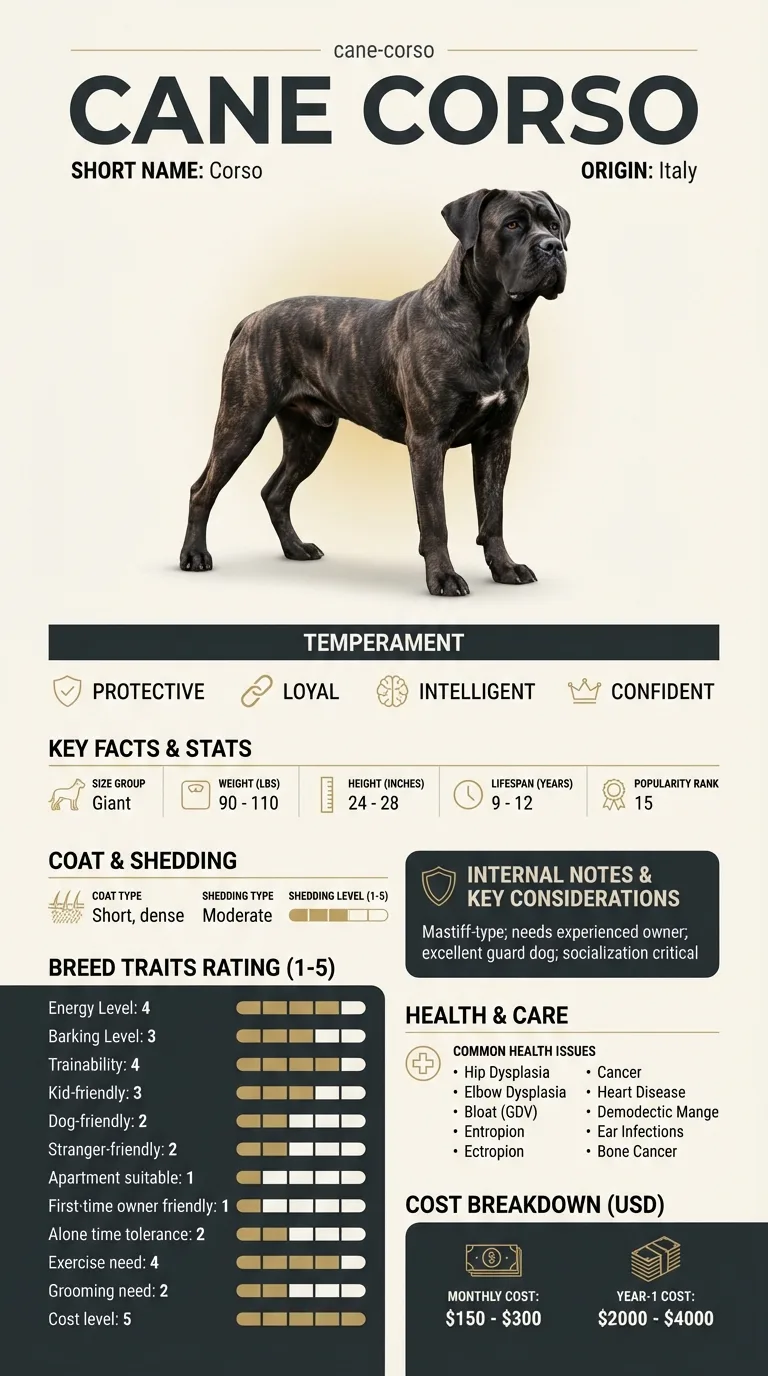
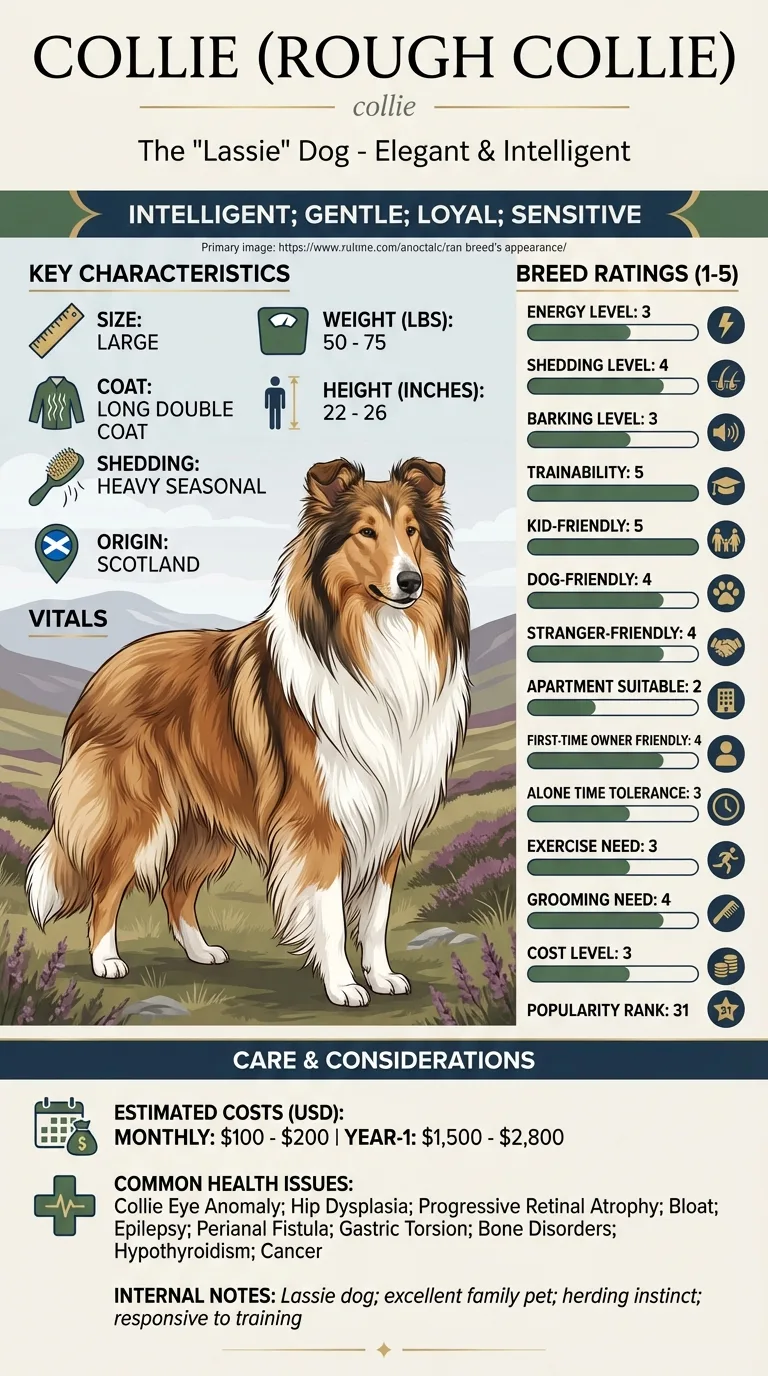
This is for someone already down to Cane Corso and Collie (Rough Collie) and deciding between them. For this pair the decision usually turns on good for first-time owners and grooming need, so those are covered first and in most detail. Anyone choosing from a flat has a clear answer here: Collie (Rough Collie) rates 2/5 against 1/5. There is no origin story here — only what changes about your week.
Between Cane Corso and Collie (Rough Collie), good for first-time owners is what separates them, and Collie (Rough Collie) is the lower-effort dog of the two to keep.
Choose Cane Corso if you do not want a standing grooming appointment, shedding is a problem in your house and you want a dog that can keep up with an active routine.
Choose Collie (Rough Collie) if this is your first dog, your walking routine is modest and the dog will be alone during the working day.
| Feature | cane corso | collie | Winner |
|---|---|---|---|
| Size class | giant | large | Equal |
| Weight | 90–110 lbs | 50–75 lbs | Equal |
| Height | 24–28 in | 22–26 in | Equal |
| Lifespan | 9–12 years | 11–14 years | collie |
| Exercise need | High (4/5) | Moderate (3/5) | collie |
| Grooming need | Low (2/5) | High (4/5) | cane corso |
| Shedding | Moderate (3/5) | High (4/5) | cane corso |
| Energy level | High (4/5) | Moderate (3/5) | Equal |
| Barking | Moderate (3/5) | Moderate (3/5) | Equal |
| Apartment suitability | Very low (1/5) | Low (2/5) | collie |
| Good for first-time owners | Very low (1/5) | High (4/5) | collie |
| Tolerates being alone | Low (2/5) | Moderate (3/5) | collie |
| Trainability | High (4/5) | Very high (5/5) | collie |
| Good with kids | Moderate (3/5) | Very high (5/5) | collie |
| Good with other dogs | Low (2/5) | High (4/5) | collie |
| Friendly to strangers | Low (2/5) | High (4/5) | collie |
| Cost level | Very high (5/5) | Moderate (3/5) | collie |
| Coat | Short, dense | Long double coat | Equal |
| Origin | Italy | Scotland | Equal |
| Typical monthly cost | $150–$300 | $100–$200 | Equal |
| Typical first-year cost | $2,000–$4,000 | $1,500–$2,800 | Equal |
Fifty pounds separates the two ranges at their nearest point. The Cane Corso sits at 90-110 pounds and 24-28 inches, solidly in giant-breed territory. The Rough Collie -- the long-coated dog most people picture when they hear the name -- runs 50-75 pounds and 22-26 inches, a large breed but nowhere near the Corso's mass. Height is closer than weight: both stand in a similar range, but the Corso carries far more bulk on that frame.
Exercise need favors the Collie for anyone without hours to spare: it rates moderate (3/5) against the Corso's high (4/5). Both were bred to work, though -- the Collie herding, the Corso guarding -- so moderate still means a real daily walk and mental engagement, not a dog content on a couch all day. The Corso simply needs more volume and more structure in that exercise before it settles.
The Collie's long double coat is the higher-maintenance option here: high (4/5) on grooming and high (4/5) on shedding, with seasonal blowouts that call for daily brushing. The Corso's short, dense coat needs comparatively little -- low (2/5) on grooming -- but still sheds at a moderate (3/5) clip year-round. If floor hair bothers you more than brushing time does, neither breed solves that outright, but the Corso asks less of your schedule.
Neither breed is a natural apartment dog. The Corso rates 1 out of 5 for apartment suitability, the Collie 2 out of 5 -- both bred for open space, not close quarters. Barking is tied at moderate for both. Alone time is where they diverge slightly: the Collie tolerates solitude a bit better (moderate, 3/5) than the Corso (low, 2/5), though neither breed suits being routinely left for a full workday.
Both breeds train well, but the Collie edges ahead -- a 5 out of 5 for trainability against the Corso's 4, reflecting generations of herding work that rewards quick responsiveness. The ownership-experience gap is much wider: the Collie rates 4 out of 5 for first-time owners, the Corso just 1. A Collie's sensitivity calls for gentle, consistent handling; a Corso's size and protective drive call for someone who's managed a large assertive dog before.
For a home with kids, other dogs, or a steady stream of visitors, the Collie is built for it: 5 out of 5 with children, 4 with other dogs, 4 with strangers, all consistent with a breed prized for gentleness. The Corso scores lower across the board -- moderate with kids, low with other dogs and strangers -- the profile of a dog bred to watch a household rather than welcome everyone into it.
The Collie's 11-14 year lifespan beats the Corso's 9-12 by a couple of years, typical for a mid-sized breed against a giant. Both share a real bloat risk -- listed as Bloat (GDV) for the Corso and Bloat plus Gastric Torsion for the Collie, essentially the same emergency condition -- along with hip dysplasia and cancer. Beyond that, the Collie carries breed-specific eye conditions and epilepsy, while the Corso's list adds elbow dysplasia, entropion, ectropion, heart disease, and bone cancer.
Expect to pay more for the Corso across the board: $150-300 monthly and $2,000-4,000 in year one, rated very high (5/5) on overall cost. The Collie runs $100-200 monthly and $1,500-2,800 for the first year, a moderate 3 out of 5. Some of that Collie figure gets absorbed by coat care rather than food and vet bills, but the total still lands well under what a 100-pound Corso costs to feed and maintain.
Cane Corso weighs 90–110 lbs and lives 9–12 years; Collie (Rough Collie) weighs 50–75 lbs and lives 11–14 years. The two diverge most on good for first-time owners, grooming need and good with kids and 3 other rated axes. Almost every rated axis separates them at least slightly. Where the table declares a winner it means less work for the owner, nothing more; descriptive rows are left as ties on purpose. The value here is in the differences between the two columns; treat any single score as approximate.

Yes, noticeably -- 50-75 pounds versus 90-110, though height is closer (22-26 inches versus 24-28). The weight gap is the bigger practical difference: a Collie is a large dog, a Corso a giant one.
The Collie, rating high (4/5) against the Corso's moderate (3/5). That long double coat also means more grooming work -- high (4/5) versus the Corso's low (2/5).
Yes -- it rates 4 out of 5 for first-time owners, well above the Corso's 1 out of 5. A Collie's sensitivity still calls for gentle handling, but its temperament and trainability make it far more forgiving of a novice's mistakes.
Not really. The Corso rates 1 out of 5 for apartment suitability and the Collie only 2 out of 5. Both were bred for open space and neither tolerates being left alone for long.
About 50% more per month -- $150-300 versus the Collie's $100-200 -- and closer to double in the first year, driven mostly by food volume and the Corso's overall cost rating of 5/5 against the Collie's 3/5.
Yes -- both are prone to bloat, hip dysplasia, and cancer. Past that overlap their risk profiles split: the Collie toward inherited eye conditions and epilepsy, the Corso toward joint and eyelid conditions plus bone cancer.
The Corso, by design -- its temperament (Protective, Loyal, Confident) and low strangers score (2/5) reflect a guardian breed. The Collie's high strangers score (4/5) and gentle, sensitive temperament point the other way, toward a herding dog bred to work alongside people, not screen them.
The Collie -- higher scores with kids, other dogs, and first-time owners make it the easier all-around fit; the Corso suits a narrower, more experienced household.
Corso: $150-300. Collie: $100-200. The Collie is the cheaper breed to keep even after factoring in its heavier grooming needs.
The Corso, at high (4/5) versus the Collie's moderate (3/5), though both need genuine daily activity, not just a yard to wander.
The Collie, at 11-14 years versus the Corso's 9-12 -- a two-to-three-year edge typical of a large breed compared to a giant one.
Secure checkout on Stripe. We never see your card.
7-day money-back guarantee. Instant access.
Health information here is general and is not veterinary advice. If your dog shows pain, sudden behaviour change, or worsening symptoms, consult a licensed veterinarian.
Some links on this site are affiliate links. We may earn a commission at no extra cost to you, and we only suggest products we believe are helpful for dog owners.
We research and check what we publish, but we do not warrant that any figure, date, price, or statement is accurate, complete, or current, and we accept no liability for any loss, cost, injury, or other harm arising from the use of this site. Use it as one reference among several. You remain responsible for your own decisions and for your dog's care - confirm anything that matters with a licensed veterinarian or another qualified professional before you act on it. Full disclaimer.
Match your lifestyle to the right dog.
Take quizNot sure which breed is right for you? Take our 2-minute quiz to find out.
Take the quiz