Behavior
Which is the better overall choice?
The Shar-Pei for smaller homes and lower activity levels; the Corso only for owners with experience, space, and time for real daily exercise.

Quick answer
Which is the better overall choice?
The Shar-Pei for smaller homes and lower activity levels; the Corso only for owners with experience, space, and time for real daily exercise.
Cane Corso or Chinese Shar-Pei? On paper they differ most on apartment suitability, and on the scales Cane Corso is the heavier at 90–110 lbs. Here is how the two compare on everything that shapes an ordinary week.
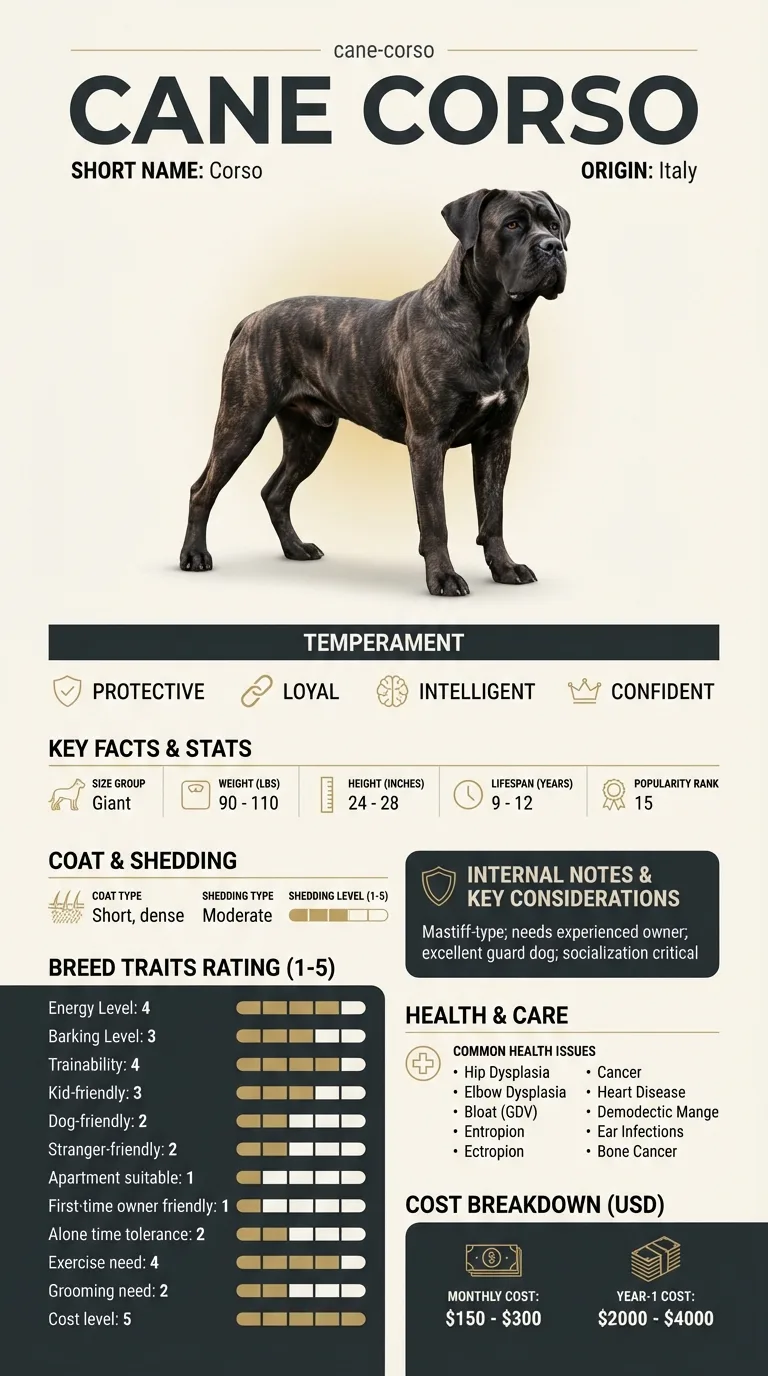
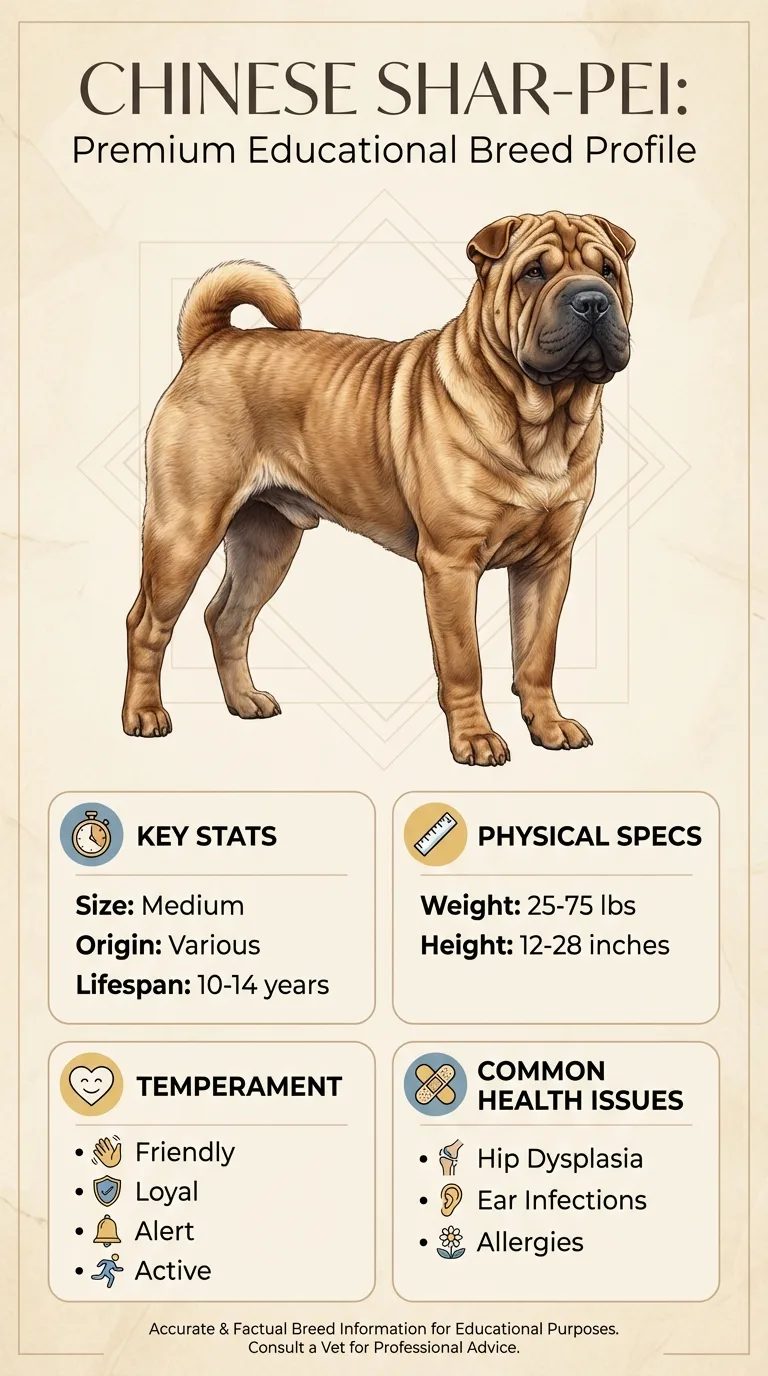
This is for someone already down to Cane Corso and Chinese Shar-Pei and deciding between them. For this pair the decision usually turns on apartment suitability and exercise need, so those are covered first and in most detail. Anyone choosing from a flat has a clear answer here: Chinese Shar-Pei rates 4/5 against 1/5. Breed history is left out; what follows is what you will actually live with.
Between Cane Corso and Chinese Shar-Pei, apartment suitability is what separates them, and Chinese Shar-Pei is the lower-effort dog of the two to keep.
Choose Cane Corso if you want a dog that picks up training quickly and you want a dog that can keep up with an active routine.
Choose Chinese Shar-Pei if you are in a flat or a smaller home, shedding is a problem in your house and your walking routine is modest.
| Feature | cane corso | chinese shar pei | Winner |
|---|---|---|---|
| Size class | giant | medium | Equal |
| Weight | 90–110 lbs | 45–60 lbs | Equal |
| Height | 24–28 in | 18–20 in | Equal |
| Lifespan | 9–12 years | 8–12 years | cane corso |
| Exercise need | High (4/5) | Low (2/5) | chinese shar pei |
| Grooming need | Low (2/5) | Low (2/5) | Equal |
| Shedding | Moderate (3/5) | Low (2/5) | chinese shar pei |
| Energy level | High (4/5) | Low (2/5) | Equal |
| Barking | Moderate (3/5) | Low (2/5) | chinese shar pei |
| Apartment suitability | Very low (1/5) | High (4/5) | chinese shar pei |
| Good for first-time owners | Very low (1/5) | Low (2/5) | chinese shar pei |
| Tolerates being alone | Low (2/5) | Moderate (3/5) | chinese shar pei |
| Trainability | High (4/5) | Low (2/5) | cane corso |
| Good with kids | Moderate (3/5) | Moderate (3/5) | Equal |
| Good with other dogs | Low (2/5) | Low (2/5) | Equal |
| Friendly to strangers | Low (2/5) | Low (2/5) | Equal |
| Cost level | Very high (5/5) | High (4/5) | chinese shar pei |
| Coat | Short, dense | Short and harsh | Equal |
| Origin | Italy | Various | Equal |
| Typical monthly cost | $150–$300 | $100–$200 | Equal |
| Typical first-year cost | $2,000–$4,000 | $1,400–$2,900 | Equal |
The Corso is a giant breed at 90-110 lbs and 24-28 inches; the Shar-Pei is medium-sized at 45-60 lbs and 18-20 inches — roughly half the Corso's weight and several inches shorter. Both are solidly built, muscular dogs for their respective classes, but the Corso is still close to double the mass. The Shar-Pei's distinctive loose, wrinkled skin makes it look bulkier than the tape measure suggests, though the Corso still outsizes it in every dimension that matters for daily handling.
The Corso needs considerably more daily exercise, rated high (4/5) against the Shar-Pei's low (2/5). Shar-Peis are famously low-key for a medium breed and are content with modest daily walks, while a Corso's size and guardian-breed background call for real structured activity to stay well-adjusted. Both breeds do better with purposeful activity than free-roaming exercise, since neither is naturally inclined to play fetch for its own sake.
Grooming ties at low (2/5) for both, but shedding tips slightly toward the Shar-Pei, rated low (2/5) against the Corso's moderate (3/5). Both breeds have short, low-fuss coats — the real coat-related maintenance work for the Shar-Pei is less about brushing and more about keeping its characteristic skin folds clean and dry, which is a different kind of routine than a low grooming score alone would suggest.
The Shar-Pei is the clearly better apartment dog: high (4/5) suitability against the Corso's very low (1/5), backed by lower barking (2/5 vs 3/5) and better tolerance for time alone (3/5 vs 2/5). A Shar-Pei's independent, reserved temperament suits solitary stretches better than a Corso's more people-oriented, protective nature does, which is part of why a Corso left alone too often tends toward anxious or destructive behavior.
The Corso rates far more trainable, high (4/5) against the Shar-Pei's low (2/5) — Shar-Peis are known for an independent streak that makes them respond to training on their own terms. Neither is recommended for a first-time owner: very low (1/5) for the Corso, low (2/5) for the Shar-Pei, both requiring confident, consistent handling. Both breeds also benefit from an owner who's comfortable being the clear decision-maker in the relationship rather than negotiating.
These two tie across the board — moderate (3/5) with kids, low (2/5) with other dogs, and low (2/5) with strangers for both. Their temperaments describe similar territory too: the Corso is protective and confident, the Shar-Pei reserved and independent. Neither breed is the naturally outgoing type, and both benefit from early, deliberate socialization, particularly around visitors and unfamiliar dogs, if you want a well-adjusted adult that isn't reactive.
This is one of the few pairs where the giant breed actually edges out the smaller one on lifespan: 9-12 years for the Corso against 8-12 for the Shar-Pei. The Shar-Pei's health list is short but distinctive — Familial Shar-Pei Fever is a breed-specific condition tied directly to its wrinkled skin, and it shares entropion and ear infections with the Corso, both linked to loose facial skin around the eyes.
The Corso costs somewhat more to keep: very high (5/5) against the Shar-Pei's high (4/5), $150-300 monthly versus $100-200, and $2,000-4,000 in year one against $1,400-2,900. The gap here is narrower than in many Corso comparisons, since the Shar-Pei's skin-fold care adds its own recurring cost in cleaning supplies and occasional dermatology visits that a smoother-skinned breed simply doesn't need to budget for.
Cane Corso weighs 90–110 lbs and lives 9–12 years; Chinese Shar-Pei weighs 45–60 lbs and lives 8–12 years. The two diverge most on apartment suitability, exercise need and energy level and 1 other rated axes. They are level on good with other dogs, grooming need and good with kids, so those cannot decide it. The comparison marks an easier option only where one exists. Facts like weight and country of origin are not scored. Both dogs are rated from the same dataset, which is what makes the numbers comparable with each other even though any individual dog sits somewhere inside its breed's range.

About twice the weight — 90-110 lbs versus 45-60 lbs for the Shar-Pei — and several inches taller, 24-28 inches against 18-20.
The Shar-Pei, rated low (2/5) for barking against the Corso's moderate (3/5), and it also tolerates being alone slightly better.
Neither scores well — the Corso rates a very low 1/5 for first-time owners and the Shar-Pei a low 2/5. Both are independent-minded breeds that do better with an experienced handler.
The Shar-Pei, clearly — 4/5 versus the Corso's very low 1/5, thanks to lower exercise needs and quieter behavior.
The Shar-Pei, at $100-200 monthly and $1,400-2,900 in year one, against $150-300 and $2,000-4,000 for the Corso — though the gap is smaller than most Corso matchups due to the Shar-Pei's skin-fold care needs.
Entropion and ear infections appear on both lists, both linked to loose skin around the eyes and ears. The Shar-Pei's Familial Shar-Pei Fever is unique to the breed, while the Corso's list adds bloat and cancer risks tied to its size.
It's close, and unusually the giant breed wins — the Corso's 9-12 year range edges out the Shar-Pei's 8-12.
The Shar-Pei for smaller homes and lower activity levels; the Corso only for owners with experience, space, and time for real daily exercise.
The Shar-Pei, at $100-200 versus the Corso's $150-300.
The Cane Corso, rated 4/5 against the Shar-Pei's 2/5.
It's close, but the Corso edges it at 9-12 years versus 8-12 for the Shar-Pei.
Secure checkout on Stripe. We never see your card.
7-day money-back guarantee. Instant access.
Health information here is general and is not veterinary advice. If your dog shows pain, sudden behaviour change, or worsening symptoms, consult a licensed veterinarian.
Some links on this site are affiliate links. We may earn a commission at no extra cost to you, and we only suggest products we believe are helpful for dog owners.
We research and check what we publish, but we do not warrant that any figure, date, price, or statement is accurate, complete, or current, and we accept no liability for any loss, cost, injury, or other harm arising from the use of this site. Use it as one reference among several. You remain responsible for your own decisions and for your dog's care - confirm anything that matters with a licensed veterinarian or another qualified professional before you act on it. Full disclaimer.
Match your lifestyle to the right dog.
Take quizNot sure which breed is right for you? Take our 2-minute quiz to find out.
Take the quiz