Behavior
Brittany or Pug -- which is the better overall choice?
For an active household, the Brittany; for a lower-key apartment life with less exercise demand, the Pug -- the exercise-need gap (4/5 versus 2/5) is really the deciding factor.

Quick answer
Brittany or Pug -- which is the better overall choice?
For an active household, the Brittany; for a lower-key apartment life with less exercise demand, the Pug -- the exercise-need gap (4/5 versus 2/5) is really the deciding factor.
Brittany Spaniel or Pug? On paper they differ most on exercise need, and on the scales Brittany Spaniel is the heavier at 30–40 lbs. Here is how the two compare on everything that shapes an ordinary week.
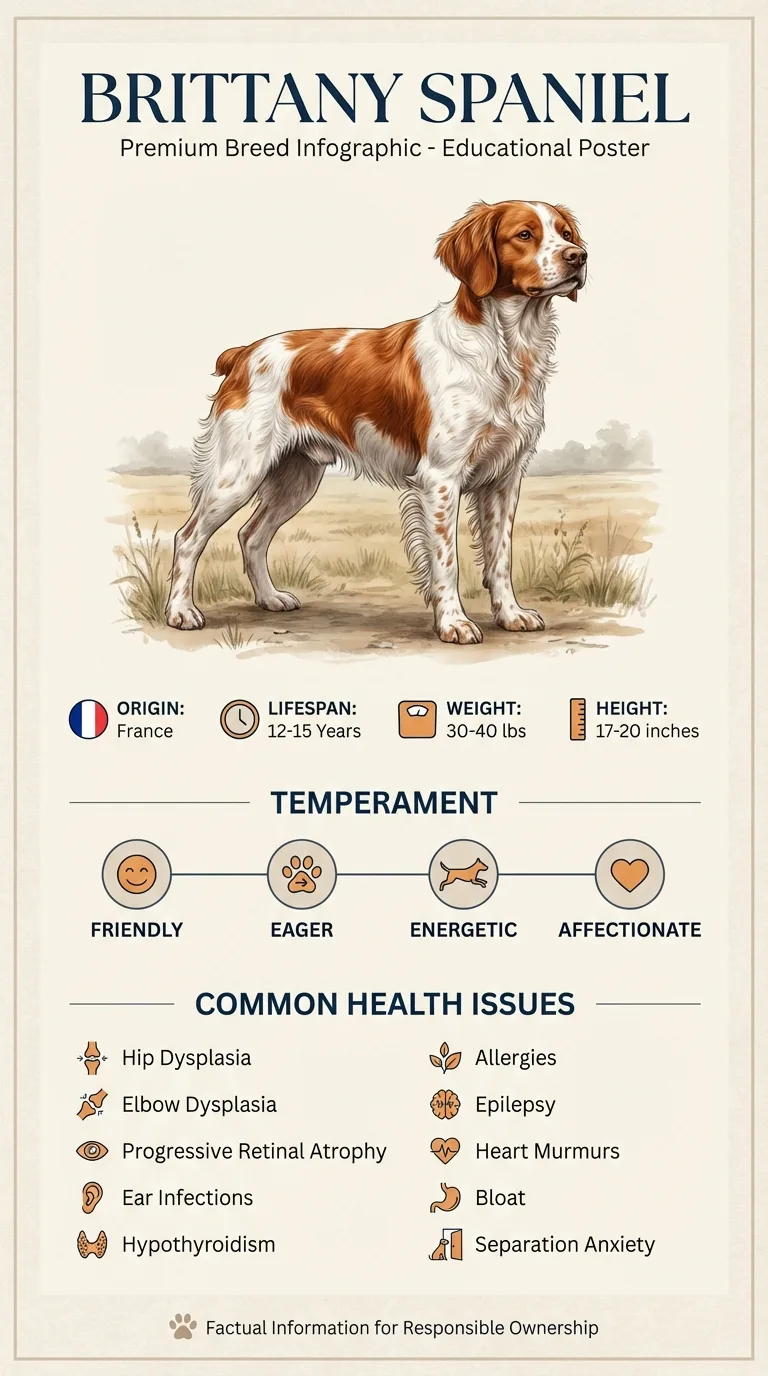
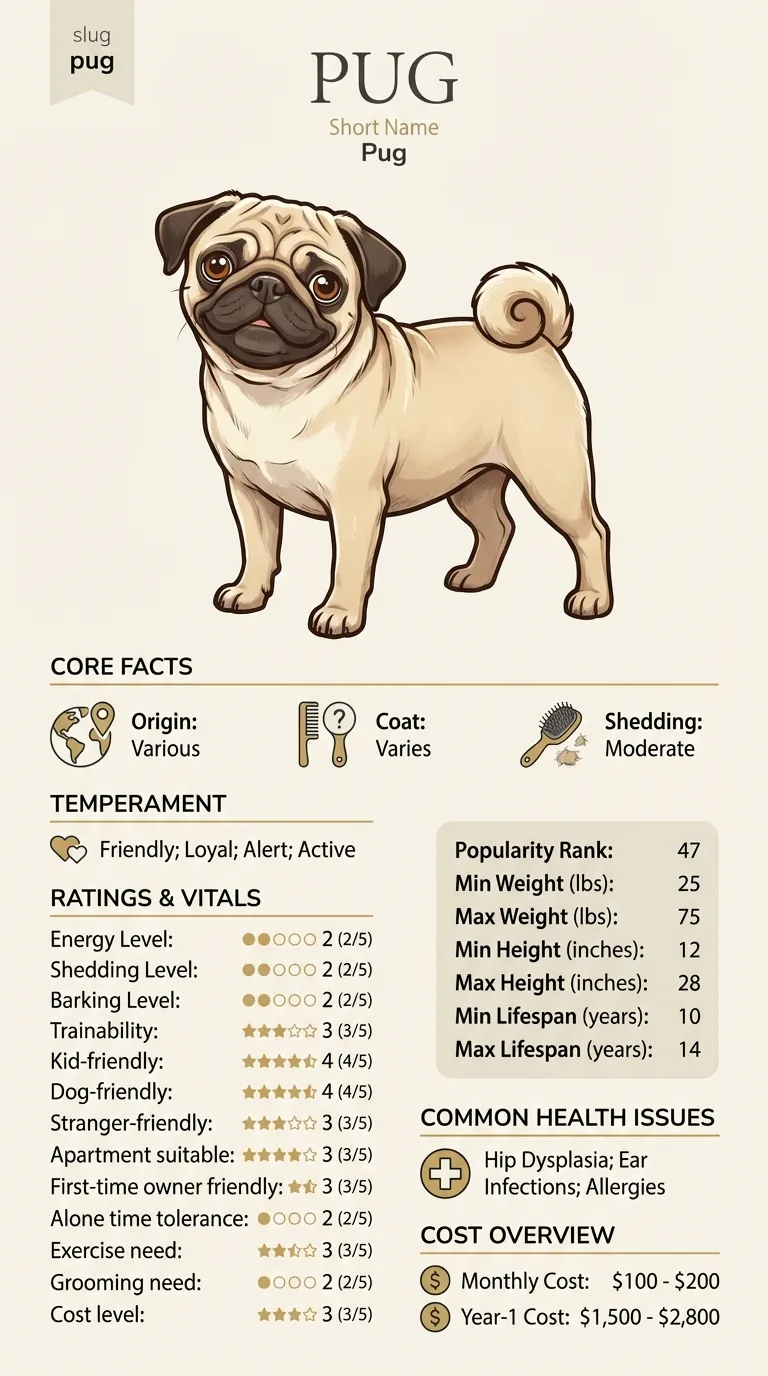
This is for someone already down to Brittany Spaniel and Pug and deciding between them. For this pair the decision usually turns on exercise need and energy level, so those are covered first and in most detail. Anyone choosing from a flat has a clear answer here: Pug rates 5/5 against 3/5. It is written for the decision rather than the breed history.
Between Brittany Spaniel and Pug, exercise need is what separates them, and Pug is the lower-effort dog of the two to keep.
Choose Brittany Spaniel if shedding is a problem in your house, you already have another dog and you want a dog that picks up training quickly.
Choose Pug if you are in a flat or a smaller home, this is your first dog and your walking routine is modest.
| Feature | brittany | pug | Winner |
|---|---|---|---|
| Size class | medium | small | Equal |
| Weight | 30–40 lbs | 14–18 lbs | Equal |
| Height | 17–20 in | 10–13 in | Equal |
| Lifespan | 12–15 years | 13–15 years | pug |
| Exercise need | High (4/5) | Low (2/5) | pug |
| Grooming need | Low (2/5) | Low (2/5) | Equal |
| Shedding | Moderate (3/5) | High (4/5) | brittany |
| Energy level | High (4/5) | Low (2/5) | Equal |
| Barking | Low (2/5) | Low (2/5) | Equal |
| Apartment suitability | Moderate (3/5) | Very high (5/5) | pug |
| Good for first-time owners | High (4/5) | Very high (5/5) | pug |
| Tolerates being alone | Low (2/5) | Low (2/5) | Equal |
| Trainability | Very high (5/5) | Moderate (3/5) | brittany |
| Good with kids | Very high (5/5) | Very high (5/5) | Equal |
| Good with other dogs | Very high (5/5) | High (4/5) | brittany |
| Friendly to strangers | High (4/5) | Very high (5/5) | pug |
| Cost level | Moderate (3/5) | Moderate (3/5) | Equal |
| Coat | Medium, wavy coat | Short, smooth double coat | Equal |
| Origin | France | Various | Equal |
| Typical monthly cost | $90–$180 | $80–$150 | Equal |
| Typical first-year cost | $1,300–$2,500 | $1,100–$2,300 | Equal |
The Pug is compact and stocky -- 14-18 lbs, 10-13 inches -- while the Brittany is taller and leaner at 30-40 lbs and 17-20 inches, roughly double the weight. The Pug's short-faced, short-legged build isn't just a size difference from the Brittany, it's a different structural category, and that shows up directly in the health section below.
This is the defining gap in the pairing: exercise need rates high (4/5) for the Brittany against low (2/5) for the Pug. A Brittany wants field time and real mileage; a Pug is content with short walks and indoor play, partly by temperament and partly because its flat-faced structure makes strenuous exercise genuinely harder on its breathing.
Grooming need ties at low (2/5) for both breeds, but shedding tips toward the Brittany being the cleaner option -- moderate (3/5) against the Pug's high (4/5). Pugs have a reputation for shedding more than their short coat suggests, and that fine hair shows up on dark clothing more than you'd expect.
The Pug rates very high (5/5) for apartment living against the Brittany's moderate (3/5), and barking ties at low (2/5) for both. Between the low exercise need and the apartment score, the Pug is simply the better fit for compact living -- this is one of the clearer size-driven advantages in this comparison set.
Interestingly, the Pug rates higher for first-time owners, very high (5/5) against the Brittany's high (4/5), despite the Brittany having the clear trainability edge -- very high (5/5) versus moderate (3/5) for the Pug. Pugs can be a bit stubborn in training sessions, but their lower exercise needs and easygoing nature make them more forgiving of a first-timer's schedule.
Both breeds rate very high (5/5) with kids, so that's a tie. The Brittany edges ahead with other dogs, very high (5/5) against high (4/5), but the Pug actually rates higher with strangers -- very high (5/5) against the Brittany's high (4/5). Pugs have a well-earned reputation as instant friends to anyone who walks in the door.
The Pug's lifespan runs slightly longer, 13-15 years against the Brittany's 12-15. What's more notable is that the two health lists don't overlap at all -- the Brittany's ten conditions lean toward joint and immune issues like hip dysplasia and allergies, while the Pug's five are almost entirely tied to its flat face and short spine: brachycephalic airway syndrome, corneal ulcers, and hemivertebrae. These are structurally different risk profiles, not variations on the same theme.
Cost level ties at moderate (3/5) for both breeds, with monthly costs of $90-$180 for the Brittany against $80-$150 for the Pug, and first-year totals of $1,300-$2,500 versus $1,100-$2,300. The Pug's lower food and exercise-gear costs are offset somewhat by the reality that brachycephalic breeds often carry higher lifetime vet bills than the sticker cost implies.
Brittany Spaniel weighs 30–40 lbs and lives 12–15 years; Pug weighs 14–18 lbs and lives 13–15 years. The two diverge most on exercise need, energy level and apartment suitability and 1 other rated axes. They are level on tolerates being alone, barking and cost level, so those cannot decide it. In the table, a "winner" means easier for an ordinary household — not better. Size, coat and origin are recorded without a verdict. Because both breeds are scored the same way, the gaps are reliable even where the absolute numbers are rough.

The Brittany by a wide margin -- high (4/5) exercise need against low (2/5) for the Pug. Part of that gap comes from the Pug's flat-faced structure, which makes intense exercise physically harder.
The Pug, at high (4/5) against the Brittany's moderate (3/5) -- a common surprise given how short the Pug's coat looks.
Yes, rated very high (5/5), even ahead of the Brittany's high (4/5), largely because its lower exercise needs are easier to keep up with. It's less trainable, though, at moderate (3/5) against the Brittany's very high (5/5).
The Pug, rated very high (5/5) against the Brittany's moderate (3/5) -- its low exercise need and small size both help here.
$90-$180 for a Brittany and $80-$150 for a Pug, with first-year totals of $1,300-$2,500 and $1,100-$2,300.
No -- the two lists don't overlap at all. The Pug's five conditions are almost entirely tied to its flat face and short spine, like brachycephalic airway syndrome and hemivertebrae, while the Brittany's ten lean toward joint and immune issues.
The Pug, rated very high (5/5) against the Brittany's high (4/5) -- Pugs are known for warming up to new people almost instantly.
For an active household, the Brittany; for a lower-key apartment life with less exercise demand, the Pug -- the exercise-need gap (4/5 versus 2/5) is really the deciding factor.
$90-$180 for a Brittany versus $80-$150 for a Pug.
The Brittany, at high (4/5) versus low (2/5) for the Pug.
The Pug, whose range starts higher at 13 years versus the Brittany's 12, though both can reach 15.
See every pug comparison.
Secure checkout on Stripe. We never see your card.
7-day money-back guarantee. Instant access.
Health information here is general and is not veterinary advice. If your dog shows pain, sudden behaviour change, or worsening symptoms, consult a licensed veterinarian.
Some links on this site are affiliate links. We may earn a commission at no extra cost to you, and we only suggest products we believe are helpful for dog owners.
We research and check what we publish, but we do not warrant that any figure, date, price, or statement is accurate, complete, or current, and we accept no liability for any loss, cost, injury, or other harm arising from the use of this site. Use it as one reference among several. You remain responsible for your own decisions and for your dog's care - confirm anything that matters with a licensed veterinarian or another qualified professional before you act on it. Full disclaimer.
Match your lifestyle to the right dog.
Take quizNot sure which breed is right for you? Take our 2-minute quiz to find out.
Take the quiz