Living
Boxer or Pug — which should a first-time owner pick?
The Pug, without much competition — it rates very high (5/5) for first-time owners against the Boxer's moderate (3/5), and its low exercise need (2/5) forgives a less experienced schedule.

Quick answer
Boxer or Pug — which should a first-time owner pick?
The Pug, without much competition — it rates very high (5/5) for first-time owners against the Boxer's moderate (3/5), and its low exercise need (2/5) forgives a less experienced schedule.
Boxer or Pug? On paper they differ most on exercise need, and on the scales Boxer is the heavier at 60–70 lbs. Here is how the two compare on everything that shapes an ordinary week.
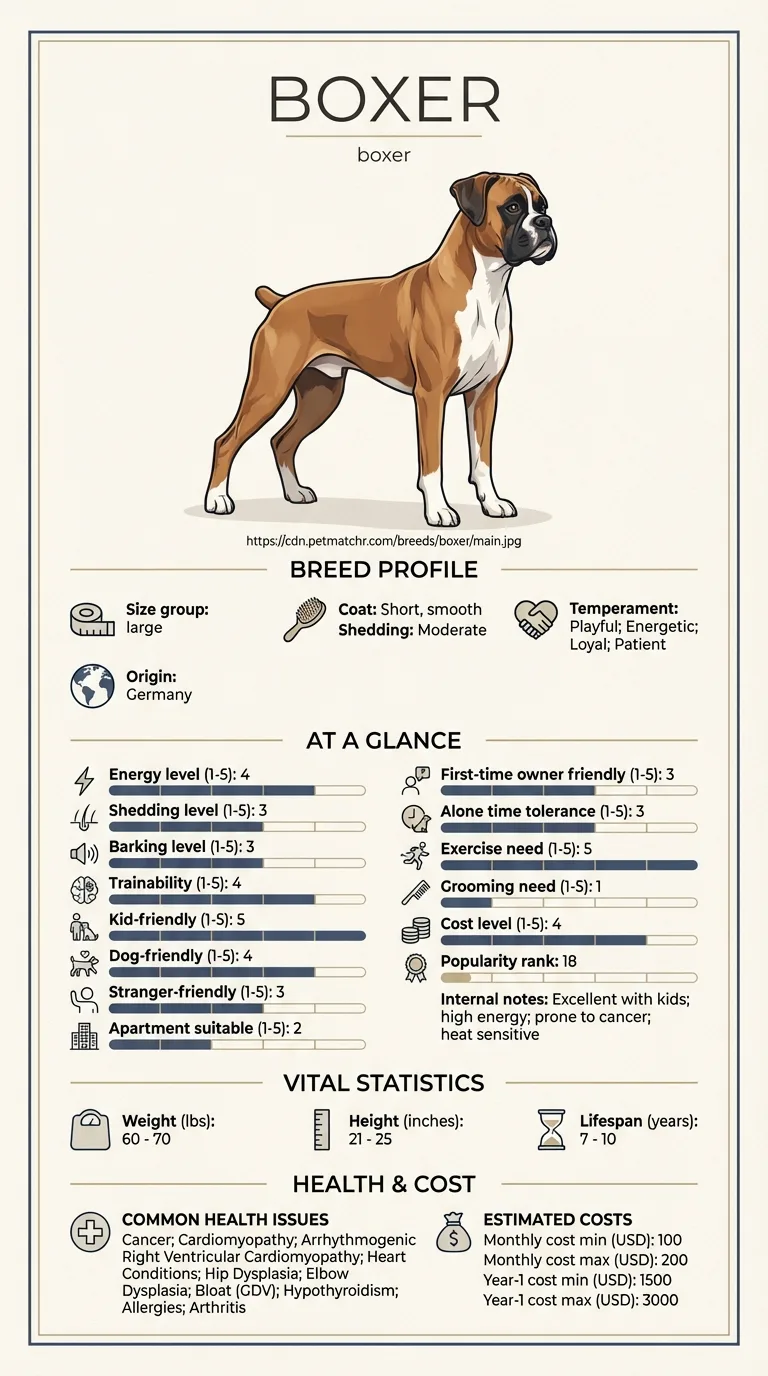
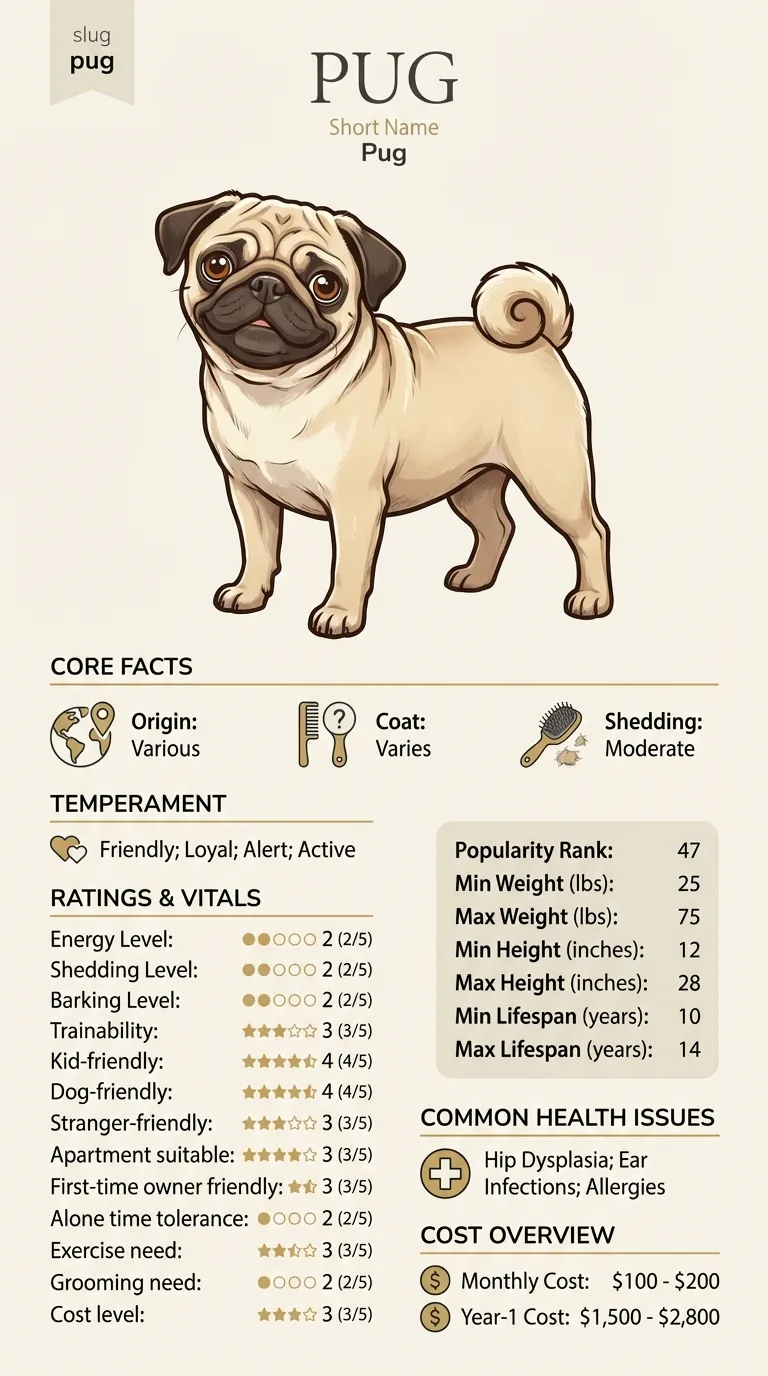
This is for someone already down to Boxer and Pug and deciding between them. For this pair the decision usually turns on exercise need and apartment suitability, so those are covered first and in most detail. Anyone choosing from a flat has a clear answer here: Pug rates 5/5 against 2/5. The focus throughout is on daily consequences rather than breed background.
Between Boxer and Pug, exercise need is what separates them, and Pug is the lower-effort dog of the two to keep.
Choose Boxer if you do not want a standing grooming appointment, shedding is a problem in your house and the dog will be alone during the working day.
Choose Pug if you are in a flat or a smaller home, this is your first dog and your walking routine is modest.
| Feature | boxer | pug | Winner |
|---|---|---|---|
| Size class | large | small | Equal |
| Weight | 60–70 lbs | 14–18 lbs | Equal |
| Height | 21–25 in | 10–13 in | Equal |
| Lifespan | 7–10 years | 13–15 years | pug |
| Exercise need | Very high (5/5) | Low (2/5) | pug |
| Grooming need | Very low (1/5) | Low (2/5) | boxer |
| Shedding | Moderate (3/5) | High (4/5) | boxer |
| Energy level | High (4/5) | Low (2/5) | Equal |
| Barking | Moderate (3/5) | Low (2/5) | pug |
| Apartment suitability | Low (2/5) | Very high (5/5) | pug |
| Good for first-time owners | Moderate (3/5) | Very high (5/5) | pug |
| Tolerates being alone | Moderate (3/5) | Low (2/5) | boxer |
| Trainability | High (4/5) | Moderate (3/5) | boxer |
| Good with kids | Very high (5/5) | Very high (5/5) | Equal |
| Good with other dogs | High (4/5) | High (4/5) | Equal |
| Friendly to strangers | Moderate (3/5) | Very high (5/5) | pug |
| Cost level | High (4/5) | Moderate (3/5) | pug |
| Coat | Short, smooth | Short, smooth double coat | Equal |
| Origin | Germany | Various | Equal |
| Typical monthly cost | $100–$200 | $80–$150 | Equal |
| Typical first-year cost | $1,500–$3,000 | $1,100–$2,300 | Equal |
The Boxer outweighs the Pug by roughly four to one — 60-70 lbs against 14-18 — and clears it by nearly a foot in height, 21-25 inches versus 10-13. Two very different silhouettes despite both having roots as companion-and-guard breeds; one is built for endurance, the other for a lap. That size gap alone should steer your choice of crate, car harness, and even how much you'll spend feeding either dog each month.
The gap here is the widest in this entire comparison: very high (5/5) exercise need for the Boxer against low (2/5) for the Pug. A Boxer that doesn't get real daily activity will find its own outlets, usually destructive ones. A Pug is genuinely content with short walks and indoor play — pushing it much harder than that risks overheating given its shorter muzzle.
Coat maintenance is low for both — very low (1/5) for the Boxer, low (2/5) for the Pug — but shedding tells a different story. The Pug rates high (4/5), notably more than the Boxer's moderate (3/5), which surprises people who assume a short coat means less fur. It doesn't; it just means the fur is easier to see on dark clothes.
The Pug is built for small-space living — very high (5/5) apartment suitability, low (2/5) barking, and low (2/5) exercise need all point the same direction. The Boxer sits at low (2/5) apartment suitability and needs daily outdoor time regardless of unit size. If you're renting a one-bedroom, this category alone probably decides your dog. Weigh that against your actual daily schedule, not just your square footage, before deciding.
The Boxer trains a step ahead — high (4/5) against the Pug's moderate (3/5) — but the Pug is the friendlier entry point for someone new to dog ownership, rating very high (5/5) on first-time-owner suitability against the Boxer's moderate (3/5). Neither breed tolerates being left alone especially well, though the Boxer edges it (moderate 3/5 versus the Pug's low 2/5).
Both breeds score very high (5/5) with kids and high (4/5) with other dogs — a genuine tie on family fit. The Pug pulls ahead with strangers, rated very high (5/5) against the Boxer's moderate (3/5); this is a breed that greets everyone like an old friend, where the Boxer takes a bit more time to warm up. A busy household with a lot of comings and goings tends to suit the Pug especially well.
Lifespan favors the Pug by several years — 13-15 against the Boxer's 7-10. The health profiles don't overlap at all based on their listed conditions: the Boxer's risks center on cancer and heart disease, while the Pug's are dominated by brachycephalic airway syndrome, along with corneal ulcers and a documented risk of pug dog encephalitis. Different bodies, different vet bills.
Cost level rates high (4/5) for the Boxer, moderate (3/5) for the Pug. Monthly costs run $100-200 versus $80-150, and first-year totals land at $1,500-3,000 against $1,100-2,300 — the Boxer's larger size drives most of that gap through food volume and medication dosing. Neither breed is cheap to keep relative to a mixed-breed dog of the same size, but the Pug stays the more budget-friendly of the two.
Boxer weighs 60–70 lbs and lives 7–10 years; Pug weighs 14–18 lbs and lives 13–15 years. The two diverge most on exercise need, apartment suitability and energy level and 2 other rated axes. They are level on good with other dogs and good with kids, so those cannot decide it. The table below marks a winner only where one breed is genuinely easier for a typical owner; size and origin are facts rather than merits and stay level. Ratings come from one source applied to both breeds, so they are meaningful against each other rather than as absolute scores.

The Pug, by the widest margin in this comparison — low (2/5) against the Boxer's very high (5/5). Short walks and indoor play are genuinely enough for a Pug.
The Pug rates very high (5/5) for first-time owners against the Boxer's moderate (3/5), and its friendliness toward strangers (very high, 5/5) makes early socialization easier too.
No overlap based on their listed conditions — the Boxer's risks run toward cancer and heart disease, the Pug's toward airway and eye issues tied to its flat face.
The Pug, rated high (4/5) against the Boxer's moderate (3/5) — a common surprise, since people assume short coats mean less shedding.
The Boxer runs $100-200 monthly and $1,500-3,000 in year one; the Pug runs $80-150 and $1,100-2,300. The gap tracks size more than anything else.
The Pug, typically 13-15 years against the Boxer's 7-10.
Clearly the Pug — very high (5/5) apartment suitability against the Boxer's low (2/5), backed up by its low exercise need and low barking rating.
The Pug, without much competition — it rates very high (5/5) for first-time owners against the Boxer's moderate (3/5), and its low exercise need (2/5) forgives a less experienced schedule.
$100-200 for the Boxer, $80-150 for the Pug — a modest gap that tracks the size difference.
About as far apart as two breeds get — very high (5/5) for the Boxer, low (2/5) for the Pug.
The Pug, typically 13-15 years against the Boxer's 7-10.
See every pug comparison.
Secure checkout on Stripe. We never see your card.
7-day money-back guarantee. Instant access.
Health information here is general and is not veterinary advice. If your dog shows pain, sudden behaviour change, or worsening symptoms, consult a licensed veterinarian.
Some links on this site are affiliate links. We may earn a commission at no extra cost to you, and we only suggest products we believe are helpful for dog owners.
We research and check what we publish, but we do not warrant that any figure, date, price, or statement is accurate, complete, or current, and we accept no liability for any loss, cost, injury, or other harm arising from the use of this site. Use it as one reference among several. You remain responsible for your own decisions and for your dog's care - confirm anything that matters with a licensed veterinarian or another qualified professional before you act on it. Full disclaimer.
Match your lifestyle to the right dog.
Take quizNot sure which breed is right for you? Take our 2-minute quiz to find out.
Take the quiz