Living
Which should you actually get?
Depends entirely on your space and tolerance for slobber versus barking. The Bloodhound needs room to roam and a nose to indulge; the Yorkshire Terrier needs a lint roller and patience for grooming bills.

Quick answer
Which should you actually get?
Depends entirely on your space and tolerance for slobber versus barking. The Bloodhound needs room to roam and a nose to indulge; the Yorkshire Terrier needs a lint roller and patience for grooming bills.
Bloodhound or Yorkshire Terrier? On paper they differ most on grooming need, and on the scales Bloodhound is the heavier at 90–110 lbs. Here is how the two compare on everything that shapes an ordinary week.
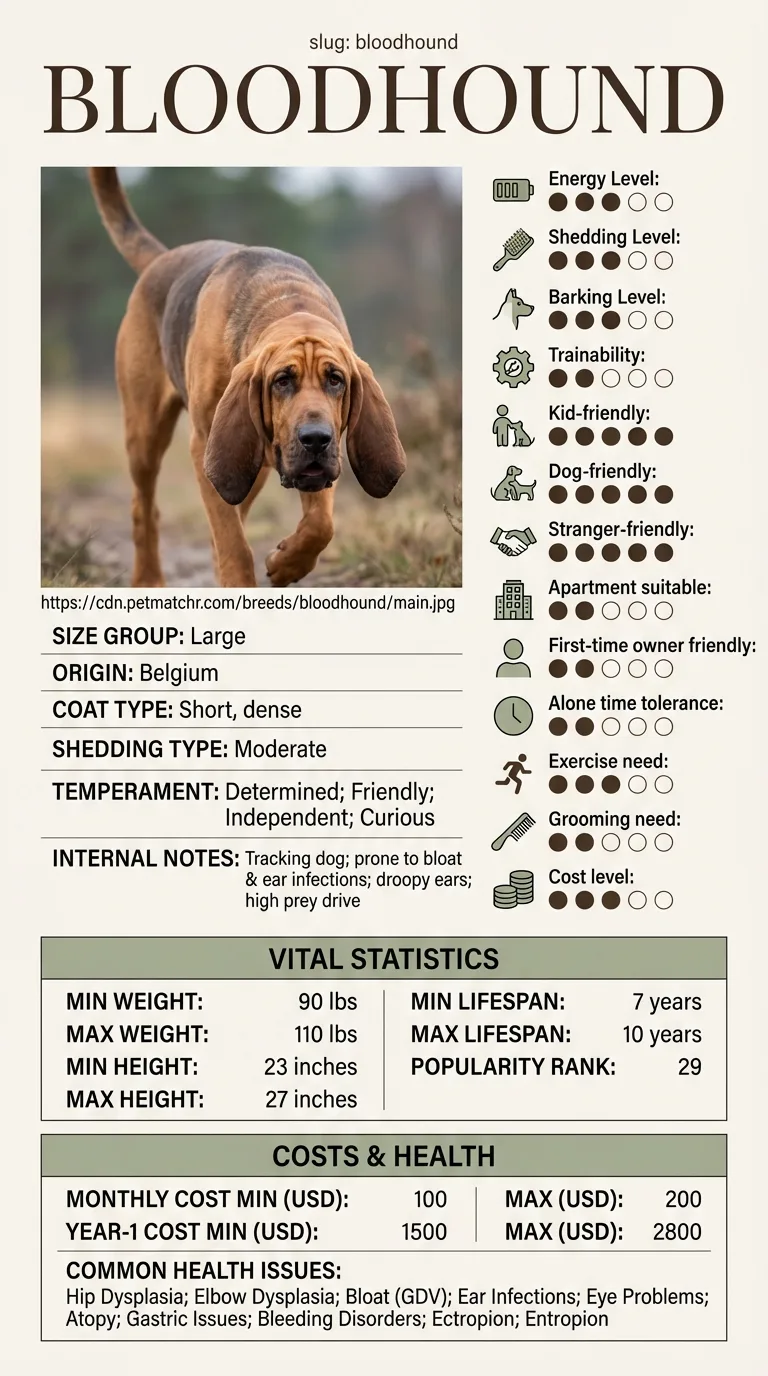
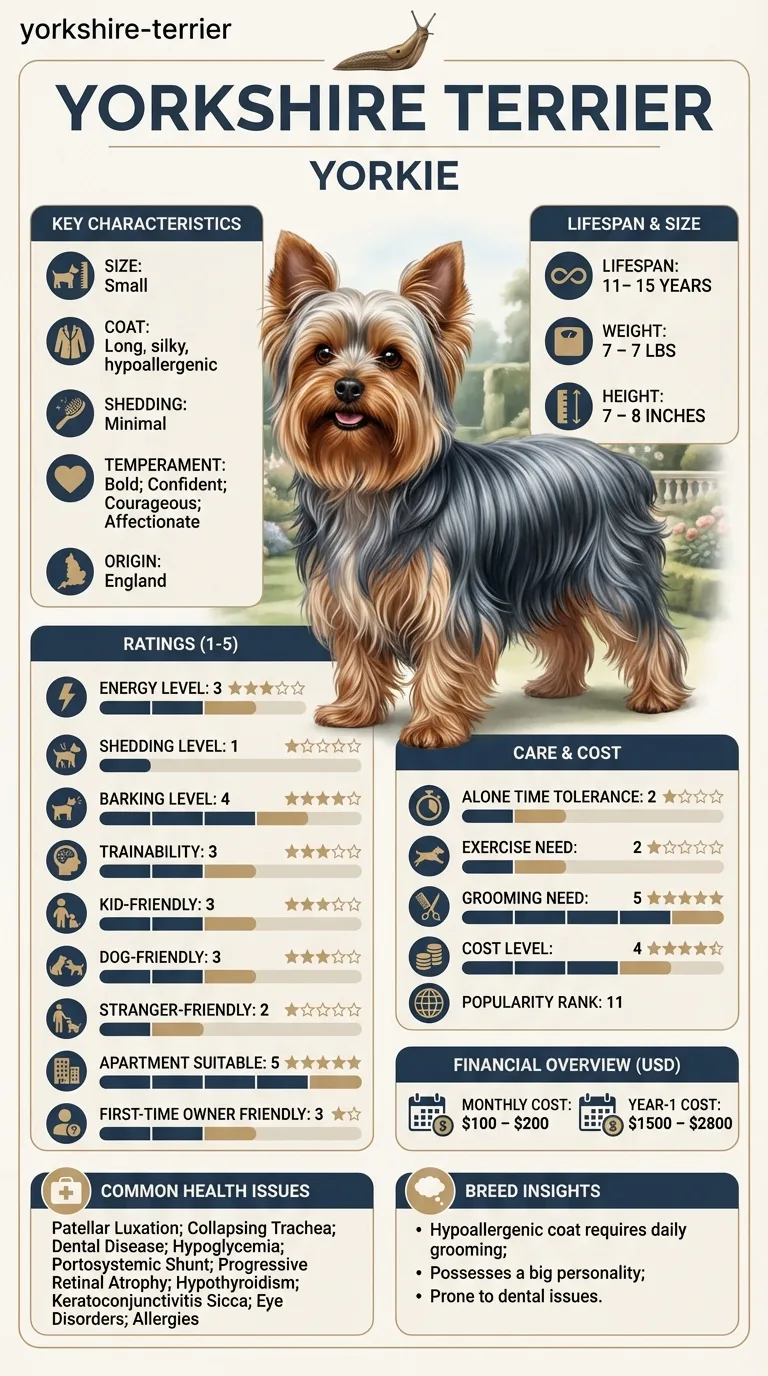
This is for someone already down to Bloodhound and Yorkshire Terrier and deciding between them. For this pair the decision usually turns on grooming need and apartment suitability, so those are covered first and in most detail. Anyone choosing from a flat has a clear answer here: Yorkshire Terrier rates 5/5 against 2/5. The focus throughout is on daily consequences rather than breed background.
Between Bloodhound and Yorkshire Terrier, grooming need is what separates them, and Yorkshire Terrier is the lower-effort dog of the two to keep.
Choose Bloodhound if you do not want a standing grooming appointment, there are young children at home and you already have another dog.
Choose Yorkshire Terrier if you are in a flat or a smaller home, this is your first dog and shedding is a problem in your house.
| Feature | bloodhound | yorkshire terrier | Winner |
|---|---|---|---|
| Size class | large | small | Equal |
| Weight | 90–110 lbs | 4–7 lbs | Equal |
| Height | 23–27 in | 7–8 in | Equal |
| Lifespan | 7–10 years | 11–15 years | yorkshire terrier |
| Exercise need | Moderate (3/5) | Low (2/5) | yorkshire terrier |
| Grooming need | Low (2/5) | Very high (5/5) | bloodhound |
| Shedding | Moderate (3/5) | Very low (1/5) | yorkshire terrier |
| Energy level | Moderate (3/5) | Moderate (3/5) | Equal |
| Barking | Moderate (3/5) | High (4/5) | bloodhound |
| Apartment suitability | Low (2/5) | Very high (5/5) | yorkshire terrier |
| Good for first-time owners | Low (2/5) | Moderate (3/5) | yorkshire terrier |
| Tolerates being alone | Low (2/5) | Low (2/5) | Equal |
| Trainability | Low (2/5) | Moderate (3/5) | yorkshire terrier |
| Good with kids | High (4/5) | Moderate (3/5) | bloodhound |
| Good with other dogs | High (4/5) | Moderate (3/5) | bloodhound |
| Friendly to strangers | High (4/5) | Low (2/5) | bloodhound |
| Cost level | Moderate (3/5) | High (4/5) | bloodhound |
| Coat | Short, dense | Long, silky, hypoallergenic | Equal |
| Origin | Belgium | England | Equal |
| Typical monthly cost | $100–$200 | $100–$190 | Equal |
| Typical first-year cost | $1,500–$2,800 | $1,400–$2,900 | Equal |
Put a Bloodhound next to a Yorkshire Terrier and the comparison almost breaks down — one runs 90 to 110 lbs and stands 23 to 27 inches at the shoulder, the other tops out around 7 lbs and 8 inches. That's roughly a 15-to-1 weight ratio, wider than most breed match-ups on this site. The Bloodhound's frame is built for tracking over miles of rough ground; the Yorkshire Terrier's is built to sit in a lap. Neither dog can really substitute for the other's job.
Exercise need actually lands close on paper — Bloodhound moderate (3/5), Yorkshire Terrier low (2/5) — and energy level ties at moderate (3/5) for both. Don't read that as similar dogs, though. A Bloodhound's moderate rating means long, nose-down walks and scent work, not casual strolls. A Yorkshire Terrier can burn off its needs in a fenced yard or a brisk hallway lap. Size, not drive, is what separates a walk that actually tires each one out.
This is where the numbers flip hard. Bloodhound grooming sits at low (2/5) with moderate (3/5) shedding — a short, dense coat that mostly needs a weekly brush. Yorkshire Terrier grooming rates very high (5/5) despite shedding almost nothing (1/5): that long, silky coat mats without regular brushing and usually needs a professional trim every 4-6 weeks. You're trading fur on the couch for a grooming bill.
Apartment suitability rates low (2/5) for the Bloodhound and very high (5/5) for the Yorkshire Terrier, and barking helps explain why a small unit still isn't effortless with the Yorkie — it rates high (4/5) on barking against the Bloodhound's moderate (3/5). Both breeds score low (2/5) on tolerating being alone, so neither is a great pick for long solo workdays regardless of square footage.
Neither breed is an easy first dog on paper. Bloodhound trainability rates low (2/5) and its first-time-owner score is also low (2/5) — a nose-driven dog that will follow a scent trail over your recall command every time. The Yorkshire Terrier scores a bit better on both, moderate (3/5) trainability and moderate (3/5) for first-timers, but it's still not a plug-and-play breed. Expect patience either way.
With kids, other dogs, and strangers, the Bloodhound consistently rates higher: high (4/5) on all three, against the Yorkshire Terrier's moderate (3/5) with kids and other dogs and low (2/5) with strangers. A gentle giant reads friendlier on paper here than a small dog that's often wary of unfamiliar people. Supervision still matters with the Bloodhound simply because of its size around small children.
Lifespan is the starkest gap in this match-up: 7-10 years for the Bloodhound versus 11-15 for the Yorkshire Terrier — the small dog can outlive the large one by the better part of a decade. The Bloodhound's health list runs to bloat (GDV), hip and elbow dysplasia, and eye issues like ectropion and entropion; the Yorkshire Terrier's includes collapsing trachea, hypoglycemia, and portosystemic shunt. Different bodies, different failure points.
Cost level rates moderate (3/5) for the Bloodhound against high (4/5) for the Yorkshire Terrier, though the dollar ranges nearly overlap — $100-200 a month for the Bloodhound, $100-190 for the Yorkie, and first-year costs of $1,500-2,800 versus $1,400-2,900. A giant dog eats more food, but a toy breed's grooming and vet visits close most of the gap.
Bloodhound weighs 90–110 lbs and lives 7–10 years; Yorkshire Terrier weighs 4–7 lbs and lives 11–15 years. The two diverge most on grooming need, apartment suitability and shedding and 1 other rated axes. They are level on tolerates being alone and energy level, so those cannot decide it. The table below marks a winner only where one breed is genuinely easier for a typical owner; size and origin are facts rather than merits and stay level. Ratings come from one source applied to both breeds, so they are meaningful against each other rather than as absolute scores.

A lot bigger — 90 to 110 lbs against 4 to 7 lbs, and 23-27 inches tall versus 7-8 inches. It's one of the widest size gaps you'll find between two breeds on this site.
The Bloodhound, rated moderate (3/5) shedding versus the Yorkshire Terrier's very low (1/5). The Yorkie's coat is often chosen for low-shed households; the trade-off is it needs far more brushing to stay that way.
Not really, though the Yorkshire Terrier edges it — moderate (3/5) versus the Bloodhound's low (2/5). Bloodhounds are scent-driven and hard to recall off a trail; Yorkies are stubborn but small enough that mistakes are easier to manage.
The Yorkshire Terrier by a wide margin — very high (5/5) apartment suitability against the Bloodhound's low (2/5). A 100-lb dog with a moderate exercise need still needs more room to move than most apartments offer.
They land close: $100-200 for the Bloodhound and $100-190 for the Yorkshire Terrier. First-year costs are similarly close, $1,500-2,800 versus $1,400-2,900 — the Yorkie's grooming bills offset its smaller food budget.
Not directly — the Bloodhound's list centers on bloat, joint dysplasia, and eye conditions like ectropion and entropion, while the Yorkshire Terrier's includes collapsing trachea, hypoglycemia, and portosystemic shunt. Two very different bodies, two very different risk profiles.
The Yorkshire Terrier, and not by a little — 11 to 15 years against the Bloodhound's 7 to 10. It's one of the larger lifespan gaps on this site, largely a function of size.
Depends entirely on your space and tolerance for slobber versus barking. The Bloodhound needs room to roam and a nose to indulge; the Yorkshire Terrier needs a lint roller and patience for grooming bills.
Barely any — Bloodhound runs $100-200, Yorkshire Terrier runs $100-190. The Yorkie's grooming needs eat into the savings you'd expect from a smaller dog.
Both rate close on paper, but the Bloodhound's moderate exercise need means committed nose-work walks, while the Yorkshire Terrier's low-to-moderate need is satisfied by a yard and a short walk.
The Yorkshire Terrier, typically 11-15 years against the Bloodhound's 7-10. Size is doing most of that work — smaller dogs generally outlive giant breeds.
Secure checkout on Stripe. We never see your card.
7-day money-back guarantee. Instant access.
Health information here is general and is not veterinary advice. If your dog shows pain, sudden behaviour change, or worsening symptoms, consult a licensed veterinarian.
Some links on this site are affiliate links. We may earn a commission at no extra cost to you, and we only suggest products we believe are helpful for dog owners.
We research and check what we publish, but we do not warrant that any figure, date, price, or statement is accurate, complete, or current, and we accept no liability for any loss, cost, injury, or other harm arising from the use of this site. Use it as one reference among several. You remain responsible for your own decisions and for your dog's care - confirm anything that matters with a licensed veterinarian or another qualified professional before you act on it. Full disclaimer.
Match your lifestyle to the right dog.
Take quizNot sure which breed is right for you? Take our 2-minute quiz to find out.
Take the quiz