Living
Which breed suits a smaller home better?
The Shiba Inu, rated 4/5 on apartment suitability against the Bloodhound's 2/5 - its small size does most of the work here.

Quick answer
Which breed suits a smaller home better?
The Shiba Inu, rated 4/5 on apartment suitability against the Bloodhound's 2/5 - its small size does most of the work here.
Bloodhound or Shiba Inu? On paper they differ most on apartment suitability, and on the scales Bloodhound is the heavier at 90–110 lbs. Here is how the two compare on everything that shapes an ordinary week.
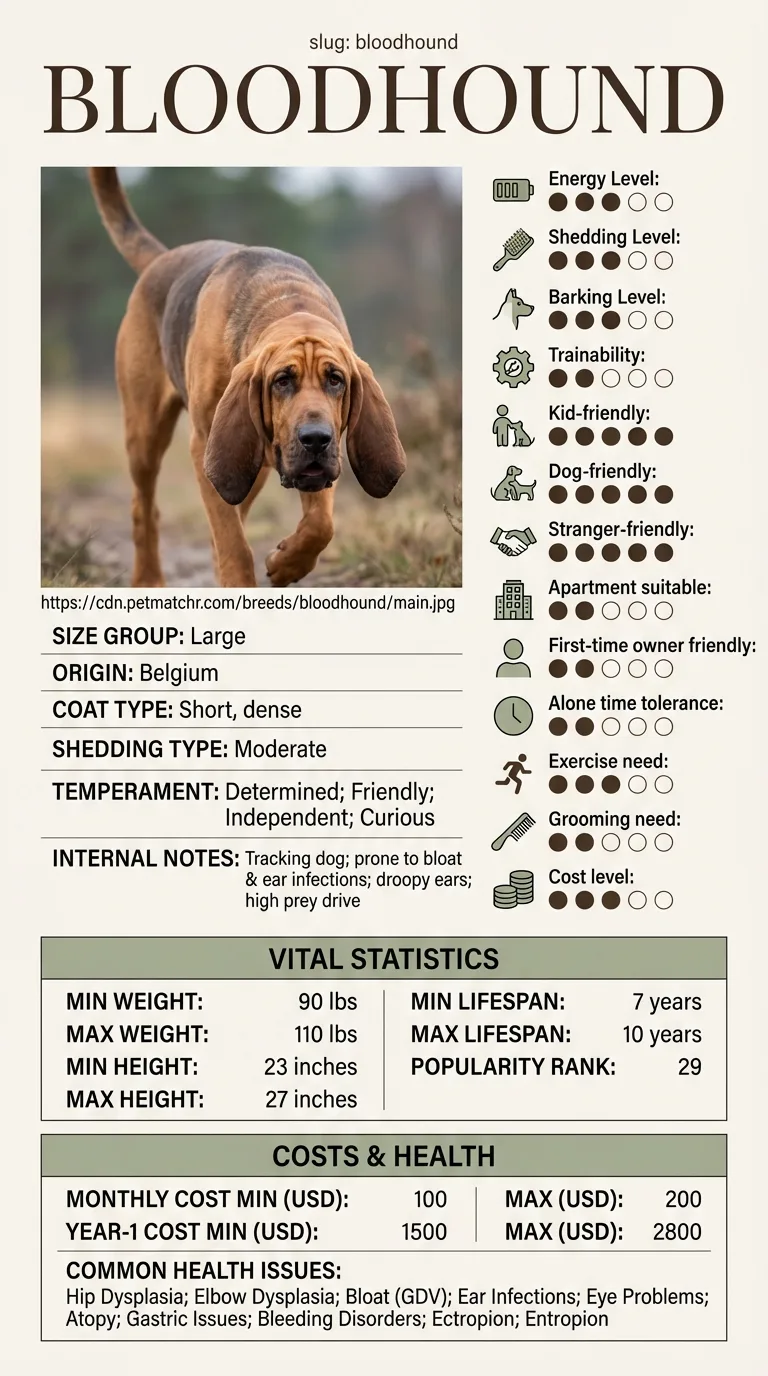
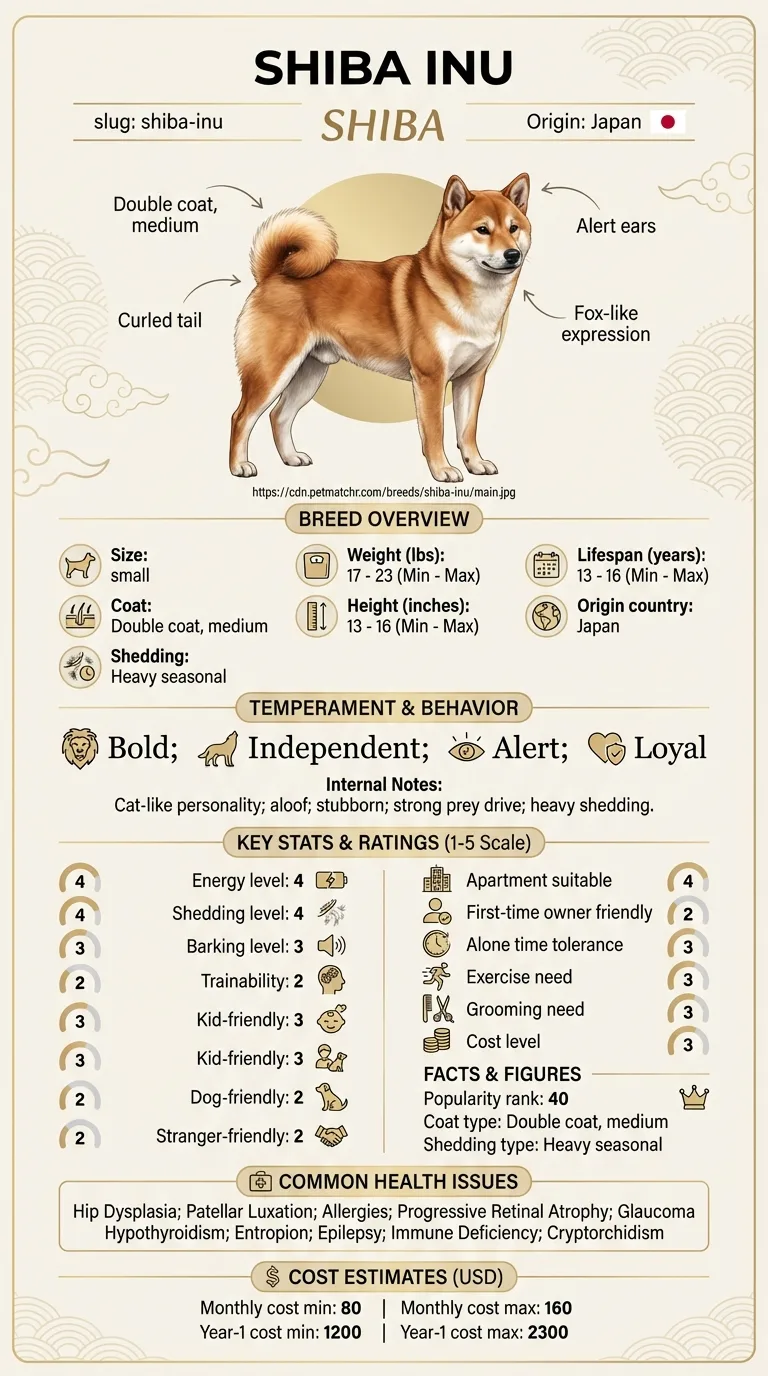
This is for someone already down to Bloodhound and Shiba Inu and deciding between them. For this pair the decision usually turns on apartment suitability and good with other dogs, so those are covered first and in most detail. Anyone choosing from a flat has a clear answer here: Shiba Inu rates 4/5 against 2/5. There is no origin story here — only what changes about your week.
Between Bloodhound and Shiba Inu, apartment suitability is what separates them, and Shiba Inu is the lower-effort dog of the two to keep.
Choose Bloodhound if you do not want a standing grooming appointment, shedding is a problem in your house and there are young children at home.
Choose Shiba Inu if you are in a flat or a smaller home, the dog will be alone during the working day and a smaller dog suits your car, your home or your back.
| Feature | bloodhound | shiba inu | Winner |
|---|---|---|---|
| Size class | large | small | Equal |
| Weight | 90–110 lbs | 17–23 lbs | Equal |
| Height | 23–27 in | 13–16 in | Equal |
| Lifespan | 7–10 years | 13–16 years | shiba inu |
| Exercise need | Moderate (3/5) | Moderate (3/5) | Equal |
| Grooming need | Low (2/5) | Moderate (3/5) | bloodhound |
| Shedding | Moderate (3/5) | High (4/5) | bloodhound |
| Energy level | Moderate (3/5) | High (4/5) | Equal |
| Barking | Moderate (3/5) | Moderate (3/5) | Equal |
| Apartment suitability | Low (2/5) | High (4/5) | shiba inu |
| Good for first-time owners | Low (2/5) | Low (2/5) | Equal |
| Tolerates being alone | Low (2/5) | Moderate (3/5) | shiba inu |
| Trainability | Low (2/5) | Low (2/5) | Equal |
| Good with kids | High (4/5) | Moderate (3/5) | bloodhound |
| Good with other dogs | High (4/5) | Low (2/5) | bloodhound |
| Friendly to strangers | High (4/5) | Low (2/5) | bloodhound |
| Cost level | Moderate (3/5) | Moderate (3/5) | Equal |
| Coat | Short, dense | Double coat, medium | Equal |
| Origin | Belgium | Japan | Equal |
| Typical monthly cost | $100–$200 | $80–$160 | Equal |
| Typical first-year cost | $1,500–$2,800 | $1,200–$2,300 | Equal |
The Shiba Inu is a fraction of the Bloodhound's size - 17-23 lbs and 13-16 inches, against 90-110 lbs and 23-27 inches. You could plausibly carry a Shiba up a flight of stairs; you will not be doing that with a Bloodhound.
Exercise need is actually tied at 3/5 for both breeds, a rare point of agreement given how different they otherwise are. The Shiba edges ahead on general energy level, rated high (4/5) against the Bloodhound's moderate (3/5), and it tends to express that energy in short, intense bursts rather than the Bloodhound's steady plodding pursuit of a scent.
The Shiba needs a bit more grooming attention, 3/5 versus the Bloodhound's 2/5, and sheds more too at 4/5 against 3/5 - its double coat blows out heavily during seasonal changes, sometimes called "shed season" by Shiba owners for good reason. The Bloodhound's coat is more consistently low-maintenance year-round.
The Shiba is far better suited to smaller spaces, rating 4/5 on apartment suitability against the Bloodhound's 2/5. Barking is tied at moderate (3/5) for both, though Shibas are known for a distinctive high-pitched vocalization that some owners find more grating than a standard bark, even at the same rated level.
Neither breed is easy to train - both rate a low 2/5 on trainability and first-time-owner suitability, tied straight across. The Bloodhound's stubbornness comes from scent-driven distraction; the Shiba's comes from a famously independent, almost cat-like temperament that resists repetitive commands. Expect patience either way.
The Bloodhound is notably more social across the board - 4/5 with kids, other dogs, and strangers, against the Shiba's 3/5, 2/5, and 2/5 respectively. A Shiba bred for independent hunting work tends to be more selective about who it warms up to, which matters if you have a busy household or multiple pets already.
Both share a risk of hip dysplasia and entropion, but the Shiba's list runs longer, including progressive retinal atrophy, epilepsy, and glaucoma. Despite the longer list, the Shiba lives considerably longer on average - 13-16 years against the Bloodhound's 7-10 - so more listed conditions doesn't necessarily mean a shorter life here.
Both land at a moderate 3/5 overall cost rating, but the Shiba is somewhat cheaper in practice - $80-160 a month and $1,200-2,300 in year one, against the Bloodhound's $100-200 and $1,500-2,800. The gap is modest but consistent across both monthly and annual figures.
Bloodhound weighs 90–110 lbs and lives 7–10 years; Shiba Inu weighs 17–23 lbs and lives 13–16 years. The two diverge most on apartment suitability, good with other dogs and friendly to strangers. They are level on barking, cost level and exercise need, so those cannot decide it. Where the table declares a winner it means less work for the owner, nothing more; descriptive rows are left as ties on purpose. The value here is in the differences between the two columns; treat any single score as approximate.

Substantially - a Shiba runs 17-23 lbs against the Bloodhound's 90-110 lbs, roughly a fifth the weight, with a shoulder height about ten inches shorter.
The Shiba Inu, at 4/5 versus the Bloodhound's 3/5 - Shiba owners often describe a dramatic seasonal coat blow that's heavier than the Bloodhound's steadier year-round shedding.
Not especially - both rate a low 2/5 for first-time owners and trainability, so expect a learning curve with either one.
The Shiba Inu, rated 4/5 on apartment suitability against the Bloodhound's 2/5, thanks to its much smaller size and lower space needs.
The Shiba is a bit cheaper - $80-160 a month and $1,200-2,300 in year one, versus the Bloodhound's $100-200 and $1,500-2,800.
Partially - both can develop hip dysplasia and entropion, but the Shiba's list is longer overall, including epilepsy, glaucoma, and progressive retinal atrophy.
The Bloodhound, clearly - it rates 4/5 in both categories against the Shiba's 2/5. Shibas tend to be more independent and selective in social settings.
The Shiba Inu, rated 4/5 on apartment suitability against the Bloodhound's 2/5 - its small size does most of the work here.
The Shiba Inu, at $80-160 versus the Bloodhound's $100-200.
No - both rate a low 2/5 on trainability, so patience and consistency matter more than breed choice here.
The Shiba Inu by a wide margin - 13-16 years compared to the Bloodhound's 7-10.
Secure checkout on Stripe. We never see your card.
7-day money-back guarantee. Instant access.
Health information here is general and is not veterinary advice. If your dog shows pain, sudden behaviour change, or worsening symptoms, consult a licensed veterinarian.
Some links on this site are affiliate links. We may earn a commission at no extra cost to you, and we only suggest products we believe are helpful for dog owners.
We research and check what we publish, but we do not warrant that any figure, date, price, or statement is accurate, complete, or current, and we accept no liability for any loss, cost, injury, or other harm arising from the use of this site. Use it as one reference among several. You remain responsible for your own decisions and for your dog's care - confirm anything that matters with a licensed veterinarian or another qualified professional before you act on it. Full disclaimer.
Match your lifestyle to the right dog.
Take quizNot sure which breed is right for you? Take our 2-minute quiz to find out.
Take the quiz