Behavior
Bernedoodle or Shar-Pei -- overall pick?
For a calmer household with less time for daily exercise, the Shar-Pei fits better; for a trainable, social family dog, the Bernedoodle's numbers are stronger.

Quick answer
Bernedoodle or Shar-Pei -- overall pick?
For a calmer household with less time for daily exercise, the Shar-Pei fits better; for a trainable, social family dog, the Bernedoodle's numbers are stronger.
Bernedoodle or Chinese Shar-Pei? On paper they differ most on trainability, and on the scales Bernedoodle is the heavier at 20–90 lbs. Here is how the two compare on everything that shapes an ordinary week.
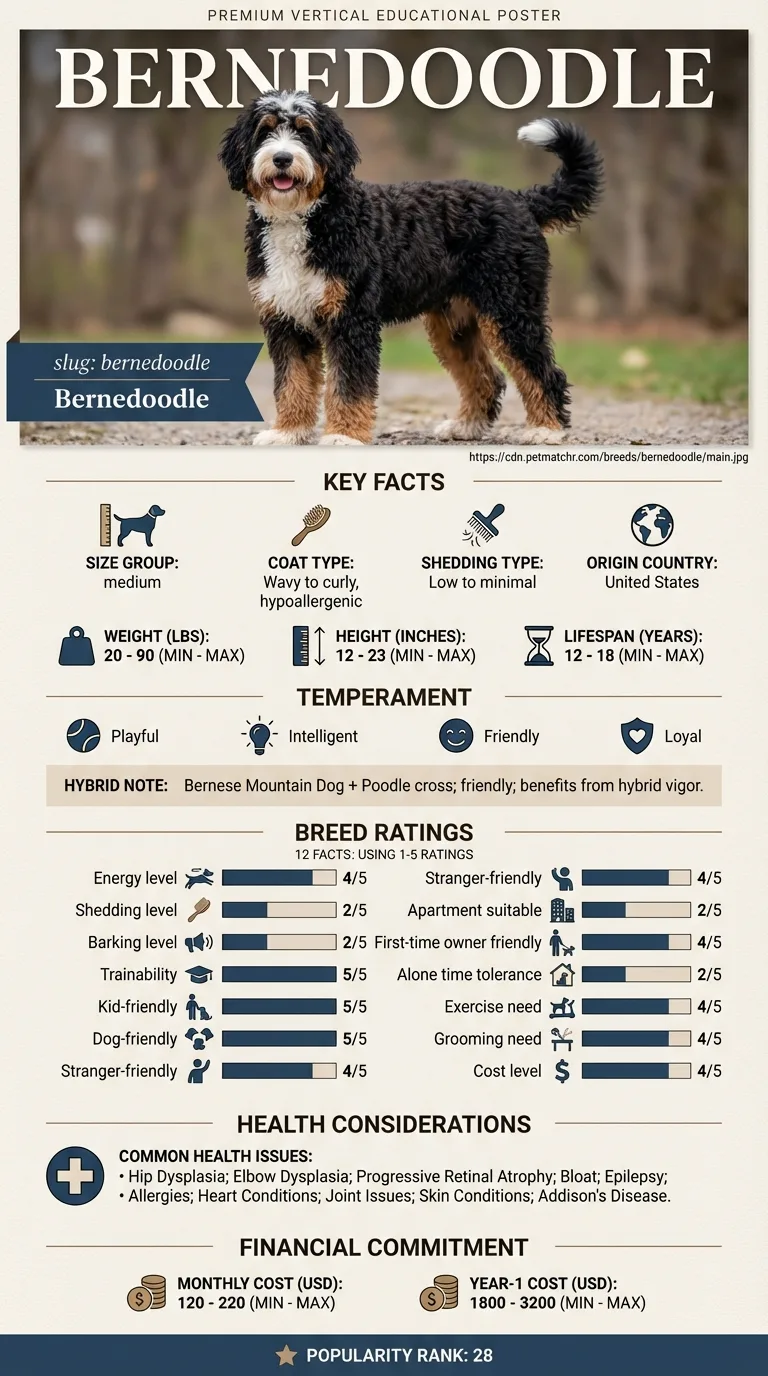
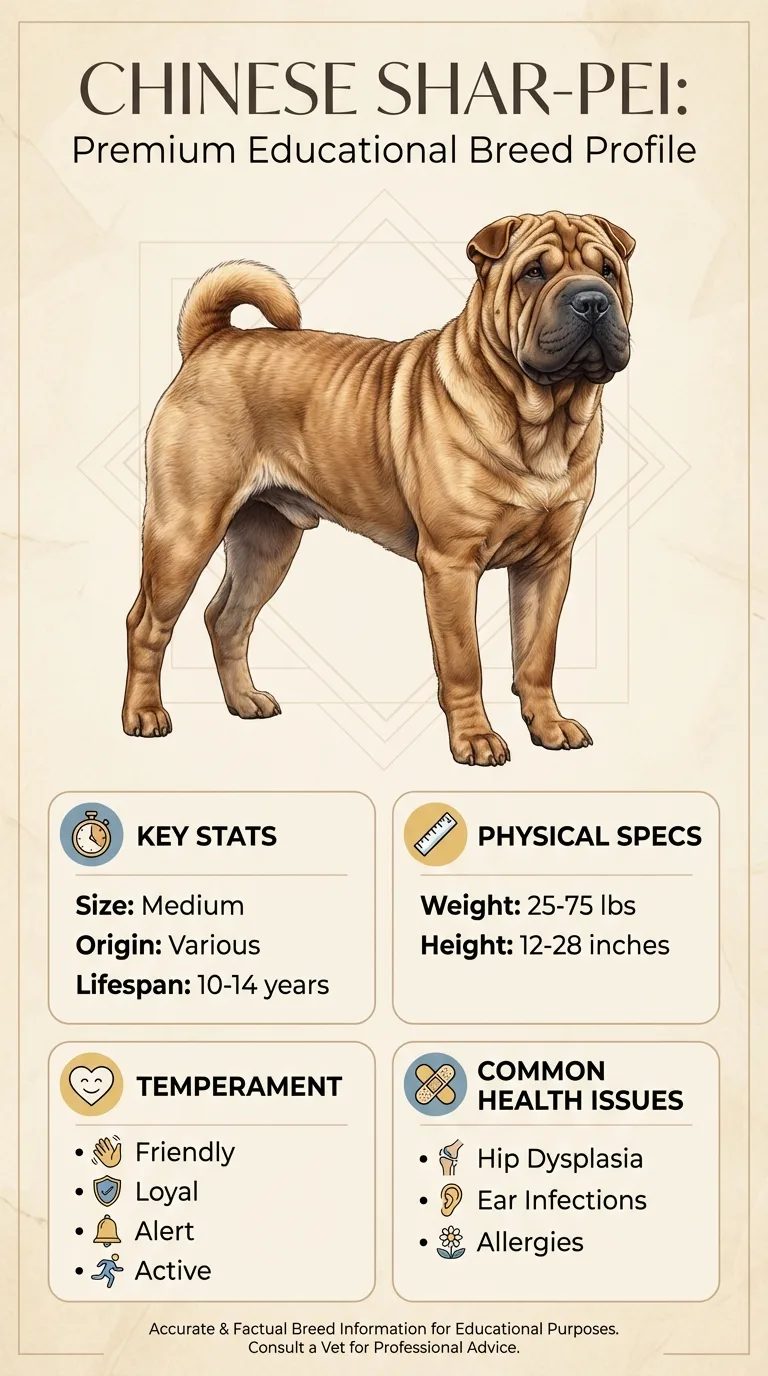
This is for someone already down to Bernedoodle and Chinese Shar-Pei and deciding between them. For this pair the decision usually turns on trainability and good with other dogs, so those are covered first and in most detail. Anyone choosing from a flat has a clear answer here: Chinese Shar-Pei rates 4/5 against 2/5. There is no origin story here — only what changes about your week.
Between Bernedoodle and Chinese Shar-Pei, trainability is what separates them, and Chinese Shar-Pei is the lower-effort dog of the two to keep.
Choose Bernedoodle if this is your first dog, there are young children at home and you already have another dog.
Choose Chinese Shar-Pei if you are in a flat or a smaller home, you do not want a standing grooming appointment and your walking routine is modest.
| Feature | bernedoodle | chinese shar pei | Winner |
|---|---|---|---|
| Size class | medium | medium | Equal |
| Weight | 20–90 lbs | 45–60 lbs | Equal |
| Height | 12–23 in | 18–20 in | Equal |
| Lifespan | 12–18 years | 8–12 years | bernedoodle |
| Exercise need | High (4/5) | Low (2/5) | chinese shar pei |
| Grooming need | High (4/5) | Low (2/5) | chinese shar pei |
| Shedding | Low (2/5) | Low (2/5) | Equal |
| Energy level | High (4/5) | Low (2/5) | Equal |
| Barking | Low (2/5) | Low (2/5) | Equal |
| Apartment suitability | Low (2/5) | High (4/5) | chinese shar pei |
| Good for first-time owners | High (4/5) | Low (2/5) | bernedoodle |
| Tolerates being alone | Low (2/5) | Moderate (3/5) | chinese shar pei |
| Trainability | Very high (5/5) | Low (2/5) | bernedoodle |
| Good with kids | Very high (5/5) | Moderate (3/5) | bernedoodle |
| Good with other dogs | Very high (5/5) | Low (2/5) | bernedoodle |
| Friendly to strangers | High (4/5) | Low (2/5) | bernedoodle |
| Cost level | High (4/5) | High (4/5) | Equal |
| Coat | Wavy to curly, hypoallergenic | Short and harsh | Equal |
| Origin | United States | Various | Equal |
| Typical monthly cost | $120–$220 | $100–$200 | Equal |
| Typical first-year cost | $1,800–$3,200 | $1,400–$2,900 | Equal |
Both breeds land in the medium class, though their numbers don't overlap much: the Shar-Pei holds a tighter 45-60 lb, 18-20 inch range, while the Bernedoodle's 20-90 lb, 12-23 inch spread runs both well below and well above it depending on which version you get. A standard Bernedoodle and a Shar-Pei could end up close in weight; a mini Bernedoodle would be a fraction of the size.
The Shar-Pei is the more laid-back of the two -- 2/5 exercise need against the Bernedoodle's 4/5. Shar-Peis are known for a calmer, more independent disposition that doesn't demand constant activity. If your schedule doesn't leave much room for daily exercise, the Shar-Pei's numbers fit that reality better than the Bernedoodle's do.
This is a rare category where the Bernedoodle isn't the higher-maintenance option: the Shar-Pei's short coat needs little grooming (2/5) against the Bernedoodle's 4/5, and shedding ties at 2/5 low for both. That's despite the Shar-Pei's distinctive wrinkled skin, which needs its own attention -- cleaning folds to prevent irritation -- that a simple grooming-need score doesn't fully capture.
The Shar-Pei suits smaller spaces better -- 4/5 apartment suitability against the Bernedoodle's 2/5 -- largely a function of its lower exercise needs. Both breeds bark rarely, tying at 2/5. The Shar-Pei also tolerates alone time a bit better (3/5 vs 2/5), consistent with its more independent, reserved temperament compared to the Bernedoodle's people-oriented nature.
The Bernedoodle rates far higher for new owners -- 4/5 vs 2/5 -- and the trainability gap is even wider, 5/5 vs 2/5. Shar-Peis are intelligent but independent and can be stubborn, traits that make them a better match for an owner with prior dog-training experience than for someone starting out. This is one of the more lopsided categories in the whole comparison.
The Bernedoodle leads clearly: kids (5/5 vs 3/5), other dogs (5/5 vs 2/5), and strangers (4/5 vs 2/5). Shar-Peis were originally bred partly for guarding and tend toward a reserved, watchful nature around unfamiliar people and dogs -- not unfriendly, just more selective with affection than the Bernedoodle's easygoing default.
The Bernedoodle lives longer on average -- 12-18 years versus 8-12 for the Shar-Pei. The Shar-Pei's health list is short but distinctive: skin fold dermatitis and Familial Shar-Pei Fever are essentially breed-specific conditions tied to its wrinkled skin, alongside entropion, hypothyroidism, and ear infections. Five conditions total, versus the Bernedoodle's ten, but concentrated in areas that need ongoing attention specific to the breed's structure.
Monthly and first-year costs run close -- $100-200 vs $120-220 monthly, $1,400-2,900 vs $1,800-3,200 first-year -- with both breeds tied at 4/5 overall cost level. The Shar-Pei's savings on grooming and exercise-related gear get offset by skin fold care and monitoring for Familial Shar-Pei Fever, keeping the two breeds closer in total cost than their coat difference alone would suggest.
Bernedoodle weighs 20–90 lbs and lives 12–18 years; Chinese Shar-Pei weighs 45–60 lbs and lives 8–12 years. The two diverge most on trainability, good with other dogs and exercise need and 6 other rated axes. They are level on barking, cost level and shedding, so those cannot decide it. Where the table declares a winner it means less work for the owner, nothing more; descriptive rows are left as ties on purpose. The value here is in the differences between the two columns; treat any single score as approximate.

The Shar-Pei, rated 2/5 against the Bernedoodle's 4/5. Shar-Peis have a naturally calmer, more independent disposition that doesn't call for heavy daily activity.
The Shar-Pei's short coat rates 2/5 for grooming need, well below the Bernedoodle's 4/5. That said, its skin folds need their own regular cleaning that a coat-focused score doesn't capture.
Not according to the data -- it rates just 2/5 for both first-time-owner suitability and trainability. Its independent streak makes it a better match for an experienced owner.
The Bernedoodle, at 12-18 years against the Shar-Pei's 8-12.
Familial Shar-Pei Fever and skin fold dermatitis are essentially specific to the breed's wrinkled skin structure, alongside entropion, hypothyroidism, and ear infections.
The Shar-Pei, rated 4/5 for apartment suitability against the Bernedoodle's 2/5, largely because of its lower exercise requirements.
They're close -- $100-200 monthly for the Shar-Pei versus $120-220 for the Bernedoodle -- despite the Shar-Pei needing far less grooming, since skin fold care adds its own cost.
For a calmer household with less time for daily exercise, the Shar-Pei fits better; for a trainable, social family dog, the Bernedoodle's numbers are stronger.
Close -- $100-200 for the Shar-Pei, $120-220 for the Bernedoodle.
Bernedoodle 4/5, Shar-Pei 2/5 -- a clear, wide gap.
Bernedoodle 12-18 years, Shar-Pei 8-12.
Secure checkout on Stripe. We never see your card.
7-day money-back guarantee. Instant access.
Health information here is general and is not veterinary advice. If your dog shows pain, sudden behaviour change, or worsening symptoms, consult a licensed veterinarian.
Some links on this site are affiliate links. We may earn a commission at no extra cost to you, and we only suggest products we believe are helpful for dog owners.
We research and check what we publish, but we do not warrant that any figure, date, price, or statement is accurate, complete, or current, and we accept no liability for any loss, cost, injury, or other harm arising from the use of this site. Use it as one reference among several. You remain responsible for your own decisions and for your dog's care - confirm anything that matters with a licensed veterinarian or another qualified professional before you act on it. Full disclaimer.
Match your lifestyle to the right dog.
Take quizNot sure which breed is right for you? Take our 2-minute quiz to find out.
Take the quiz