Living
Which breed fits most households better?
The Shiba Inu for apartment or lower-activity households - smaller, more apartment-suited, and cheaper - though its independence makes training a real project either way.

Quick answer
Which breed fits most households better?
The Shiba Inu for apartment or lower-activity households - smaller, more apartment-suited, and cheaper - though its independence makes training a real project either way.
Belgian Malinois or Shiba Inu? On paper they differ most on apartment suitability, and on the scales Belgian Malinois is the heavier at 55–65 lbs. Here is how the two compare on everything that shapes an ordinary week.
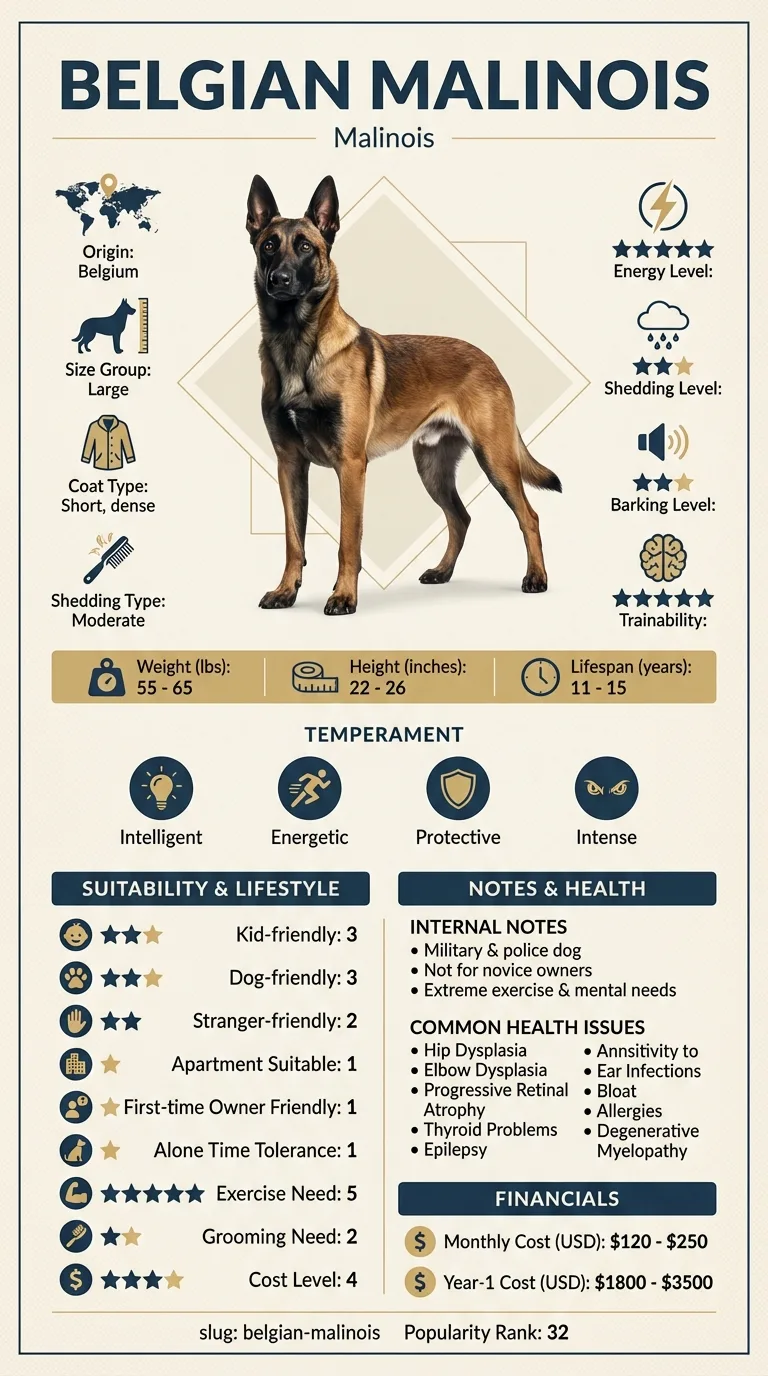
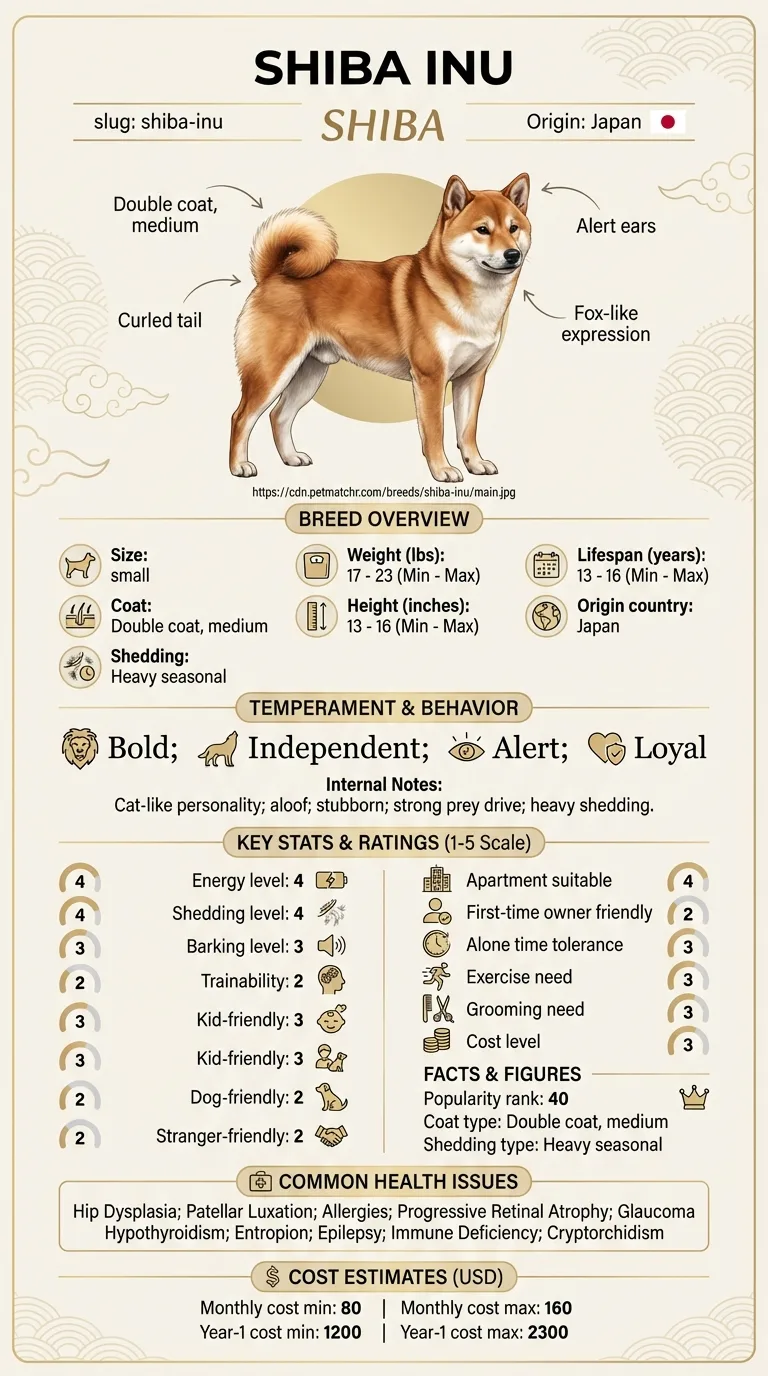
This is for someone already down to Belgian Malinois and Shiba Inu and deciding between them. For this pair the decision usually turns on apartment suitability and trainability, so those are covered first and in most detail. Anyone choosing from a flat has a clear answer here: Shiba Inu rates 4/5 against 1/5. Breed history is left out; what follows is what you will actually live with.
Between Belgian Malinois and Shiba Inu, apartment suitability is what separates them, and Shiba Inu is the lower-effort dog of the two to keep.
Choose Belgian Malinois if you do not want a standing grooming appointment, shedding is a problem in your house and you already have another dog.
Choose Shiba Inu if you are in a flat or a smaller home, your walking routine is modest and the dog will be alone during the working day.
| Feature | belgian malinois | shiba inu | Winner |
|---|---|---|---|
| Size class | large | small | Equal |
| Weight | 55–65 lbs | 17–23 lbs | Equal |
| Height | 22–26 in | 13–16 in | Equal |
| Lifespan | 11–15 years | 13–16 years | shiba inu |
| Exercise need | Very high (5/5) | Moderate (3/5) | shiba inu |
| Grooming need | Low (2/5) | Moderate (3/5) | belgian malinois |
| Shedding | Moderate (3/5) | High (4/5) | belgian malinois |
| Energy level | Very high (5/5) | High (4/5) | Equal |
| Barking | Moderate (3/5) | Moderate (3/5) | Equal |
| Apartment suitability | Very low (1/5) | High (4/5) | shiba inu |
| Good for first-time owners | Very low (1/5) | Low (2/5) | shiba inu |
| Tolerates being alone | Very low (1/5) | Moderate (3/5) | shiba inu |
| Trainability | Very high (5/5) | Low (2/5) | belgian malinois |
| Good with kids | Moderate (3/5) | Moderate (3/5) | Equal |
| Good with other dogs | Moderate (3/5) | Low (2/5) | belgian malinois |
| Friendly to strangers | Low (2/5) | Low (2/5) | Equal |
| Cost level | High (4/5) | Moderate (3/5) | shiba inu |
| Coat | Short, dense | Double coat, medium | Equal |
| Origin | Belgium | Japan | Equal |
| Typical monthly cost | $120–$250 | $80–$160 | Equal |
| Typical first-year cost | $1,800–$3,500 | $1,200–$2,300 | Equal |
Weight-wise, the Shiba Inu (17-23 lbs, 13-16 inches) is well under the Malinois's 55-65 lbs and 22-26. Don't let the compact frame fool you about temperament, though; the Shiba's independent streak is famous well beyond its size class, closer in attitude to a much bigger, more willful dog. Physically, though, it's an easy dog to lift, carry, or travel with compared to the Malinois.
The Shiba rates a moderate 3/5 on exercise need, two full points below the Malinois's 5/5 - it's an active breed but not a demanding one, content with solid daily walks rather than structured work sessions. This is one of the larger exercise gaps in this comparison set, and it matters for anyone weighing how much daily time they actually have.
The Malinois needs less grooming overall, 2/5 against the Shiba's moderate 3/5, and sheds less too - 3/5 versus the Shiba's high 4/5. Shibas are famous for two intense seasonal coat blows a year on top of steady year-round shedding, something owners coming from short-coated breeds are often unprepared for. A high-velocity dryer or dedicated deshedding tool makes those blowout weeks far more manageable.
Both breeds tie on barking (moderate, 3/5), but the Shiba is far better suited to small spaces overall - 4/5 for apartments against the Malinois's 1/5. Alone-time tolerance also favors the Shiba, a moderate 3/5 versus the Malinois's rock-bottom 1/5, making it the more realistic choice for anyone working a standard office schedule. Crate training still helps either dog settle during the workday.
This is the widest trainability gap in the batch: the Malinois rates 5/5, the Shiba just 2/5, low on this site's scale. Shibas are intelligent but notoriously independent-minded, often described as cat-like in their willingness to ignore a command they've decided isn't worth following. First-time-owner scores are close regardless (2/5 for the Shiba, 1/5 for the Malinois) - neither is an easy beginner pick, just for different reasons.
Kids and strangers rate as ties (moderate, 3/5, and low, 2/5, respectively), but the Malinois actually does better with other dogs - 3/5 against the Shiba's low 2/5. Shibas are known for same-sex aggression and general standoffishness with unfamiliar dogs, a trait that shows up clearly in this score despite the breed's popularity as a companion. A careful, slow introduction matters more than usual before adding a second dog to a Shiba household.
The Shiba lives slightly longer on average, 13-16 years against the Malinois's 11-15. Shared risks include hip dysplasia, progressive retinal atrophy, allergies, and epilepsy. The Shiba's remaining list leans toward eye conditions like glaucoma and entropion, plus immune deficiency risk; the Malinois carries more structural and working-dog concerns like elbow dysplasia and degenerative myelopathy. Routine eye checks are worth building into a Shiba's regular vet visits.
The Shiba is cheaper to keep, rating 3/5 (moderate) against the Malinois's 4/5 (high) - $80-160 monthly versus $120-250, and $1,200-2,300 in the first year versus $1,800-3,500. Its smaller size and lower activity needs both work in its favor here. That gap is one of the more meaningful cost differences in this batch of comparisons over a full year, and it grows further once training expenses for the Malinois are added in.
Belgian Malinois weighs 55–65 lbs and lives 11–15 years; Shiba Inu weighs 17–23 lbs and lives 13–16 years. The two diverge most on apartment suitability, trainability and exercise need and 1 other rated axes. They are level on barking, good with kids and friendly to strangers, so those cannot decide it. The comparison marks an easier option only where one exists. Facts like weight and country of origin are not scored. Both dogs are rated from the same dataset, which is what makes the numbers comparable with each other even though any individual dog sits somewhere inside its breed's range.

Considerably - 17-23 lbs and 13-16 inches against the Malinois's 55-65 lbs and 22-26 inches, less than half the weight at either end of the range.
The Malinois, by a wide margin - it rates 5/5 against the Shiba's 2/5, the largest trainability gap in this batch. Shibas are intelligent but famously independent, more likely to ignore a command than a Malinois would.
Not really, though the Shiba edges out slightly - 2/5 versus the Malinois's 1/5. The Shiba's independence and the Malinois's intensity both present real challenges for someone new to dog ownership.
The Shiba, rated high (4/5) against the Malinois's moderate (3/5) - Shibas are known for two intense seasonal coat blows a year layered on top of regular shedding.
The Shiba runs cheaper - $80-160 versus $120-250 for the Malinois, a gap of roughly $600 across a typical first year.
Some - hip dysplasia, progressive retinal atrophy, allergies, and epilepsy appear on both lists. The Shiba's list additionally includes glaucoma, entropion, and immune deficiency risk; the Malinois adds elbow dysplasia and degenerative myelopathy.
The Malinois, somewhat unexpectedly - it rates 3/5 against the Shiba's low 2/5. Shibas are known for same-sex aggression and general reserve around unfamiliar dogs.
The Shiba Inu for apartment or lower-activity households - smaller, more apartment-suited, and cheaper - though its independence makes training a real project either way.
Meaningfully - $80-160 versus $120-250 for the Malinois, roughly $600 less over a typical first year.
The Malinois, rated 5/5 against the Shiba's moderate 3/5 - one of the wider exercise gaps in this comparison set.
The Shiba Inu, at 13-16 years versus 11-15 for the Malinois, a modest edge favoring the smaller breed.
Secure checkout on Stripe. We never see your card.
7-day money-back guarantee. Instant access.
Health information here is general and is not veterinary advice. If your dog shows pain, sudden behaviour change, or worsening symptoms, consult a licensed veterinarian.
Some links on this site are affiliate links. We may earn a commission at no extra cost to you, and we only suggest products we believe are helpful for dog owners.
We research and check what we publish, but we do not warrant that any figure, date, price, or statement is accurate, complete, or current, and we accept no liability for any loss, cost, injury, or other harm arising from the use of this site. Use it as one reference among several. You remain responsible for your own decisions and for your dog's care - confirm anything that matters with a licensed veterinarian or another qualified professional before you act on it. Full disclaimer.
Match your lifestyle to the right dog.
Take quizNot sure which breed is right for you? Take our 2-minute quiz to find out.
Take the quiz