Living
Malinois or Pomeranian for most households?
The Pomeranian, moderate first-time-owner fit (3/5) and very high apartment suitability (5/5) against the Malinois's 1/5 on both.

Quick answer
Malinois or Pomeranian for most households?
The Pomeranian, moderate first-time-owner fit (3/5) and very high apartment suitability (5/5) against the Malinois's 1/5 on both.
Belgian Malinois or Pomeranian? On paper they differ most on apartment suitability, and on the scales Belgian Malinois is the heavier at 55–65 lbs. Here is how the two compare on everything that shapes an ordinary week.
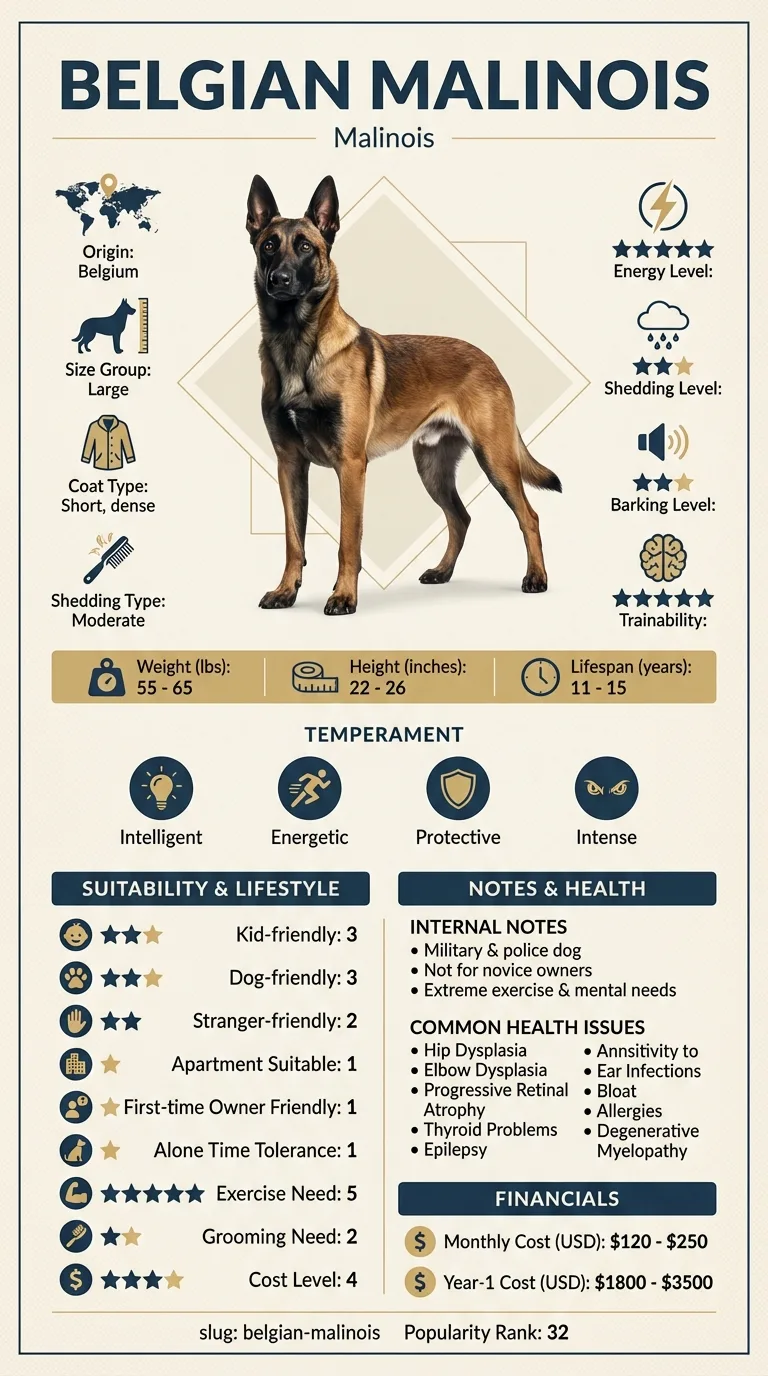
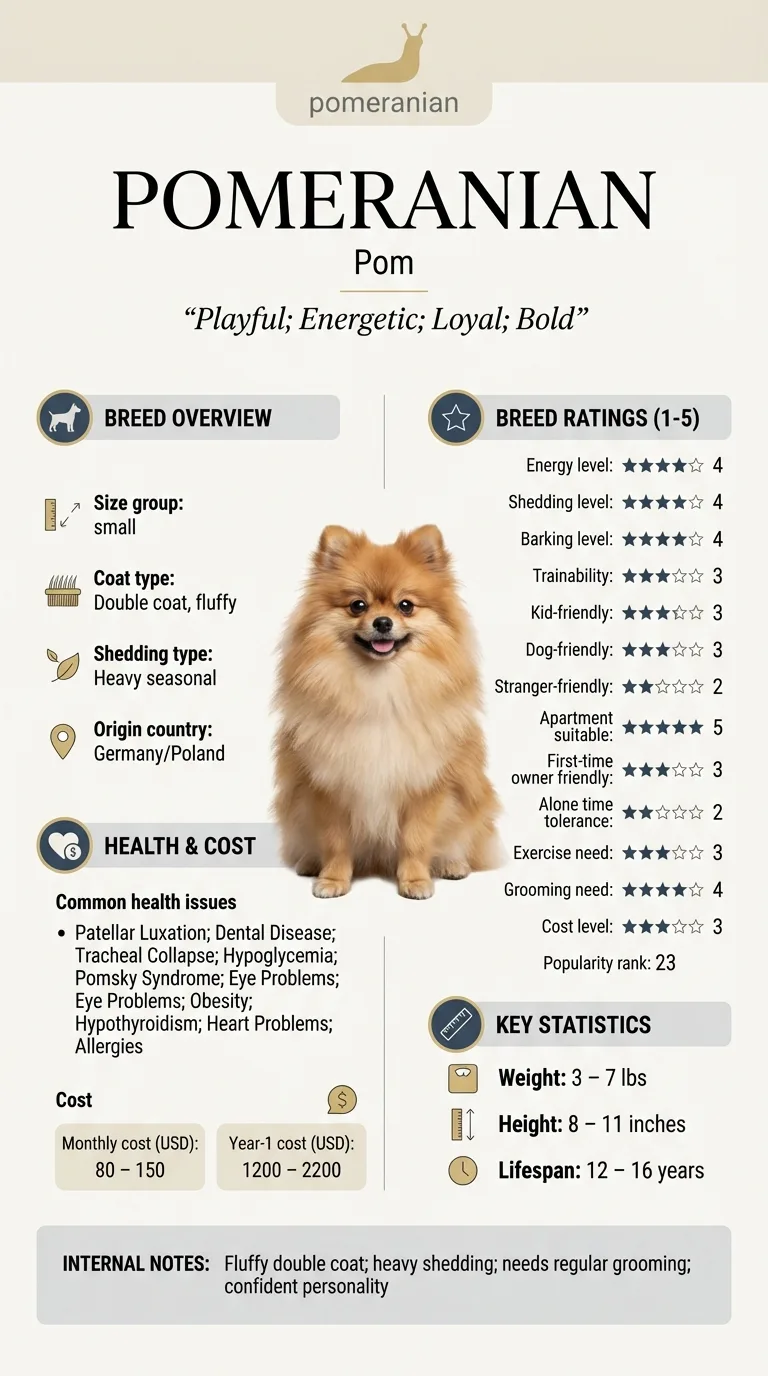
This is for someone already down to Belgian Malinois and Pomeranian and deciding between them. For this pair the decision usually turns on apartment suitability and exercise need, so those are covered first and in most detail. Anyone choosing from a flat has a clear answer here: Pomeranian rates 5/5 against 1/5. It is written for the decision rather than the breed history.
Between Belgian Malinois and Pomeranian, apartment suitability is what separates them, and Pomeranian is the lower-effort dog of the two to keep.
Choose Belgian Malinois if you do not want a standing grooming appointment, shedding is a problem in your house and you want a dog that picks up training quickly.
Choose Pomeranian if you are in a flat or a smaller home, this is your first dog and your walking routine is modest.
| Feature | belgian malinois | pomeranian | Winner |
|---|---|---|---|
| Size class | large | small | Equal |
| Weight | 55–65 lbs | 3–7 lbs | Equal |
| Height | 22–26 in | 8–11 in | Equal |
| Lifespan | 11–15 years | 12–16 years | pomeranian |
| Exercise need | Very high (5/5) | Moderate (3/5) | pomeranian |
| Grooming need | Low (2/5) | High (4/5) | belgian malinois |
| Shedding | Moderate (3/5) | High (4/5) | belgian malinois |
| Energy level | Very high (5/5) | High (4/5) | Equal |
| Barking | Moderate (3/5) | High (4/5) | belgian malinois |
| Apartment suitability | Very low (1/5) | Very high (5/5) | pomeranian |
| Good for first-time owners | Very low (1/5) | Moderate (3/5) | pomeranian |
| Tolerates being alone | Very low (1/5) | Low (2/5) | pomeranian |
| Trainability | Very high (5/5) | Moderate (3/5) | belgian malinois |
| Good with kids | Moderate (3/5) | Moderate (3/5) | Equal |
| Good with other dogs | Moderate (3/5) | Moderate (3/5) | Equal |
| Friendly to strangers | Low (2/5) | Low (2/5) | Equal |
| Cost level | High (4/5) | Moderate (3/5) | pomeranian |
| Coat | Short, dense | Double coat, fluffy | Equal |
| Origin | Belgium | Germany/Poland | Equal |
| Typical monthly cost | $120–$250 | $80–$150 | Equal |
| Typical first-year cost | $1,800–$3,500 | $1,200–$2,200 | Equal |
The Pomeranian is tiny, 3-7 lbs, 8-11 inches, a fraction of the Malinois's 55-65 lbs and 22-26 inch frame. Its fluffy double coat makes it look bigger than it actually is; underneath the fur is a very small dog. Once you get past the fur, a Pomeranian's actual body is closer in scale to a large housecat than to a dog like the Malinois, worth remembering when picking gear like crates and carriers.
The Malinois needs considerably more structured exercise (5/5 vs the Pomeranian's moderate 3/5), though energy levels are closer than you'd guess, high (4/5) for the Pomeranian against the Malinois's very high (5/5). Pomeranians are known for being busy little dogs, just not ones that need miles of walking to burn it off. Structured play and short bursts of activity throughout the day suit a Pomeranian well, a very different rhythm from the sustained daily exercise sessions a Malinois genuinely requires.
Don't assume small means low-maintenance here. The Pomeranian rates high for both grooming (4/5) and shedding (4/5) thanks to its thick double coat, actually more work on both fronts than the Malinois's 2/5 grooming and 3/5 shedding. It's one of the few small breeds in this batch that isn't the easier-care option. Budget for a grooming appointment every few weeks if you're not comfortable brushing out a double coat yourself, since matting sets in fast once maintenance lapses.
The Pomeranian also barks more (high, 4/5) than the Malinois (moderate, 3/5), small and vocal is a real combination here, not a myth. It's still the far better apartment prospect overall, rating very high (5/5) against the Malinois's very low (1/5), though it only tolerates being alone slightly better (2/5 vs 1/5). If a building has strict noise rules, don't assume the Pomeranian is automatically the safer bet just because it's small; ask about bark-training resources first.
The Malinois trains higher (5/5 vs the Pomeranian's moderate 3/5), but for a new owner the Pomeranian is the safer bet, moderate (3/5) for first-timers against the Malinois's very low (1/5). Pomeranians can be stubborn in training sessions, part of why their score sits at moderate rather than high despite the breed's intelligence. Consistency and short, upbeat sessions tend to work best with a Pomeranian, a different approach than the structured, high-drive training a Malinois typically needs.
Kids, other dogs, and strangers all tie at similar or matching levels, moderate 3/5 with kids for both, moderate 3/5 with other dogs for both, and low 2/5 with strangers for both. This is one of the more evenly matched household-fit comparisons in this batch, unusual given how different the two breeds otherwise are. That similarity is one of the more useful data points here, since it means the household-fit decision really comes down to the size, grooming, and apartment factors covered elsewhere.
The Pomeranian can live up to 16 years, edging out the Malinois's 11-15 range. Health-wise the lists barely intersect, only allergies overlap, while the Pomeranian carries its own risks like tracheal collapse, patellar luxation, and hypoglycemia, all fairly typical for a toy breed this size. Ask a breeder about luxating patellas specifically if you're considering a Pomeranian, since it's one of the more common orthopedic issues reported in the breed.
The Pomeranian is cheaper to keep, moderate cost (3/5) against the Malinois's high (4/5), $80-$150 monthly versus $120-$250, and a first-year ceiling of $2,200 against $3,500. Even with its above-average grooming needs, its overall bills stay well below the Malinois's. Even accounting for its higher grooming costs, a Pomeranian's smaller size keeps food and medication costs well below what a 55-65 lb dog like the Malinois requires.
Belgian Malinois weighs 55–65 lbs and lives 11–15 years; Pomeranian weighs 3–7 lbs and lives 12–16 years. The two diverge most on apartment suitability, exercise need and grooming need and 2 other rated axes. They are level on good with other dogs, good with kids and friendly to strangers, so those cannot decide it. In the table, a "winner" means easier for an ordinary household — not better. Size, coat and origin are recorded without a verdict. Because both breeds are scored the same way, the gaps are reliable even where the absolute numbers are rough.

Less than you'd think. It rates high for both grooming (4/5) and shedding (4/5), more upkeep on both fronts than the Malinois's 2/5 and 3/5.
The Pomeranian, rated high (4/5) against the Malinois's moderate (3/5), small size doesn't mean quiet here.
The Pomeranian, up to 16 years against the Malinois's 11-15. That's on the longer end for a small breed of its size.
Better than the Malinois, moderate (3/5) for first-timers against the Malinois's very low (1/5), though it's not rated as easy as some other small breeds in this comparison set.
The Pomeranian, clearly, $80-$150 a month against the Malinois's $120-$250. That's despite its above-average grooming needs for a small dog.
Barely, only allergies overlap. The Pomeranian's other risks, like tracheal collapse and hypoglycemia, are unrelated to anything on the Malinois's list.
More than expected. Both rate moderate (3/5) with kids and low (2/5) with strangers, one of the more evenly matched pairings in this comparison set.
The Pomeranian, moderate first-time-owner fit (3/5) and very high apartment suitability (5/5) against the Malinois's 1/5 on both.
About $40-$100 less for the Pomeranian ($80-$150 vs $120-$250).
The Malinois, 5/5 versus the Pomeranian's moderate 3/5.
The Pomeranian, up to 16 years against the Malinois's 11-15. That's on the longer end for a small breed of its size.
Secure checkout on Stripe. We never see your card.
7-day money-back guarantee. Instant access.
Health information here is general and is not veterinary advice. If your dog shows pain, sudden behaviour change, or worsening symptoms, consult a licensed veterinarian.
Some links on this site are affiliate links. We may earn a commission at no extra cost to you, and we only suggest products we believe are helpful for dog owners.
We research and check what we publish, but we do not warrant that any figure, date, price, or statement is accurate, complete, or current, and we accept no liability for any loss, cost, injury, or other harm arising from the use of this site. Use it as one reference among several. You remain responsible for your own decisions and for your dog's care - confirm anything that matters with a licensed veterinarian or another qualified professional before you act on it. Full disclaimer.
Match your lifestyle to the right dog.
Take quizNot sure which breed is right for you? Take our 2-minute quiz to find out.
Take the quiz