DogBreedCompass

Pit Bull or Cane Corso: Difficult With Dogs, or With People

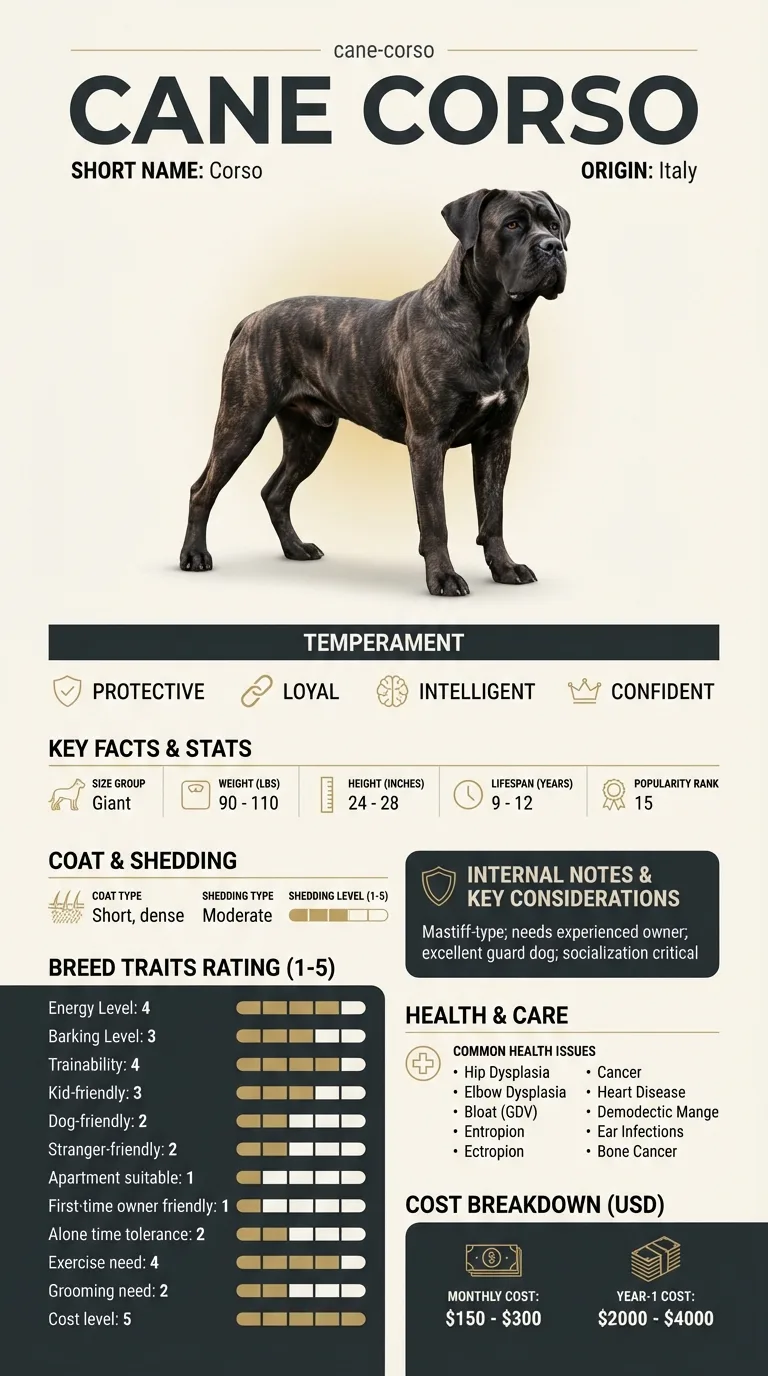
Both breeds rate 2/5 with other dogs. The Cane Corso adds a 2/5 with strangers, a 1/5 for first-time owners and up to 110 pounds of body weight, and its own notes call socialisation critical.

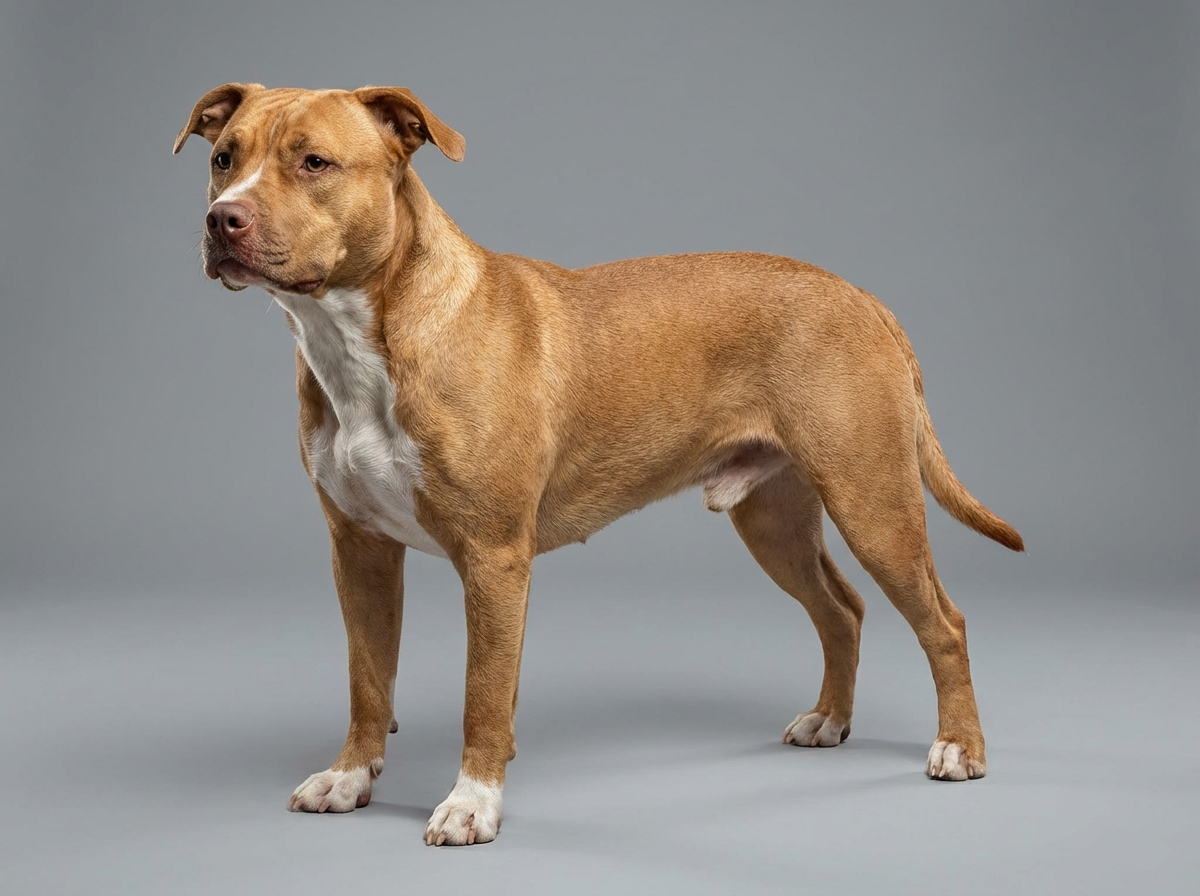
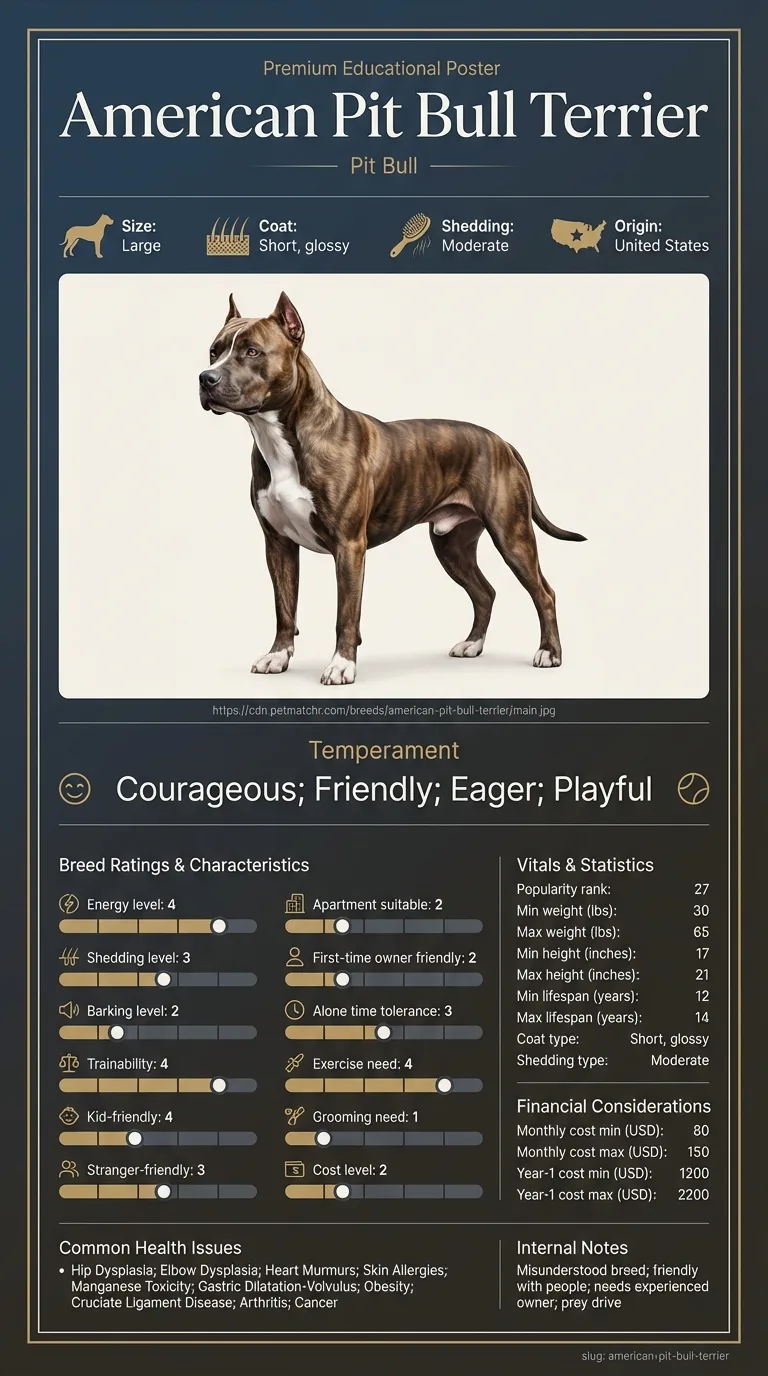
american pit bull terrier infographic
cane corso infographic

This page is for someone considering a serious guardian breed, and needing an honest account of what a 2/5 stranger rating on a 110 pound dog demands from an owner.

Quick verdict

The Corso is a genuine guardian requiring experience, structure and lifelong management, while the Pit Bull is a people-friendly dog whose one hard requirement is careful handling around other dogs.

Choose american pit bull terrier if...

Choose the American Pit Bull Terrier if you want an athletic, affordable, long-lived dog that is warm with people, and you can manage dog-dog introductions and check the restrictions that apply to bully-type breeds.

Choose cane corso if...

Choose the Cane Corso only if you have prior experience with guardian breeds, you will commit to structured socialisation through the first two years and management afterwards, and you can carry 5/5 running costs.

Head-to-head comparison

Featureamerican pit bull terriercane corsoWinner
Weight30–65 lbs90–110 lbsamerican pit bull terrier
Height17–21 in24–28 inamerican pit bull terrier
Lifespan12–14 years9–12 yearsamerican pit bull terrier
CoatShort, glossyShort, denseEqual
Grooming need1/52/5american pit bull terrier
Shedding3/5 — moderate3/5 — moderateEqual
Energy level4/54/5Equal
Exercise need4/54/5Equal
Trainability4/54/5Equal
Barking2/53/5american pit bull terrier
Good with kids4/53/5american pit bull terrier
Good with other dogs2/52/5Equal
Friendly to strangers3/52/5american pit bull terrier
Apartment suitability2/51/5american pit bull terrier
Good for first-time owners2/51/5american pit bull terrier
Tolerates being alone3/52/5american pit bull terrier
Typical monthly cost$80–150$150–300american pit bull terrier
Typical first-year cost$1,200–2,200$2,000–4,000american pit bull terrier

Deep dive

Difficult with dogs and difficult with people are not the same problem

Both breeds rate 2/5 with other dogs, and it is tempting to read that as the same trait. It is not, and the distinction matters more than any other on this page.

The Pit Bull's difficulty is species-specific. It is typically warm and open with people — 4/5 with children, 3/5 with strangers, described as courageous, friendly, eager and playful — and its issue is other dogs. That is a manageable problem because it is predictable: you control which dogs your dog meets, and you can plan every walk around it. No dog parks, no on-lead greetings with unknown dogs, introductions on neutral ground with a handler at each end, quieter walking times.

The Cane Corso has that same dog-dog rating plus a 2/5 with strangers, and a stranger rating cannot be planned around in the same way. People are everywhere. A delivery driver comes to the door, a child runs past a garden fence, a friend arrives unannounced. A guardian breed's reserve is functional — it watches, it positions itself, it does not greet — and in a well-bred, well-socialised Corso that reserve is stable and clear-headed rather than jumpy. In an under-socialised one it becomes suspicion, then reactivity, and it is attached to a 110 pound dog.

That is why the breed's own notes call socialisation critical and rate it 1/5 for first-time owners. The work required is structured and extensive: deliberate, repeated, positive exposure to unfamiliar people, environments, surfaces, vehicles and noises through the first two years, with real attention to keeping arousal low, and honest management afterwards.

Loose-lead training is a safety requirement rather than a nicety in this breed. A dog that outweighs its handler and has not learned to walk politely is a dog that eventually cannot be walked at all.

Both breeds also sit on restriction lists in some jurisdictions and insurance schedules. Check the rules where you live and where you might move, in writing, before committing to either.

Cost level 5/5 against 2/5

The Corso is one of the most expensive dogs on this site to keep and the Pit Bull is one of the cheapest: $150–300 a month against $80–150, and a first year of $2,000–4,000 against $1,200–2,200.

Food accounts for part of it — a 100 pound dog eats a great deal, and a giant-breed puppy needs a formulation with controlled calcium for the first eighteen months. The rest is weight-based veterinary pricing. Anaesthesia, sedation, antibiotics, pain relief and parasite prevention are all dosed by kilogram, so every routine event costs proportionally more. A dental, a lump removal or a course of anti-inflammatories on a Corso is simply a larger bill than the same job on a Pit Bull.

Equipment steps up too: crates, beds, a car ramp, a strong harness and lead, and boarding fees where kennels accept the breed at all.

Insurance is where the two diverge in kind rather than degree. Corso premiums reflect size, orthopaedic risk and cancer. Pit Bull premiums reflect breed restrictions — the issue is often whether cover is available at all rather than what it costs.

The cheapest thing either owner can do is keep the dog lean. It protects the joints in both breeds, reduces cruciate risk in the Pit Bull, and reduces the load on a giant frame in the Corso.

One more figure belongs here: lifespan. The Corso's 9 to 12 years against the Pit Bull's 12 to 14 means the higher running cost is compressed into fewer years, and giant-breed veterinary spending concentrates in the last two.

Mange, eyelids and the giant-breed pattern

The Corso's health list runs hip dysplasia, elbow dysplasia, bloat, entropion, ectropion, cancer, heart disease, demodectic mange, ear infections and bone cancer.

Demodectic mange is the entry worth understanding, because it is easy to misread. Demodex mites live on almost every dog's skin harmlessly; disease occurs when the immune system fails to keep them in check. A small localised patch of hair loss on a puppy's face is common and usually self-resolving. Generalised demodicosis — widespread hair loss, crusting, secondary bacterial infection and thickened skin — is a different matter and points to an underlying immune weakness. In a young dog it has a hereditary component, which makes it a legitimate breeder question, and affected dogs should not be bred from.

Entropion and ectropion sit together, which is unusual. Entropion is an eyelid rolling inward so lashes rub the cornea; ectropion is a lid rolling outward, leaving the eye exposed and prone to irritation. Loose facial skin makes both more likely, and severe cases of either are corrected surgically. Persistent squinting, weeping or rubbing at an eye deserves attention.

Bloat is the acute emergency, as with any deep-chested giant. Split meals, quiet time around eating, a slow-feeder bowl if needed, and knowing the out-of-hours route in advance. Prophylactic gastropexy is a reasonable conversation with a vet.

Bone cancer appears separately from cancer, and the practical rule follows: a limp in a large-breed dog that has not resolved in a week or two is a radiograph, not more rest.

The Pit Bull's list is lighter at the top: hip and elbow dysplasia, skin allergies, heart murmurs, bloat, obesity, cruciate ligament disease, arthritis and cancer. Skin allergies are its most common day-to-day complaint.

Two 4/5 dogs, and why one is still much harder

Both breeds rate 4/5 for trainability and 4/5 for exercise, which makes the 1/5 against 2/5 for beginners look inconsistent until you look at what the training is for.

With a Pit Bull, training is mostly about building a reliable recall, a solid leave-it and good lead manners, and then using those tools to manage encounters with other dogs. It is a responsive, handler-oriented breed that enjoys structured work — obedience, weight pull, agility, scent work — and an hour to ninety minutes of activity plus a training session leaves it settled.

With a Corso, training is about establishing a consistent structure that a powerful territorial dog can rely on. The breed is intelligent, confident and clear-headed, and it works well with a fair, calm, consistent handler. It responds badly to inconsistency and badly to heavy-handedness — this is not a dog to be intimidated, and attempting it produces conflict rather than compliance.

The stakes are also different. A poorly trained Pit Bull is a management problem. A poorly trained Corso is a liability, because its natural response to an ambiguous situation is to act as a guardian, and it has the size to make that decision consequential.

Exercise is 4/5 for both — an hour to ninety minutes. The Corso is a working guardian rather than an endurance athlete: it wants purposeful activity, structured walks and a job, and it settles well indoors afterwards. Its growth window also needs respecting, since forced exercise, stairs and jumping before around eighteen months feed straight into the hip and elbow dysplasia on its list.

With children the Pit Bull leads 4/5 to 3/5. The Corso's score reflects size, guarding instinct around visiting children, and the amount of supervision required rather than any hostility toward a family's own.

Who each of these dogs is for

The Cane Corso is an excellent dog in the right hands. Owners who have kept guardian breeds describe them as calm, discerning, deeply loyal and much less reactive than their reputation suggests — a Corso that is properly raised does not bark at everything or lunge at passers-by; it observes, decides that nothing is happening, and lies down.

Getting there takes work that most households do not do. The socialisation window is not optional, the structure has to be consistent for years, the physical management has to be real, and the financial commitment is at the top of this site's range. A 1/5 for beginners is not a stylistic warning.

The Pit Bull's demands are narrower and cheaper. An hour a day, five minutes of grooming a week, a low food bill, and a dog that is genuinely delighted by people. What it asks in return is judgement about other dogs, and the willingness to navigate a legal and insurance landscape most breeds never encounter.

Anyone considering a Corso should meet several adults, take the lead of one, and talk to owners about what their first two years looked like. Anyone considering either should read their tenancy agreement and their insurance exclusions first.

And for both breeds, the single most useful habit is free and identical: keep the dog lean, keep the training consistent, and never let management drift because things have been fine for a while.

Lifespan is the last line of the comparison and it is not close — 12 to 14 years against 9 to 12. For many owners that alone settles it.

American Pit Bull Terrier vs Cane Corso at a glance

Both breeds rate 2/5 with other dogs. The Cane Corso adds a 2/5 with strangers, a 1/5 for first-time owners, and up to 110 pounds of body weight to that number, and its own breed notes call socialisation critical rather than optional.

The Corso is a genuine guardian breed requiring real experience, structured training, and lifelong management of visitors and unfamiliar situations. The Pit Bull, by comparison, is a people-friendly dog whose one hard requirement is careful handling specifically around other dogs.

Choose the American Pit Bull Terrier if you want an athletic, affordable, long-lived dog that is warm with people, and you can manage dog-dog introductions and check restrictions that apply to bully-type breeds. Choose the Cane Corso only if you have prior experience with guardian breeds, will commit to structured socialisation through the first two years, and can carry its higher running costs.

Frequently asked questions

Which is harder to own?

The Cane Corso, at 1/5 for first-time owners against 2/5. Both are 2/5 with other dogs, but the Corso adds a 2/5 with strangers on a 110 pound frame, which cannot be planned around the way dog-dog reactivity can.

Is a Cane Corso aggressive?

A well-bred, well-socialised Corso is watchful and clear-headed rather than reactive — it observes and settles. The risk is an under-socialised dog whose natural reserve drifts into suspicion, which is why its own notes call socialisation critical.

How much does a Cane Corso cost to keep?

$150–300 a month and $2,000–4,000 in the first year, at cost level 5/5 against the Pit Bull's 2/5. Food volume and weight-based veterinary pricing account for most of it, and giant-breed spending concentrates in the last two years.

What is demodectic mange and should I worry about it?

Mites that live harmlessly on most dogs cause disease when the immune system cannot control them. A small facial patch in a puppy is common and usually resolves; widespread hair loss and crusting points to an immune weakness with a hereditary component.

Do both breeds need the same exercise?

Yes — both rate 4/5, meaning an hour to ninety minutes. The Corso wants purposeful, structured activity rather than distance, and its puppy exercise must be restrained until growth plates close at around eighteen months.

Which is better with children?

The Pit Bull at 4/5 against 3/5. The Corso's score reflects its size, its guarding instinct around visiting children and the supervision required, rather than hostility toward its own family.

Do breed restrictions apply to both?

Often, in different ways. Bully-type dogs are widely restricted by tenancy agreements and insurers; Cane Corsos appear on some restriction lists too and are priced heavily by underwriters. Check both in writing before committing.

Quick answers

View more answers
Living

Pit Bull or Cane Corso: which should I choose?

The Pit Bull for almost any household without prior guardian-breed experience — cheaper, longer-lived and warm with people. The Corso only with real experience, a socialisation plan and the budget for 5/5 running costs.

Costs

Which is cheaper to own?

The Pit Bull, by a wide margin — $80–150 a month against $150–300, and $1,200–2,200 in the first year against $2,000–4,000.

Health

What is the most urgent health risk for a Corso?

Bloat in the short term and bone cancer in the long term. A restless dog retching without producing anything needs emergency surgery, and a persistent limp in a large breed deserves an X-ray rather than rest.

Training

How long does Corso socialisation need to continue?

Actively through the first two years, with structured management afterwards. The aim is a dog that observes and settles rather than one that reacts, and the window does not reopen later.

Related DogBreedCompass guides

  • American Pit Bull Terrier breed guideThe Pit Bull profile covers temperament, exercise and the practical realities of ownership.
  • Cane Corso breed guideThe Corso profile covers guardian temperament, socialisation and growth-stage management.
  • hip dysplasia in Cane CorsosHip dysplasia is the shared orthopaedic screening question for either breeder.
  • bloat in Cane CorsosBloat is the acute emergency for a deep-chested giant and worth planning for in advance.
  • skin allergies in Pit Bull TerriersSkin allergies are the Pit Bull's most common day-to-day veterinary complaint.
  • American Pit Bull Terrier vs Belgian MalinoisReaders weighing demanding working breeds usually want the other 1/5 option assessed too.

Related guides

Important reminder

Health information here is general and is not veterinary advice. Screening, skin disease and emergency signs should be discussed with your own veterinarian.

Some links on this site are affiliate links. We may earn a commission if you buy through them, at no additional cost to you.

Find Your Perfect Breed

Match your lifestyle to the right dog.

Take quiz

Find your match

Not sure which breed is right for you? Take our 2-minute quiz to find out.

Take the quiz