Health
Is the Akita brachycephalic?
No — this breed has a moderate, proportionate muzzle and doesn't fit the brachycephalic category.

Quick answer
Is the Akita brachycephalic?
No — this breed has a moderate, proportionate muzzle and doesn't fit the brachycephalic category.
BOAS is a term that gets searched for across almost every large or heavy-coated breed, but the Akita's actual head shape puts it in a fundamentally different category from the flat-faced breeds this condition describes.
Owners who've seen 'BOAS' mentioned in general large-breed health content and want to know whether it genuinely applies to their Akita are the audience here.
This guide is not medical advice. If your dog shows pain, sudden behavior change, or worsening symptoms, consult a licensed veterinarian.
Some links may be affiliate links. We may earn a commission at no extra cost to you. We only suggest products we believe are helpful for dog owners.
Check this first
Labored breathing, blue-tinged gums or tongue, collapse, or extreme distress in hot weather all warrant same-day emergency veterinary care regardless of the underlying cause. In an Akita, heat-related breathing distress tied to this breed's dense coat and poor heat tolerance is a far more statistically likely explanation than airway obstruction from muzzle conformation.
Loud snoring during sleep, without daytime breathing difficulty, is common and generally not concerning in any breed. New, persistent noisy breathing while awake and active, however, deserves a vet visit to identify the actual cause, whether that's a laryngeal issue, an unrelated respiratory condition, or a heat-related response.
The practical guidance for an Akita owner is not to dismiss real breathing changes just because BOAS doesn't apply, but to recognize that heat-related distress, not muzzle-shape-driven obstruction, is the far more likely explanation to investigate with your vet.
If any of these apply, call your vet or an emergency clinic now. The rest of this page is for the cases that are not an emergency.
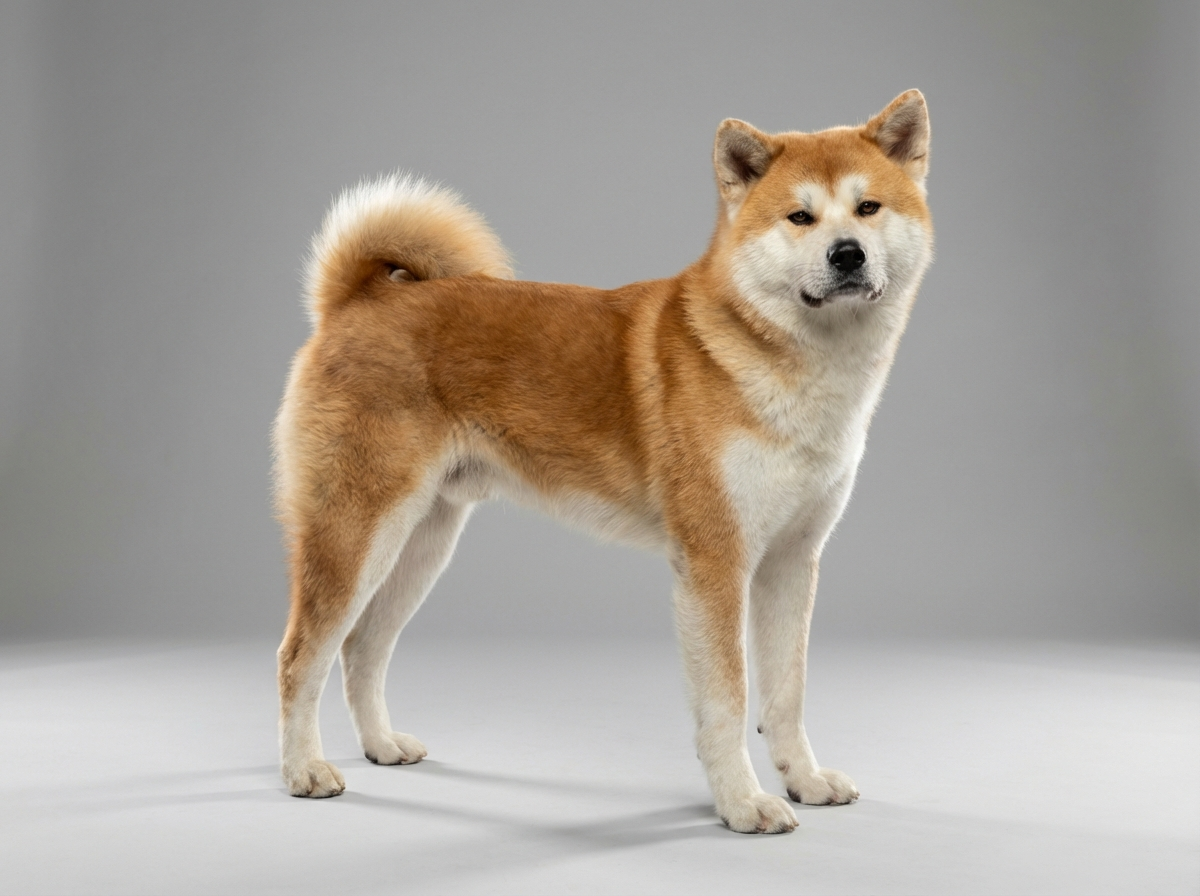
Brachycephalic airway syndrome describes airway problems caused by an extremely shortened skull and muzzle, seen in breeds like Bulldogs and Pugs. The Akita's moderate, proportionate muzzle and broad-but-not-flattened head place it outside this category entirely — this breed's genuine breathing-adjacent vulnerability instead centers on heat intolerance from its dense double coat.
True BOAS is well documented in specifically brachycephalic breeds and is not established as occurring in Akitas, whose head and muzzle proportions don't match the anatomical profile associated with the condition.
The Akita's actual head conformation — a broad skull paired with a full-length, proportionate muzzle — is the opposite of what defines a brachycephalic breed. This breed's real breathing-adjacent driver is its dense double coat, originally developed for the snowy mountainous climate of northern Japan, which retains heat effectively but dissipates it poorly, creating heat-related respiratory distress in warm weather rather than structural airway obstruction.
Heat and humidity are the environmental factors genuinely relevant to this breed's breathing comfort, given its coat-driven heat sensitivity. Obesity can also worsen breathing effort in any dog, and age-related laryngeal changes become more relevant in senior Akitas, but neither relates to the muzzle-shape mechanism that drives true BOAS.
Seek emergency care for labored breathing, blue-tinged gums, collapse, or extreme distress in heat. Schedule a vet visit for new, persistent noisy breathing while awake, which may indicate an age-related laryngeal issue or another condition worth investigating.
Applying a flat-faced-breed condition to a moderate-muzzled breed can lead research in the wrong direction. Avoid these mistakes.
See all Akita health problems, which breeds are prone to brachycephalic airway syndrome boas, or the full Akita breed guide for temperament, exercise needs and ownership costs.
Because BOAS itself isn't a relevant diagnosis for this breed, there's no meaningful timeline to track for it. Heat-related distress typically resolves within minutes of cooling and rest; any diagnosed age-related respiratory condition has its own distinct management timeline.
Success is correctly identifying that heat sensitivity, not structural airway obstruction, is the relevant concern for this breed, and managing it accordingly through shade, water, and appropriately timed exercise.
If you think your Akita has brachycephalic airway syndrome (boas), the plan is three steps: write down what you have seen and when it started, book a veterinary appointment rather than waiting for the next flare, and take video of the behaviour or symptom before you go — the thing you are worried about rarely happens in the consulting room. Screening in the parents covers hip dysplasia, progressive retinal atrophy, hypothyroidism.
What the vet visit should produce is a diagnosis and a written plan, not just reassurance: what is being ruled out, what the monitoring interval is, and which signs mean you come back sooner. Ask what the treatment costs across a year rather than per visit, because that is the number that decides whether you are managing this condition or reacting to it.
Between appointments, keep a short log — dates, what you saw, what changed. It is the single most useful thing an owner brings to a follow-up, and for brachycephalic airway syndrome (boas) it is often what separates a clear pattern from a guess.
After reading about BOAS in general large-breed content, Marisol worried her Akita, Kishi, might be at risk given how heavily he panted during summer walks in Phoenix. Her vet examined Kishi's muzzle and airway structure and confirmed there was no brachycephalic conformation at play. Instead, the panting was explained by Kishi's dense double coat struggling to dissipate heat in the desert climate. Marisol shifted her focus to early-morning walks, provided a cooling mat, and made sure Kishi always had access to shade and water, which resolved her concern far more effectively than researching a condition that didn't actually apply to him.
Key takeaway: The Akita's real breathing-adjacent vulnerability is heat intolerance from its coat, not structural airway obstruction — understanding the actual mechanism leads to far more useful management.
No — the Akita has a moderate, proportionate muzzle length and a broad but not flattened skull, placing it outside the brachycephalic category that includes breeds like Bulldogs, Pugs, and Boxers.
Yes, but the mechanism is different — heat intolerance from this breed's dense double coat, and in older dogs, age-related conditions like laryngeal paralysis, are the more relevant respiratory concerns rather than structural airway obstruction from muzzle shape.
This is most often related to the breed's dense double coat, which was developed for cold climates and doesn't dissipate heat as efficiently as a short, single coat, rather than any airway obstruction.
It's an age-related condition where the voice box no longer opens properly during breathing, documented across many large breeds in their senior years. It's a genuine large-breed respiratory concern worth knowing about, distinct from BOAS.
Occasional snoring during sleep is common and not a specific concern in this breed; new, loud breathing noise while awake and active is worth mentioning to your vet.
Heat-related distress in warm weather and, in older dogs, age-related laryngeal changes are the two most relevant respiratory considerations for this breed, rather than structural BOAS.
No — head breadth and muzzle length are different measurements. The Akita's broad skull is paired with a full-length, proportionate muzzle, which is the opposite of the shortened muzzle that defines a truly brachycephalic breed.
No — this breed has a moderate, proportionate muzzle and doesn't fit the brachycephalic category.
Heat intolerance from their dense double coat is the more relevant concern, not structural airway obstruction.
Their dense double coat, bred for cold climates, doesn't dissipate heat efficiently.
Occasional sleep snoring is normal; new noisy breathing while awake deserves a vet check.
Age-related laryngeal paralysis is a more relevant large-breed concern than BOAS.
A one-page prep sheet for this condition: the signs, the questions to ask, what to get priced. Unlocks here.
You get: Vet visit prep sheet
No spam. One-click unsubscribe. See our privacy policy.
Preview page 1 before you decide.