Costs
Weimaraner cost in Charleston
Roughly $110–$240 a month and $1,700–$3,200 in year one at average pricing — with tourism-driven boarding demand making the seasonal cost of leaving this breed the number that actually varies.

See Weimaraner price across all cities →
Quick answer
Weimaraner cost in Charleston
Roughly $110–$240 a month and $1,700–$3,200 in year one at average pricing — with tourism-driven boarding demand making the seasonal cost of leaving this breed the number that actually varies.
A Weimaraner in Charleston costs about $110 to $240 a month, with year one at $1,700 to $3,200 — almost exactly the national midpoint. The distortion in this city is not the average price of anything. It is what happens to the price and availability of boarding during the months everyone wants it.
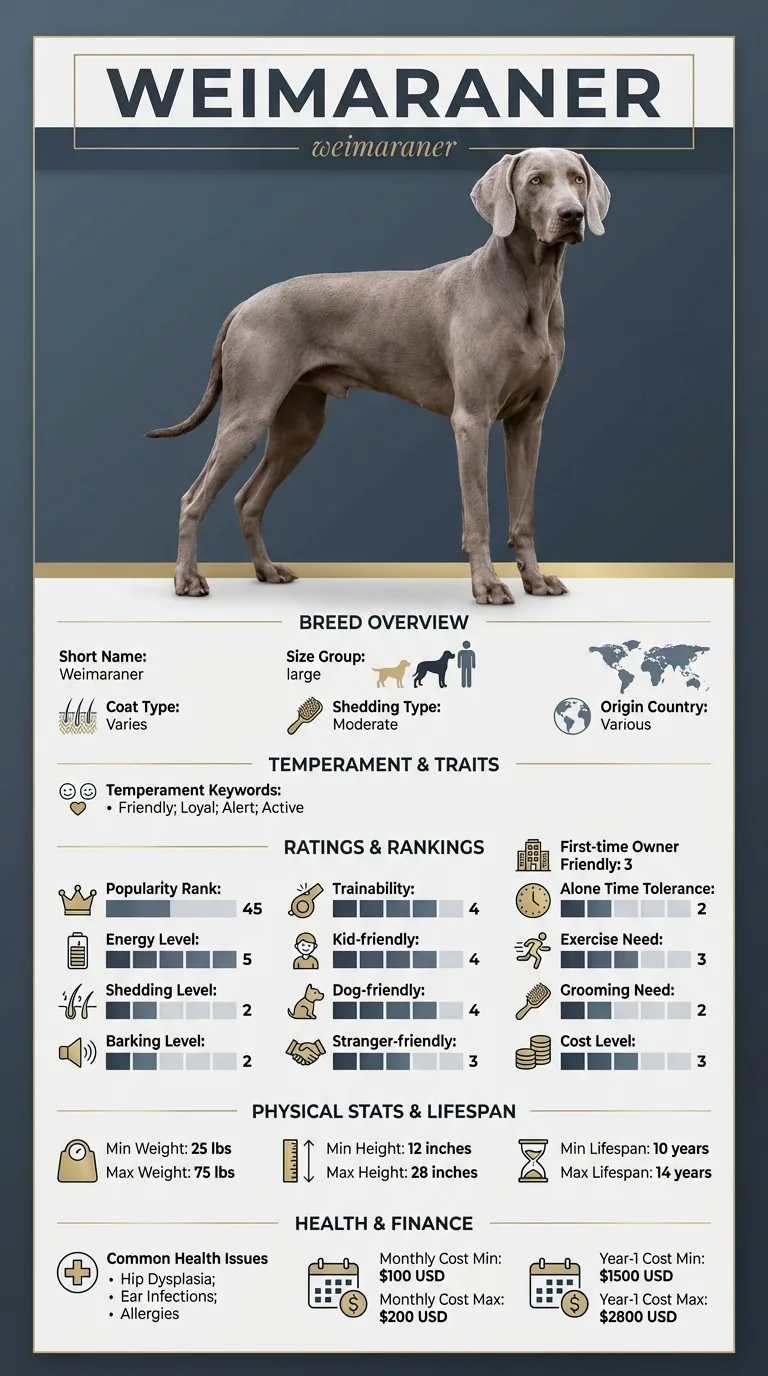
Bloat (GDV), Hip Dysplasia, Hypertrophic Osteodystrophy, Von Willebrand Disease and Separation Anxiety are the documented risks for this breed. In Charleston the behavioural item is the one that turns into recurring, seasonally priced spending rather than a single invoice.
Charleston's baseline sits at the national midpoint, but a tourism-driven boarding market means the same trip costs very different amounts depending on the month you take it.
Estimate · source: estimation · confidence: medium · updated 2026-09-06 · not a quote
| Item | Cost range |
|---|---|
One-time setup: exam, spay or neuter, crate and gear Large-breed crate, harness and long line at Charleston's mid-market retail. | $480 - $800 |
| Item | Cost range |
|---|---|
Food for a 55-to-90-pound sporting dog South Carolina retail sits close to national pricing; the volume is set by an athletic large breed. | $55 - $95 |
Each range starts from a national baseline for this breed's size class and is then adjusted for local cost of living and veterinary pricing. The baselines, and the source each one came from, are listed on our sources page (dataset 2026.09). Two inputs, the purchase price and the emergency reserve, have no published national figure we could verify, so we leave them to you rather than invent them.
These are planning estimates, not quotes. Your own numbers will move with the individual dog, your vet and your insurer. Build a budget with your own figures.
Insurance in Charleston addresses the surgical half of this breed's risk profile; the behavioural half, which local seasonality makes expensive, sits outside it.
Buy early, while the record is clean. Hip Dysplasia is documented in this breed and gets excluded quickly once anything orthopedic is written down.
Owners with strong reserves may prefer to hold the premium against the boarding bill, which is the cost this city reliably produces.
Charleston savings come from treating boarding like travel: book it early, keep a fallback, and avoid the peak weeks where you can.
Most cost pages treat boarding as a flat rate you occasionally pay. In a tourism city it behaves like a hotel room: cheaper and freely available in the quiet months, tight and expensive when the calendar fills.
A breed that cannot be left with a bowl of food and a neighbour's evening visit is exposed to that curve in a way most dogs are not. If you have a wedding, a holiday weekend or a work trip in high season, you are buying into a constrained market, and buying late costs more than buying early — when there is space at all.
The workable response is to behave like a traveller rather than a dog owner. Book the boarding when you book the trip, keep a relationship with a second provider as a fallback, and treat the peak-season premium as a known line rather than a surprise.
The Lowcountry's warmth and humidity keep flea, tick and heartworm exposure live for roughly eleven months a year, which is close to a full schedule. Preventives are dosed by body weight, and a 55-to-90-pound dog sits at the top of the pricing brackets, so this line runs higher here than in a northern city with the same headline cost of living.
Heat also compresses the exercise day. This breed carries the maximum exercise rating on our scale, and a Charleston summer afternoon is not the time to deliver it. Early morning becomes the working slot for months at a stretch.
The compensation is that the coat costs nothing to maintain. Short, sleek and low-shedding by the standard, it needs a brush and a rinse rather than a groomer — a genuine saving in a humid climate that punishes heavier coats.

A Mount Pleasant household needed four nights of boarding for their Weimaraner during a busy April weekend and started calling three days out. Two facilities were full, the third had one large-dog run left at a premium rate, and they took it because leaving the dog was not an option — the last attempt at neighbour drop-ins had produced a destroyed screen door. The following year they booked in January for the same weekend and paid noticeably less at their preferred facility.
Key takeaway: In Charleston the variable cost of this breed is boarding, and it behaves like a hotel market — early booking, not price negotiation, is what actually saves money.
About $110 to $240, essentially the national midpoint, excluding boarding in peak season.
Roughly $1,700 to $3,200 covering the initial exam and vaccines, spay or neuter if chosen, and large-breed crate and gear.
Because boarding and daycare capacity competes with visitor demand. In peak season it is both pricier and harder to book, and this breed cannot simply be left at home instead.
For most breeds, yes. For one with the lowest alone-time tolerance we record and documented Separation Anxiety, a couple of drop-in visits a day is rarely enough.
Worth quoting for the surgical risks — Bloat in particular. Behavioural costs, which this city inflates, are typically outside standard cover.
Around $840 at Charleston's mid-range pricing, held liquid rather than earmarked.
Roughly $110–$240 a month and $1,700–$3,200 in year one at average pricing — with tourism-driven boarding demand making the seasonal cost of leaving this breed the number that actually varies.
This guide is not medical advice. If your dog shows pain, sudden behavior change, or worsening symptoms, consult a licensed veterinarian.
Some links may be affiliate links. We may earn a commission at no extra cost to you. We only suggest products we believe are helpful for dog owners.
We research and check what we publish, but we do not warrant that any figure, date, price, or statement is accurate, complete, or current, and we accept no liability for any loss, cost, injury, or other harm arising from the use of this site. Use it as one reference among several. You remain responsible for your own decisions and for your dog's care - confirm anything that matters with a licensed veterinarian or another qualified professional before you act on it. Full disclaimer.
One sheet with every line item, the emergency fund and when insurance pays off - unlocks on this page.
You get: 12-month budget sheet
No spam. One-click unsubscribe. See our privacy policy.
Preview page 1 before you decide.