Costs
Weimaraner cost in Bridgeport
About $126–$276 a month and $1,955–$3,680 for year one at New York-adjacent pricing — with rail-timetable commuting creating the unpredictable long days this breed handles worst.

See Weimaraner price across all cities →
Quick answer
Weimaraner cost in Bridgeport
About $126–$276 a month and $1,955–$3,680 for year one at New York-adjacent pricing — with rail-timetable commuting creating the unpredictable long days this breed handles worst.
Plan on $126 to $276 a month for a Weimaraner in Bridgeport, and $1,955 to $3,680 for the first year. Fairfield County sits close enough to New York that vet, boarding and daycare prices are pulled upward with it. The local factor that matters more for this breed, though, is the railway line running through the middle of the city.
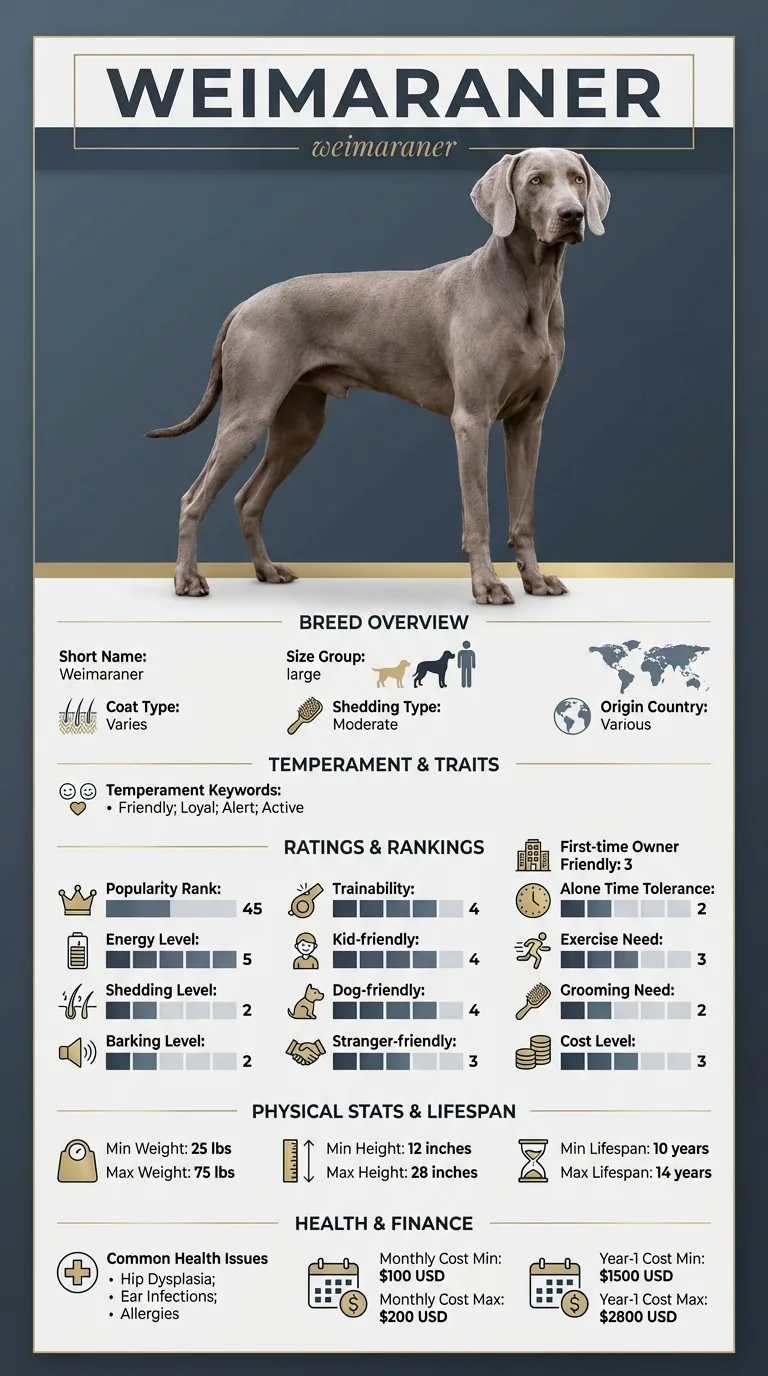
Bloat (GDV), Hip Dysplasia, Hypertrophic Osteodystrophy, Von Willebrand Disease and Separation Anxiety are all documented for this breed. In Bridgeport, the last of those is the one the local commuting pattern actively feeds.
Bridgeport prices sit above the Connecticut average because of the New York pull, and this breed's costs concentrate in exactly the size-priced services that pull hardest.
Estimate · source: estimation · confidence: medium · updated 2026-09-06 · not a quote
| Item | Cost range |
|---|---|
One-time setup: exam, spay or neuter, crate and gear Large-breed sizing on everything, at prices set by proximity to New York. | $552 - $920 |
| Item | Cost range |
|---|---|
Food for a 55-to-90-pound sporting dog Fairfield County retail pricing on the volume an athletic large breed actually eats. | $63 - $109 |
Each range starts from a national baseline for this breed's size class and is then adjusted for local cost of living and veterinary pricing. The baselines, and the source each one came from, are listed on our sources page (dataset 2026.09). Two inputs, the purchase price and the emergency reserve, have no published national figure we could verify, so we leave them to you rather than invent them.
These are planning estimates, not quotes. Your own numbers will move with the individual dog, your vet and your insurer. Build a budget with your own figures.
Given elevated regional pricing, insurance for a Bridgeport Weimaraner is mostly a hedge against the size of a local emergency invoice rather than against unusual risk.
Take a quote in the first year, before any orthopedic or bone-development note enters the record and narrows what a policy will cover.
If your savings comfortably exceed the emergency figure and you would spend it without hesitation, self-funding is reasonable.
The Bridgeport lever is scheduling: cover the long day rather than the average day, and stop paying for anything this coat does not need.
Dogs settle around routine. What a rail commuter cannot offer is a reliable end time, because the last hour of the day belongs to the schedule rather than to the person. Leaving the office fifteen minutes early does not get you home fifteen minutes earlier; it gets you standing on a platform.
That produces a specific pattern: a long, fixed absence with a ragged edge on the end. For most dogs the ragged edge is irrelevant. For a breed already carrying documented separation distress, the days that run an extra hour are the ones that undo the progress made on the days that ran normally.
The practical implication for a Bridgeport budget is that midday cover should be booked on the assumption of the long day, not the average day. A walker scheduled at the midpoint of a predictable absence does far more good than one squeezed in near the end of an unpredictable one.
Bridgeport's cost profile is genuinely awkward. Proximity to the New York metro lifts what local providers charge for boarding, daycare and veterinary work above the Connecticut average, but the city itself is economically mixed rather than uniformly wealthy.
For a large sporting breed, that shows up most in the categories priced by dog size. Boarding rates step up by weight bracket, and a 55-to-90-pound dog sits in the expensive tier. So does every parasite preventive, over an eight-month season.
The one genuine saving is grooming. A documented grooming need of 1, a short sleek coat and low shedding mean this is a breed you maintain yourself with a rubber curry brush, which in a market this expensive is worth more than it sounds.

A Black Rock commuter had a walker booked at 4pm, reasoning that it landed shortly before he normally got home. Through one bad autumn of track work, his usual train was repeatedly replaced by a later one, and the dog was regularly going five hours past the visit rather than two. The chewing started at the front door and worked outward. Moving the walk to midday, so that the covered gap sat in the middle of the absence instead of at the end, settled the dog within a fortnight at exactly the same cost.
Key takeaway: On this commuter line, when the midday visit happens matters as much as whether it happens — because the part of the day you cannot predict is the end of it.
Around $126 to $276, above the national middle because Fairfield County pricing follows the New York metro rather than the rest of Connecticut.
Roughly $1,955 to $3,680, covering the initial exam and vaccines, spay or neuter if you choose it, and gear sized for a large breed.
Because a train timetable removes your ability to shorten a bad day. The absence has a hard floor and an unpredictable extra hour on the end, and this breed reacts badly to exactly that inconsistency.
Near the middle of the expected absence rather than close to your return, so that a delayed train does not turn a covered day into an uncovered one.
Worth quoting, since local emergency pricing is elevated and Bloat, the documented emergency in this breed, is expensive anywhere.
About $970, matching what after-hours care tends to cost in this corridor.
About $126–$276 a month and $1,955–$3,680 for year one at New York-adjacent pricing — with rail-timetable commuting creating the unpredictable long days this breed handles worst.
This guide is not medical advice. If your dog shows pain, sudden behavior change, or worsening symptoms, consult a licensed veterinarian.
Some links may be affiliate links. We may earn a commission at no extra cost to you. We only suggest products we believe are helpful for dog owners.
We research and check what we publish, but we do not warrant that any figure, date, price, or statement is accurate, complete, or current, and we accept no liability for any loss, cost, injury, or other harm arising from the use of this site. Use it as one reference among several. You remain responsible for your own decisions and for your dog's care - confirm anything that matters with a licensed veterinarian or another qualified professional before you act on it. Full disclaimer.
One sheet with every line item, the emergency fund and when insurance pays off - unlocks on this page.
You get: 12-month budget sheet
No spam. One-click unsubscribe. See our privacy policy.
Preview page 1 before you decide.