Costs
Weimaraner cost in Burlington
About $112–$245 monthly and $1,734–$3,264 in year one — average pricing with a short six-month parasite season, and a preventive bloat-surgery conversation that belongs in the first year.

See Weimaraner price across all cities →
Quick answer
Weimaraner cost in Burlington
About $112–$245 monthly and $1,734–$3,264 in year one — average pricing with a short six-month parasite season, and a preventive bloat-surgery conversation that belongs in the first year.
A Weimaraner in Burlington costs roughly $112 to $245 a month, with year one between $1,734 and $3,264. Vermont's general cost of living sits close to the national middle, and its winters cut parasite prevention down to about six months. The complication is supply: this is a small veterinary market, with fewer competing practices than a metro of the same price level would normally have.
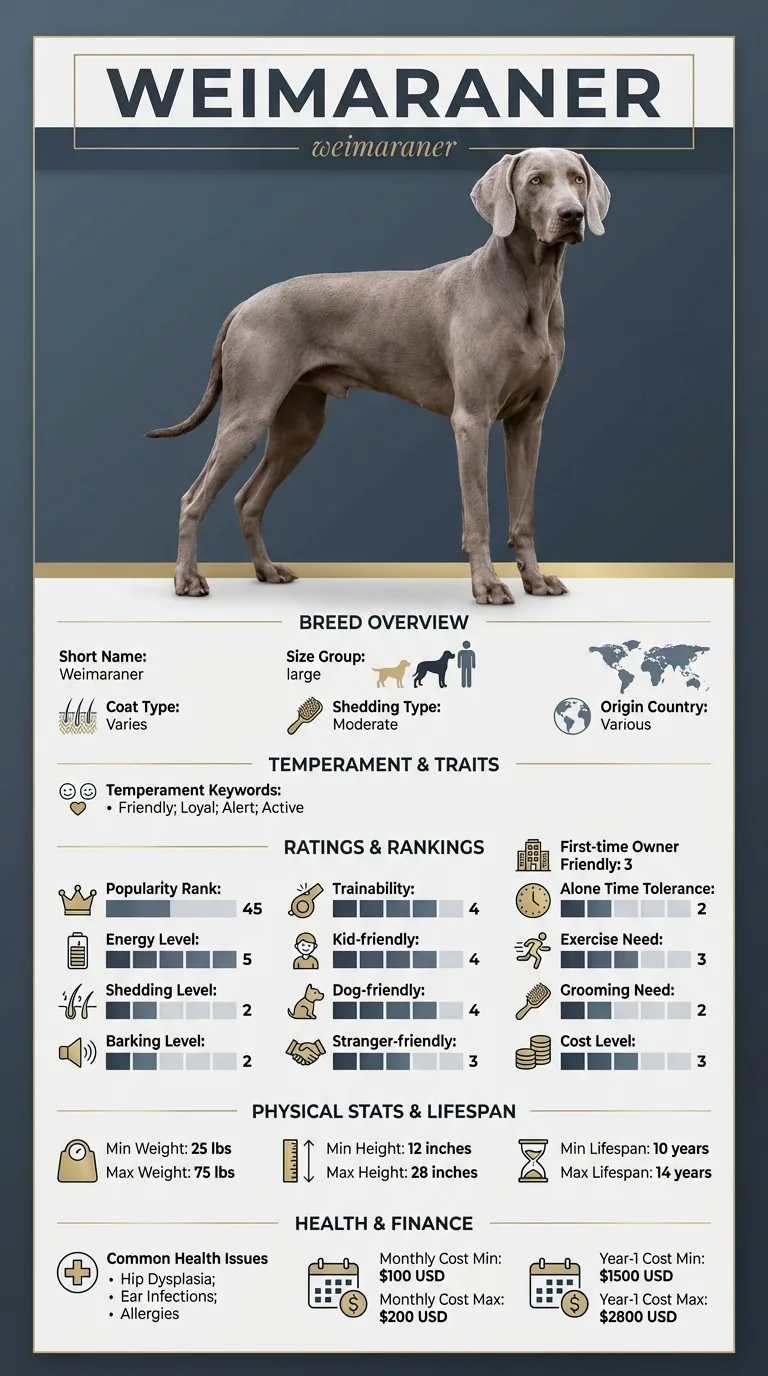
The documented list is Bloat (GDV), Hip Dysplasia, Hypertrophic Osteodystrophy, Von Willebrand Disease and Separation Anxiety. Deep-chested breeds carry the first of those as a lifelong background risk, which is why the preventive options are worth understanding early rather than researching in a waiting room.
Burlington's figures are close to national norms with a short-season discount, and one optional line most cost pages never mention: a preventive procedure discussed for high-risk deep-chested breeds.
Estimate · source: estimation · confidence: medium · updated 2026-09-06 · not a quote
| Item | Cost range |
|---|---|
Optional preventive gastropexy combined with spay or neuter Only appropriate if your veterinarian recommends it, and only economical when combined with a procedure the dog is already having. | $300 - $900 |
One-time setup: exam, spay or neuter, crate, gear and winter coat Includes insulated outerwear, which a documented short, sleek coat makes necessary rather than optional here. | $490 - $816 |
| Item | Cost range |
|---|---|
Food for a 55-to-90-pound sporting dog Vermont retail sits near the national middle; portion size is driven by the dog, not the state. | $56 - $97 |
Each range starts from a national baseline for this breed's size class and is then adjusted for local cost of living and veterinary pricing. The baselines, and the source each one came from, are listed on our sources page (dataset 2026.09). Two inputs, the purchase price and the emergency reserve, have no published national figure we could verify, so we leave them to you rather than invent them.
These are planning estimates, not quotes. Your own numbers will move with the individual dog, your vet and your insurer. Build a budget with your own figures.
In a small market with limited after-hours choice, insurance mostly buys the confidence to say yes immediately at whichever clinic is open.
Enrol young. If you go on to have a preventive gastropexy performed, tell your insurer, since it changes the risk you are asking them to carry.
A household with strong savings and a settled relationship with a local practice can reasonably run without a policy.
Burlington savings come from the short season and from decisions made early, since there is limited scope to shop around later.
There is a preventive surgical procedure for bloat, a prophylactic gastropexy, which tacks the stomach so it cannot rotate. It is commonly discussed for deep-chested, high-risk breeds, and it is frequently done at the same time as a spay or neuter so the dog is only anaesthetised once.
Whether it is appropriate for your dog is a veterinary decision, not a budgeting one, and it is not a universal recommendation. But it is a conversation that has to happen before the spay or neuter, not after, because the whole economic argument rests on combining the two procedures.
In a small market that is worth raising yourself. Ask at the first or second puppy visit whether your practice performs it, what combining it with the neuter would cost, and whether they consider it warranted for this breed. That is a fifteen-minute conversation with a genuinely large potential consequence.
The rest of the Burlington picture is straightforward. A six-month parasite window is one of the shorter ones on this site, and since every preventive is dosed by weight, a 55-to-90-pound dog saves at the expensive end of that schedule.
Against that, fewer competing clinics means less room to shop on routine pricing, so the usual advice about comparing quotes has less traction here than it would in a large metro.
And then there is the coat. The breed standard describes it as short and sleek, with low shedding — wonderful for the vacuum, useless against a Champlain Valley January. A dog with the maximum exercise rating on our scale still needs to go out every day in that, so insulated outerwear is equipment rather than indulgence.

A Burlington owner mentioned in passing at a six-month check that she had read about stomach twisting in deep-chested breeds. Her vet explained the preventive procedure, said it was reasonable to consider for this breed, and noted that doing it alongside the already-scheduled spay would mean one anaesthetic instead of two. She went ahead. Four years later a friend two towns over lost a similar dog to bloat overnight, and the difference between the two households came down to a question asked at the right appointment.
Key takeaway: In a small veterinary market the most valuable Burlington move is early information — the preventive options for this breed's signature emergency only make economic sense if you ask before the neuter, not after.
Around $112 to $245, close to national norms, with a genuine saving on the shortened parasite schedule.
Roughly $1,734 to $3,264, and potentially more if you and your vet decide a preventive gastropexy alongside the neuter is warranted.
It is a preventive procedure that fixes the stomach in place to stop it twisting, discussed for deep-chested breeds with documented bloat risk. It is often combined with a spay or neuter, which is why the timing of the conversation matters.
That is a decision for your veterinarian based on the individual dog. The point of this page is that you should ask before the neuter is scheduled, not after.
Mostly it affects choice rather than price. Fewer practices means less comparison shopping, and it makes knowing your after-hours option in advance more important.
About $860, held liquid. The scenario it exists for does not allow time to arrange anything.
About $112–$245 monthly and $1,734–$3,264 in year one — average pricing with a short six-month parasite season, and a preventive bloat-surgery conversation that belongs in the first year.
This guide is not medical advice. If your dog shows pain, sudden behavior change, or worsening symptoms, consult a licensed veterinarian.
Some links may be affiliate links. We may earn a commission at no extra cost to you. We only suggest products we believe are helpful for dog owners.
We research and check what we publish, but we do not warrant that any figure, date, price, or statement is accurate, complete, or current, and we accept no liability for any loss, cost, injury, or other harm arising from the use of this site. Use it as one reference among several. You remain responsible for your own decisions and for your dog's care - confirm anything that matters with a licensed veterinarian or another qualified professional before you act on it. Full disclaimer.
One sheet with every line item, the emergency fund and when insurance pays off - unlocks on this page.
You get: 12-month budget sheet
No spam. One-click unsubscribe. See our privacy policy.
Preview page 1 before you decide.