Costs
Weimaraner cost in Boise
About $105–$228 a month and $1,615–$3,040 in year one — near-average pricing, with the Foothills a superb adult resource and a genuine growth-stage hazard for a large-breed puppy.

See Weimaraner price across all cities →
Quick answer
Weimaraner cost in Boise
About $105–$228 a month and $1,615–$3,040 in year one — near-average pricing, with the Foothills a superb adult resource and a genuine growth-stage hazard for a large-breed puppy.
Keeping a Weimaraner in Boise costs somewhere between $105 and $228 a month, with year one at $1,615 to $3,040 — just under the national middle. Boise's defining feature for dog owners is the Foothills: a very large trail network rising directly out of the north end of town, reachable without a highway. For an adult dog of this breed, that access is close to perfect. For a puppy, it is the most expensive mistake available in this city.
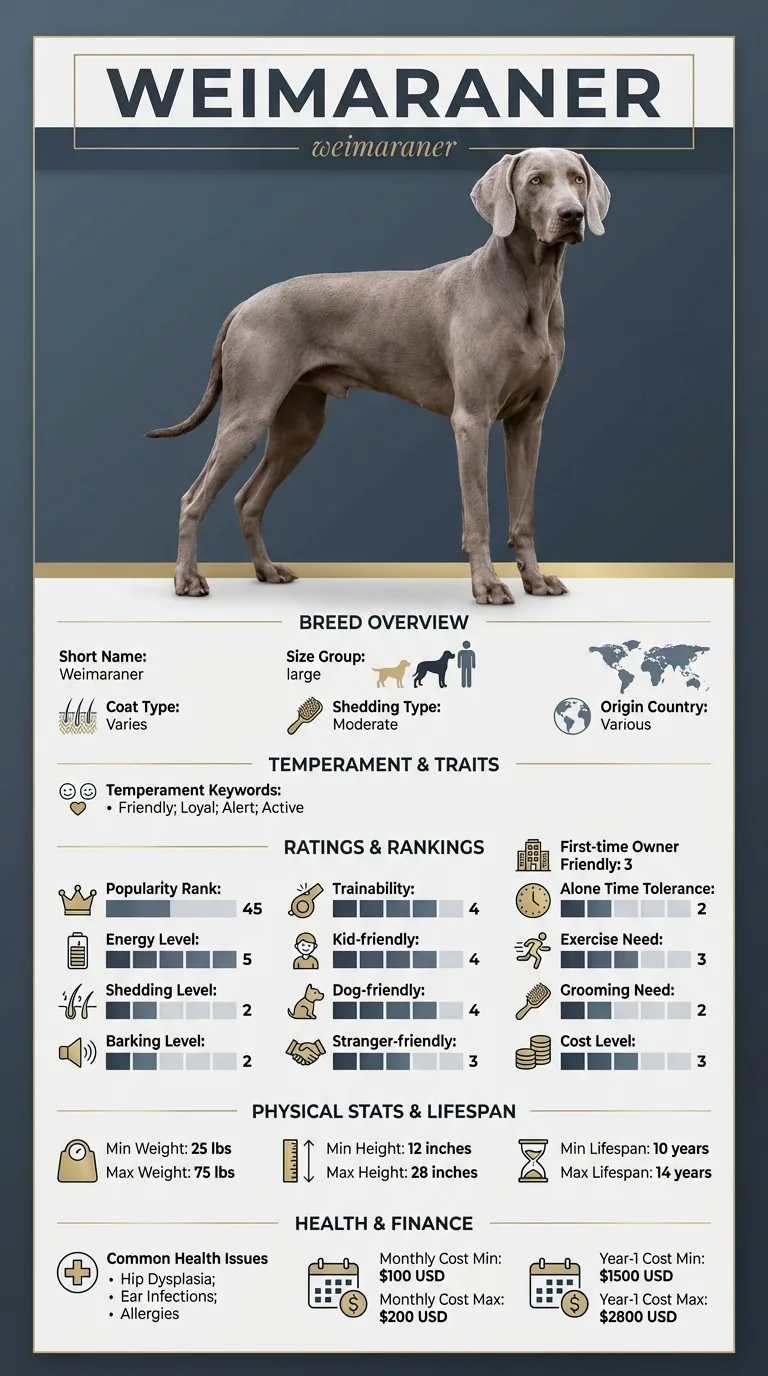
Bloat (GDV), Hip Dysplasia, Hypertrophic Osteodystrophy, Von Willebrand Disease and Separation Anxiety are all documented for this breed. In Boise, the growth-stage conditions are the ones most likely to be triggered by local habits rather than bad luck.
Boise's pricing is unremarkable; what shapes the first-year figure here is whether the household spends on growth-stage monitoring or on treating the consequence of skipping it.
Estimate · source: estimation · confidence: medium · updated 2026-09-06 · not a quote
| Item | Cost range |
|---|---|
One-time setup: exam, spay or neuter, crate and gear Crate, harness and long line in large-breed sizing at Boise's near-average retail. | $456 - $760 |
| Item | Cost range |
|---|---|
Large-breed puppy and adult food Large-breed puppy formulations are built to moderate growth rate, which is directly relevant to the bone conditions documented in this breed. | $52 - $90 |
Each range starts from a national baseline for this breed's size class and is then adjusted for local cost of living and veterinary pricing. The baselines, and the source each one came from, are listed on our sources page (dataset 2026.09). Two inputs, the purchase price and the emergency reserve, have no published national figure we could verify, so we leave them to you rather than invent them.
These are planning estimates, not quotes. Your own numbers will move with the individual dog, your vet and your insurer. Build a budget with your own figures.
For a Boise Weimaraner the insurance question is unusually time-sensitive, because the conditions most likely to appear first are developmental and appear during puppyhood.
Before the first limp. Hypertrophic Osteodystrophy can present in the first year, and anything already noted becomes a pre-existing exclusion.
An owner buying an adult dog with a clean orthopedic history, holding solid savings, faces a genuinely different calculation.
In Boise the money-saving move and the health-protecting move are the same one: keep year one on the flat.
The Foothills network runs to well over a hundred miles of interconnected trail, and a great deal of it starts a short walk or a five-minute drive from residential streets. There is no gatekeeping distance, no permit, no planning required. That is exactly why new owners here take an obviously energetic five-month-old on a six-mile ridge loop and think of it as a good day out.
For a large-breed puppy in its growth window, it is not. Hypertrophic Osteodystrophy is documented in this breed, and long repetitive mileage on an unfinished skeleton is the pattern veterinarians consistently warn against. The dog will happily do it — a maximum-energy gundog has no self-limiting instinct — which is what makes it a judgment call for the human.
The cost of getting it wrong is a lame puppy, a diagnostic workup, imaging and rest. The cost of getting it right is patience and a slightly duller first year.
Boise's second asset is better suited to a growing dog: the paved riverside greenbelt running through the city, flat, shaded in places, and easy to cut short. Short, frequent, level outings are what a large-breed puppy is supposed to get, and the greenbelt delivers them without a climb.
That suggests a simple two-stage plan for a Boise Weimaraner. Year one belongs to the river path, structured play and training. From roughly the point your vet confirms the growth plates have closed, the Foothills open up and stay open for the next decade.
Budget-wise, this is the rare case where the cautious route is also the cheap route. Recheck visits during the growth window cost a fraction of an orthopedic workup, and Idaho's near-average clinic pricing keeps them affordable.

A North End household took their six-month-old Weimaraner on a long Foothills loop most weekends because the dog seemed tireless and clearly loved it. Midway through the summer the puppy came up lame on a foreleg with no obvious injury, and the workup that followed was neither quick nor cheap. The advice they got afterwards was blunt: this is a breed with documented growth-stage bone problems, and it will run itself into trouble because it has no idea when to stop. They spent the rest of the year on the greenbelt.
Key takeaway: Boise's trail access is the best thing about owning this breed here and the easiest thing to overuse in year one — the Foothills are a reward for a finished skeleton, not a training ground for a growing one.
Roughly $105 to $228, a shade under the national middle, reflecting Idaho's modestly below-average cost base.
About $1,615 to $3,040, including the initial vet work, spay or neuter if chosen, large-breed gear and the growth-stage rechecks this breed genuinely benefits from.
Briefly and gently, yes; for long mileage, wait. Hypertrophic Osteodystrophy is a documented large-breed growth condition in this breed, and sustained distance on an unfinished skeleton is the risk you are managing.
Ask your vet rather than a calendar. The usual marker is skeletal maturity, which in a dog of this size arrives later than owners expect.
Worth quoting before the first year is out, precisely because growth-stage bone problems can appear early and are then written out of future cover.
Around $800. Bloat is the documented emergency it is really for, though orthopedic imaging can eat a similar amount without any drama at all.
About $105–$228 a month and $1,615–$3,040 in year one — near-average pricing, with the Foothills a superb adult resource and a genuine growth-stage hazard for a large-breed puppy.
This guide is not medical advice. If your dog shows pain, sudden behavior change, or worsening symptoms, consult a licensed veterinarian.
Some links may be affiliate links. We may earn a commission at no extra cost to you. We only suggest products we believe are helpful for dog owners.
We research and check what we publish, but we do not warrant that any figure, date, price, or statement is accurate, complete, or current, and we accept no liability for any loss, cost, injury, or other harm arising from the use of this site. Use it as one reference among several. You remain responsible for your own decisions and for your dog's care - confirm anything that matters with a licensed veterinarian or another qualified professional before you act on it. Full disclaimer.
One sheet with every line item, the emergency fund and when insurance pays off - unlocks on this page.
You get: 12-month budget sheet
No spam. One-click unsubscribe. See our privacy policy.
Preview page 1 before you decide.