Costs
Weimaraner cost in Des Moines
About $101–$221 monthly and $1,564–$2,944 in year one — below-average costs, and one of the few metros where a short commute lets you break this breed's day at lunch instead of paying someone to do it.

See Weimaraner price across all cities →
Quick answer
Weimaraner cost in Des Moines
About $101–$221 monthly and $1,564–$2,944 in year one — below-average costs, and one of the few metros where a short commute lets you break this breed's day at lunch instead of paying someone to do it.
A Weimaraner in Des Moines costs about $101 to $221 a month, with the first year between $1,564 and $2,944 — comfortably under national norms. What makes this city genuinely well matched to the breed, though, is a statistic that never appears in a dog budget: Des Moines has one of the shortest average commutes of any metro in the country.
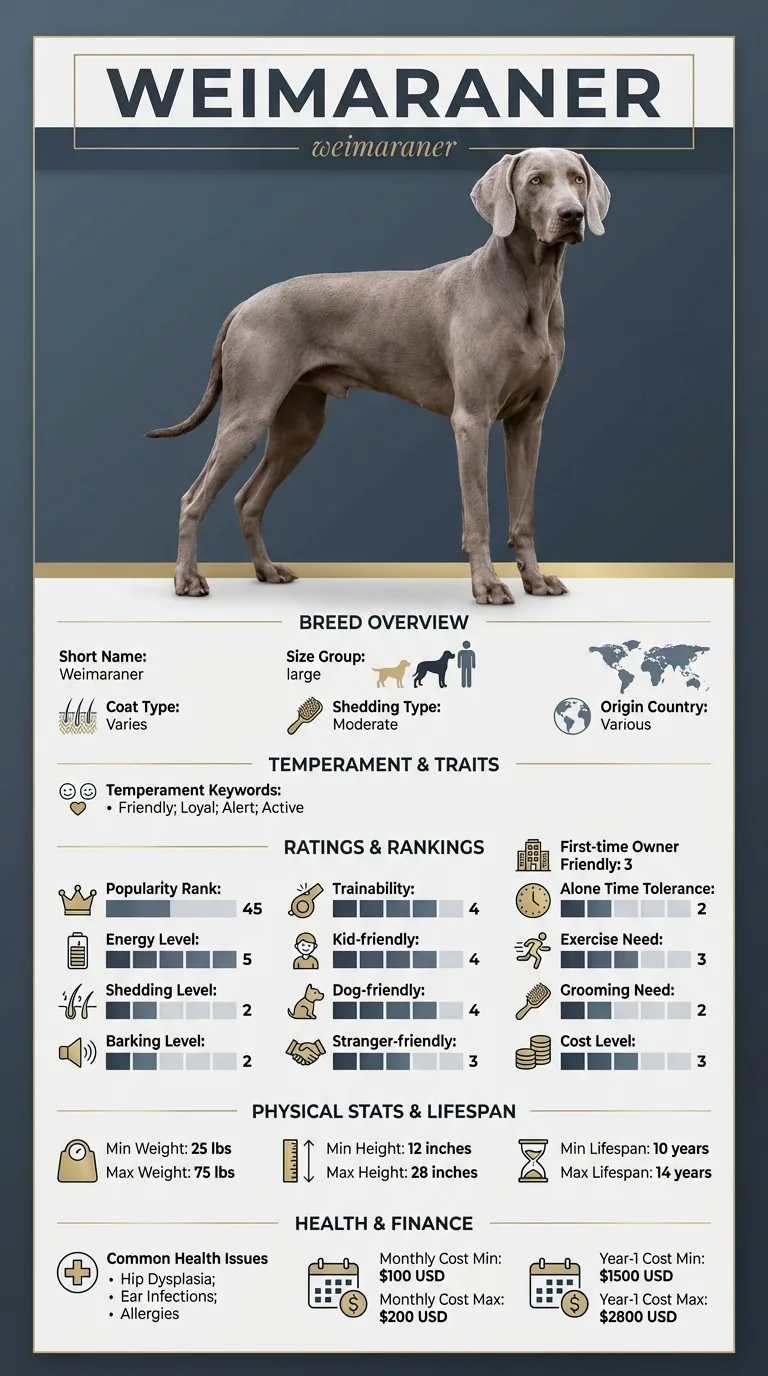
Bloat (GDV), Hip Dysplasia, Hypertrophic Osteodystrophy, Von Willebrand Disease and Separation Anxiety are the documented risks for this breed. In a low-cost metro the surgical items still cost real money, so the reserve matters as much here as anywhere.
Des Moines is one of the more affordable places on this site to keep a large dog, and uniquely for this breed, the single most expensive line elsewhere — midday cover — can often be handled for free.
Estimate · source: estimation · confidence: medium · updated 2026-09-06 · not a quote
| Item | Cost range |
|---|---|
One-time setup: exam, spay or neuter, crate, gear and winter coat Large-breed sizing throughout, at some of the lower retail pricing on this site. | $442 - $736 |
| Item | Cost range |
|---|---|
Food for a 55-to-90-pound sporting dog Iowa retail pricing on the volume an athletic large breed genuinely eats. | $51 - $87 |
Each range starts from a national baseline for this breed's size class and is then adjusted for local cost of living and veterinary pricing. The baselines, and the source each one came from, are listed on our sources page (dataset 2026.09). Two inputs, the purchase price and the emergency reserve, have no published national figure we could verify, so we leave them to you rather than invent them.
These are planning estimates, not quotes. Your own numbers will move with the individual dog, your vet and your insurer. Build a budget with your own figures.
Insurance here is priced against a moderate market, so the premium is reasonable and the surgical risks it covers are unchanged by the low cost of living.
Enrol young, before any hip or bone-development finding is recorded and excluded from future cover.
With Iowa's pricing, an owner holding a solid reserve can absorb most non-catastrophic events without a policy.
The Des Moines play is to use the commute advantage deliberately rather than accidentally, and to keep the reserve intact.
A dog with this breed's alone-time profile does not need company all day. It needs the day broken. Nine unbroken hours is where the trouble starts; two blocks of four with a real break between them is a completely different proposition for the same dog.
In a sprawling metro that break has to be bought, because nobody can drive home and back inside an hour. Des Moines is one of the few large-ish American cities where a great many workers genuinely can, and where the employment base — heavily weighted toward office work in insurance and financial services — tends to run predictable daytime hours rather than shifts.
Combine those two things and the maths changes. A household that uses its lunch hour deliberately can run this breed without a walker, which is a saving of hundreds to low thousands a year against what the same dog costs in a commuter city.
The other structural advantage is housing. A fenced yard is ordinary in this metro rather than a luxury, which means the routine bathroom trips that dominate an apartment dweller's day cost nothing at all.
A yard is not exercise, though. This breed carries the top exercise rating on our five-point scale, and no garden in Polk County is going to satisfy that. The yard buys convenience; the trail network and the river paths supply the actual work.
Winter is the constraint. Iowa cold cuts the parasite season to roughly seven months, which is a genuine saving on weight-dosed preventives for a large dog, and simultaneously makes an insulated coat necessary for an animal whose own coat is documented as short, sleek and low-shedding with nothing underneath it.

A Des Moines household budgeted for a daily walker before their Weimaraner arrived, assuming that was simply what this breed required. After a fortnight the owner realised her office was eleven minutes from the house and started going home instead, letting the dog out and doing ten minutes of training in the kitchen. The dog settled better than it had with the walker, because the person coming through the door was the one it was bonded to. They cancelled the service and kept the money.
Key takeaway: In Des Moines the commute is short enough that the most expensive line item on this breed's budget elsewhere can often be removed entirely — and a devoted breed responds better to its own person anyway.
Around $101 to $221, below the national middle, and realistically achievable without a dog walker if someone can get home midday.
Roughly $1,564 to $2,944, including the initial exam and vaccines, spay or neuter if you choose it, large-breed gear and a winter coat.
For this breed, more than almost anything else. Breaking the day in half is what a paid walker does, and a fifteen-minute drive home lets you do it for free.
For convenience yes, for exercise no. The breed sits at the maximum on our exercise scale and needs distance, not a lawn.
Worth quoting. Premiums follow a moderate local market, while Bloat and the orthopedic conditions documented in this breed cost the same anywhere.
About $770 at Des Moines pricing, held somewhere you can reach it the same night.
About $101–$221 monthly and $1,564–$2,944 in year one — below-average costs, and one of the few metros where a short commute lets you break this breed's day at lunch instead of paying someone to do it.
This guide is not medical advice. If your dog shows pain, sudden behavior change, or worsening symptoms, consult a licensed veterinarian.
Some links may be affiliate links. We may earn a commission at no extra cost to you. We only suggest products we believe are helpful for dog owners.
We research and check what we publish, but we do not warrant that any figure, date, price, or statement is accurate, complete, or current, and we accept no liability for any loss, cost, injury, or other harm arising from the use of this site. Use it as one reference among several. You remain responsible for your own decisions and for your dog's care - confirm anything that matters with a licensed veterinarian or another qualified professional before you act on it. Full disclaimer.
One sheet with every line item, the emergency fund and when insurance pays off - unlocks on this page.
You get: 12-month budget sheet
No spam. One-click unsubscribe. See our privacy policy.
Preview page 1 before you decide.