Costs
Weimaraner cost in Charlotte
About $109–$238 monthly and $1,683–$3,168 in year one at near-average pricing — with greenway proximity, not lot size, deciding whether this maximum-exercise breed needs paid daycare.

See Weimaraner price across all cities →
Quick answer
Weimaraner cost in Charlotte
About $109–$238 monthly and $1,683–$3,168 in year one at near-average pricing — with greenway proximity, not lot size, deciding whether this maximum-exercise breed needs paid daycare.
Charlotte sits just under national norms for this breed: roughly $109 to $238 a month, and $1,683 to $3,168 across year one. The city's real variable for a Weimaraner is not on the price list at all. It is the size of the back garden, and in one of the country's fastest-growing metros, that has been shrinking for years.
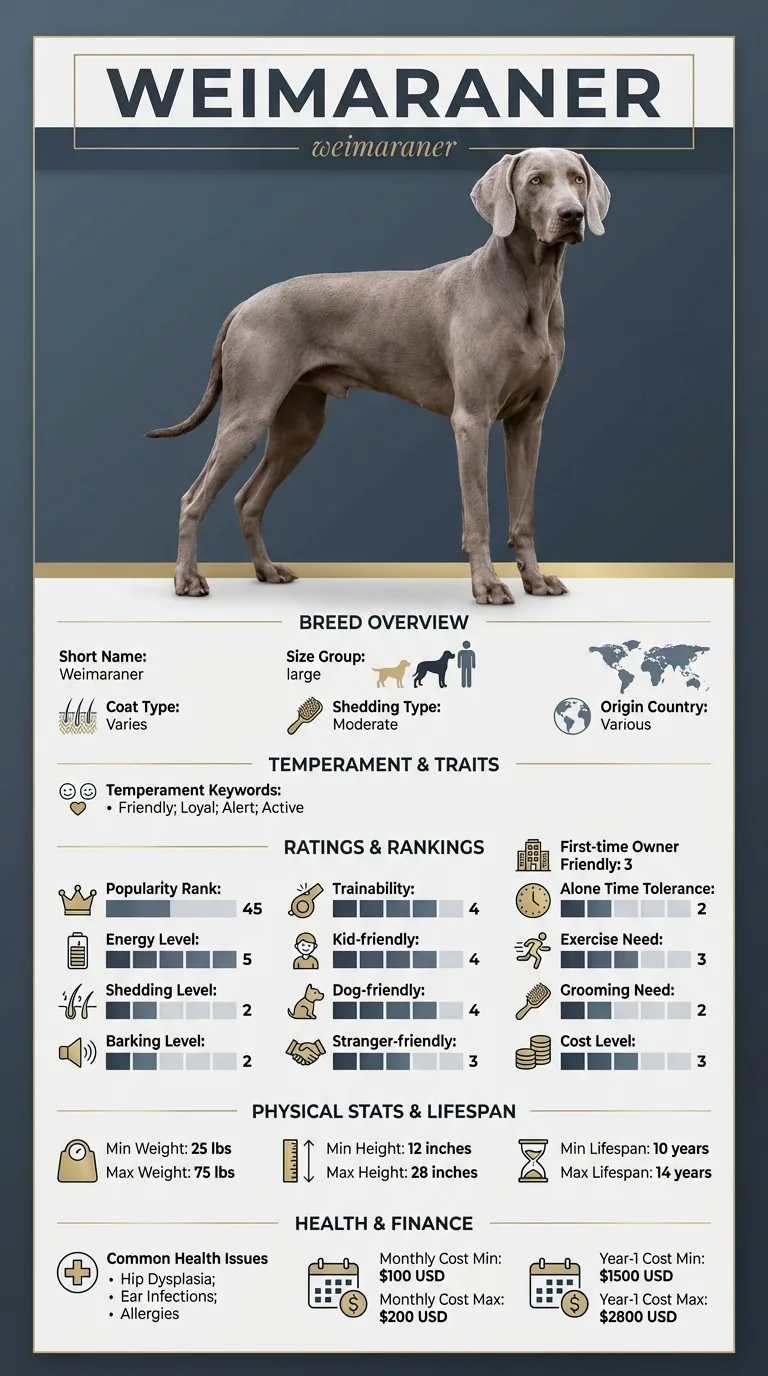
Bloat (GDV), Hip Dysplasia, Hypertrophic Osteodystrophy, Von Willebrand Disease and Separation Anxiety are documented in this breed. Locally, the expensive failure mode is behavioural: an under-exercised dog with the lowest alone-time tolerance we record does not sit quietly, it dismantles things.
Charlotte's prices are unremarkable; what moves a Weimaraner budget here is whether the household's location supplies free distance or forces a purchased substitute.
Estimate · source: estimation · confidence: medium · updated 2026-09-06 · not a quote
| Item | Cost range |
|---|---|
One-time setup: exam, spay or neuter, crate and gear Large-breed crate and secure fencing hardware if the new-build fence was specified for a smaller dog. | $475 - $792 |
| Item | Cost range |
|---|---|
Food for a 55-to-90-pound sporting dog North Carolina retail sits slightly under national pricing on a volume set by the dog's build. | $54 - $94 |
Each range starts from a national baseline for this breed's size class and is then adjusted for local cost of living and veterinary pricing. The baselines, and the source each one came from, are listed on our sources page (dataset 2026.09). Two inputs, the purchase price and the emergency reserve, have no published national figure we could verify, so we leave them to you rather than invent them.
These are planning estimates, not quotes. Your own numbers will move with the individual dog, your vet and your insurer. Build a budget with your own figures.
Insurance in Charlotte is a straightforward hedge against this breed's surgical list, priced against a market close to the national average.
Take the quote in the first year, before growth-stage or orthopedic findings appear and get written out of cover.
Owners holding a comfortable reserve may reasonably self-fund, especially given local pricing sits below coastal levels.
The Charlotte strategy is location and training: free distance beats a bigger lawn, and early classes beat late behaviour work.
Growth has changed what a Charlotte house looks like. Lots are tighter, fences are closer together, and the practical result is that a large sporting dog can cross the whole garden in a few strides. That is fine for a bathroom break and useless as a workout.
What the county does have is a substantial and still-expanding greenway network — long, connected, paved corridors following the creeks, several of them running for miles through built-up areas. For this breed those are worth far more than a bigger lawn, because they permit distance rather than laps.
So when you are choosing between two Charlotte neighbourhoods, the question that affects the dog budget is not which house has more grass. It is which one lets you walk onto a continuous greenway without loading the dog into a car first.
The other side of rapid growth is demand. Trainers, walkers and daycares in the popular corridors book up, and this is a breed that needs all three more than most. Rated 4 for trainability but described as headstrong, a Weimaraner responds extremely well to structured work and extremely badly to none.
Booking training early in the first year is therefore both a behavioural and a financial decision. A group class for an adolescent costs a fraction of private behaviour consultations for a two-year-old that has learned it can pull an adult off balance.
On the recurring side, North Carolina's ten-month parasite season is long without being year-round, and every dose is priced for a dog in the top weight bracket. Grooming, by contrast, is close to a non-cost: this coat is documented as short, sleek and low-shedding.

A family moving from an older Charlotte neighbourhood to a new development traded a modest house on a deep lot for a larger house on a compact one, and assumed their two-year-old Weimaraner would barely notice. Within a month the dog was digging at the fence line and had started barking at everything that moved. The fix was not another move: it was the realisation that their previous routine had involved a long creek walk they no longer did. Once they built a daily greenway run back into the schedule, the digging stopped.
Key takeaway: For this breed in Charlotte, connected greenway access does what a big yard cannot — and losing it, even while gaining house, is what quietly starts the problems.
Around $109 to $238, marginally under the national middle, before any walking or daycare service.
Roughly $1,683 to $3,168 including initial veterinary work, spay or neuter if you choose it, large-breed gear and a first obedience course.
No. With the maximum exercise and energy ratings we record, this dog needs distance and variety, which a modern Charlotte lot cannot supply on its own.
Potentially the entire daycare line. Households that can walk onto a connected greenway tend to manage this breed without buying supplementary exercise.
Worth quoting while the dog is young. Bloat is the documented emergency in this breed and Charlotte's vet pricing is close enough to average that policies price predictably.
About $830, which reflects local pricing for a serious after-hours episode.
About $109–$238 monthly and $1,683–$3,168 in year one at near-average pricing — with greenway proximity, not lot size, deciding whether this maximum-exercise breed needs paid daycare.
This guide is not medical advice. If your dog shows pain, sudden behavior change, or worsening symptoms, consult a licensed veterinarian.
Some links may be affiliate links. We may earn a commission at no extra cost to you. We only suggest products we believe are helpful for dog owners.
We research and check what we publish, but we do not warrant that any figure, date, price, or statement is accurate, complete, or current, and we accept no liability for any loss, cost, injury, or other harm arising from the use of this site. Use it as one reference among several. You remain responsible for your own decisions and for your dog's care - confirm anything that matters with a licensed veterinarian or another qualified professional before you act on it. Full disclaimer.
One sheet with every line item, the emergency fund and when insurance pays off - unlocks on this page.
You get: 12-month budget sheet
No spam. One-click unsubscribe. See our privacy policy.
Preview page 1 before you decide.