Costs
Akita cost in Honolulu
About $180–$340/month, $2,600–$4,400 for year one — the highest-cost city on this site.

See Akita price across all cities →
Quick answer
Akita cost in Honolulu
About $180–$340/month, $2,600–$4,400 for year one — the highest-cost city on this site.
An Akita in Honolulu runs about $180–$340 a month, with the first year closer to $2,600–$4,400 — by far the highest cost on this site once inter-island and mainland shipping are factored in.
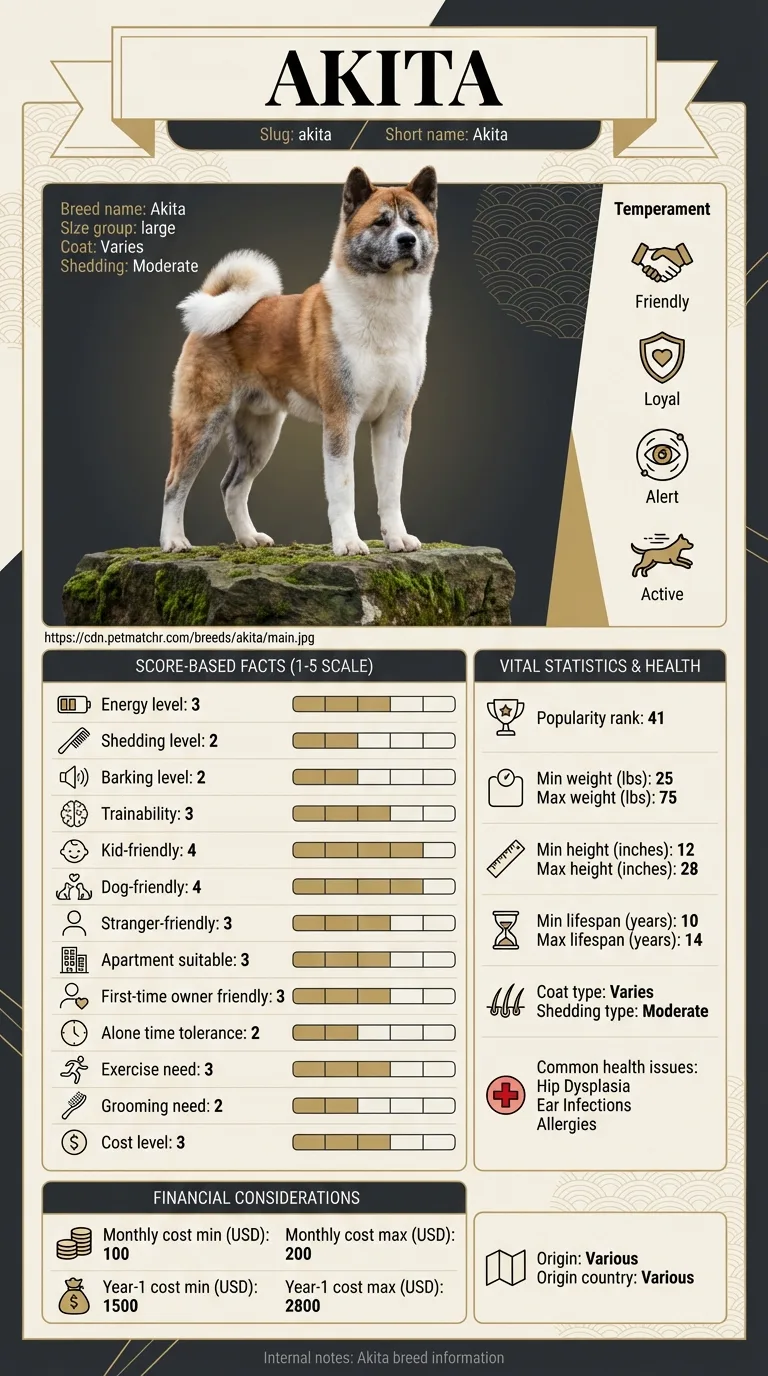
Beyond Hawaii's baseline high prices, the breed's own risks apply — hip dysplasia and the Akita's tendency toward ear infections are the likeliest sources of an unplanned bill, and both cost meaningfully more to treat here than almost anywhere else on this site. Hawaii's strict animal-entry rules also mean any dog arriving from the mainland faces a real, separate one-time cost most other cities don't have.
These figures adjust the Akita's typical national cost range sharply upward for Honolulu — Hawaii's shipping-dependent economy makes it the highest-cost city on this site by a wide margin, touching every line item rather than just one or two.
Estimate · source: estimation · confidence: low · updated 2026-10-06 · not a quote
| Item | Cost range |
|---|---|
One-time entry/quarantine costs Highly variable depending on how well-prepared vaccination and paperwork timing are before arrival — ranges from a manageable pre-clearance fee to a costly multi-week quarantine stay. Research this well before a move to Hawaii. | $200 - $1500 |
One-time setup (initial vet visit, spay/neuter, large-breed gear) Priced at Honolulu's exceptionally high rates; this and the entry costs above are the biggest reasons the first-year total on this page is the highest on this site. | $650 - $1100 |
| Item | Cost range |
|---|---|
Food Shipping costs meaningfully increase pet food pricing in Hawaii; an AAFCO-compliant food matters more than a specific brand, but expect this line item to run well above mainland prices regardless of brand. | $75 - $120 |
Grooming Akitas mostly self-groom; at-home brushing through the coat-blow seasons covers most needs, though Honolulu's own high prices apply if professional grooming is used. | $20 - $40 |
Flea, tick & heartworm prevention Hawaii's mild, humid climate keeps this active year-round, and shipping costs push the per-dose price above mainland pricing. | $22 - $38 |
Each range starts from a national baseline for this breed's size class and is then adjusted for local cost of living and veterinary pricing. The baselines, and the source each one came from, are listed on our sources page (dataset 2026.09). Two inputs, the purchase price and the emergency reserve, have no published national figure we could verify, so we leave them to you rather than invent them.
These are planning estimates, not quotes. Your own numbers will move with the individual dog, your vet and your insurer. Build a budget with your own figures.
For an Akita in Honolulu, insurance is arguably the strongest case on this entire site — both the breed's hip dysplasia risk and the islands' exceptionally high vet costs point firmly the same direction.
Given the possibility that an advanced procedure could require flying the dog to the mainland, insurance purchased while the dog is young offers real protection against a worst-case cost that runs meaningfully higher here than almost anywhere else this breed is covered.
Only owners who've built an unusually large emergency fund — genuinely sized for Hawaii's costs, including possible mainland travel for treatment — should consider self-insuring instead of a policy.
Honolulu's costs run high across every category; the realistic savings come from buying smart around shipping costs and planning the entry process carefully rather than expecting to find a cheap option locally.
Almost everything sold in Hawaii, aside from what's grown or produced locally, arrives by ship or air from the mainland, and that shipping cost is baked into the price of pet food, supplies, veterinary equipment and medications alike. For a large breed like the Akita, whose food and supply needs already run higher than a small dog's simply due to size, that shipping premium compounds into a meaningfully bigger total than the same breed would cost almost anywhere else on this site.
Hawaii's animal-entry requirements are also worth knowing about specifically, since they're stricter than any other state covered here. A dog arriving from the mainland faces a quarantine or pre-arrival health-certification process aimed at keeping rabies out of the islands — Hawaii is one of the few rabies-free places in the U.S. — and depending on how well-prepared the paperwork and vaccination timing are before arrival, this can mean anywhere from a manageable pre-clearance process to a costly multi-week quarantine stay. This is a one-time cost, not a recurring one, but it can be substantial and is worth researching well before a move, not after.
On the vet-care side, Oahu (where Honolulu sits) has a reasonably deep pool of general practitioners for an island this size, but board-certified specialists are limited, and a genuinely advanced case may mean flying a dog to the mainland for treatment — an added cost and logistical challenge that essentially no other city on this site has to consider.

A family relocating to Honolulu with their Akita started researching Hawaii's animal-entry requirements nearly six months before their move, working with their mainland vet to time vaccinations and paperwork to qualify for the shortest pre-clearance option rather than a full quarantine stay. The upfront planning meant their dog cleared entry within days of arrival rather than facing a multi-week quarantine, saving both significant cost and, just as importantly, avoiding weeks of separation from their pet during an already stressful move.
Key takeaway: Hawaii's entry requirements reward early planning dramatically — starting the paperwork and vaccination timeline months ahead of a move is the single biggest cost-saving decision an owner relocating here with an Akita can make.
Around $180–$340, covering food, routine vet care, grooming and parasite prevention. Hawaii's shipping-dependent cost structure pushes nearly every line item above what the same breed costs on the mainland.
Roughly $2,600–$4,400, including the initial vet exam, spay/neuter if needed, and large-breed gear on top of ongoing monthly costs — the highest first-year range on this site.
Yes — Hawaii has strict animal-entry rules aimed at keeping the islands rabies-free, and a dog arriving from the mainland may face a quarantine or pre-clearance process depending on how the vaccination and paperwork timeline lines up before arrival. This is a real, sometimes substantial one-time cost worth researching well ahead of a move.
General veterinary care is reasonably available on Oahu, but board-certified specialists are limited given the island's size. A genuinely advanced case, such as complex orthopedic surgery, may require flying the dog to the mainland for treatment.
Strongly worth pricing out given both the breed's hip dysplasia risk and Hawaii's exceptionally high vet costs — a specialist procedure here, or one requiring mainland travel, costs more than almost anywhere else this breed is covered.
Around $1,200 is a reasonable floor given the islands' high overall pricing. If hip dysplasia becomes a specific concern and mainland travel for treatment is a possibility, building toward $4,000 or more better reflects the real worst case here.
About $180–$340/month, $2,600–$4,400 for year one — the highest-cost city on this site.
This guide is not medical advice. If your dog shows pain, sudden behavior change, or worsening symptoms, consult a licensed veterinarian.
Some links may be affiliate links. We may earn a commission at no extra cost to you. We only suggest products we believe are helpful for dog owners.
We research and check what we publish, but we do not warrant that any figure, date, price, or statement is accurate, complete, or current, and we accept no liability for any loss, cost, injury, or other harm arising from the use of this site. Use it as one reference among several. You remain responsible for your own decisions and for your dog's care - confirm anything that matters with a licensed veterinarian or another qualified professional before you act on it. Full disclaimer.
One sheet with every line item, the emergency fund and when insurance pays off - unlocks on this page.
You get: 12-month budget sheet
No spam. One-click unsubscribe. See our privacy policy.
See a sample page before you decide.