Behavior
Which needs more exercise?
The Siberian Husky, rated Very High (5/5) versus the Schnauzer's High (4/5).

Quick answer
Which needs more exercise?
The Siberian Husky, rated Very High (5/5) versus the Schnauzer's High (4/5).
Schnauzer (Standard) or Siberian Husky? On paper they differ most on shedding, and on the scales Siberian Husky is the heavier at 45–60 lbs. Here is how the two compare on everything that shapes an ordinary week.
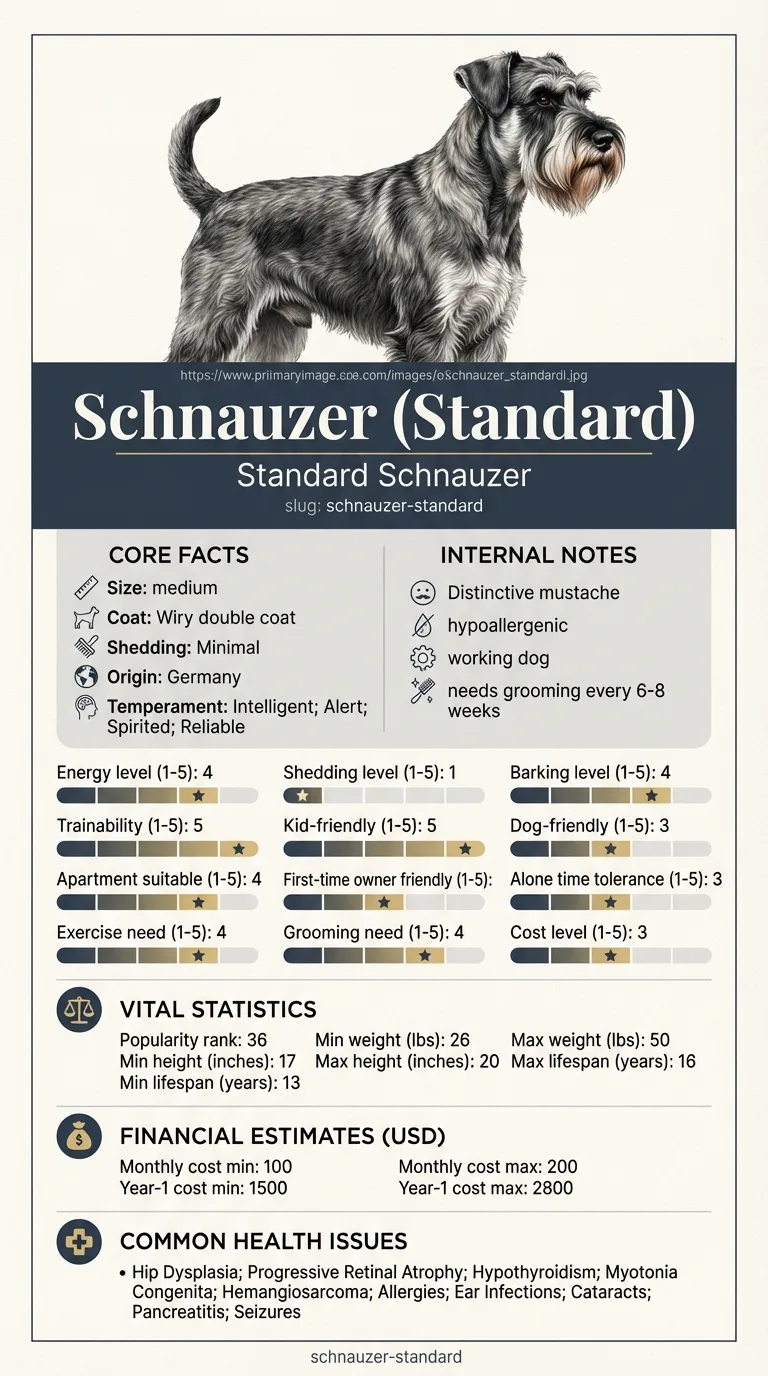
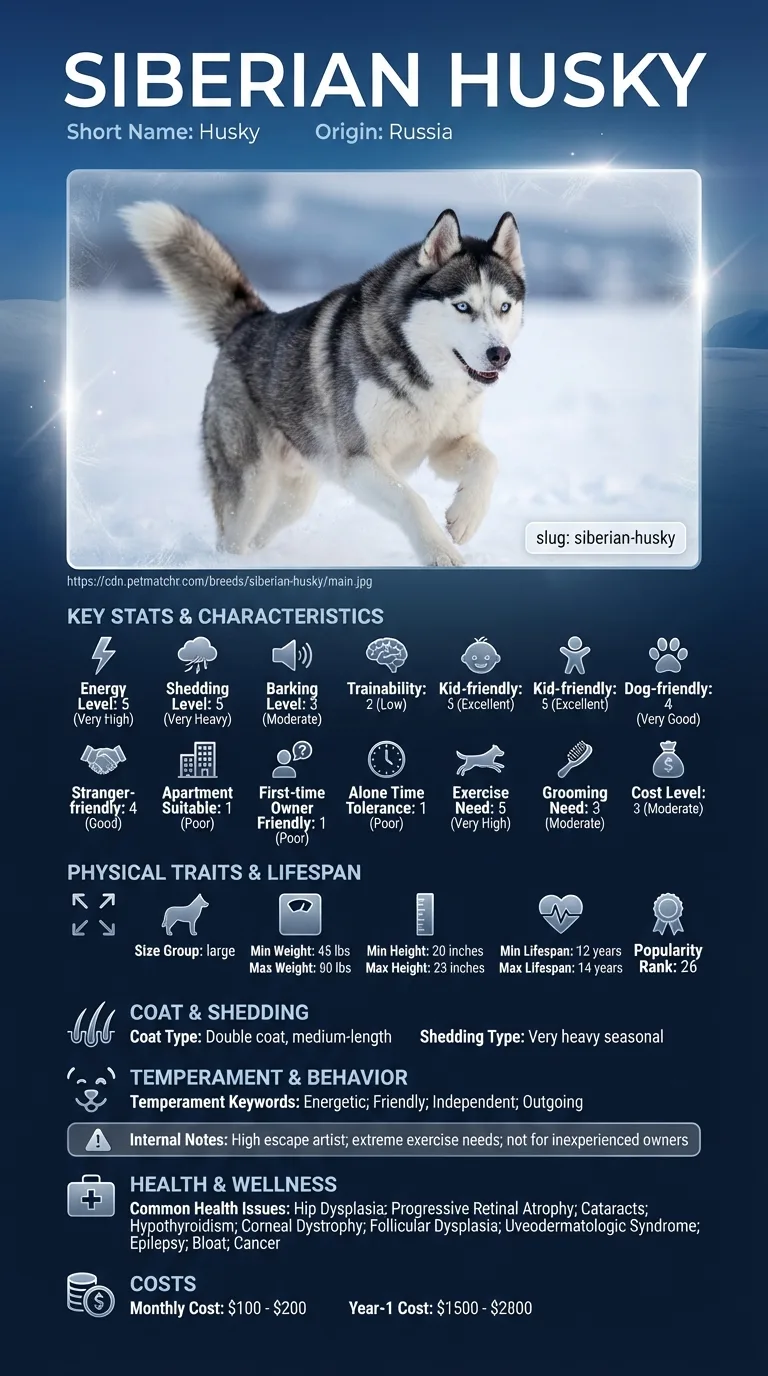
This is for someone already down to Schnauzer (Standard) and Siberian Husky and deciding between them. For this pair the decision usually turns on shedding and apartment suitability, so those are covered first and in most detail. Anyone choosing from a flat has a clear answer here: Schnauzer (Standard) rates 4/5 against 1/5. It is written for the decision rather than the breed history.
Between Schnauzer (Standard) and Siberian Husky, shedding is what separates them, and Schnauzer (Standard) is the lower-effort dog of the two to keep.
Choose Schnauzer (Standard) if you are in a flat or a smaller home, this is your first dog and shedding is a problem in your house.
Choose Siberian Husky if you do not want a standing grooming appointment, you already have another dog and you want a dog that can keep up with an active routine.
| Feature | schnauzer standard | siberian husky | Winner |
|---|---|---|---|
| Size class | medium | large | Equal |
| Weight | 26–50 lbs | 45–60 lbs | Equal |
| Height | 17–20 in | 20–23 in | Equal |
| Lifespan | 13–16 years | 12–14 years | schnauzer standard |
| Exercise need | High (4/5) | Very high (5/5) | schnauzer standard |
| Grooming need | High (4/5) | Moderate (3/5) | siberian husky |
| Shedding | Very low (1/5) | Very high (5/5) | schnauzer standard |
| Energy level | High (4/5) | Very high (5/5) | Equal |
| Barking | High (4/5) | Moderate (3/5) | siberian husky |
| Apartment suitability | High (4/5) | Very low (1/5) | schnauzer standard |
| Good for first-time owners | Moderate (3/5) | Very low (1/5) | schnauzer standard |
| Tolerates being alone | Moderate (3/5) | Very low (1/5) | schnauzer standard |
| Trainability | Very high (5/5) | Low (2/5) | schnauzer standard |
| Good with kids | Very high (5/5) | Very high (5/5) | Equal |
| Good with other dogs | Moderate (3/5) | High (4/5) | siberian husky |
| Friendly to strangers | Moderate (3/5) | High (4/5) | siberian husky |
| Cost level | Moderate (3/5) | Moderate (3/5) | Equal |
| Coat | Wiry double coat | Double coat, medium-length | Equal |
| Origin | Germany | Russia | Equal |
| Typical monthly cost | $100–$200 | $100–$200 | Equal |
| Typical first-year cost | $1,500–$2,800 | $1,500–$2,800 | Equal |
Where the Standard Schnauzer tops out at 50 lbs and 20 inches, the Siberian Husky starts near that weight and climbs to 60 lbs and 23 inches — a genuinely large dog next to a medium one. The Husky's frame reflects its origin as a sled-pulling breed built for endurance across long distances, while the Schnauzer's more compact, square body was suited to farm work in tighter quarters. Both are athletic rather than bulky, but the Husky's extra height and reach mean it needs more physical space to move comfortably, a detail worth weighing before committing to either breed.
The Husky rates Very High (5/5) for exercise need against the Schnauzer's already-demanding High (4/5) — a meaningful step up given the Husky's sled-dog stamina and Energetic temperament trait. Both dogs carry serious activity requirements, but the Husky's needs are harder to satisfy with a simple walk; it was bred to run for hours and often needs structured outlets like jogging, hiking or dedicated exercise equipment. The Schnauzer's High energy is real but more manageable with a solid daily walk and some yard time. Neither breed suits a sedentary household.
Shedding is where these two diverge most sharply: the Schnauzer rates Very Low (1/5) thanks to its wiry, non-shedding double coat, while the Husky rates Very High (5/5), blowing its dense double coat seasonally in dramatic clumps. Grooming maintenance runs the opposite direction, though — the Schnauzer needs High (4/5) attention for hand-stripping or clipping, while the Husky's Moderate (3/5) rating reflects a coat that mostly just needs regular brushing rather than professional trims. Owners sensitive to loose fur around the house should lean Schnauzer; those who don't mind seasonal shedding but want less clipping upkeep may prefer the Husky.
The gap here is stark: the Schnauzer rates High (4/5) for apartment suitability while the Husky rates Very Low (1/5), and the pattern repeats for alone-tolerance, where the Schnauzer's Moderate (3/5) dwarfs the Husky's Very Low (1/5). Huskies are notorious for vocalizing when bored or isolated, and though their Moderate (3/5) barking score is technically lower than the Schnauzer's High (4/5), they're known for howling instead — a sound that travels through apartment walls just as easily. Combined with its Very High exercise needs, the Husky is a poor match for apartment living or long solo hours.
The contrast in trainability is dramatic: the Schnauzer rates Very High (5/5) while the Husky rates Low (2/5), reflecting the Husky's Independent temperament trait and famously selective recall. First-time-owner suitability follows the same pattern — Moderate (3/5) for the Schnauzer versus Very Low (1/5) for the Husky. Huskies are intelligent but bred to think for themselves on the trail, not to defer to handlers, which makes consistent obedience work far harder than with the biddable, Alert Schnauzer. New owners drawn to the Husky's looks should be prepared for a steep learning curve.
Both breeds rate Very High (5/5) with kids, so families aren't choosing between good and bad here — both are strong choices. The difference shows up elsewhere: the Husky beats the Schnauzer with other dogs, High (4/5) versus Moderate (3/5), consistent with its pack-oriented sled-dog history, and it's also friendlier to strangers at High (4/5) against the Schnauzer's Moderate (3/5). The Schnauzer's more Alert, Reliable temperament makes it a naturally better watchdog, while the Husky's Friendly, Outgoing nature means it's unlikely to guard the house — worth knowing if a family wants a dog that's protective versus simply sociable.
The Schnauzer's 13–16 year lifespan edges out the Husky's 12–14 years. Both breeds share Hip Dysplasia, Progressive Retinal Atrophy, Cataracts and Hypothyroidism as concerns, but each carries distinct risks too: the Schnauzer's list includes Myotonia Congenita and Hemangiosarcoma, while the Husky's includes Corneal Dystrophy, Follicular Dysplasia, Uveodermatologic Syndrome and Bloat. The overlap in eye and thyroid conditions means both breeds benefit from regular ophthalmologic screening, but the Husky's added Bloat risk means owners should also watch feeding habits and avoid vigorous exercise right after meals.
Cost is a rare category where these two land identically: both rate Moderate (3/5) overall, with matching typical monthly spend of $100–$200 and first-year costs of $1,500–$2,800. The similarity masks different cost drivers, though — the Schnauzer's budget leans toward grooming and clipping, while the Husky's goes toward food volume for its larger frame and potential fencing or containment costs given its Very Low apartment suitability and escape-prone reputation. Prospective owners should price out those specific line items rather than assuming the headline numbers tell the whole story.
Schnauzer (Standard) weighs 26–50 lbs and lives 13–16 years; Siberian Husky weighs 45–60 lbs and lives 12–14 years. The two diverge most on shedding, apartment suitability and trainability and 2 other rated axes. They are level on cost level and good with kids, so those cannot decide it. In the table, a "winner" means easier for an ordinary household — not better. Size, coat and origin are recorded without a verdict. Because both breeds are scored the same way, the gaps are reliable even where the absolute numbers are rough.

Yes — the Husky reaches 45–60 lbs and 20–23 inches, compared to the Schnauzer's 26–50 lbs and 17–20 inches, making the Husky the larger breed overall.
The Standard Schnauzer by a wide margin — it rates Moderate (3/5) for first-time owners versus the Husky's Very Low (1/5), thanks to easier trainability and less intense exercise demands.
Much more — the Husky rates Very High (5/5) for shedding against the Schnauzer's Very Low (1/5), so expect regular seasonal coat-blows with the Husky.
Neither is silent, but the Husky rates lower on barking (Moderate 3/5 vs the Schnauzer's High 4/5) — though Huskies are known for howling instead of barking.
Not comfortably — the Schnauzer rates only Moderate (3/5) for alone-tolerance and the Husky rates Very Low (1/5), so both need company or enrichment during long absences.
The Schnauzer, rated Very High (5/5) for trainability compared to the Husky's Low (2/5) — the Husky's independent streak makes obedience work slower going.
Yes — both rate Very High (5/5) with kids, so this category is a genuine tie.
The Siberian Husky, rated Very High (5/5) versus the Schnauzer's High (4/5).
The Standard Schnauzer, rated High (4/5) versus the Husky's Very Low (1/5).
The Schnauzer, with a 13–16 year lifespan versus the Husky's 12–14 years.
The Siberian Husky, rated High (4/5) versus the Schnauzer's Moderate (3/5).
Secure checkout on Stripe. We never see your card.
7-day money-back guarantee. Instant access.
Health information here is general and is not veterinary advice. If your dog shows pain, sudden behaviour change, or worsening symptoms, consult a licensed veterinarian.
Some links on this site are affiliate links. We may earn a commission at no extra cost to you, and we only suggest products we believe are helpful for dog owners.
We research and check what we publish, but we do not warrant that any figure, date, price, or statement is accurate, complete, or current, and we accept no liability for any loss, cost, injury, or other harm arising from the use of this site. Use it as one reference among several. You remain responsible for your own decisions and for your dog's care - confirm anything that matters with a licensed veterinarian or another qualified professional before you act on it. Full disclaimer.
Match your lifestyle to the right dog.
Take quizNot sure which breed is right for you? Take our 2-minute quiz to find out.
Take the quiz