Living
Which is heavier?
The Rottweiler, up to 135 lbs versus the Husky's 60 lbs.

Quick answer
Which is heavier?
The Rottweiler, up to 135 lbs versus the Husky's 60 lbs.
Rottweiler or Siberian Husky? On paper they differ most on trainability, and on the scales Rottweiler is the heavier at 80–135 lbs. Here is how the two compare on everything that shapes an ordinary week.
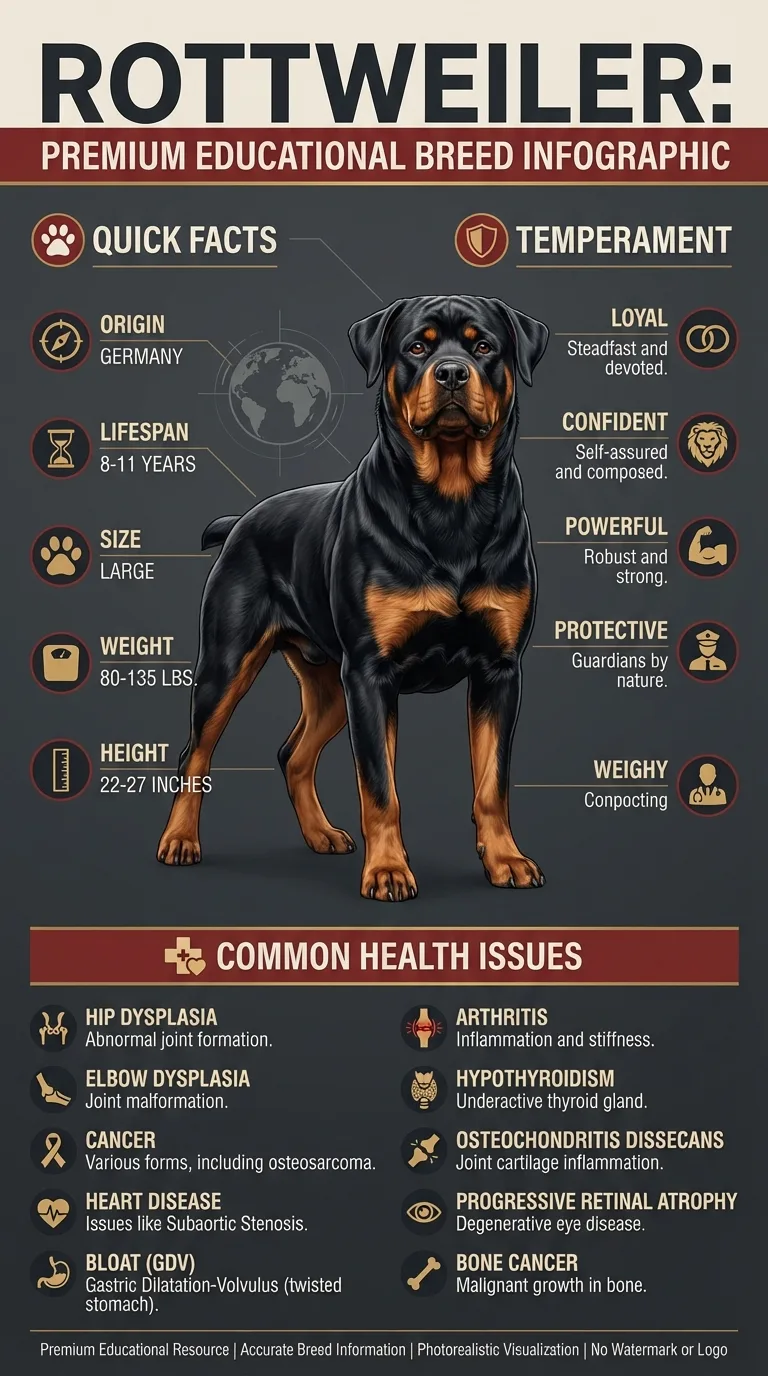
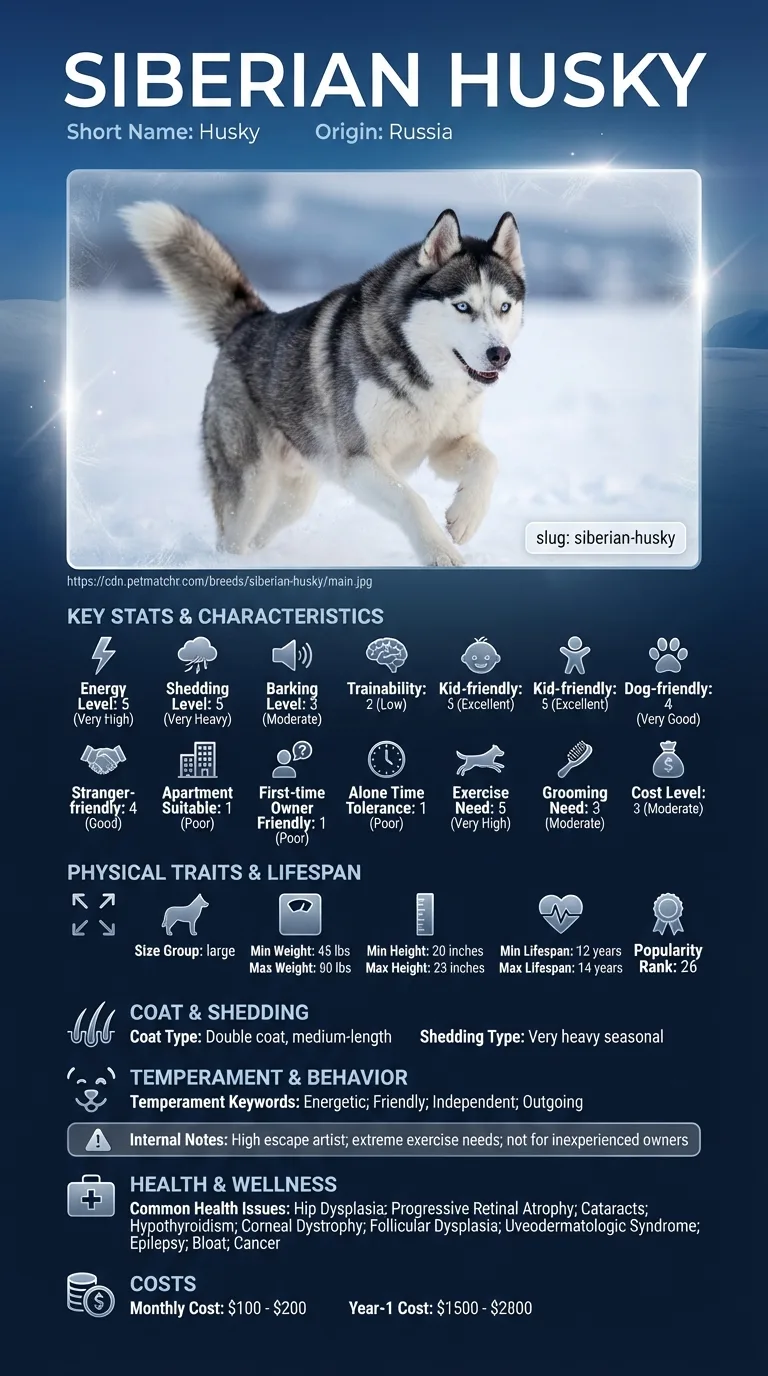
This is for someone already down to Rottweiler and Siberian Husky and deciding between them. For this pair the decision usually turns on trainability and friendly to strangers, so those are covered first and in most detail. Anyone choosing from a flat has a clear answer here: Rottweiler rates 2/5 against 1/5. Breed history is left out; what follows is what you will actually live with.
Between Rottweiler and Siberian Husky, trainability is what separates them, and Rottweiler is the lower-effort dog of the two to keep.
Choose Rottweiler if you do not want a standing grooming appointment, shedding is a problem in your house and your walking routine is modest.
Choose Siberian Husky if there are young children at home, you already have another dog and a smaller dog suits your car, your home or your back.
| Feature | rottweiler | siberian husky | Winner |
|---|---|---|---|
| Size class | large | large | Equal |
| Weight | 80–135 lbs | 45–60 lbs | Equal |
| Height | 22–27 in | 20–23 in | Equal |
| Lifespan | 8–11 years | 12–14 years | siberian husky |
| Exercise need | High (4/5) | Very high (5/5) | rottweiler |
| Grooming need | Low (2/5) | Moderate (3/5) | rottweiler |
| Shedding | High (4/5) | Very high (5/5) | rottweiler |
| Energy level | High (4/5) | Very high (5/5) | Equal |
| Barking | Moderate (3/5) | Moderate (3/5) | Equal |
| Apartment suitability | Low (2/5) | Very low (1/5) | rottweiler |
| Good for first-time owners | Low (2/5) | Very low (1/5) | rottweiler |
| Tolerates being alone | Low (2/5) | Very low (1/5) | rottweiler |
| Trainability | High (4/5) | Low (2/5) | rottweiler |
| Good with kids | High (4/5) | Very high (5/5) | siberian husky |
| Good with other dogs | Moderate (3/5) | High (4/5) | siberian husky |
| Friendly to strangers | Low (2/5) | High (4/5) | siberian husky |
| Cost level | High (4/5) | Moderate (3/5) | siberian husky |
| Coat | Double coat, short | Double coat, medium-length | Equal |
| Origin | Germany | Russia | Equal |
| Typical monthly cost | $125–$250 | $100–$200 | Equal |
| Typical first-year cost | $2,000–$3,500 | $1,500–$2,800 | Equal |
Both land in the large-breed class, but the Rottweiler is the heavier of the two — 80–135 lbs against the Husky's leaner 45–60 lbs — while standing similarly tall, 22–27 in versus 20–23 in. The Husky's frame is built for endurance running rather than raw mass, so despite the shared large label, expect a noticeably different physical presence: the Rottweiler is a dense, blocky dog, the Husky a lean, athletic one. The Husky's lighter frame also means it's generally easier to physically restrain or redirect than the far heavier Rottweiler, even though both are technically large breeds.
The Siberian Husky needs even more than the already-active Rottweiler — Very high (5/5) exercise need against High (4/5), with energy level following the same pattern. Huskies were bred to pull sleds across long distances and that stamina doesn't disappear as a pet; under-exercised Huskies are notorious escape artists and destructive diggers. The Rottweiler's activity needs are serious but comparatively more containable. A securely fenced yard is close to mandatory for the Husky given its Very high exercise need and well-documented escape tendencies, more so than for the Rottweiler.
The Rottweiler needs less upkeep on both fronts — Low (2/5) grooming versus Moderate (3/5) for the Husky, and High (4/5) shedding versus a striking Very high (5/5) for the Husky, whose thick double coat blows out twice a year in dramatic fashion. Husky owners typically describe shed season as producing enough loose undercoat to fill grocery bags; the Rottweiler's shedding, while still heavy, is comparatively steadier and less dramatic. Daily brushing during the Husky's twice-yearly coat blow can meaningfully cut down on the amount of loose fur that ends up on furniture and clothing.
Both score poorly for small-space living, but the Husky is worse — Very low (1/5) apartment suitability against Low (2/5) for the Rottweiler — and it also tolerates being alone less well, Very low (1/5) versus Low (2/5). Barking ties at Moderate (3/5), though Huskies are known for vocalizing through howls and talking rather than straightforward barking. Neither breed suits a home where long solo hours are the norm. That shared Moderate barking score doesn't fully capture the Husky's tendency to howl, a distinct kind of noise some neighbors find more disruptive than steady barking.
The Rottweiler is significantly more trainable, High (4/5) against Low (2/5) for the Husky, and also scores better for first-time owners, Low (2/5) versus a rock-bottom Very low (1/5) for the Husky. The Husky's Independent temperament word explains the gap — bred to problem-solve on the trail without constant human direction, Huskies are famous for selective hearing, while the Rottweiler's Loyal, Confident profile makes it more responsive to structured training. Recall training is a particular challenge with the Husky given its Low trainability score, and many owners rely on secure enclosures rather than off-leash freedom.
The Husky pulls ahead in sociability across the board — Very high (5/5) with kids against High (4/5) for the Rottweiler, High (4/5) with other dogs versus Moderate (3/5), and a notably friendlier High (4/5) with strangers against the Rottweiler's Low (2/5). The Husky's Friendly, Outgoing temperament makes it a poor guard dog by comparison but an easier fit for households that want a dog to warmly greet everyone who walks in. The Husky's pack-oriented history also makes it generally comfortable in multi-dog households, an area where its High rating for other dogs holds up well in practice.
The Husky lives longer, 12–14 years against 8–11 for the Rottweiler, and both carry ten-condition health lists. The Husky's includes eye-focused concerns — Progressive Retinal Atrophy, Cataracts, Corneal Dystrophy — plus Follicular Dysplasia and Uveodermatologic Syndrome, alongside Epilepsy, Bloat, and Cancer, while the Rottweiler's list leans toward orthopedic and cardiac risk with Hip Dysplasia, Elbow Dysplasia, and Heart Disease. Both breeds warrant regular vet screening despite the Husky's longer average lifespan. Cancer appears on both breeds' health lists, a reminder that regular veterinary screening matters regardless of which dog a household ultimately chooses.
The Husky is the more affordable breed to keep, Moderate (3/5) cost level against High (4/5) for the Rottweiler, with monthly costs of $100–$200 versus $125–$250 and first-year costs of $1,500–$2,800 against $2,000–$3,500 — though a Husky's tendency toward escape and destruction if under-exercised can add unplanned costs like fencing repairs that don't show up in a standard budget line. Fencing upgrades to prevent escape can be a real added cost for Husky owners that doesn't show up in the standard monthly cost estimate.
Rottweiler weighs 80–135 lbs and lives 8–11 years; Siberian Husky weighs 45–60 lbs and lives 12–14 years. The two diverge most on trainability and friendly to strangers. Almost every rated axis separates them at least slightly. The comparison marks an easier option only where one exists. Facts like weight and country of origin are not scored. Both dogs are rated from the same dataset, which is what makes the numbers comparable with each other even though any individual dog sits somewhere inside its breed's range.

The Husky, rated Very high (5/5) against High (4/5) for the Rottweiler — both are demanding, but the Husky's sled-dog stamina sets an even higher bar.
The Rottweiler, scoring High (4/5) versus Low (2/5) for the Husky, whose Independent nature makes off-leash reliability a common struggle.
The Husky, rated High (4/5) friendliness to strangers versus Low (2/5) for the Rottweiler — a Husky's Friendly, Outgoing nature makes it a poor watchdog.
The Husky, Very high (5/5) versus High (4/5) for the Rottweiler, with dramatic biannual coat blows.
The Husky, 12–14 years compared to 8–11 for the Rottweiler.
Not really — the Rottweiler scores Low (2/5) and the Husky scores Very low (1/5), the lowest rating in this comparison.
The Husky, at $100–$200 monthly versus $125–$250 for the Rottweiler, though escape-proofing costs can offset the savings.
The Rottweiler, up to 135 lbs versus the Husky's 60 lbs.
The Siberian Husky, rated Low (2/5) trainability versus High (4/5) for the Rottweiler.
The Siberian Husky, at Very low (1/5) versus Low (2/5) for the Rottweiler.
The Siberian Husky, High (4/5) versus Low (2/5) for the Rottweiler.
Secure checkout on Stripe. We never see your card.
7-day money-back guarantee. Instant access.
Health information here is general and is not veterinary advice. If your dog shows pain, sudden behaviour change, or worsening symptoms, consult a licensed veterinarian.
Some links on this site are affiliate links. We may earn a commission at no extra cost to you, and we only suggest products we believe are helpful for dog owners.
We research and check what we publish, but we do not warrant that any figure, date, price, or statement is accurate, complete, or current, and we accept no liability for any loss, cost, injury, or other harm arising from the use of this site. Use it as one reference among several. You remain responsible for your own decisions and for your dog's care - confirm anything that matters with a licensed veterinarian or another qualified professional before you act on it. Full disclaimer.
Match your lifestyle to the right dog.
Take quizNot sure which breed is right for you? Take our 2-minute quiz to find out.
Take the quiz