Living
Which is heavier?
The Rottweiler Mix, up to 135 lbs versus the Husky's 60 lbs max.

Quick answer
Which is heavier?
The Rottweiler Mix, up to 135 lbs versus the Husky's 60 lbs max.
Rottweiler Mix or Siberian Husky? On paper they differ most on energy level, and on the scales Rottweiler Mix is the heavier at 80–135 lbs. Here is how the two compare on everything that shapes an ordinary week.
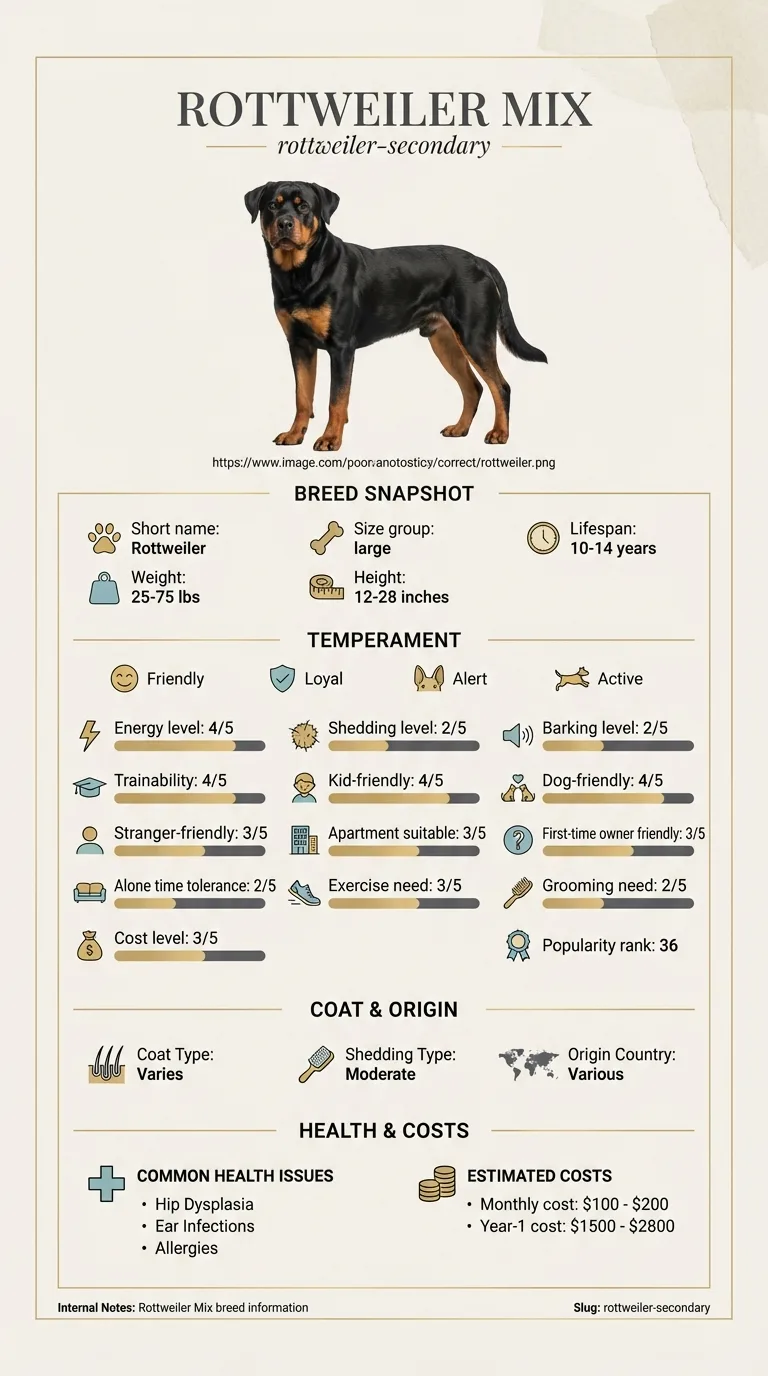
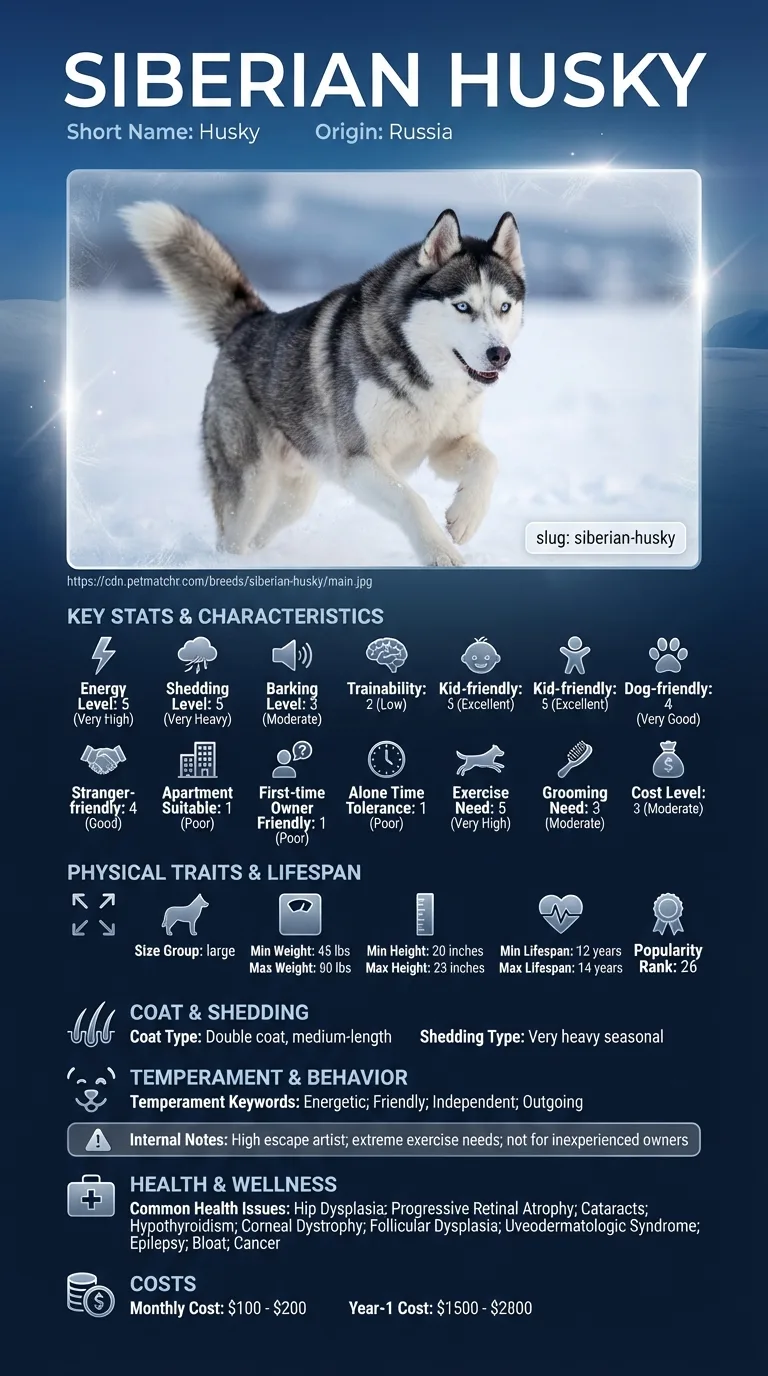
This is for someone already down to Rottweiler Mix and Siberian Husky and deciding between them. For this pair the decision usually turns on energy level and shedding, so those are covered first and in most detail. Anyone choosing from a flat has a clear answer here: Rottweiler Mix rates 2/5 against 1/5. The focus throughout is on daily consequences rather than breed background.
Between Rottweiler Mix and Siberian Husky, energy level is what separates them, and Rottweiler Mix is the lower-effort dog of the two to keep.
Choose Rottweiler Mix if you do not want a standing grooming appointment, shedding is a problem in your house and your walking routine is modest.
Choose Siberian Husky if there are young children at home, you already have another dog and a smaller dog suits your car, your home or your back.
| Feature | rottweiler secondary | siberian husky | Winner |
|---|---|---|---|
| Size class | large | large | Equal |
| Weight | 80–135 lbs | 45–60 lbs | Equal |
| Height | 22–27 in | 20–23 in | Equal |
| Lifespan | 9–10 years | 12–14 years | siberian husky |
| Exercise need | High (4/5) | Very high (5/5) | rottweiler secondary |
| Grooming need | Low (2/5) | Moderate (3/5) | rottweiler secondary |
| Shedding | Moderate (3/5) | Very high (5/5) | rottweiler secondary |
| Energy level | Moderate (3/5) | Very high (5/5) | Equal |
| Barking | Low (2/5) | Moderate (3/5) | rottweiler secondary |
| Apartment suitability | Low (2/5) | Very low (1/5) | rottweiler secondary |
| Good for first-time owners | Low (2/5) | Very low (1/5) | rottweiler secondary |
| Tolerates being alone | Moderate (3/5) | Very low (1/5) | rottweiler secondary |
| Trainability | High (4/5) | Low (2/5) | rottweiler secondary |
| Good with kids | Moderate (3/5) | Very high (5/5) | siberian husky |
| Good with other dogs | Low (2/5) | High (4/5) | siberian husky |
| Friendly to strangers | Low (2/5) | High (4/5) | siberian husky |
| Cost level | High (4/5) | Moderate (3/5) | siberian husky |
| Coat | Short, dense double coat | Double coat, medium-length | Equal |
| Origin | Various | Russia | Equal |
| Typical monthly cost | $110–$240 | $100–$200 | Equal |
| Typical first-year cost | $1,700–$3,200 | $1,500–$2,800 | Equal |
Both breeds land in the large size class, but they get there differently: the Rottweiler Mix's 80-135 lbs on a 22-27 inch frame reads as dense muscle, while the Siberian Husky's 45-60 lbs on a 20-23 inch frame reads as lean, efficient endurance build. The Husky is essentially built like a sled-pulling athlete, while the Rottweiler Mix is built like a guardian. Despite the Rottweiler Mix weighing up to three times more at the high end, the two occupy similar footprints in a home -- comparable height, similar space needs, just very different mass and center of gravity.
The Siberian Husky rates Very High (5/5) exercise need against the Rottweiler Mix's already-demanding High (4/5), and Energy level tells a similar story -- Very High (5/5) for the Husky versus Moderate (3/5) for the Rottweiler Mix. Bred to run for miles pulling sleds, the Energetic, Independent Husky is one of the most exercise-hungry breeds in any comparison, and under-exercising one reliably leads to escape attempts and destructive behavior. The Rottweiler Mix's exercise needs are real but more manageable through structured walks and play. Anyone without daily access to serious off-leash running or biking should think hard before choosing the Husky.
Grooming need rates Low (2/5) for the Rottweiler Mix and Moderate (3/5) for the Siberian Husky, but shedding is where the real difference shows: Moderate (3/5) versus Very High (5/5). Huskies famously 'blow' their thick double coat twice a year, releasing enormous volumes of undercoat that require daily brushing for weeks at a stretch -- a phenomenon owners often describe as producing a second dog's worth of fur. The Rottweiler Mix's short, dense coat sheds more predictably and evenly. Anyone who has lived through a Husky's spring coat blow rarely underestimates it again when comparing coat care across breeds.
Neither breed suits apartment living: the Rottweiler Mix rates Low (2/5) and the Husky Very Low (1/5), among the lowest apartment scores in any comparison. Alone-time tolerance is even starker -- Moderate (3/5) for the Rottweiler Mix versus Very Low (1/5) for the Husky, whose pack-oriented, Independent-but-social nature makes prolonged solitude a genuine welfare concern, often triggering howling, digging, or fence-testing. Barking rates Moderate (3/5) for the Husky against Low (2/5) for the Rottweiler Mix, though Huskies are better known for howling and vocalizing than typical barking. Both breeds need active households, not empty apartments during a nine-to-five workday.
Trainability strongly favors the Rottweiler Mix, High (4/5) against the Husky's Low (2/5), and the first-time-owner scores confirm both are demanding: Low (2/5) for the Rottweiler Mix and Very Low (1/5) for the Husky, one of the lowest scores in this dataset. Independent by design -- bred to make sled-pulling decisions on the trail without constant human direction -- the Husky often treats recall commands as optional, making secure fencing non-negotiable. The Rottweiler Mix's Confident, Steady temperament responds much more readily to structured obedience work, even though it still demands an experienced, consistent handler.
The Siberian Husky rates higher with kids (Very High 5/5 vs Moderate 3/5), other dogs (High 4/5 vs Low 2/5), and strangers (High 4/5 vs Low 2/5), reflecting its Friendly, Outgoing pack temperament that historically worked and lived in close quarters with other dogs and handlers. The Rottweiler Mix's Watchful, Loyal instincts make it more selective and protective by comparison. Ironically, the more physically demanding Husky is often the more instantly sociable dog in a crowded household, while the more trainable Rottweiler Mix requires more deliberate socialization to reach that same comfort level around strangers and other pets.
The Siberian Husky's 12-14 year lifespan beats the Rottweiler Mix's 9-10 by a solid margin, though its ten-item health list is more extensive: Hip Dysplasia, Progressive Retinal Atrophy, Cataracts, Hypothyroidism, Corneal Dystrophy, Follicular Dysplasia, Uveodermatologic Syndrome, Epilepsy, Bloat, and Cancer, with several eye conditions standing out as breed-specific concerns worth screening for. The Rottweiler Mix's shorter five-item list -- Hip Dysplasia, Elbow Dysplasia, Osteosarcoma, Subaortic Stenosis, Cruciate Ligament Tears -- weighs more heavily toward orthopedic and cardiac strain tied to its greater body mass. Both breeds benefit from early joint and eye screening given the length of these respective lists.
Cost level rates High (4/5) for the Rottweiler Mix against Moderate (3/5) for the Husky, and the numbers track: $110-$240 monthly and $1,700-$3,200 first-year for the Rottweiler Mix versus $100-$200 monthly and $1,500-$2,800 for the Husky. The gap again traces largely to food volume given the substantial weight difference. What the raw numbers don't capture is the Husky's exercise-related cost -- secure, tall fencing to prevent escape and potentially professional exercise services like dog running or daycare can add real expense that a lower-drive breed like the Rottweiler Mix doesn't demand to the same degree.
Rottweiler Mix weighs 80–135 lbs and lives 9–10 years; Siberian Husky weighs 45–60 lbs and lives 12–14 years. The two diverge most on energy level, shedding and tolerates being alone and 4 other rated axes. Almost every rated axis separates them at least slightly. The table below marks a winner only where one breed is genuinely easier for a typical owner; size and origin are facts rather than merits and stay level. Ratings come from one source applied to both breeds, so they are meaningful against each other rather than as absolute scores.

Yes, notably -- the Husky rates Low (2/5) trainability against the Rottweiler Mix's High (4/5), reflecting the Husky's independent, self-directed working heritage.
The Siberian Husky, rated Very High (5/5) with kids compared to Moderate (3/5) for the Rottweiler Mix.
Neither is ideal, but the Husky is especially unsuited to it, rated Very Low (1/5) for tolerating being alone versus Moderate (3/5) for the Rottweiler Mix.
The Siberian Husky, rated Very High (5/5) shedding due to its dramatic seasonal coat blow, versus Moderate (3/5) for the Rottweiler Mix.
The Siberian Husky, typically 12-14 years versus 9-10 years for the Rottweiler Mix.
Generally not recommended -- it rates Very Low (1/5) for first-time owners, the lowest score in this comparison, due to its independence and escape-prone nature.
The Siberian Husky, rated Very High (5/5) exercise need versus High (4/5) for the Rottweiler Mix -- both are demanding, but the Husky edges higher.
The Rottweiler Mix, up to 135 lbs versus the Husky's 60 lbs max.
The Rottweiler Mix, rated High (4/5) versus Low (2/5) for the Husky.
The Siberian Husky, rated Very High (5/5) shedding.
The Rottweiler Mix, rated Moderate (3/5) versus Very Low (1/5) for the Husky.
Secure checkout on Stripe. We never see your card.
7-day money-back guarantee. Instant access.
Health information here is general and is not veterinary advice. If your dog shows pain, sudden behaviour change, or worsening symptoms, consult a licensed veterinarian.
Some links on this site are affiliate links. We may earn a commission at no extra cost to you, and we only suggest products we believe are helpful for dog owners.
We research and check what we publish, but we do not warrant that any figure, date, price, or statement is accurate, complete, or current, and we accept no liability for any loss, cost, injury, or other harm arising from the use of this site. Use it as one reference among several. You remain responsible for your own decisions and for your dog's care - confirm anything that matters with a licensed veterinarian or another qualified professional before you act on it. Full disclaimer.
Match your lifestyle to the right dog.
Take quizNot sure which breed is right for you? Take our 2-minute quiz to find out.
Take the quiz