Behavior
Which needs more exercise?
The German Wirehaired Pointer, rating very high (5/5) versus the mix's high (4/5).

Quick answer
Which needs more exercise?
The German Wirehaired Pointer, rating very high (5/5) versus the mix's high (4/5).
German Wirehaired Pointer or Rottweiler Mix? On paper they differ most on energy level, and on the scales Rottweiler Mix is the heavier at 80–135 lbs. Here is how the two compare on everything that shapes an ordinary week.
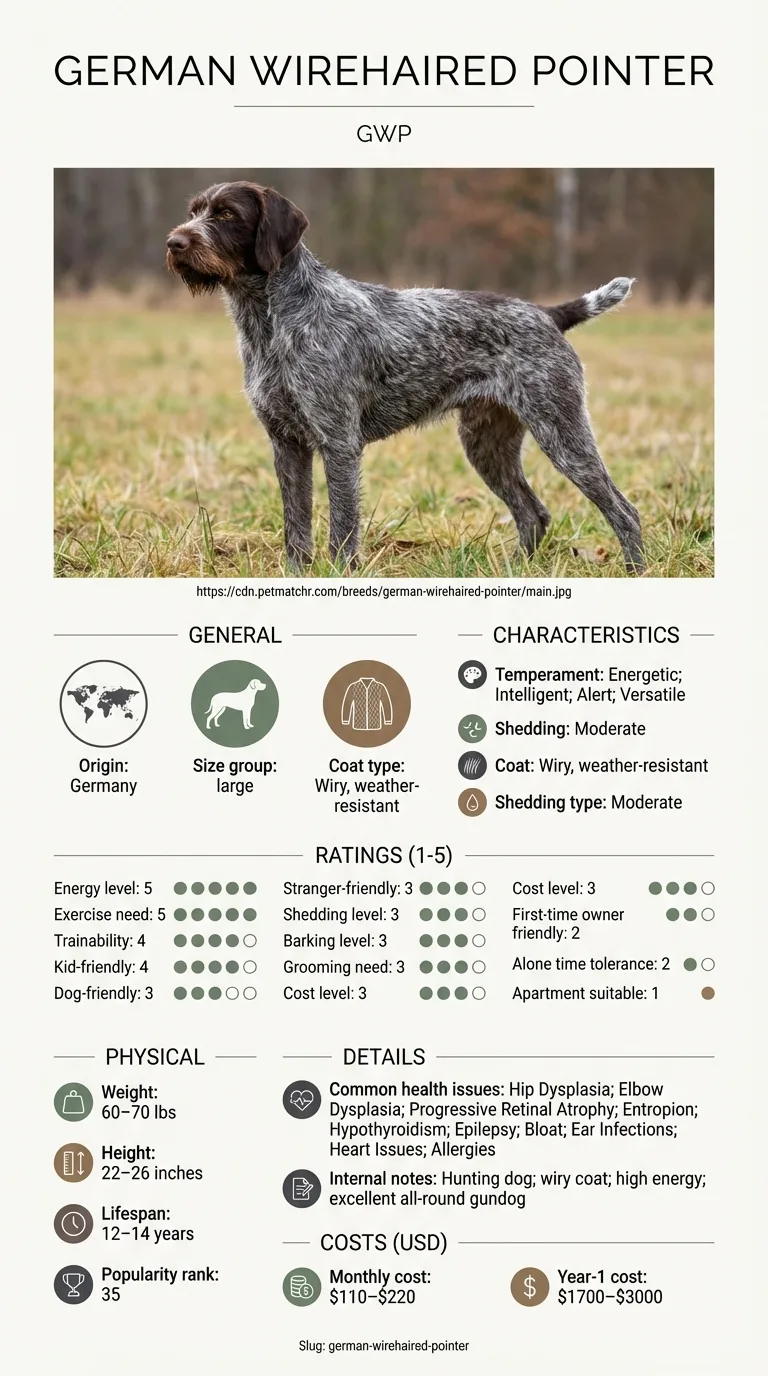
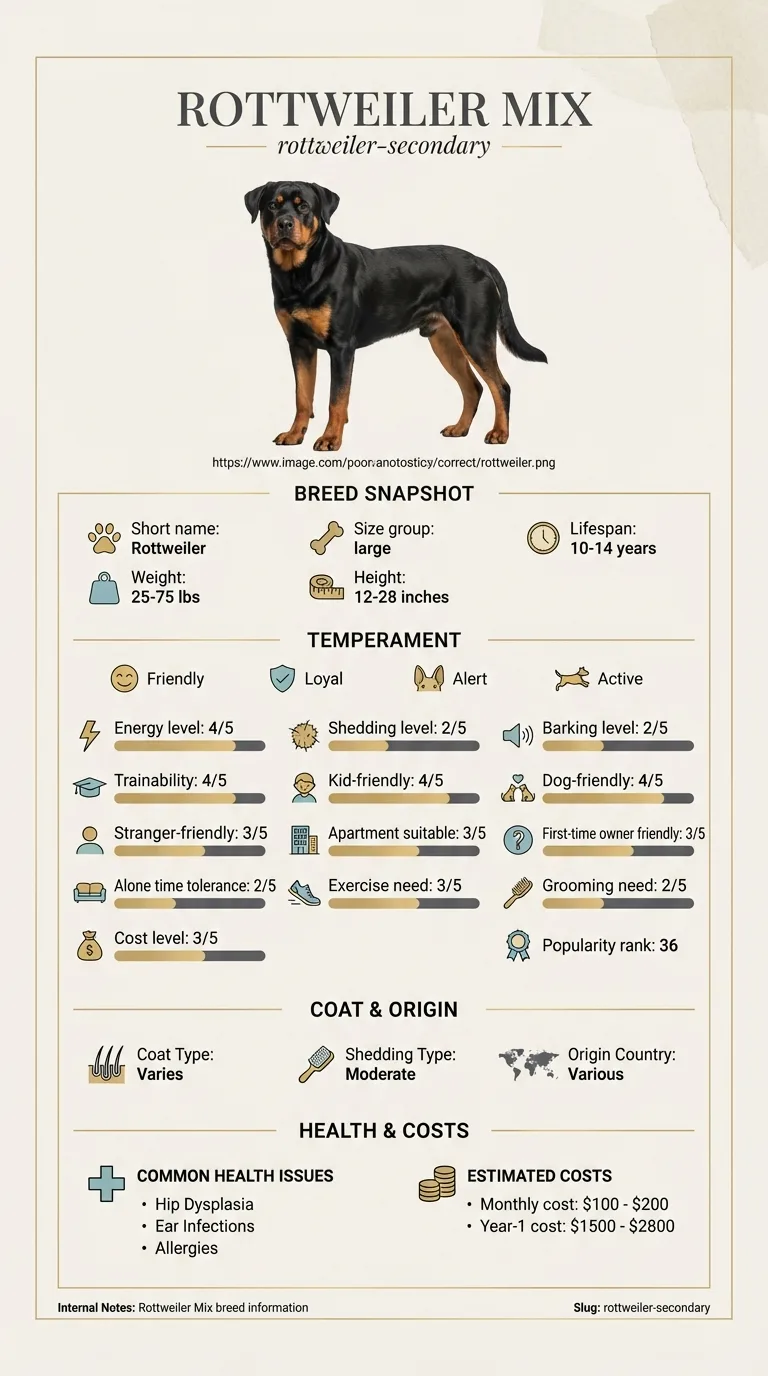
This is for someone already down to German Wirehaired Pointer and Rottweiler Mix and deciding between them. For this pair the decision usually turns on energy level, so those are covered first and in most detail. Anyone choosing from a flat has a clear answer here: Rottweiler Mix rates 2/5 against 1/5. It is written for the decision rather than the breed history.
Between German Wirehaired Pointer and Rottweiler Mix, energy level is what separates them, and Rottweiler Mix is the lower-effort dog of the two to keep.
Choose German Wirehaired Pointer if there are young children at home, you already have another dog and a smaller dog suits your car, your home or your back.
Choose Rottweiler Mix if you do not want a standing grooming appointment, your walking routine is modest and the dog will be alone during the working day.
| Feature | german wirehaired pointer | rottweiler secondary | Winner |
|---|---|---|---|
| Size class | large | large | Equal |
| Weight | 60–70 lbs | 80–135 lbs | Equal |
| Height | 22–26 in | 22–27 in | Equal |
| Lifespan | 12–14 years | 9–10 years | german wirehaired pointer |
| Exercise need | Very high (5/5) | High (4/5) | rottweiler secondary |
| Grooming need | Moderate (3/5) | Low (2/5) | rottweiler secondary |
| Shedding | Moderate (3/5) | Moderate (3/5) | Equal |
| Energy level | Very high (5/5) | Moderate (3/5) | Equal |
| Barking | Moderate (3/5) | Low (2/5) | rottweiler secondary |
| Apartment suitability | Very low (1/5) | Low (2/5) | rottweiler secondary |
| Good for first-time owners | Low (2/5) | Low (2/5) | Equal |
| Tolerates being alone | Low (2/5) | Moderate (3/5) | rottweiler secondary |
| Trainability | High (4/5) | High (4/5) | Equal |
| Good with kids | High (4/5) | Moderate (3/5) | german wirehaired pointer |
| Good with other dogs | Moderate (3/5) | Low (2/5) | german wirehaired pointer |
| Friendly to strangers | Moderate (3/5) | Low (2/5) | german wirehaired pointer |
| Cost level | Moderate (3/5) | High (4/5) | german wirehaired pointer |
| Coat | Wiry, weather-resistant | Short, dense double coat | Equal |
| Origin | Germany | Various | Equal |
| Typical monthly cost | $110–$220 | $110–$240 | Equal |
| Typical first-year cost | $1,700–$3,000 | $1,700–$3,200 | Equal |
The weight and height ranges mirror the standard Rottweiler comparison -- 80-135 lbs and 22-27 inches for the Rottweiler Mix against the GWP's 60-70 lbs and 22-26 inches -- though mixed-breed dogs carry more individual variation than purebreds, so an actual Rottweiler Mix might land anywhere within or even outside that stated range. Still, the general pattern holds: expect a notably heavier, more powerfully built dog in the mix compared to the leaner, sporting-bred GWP, even at comparable shoulder height.
Here the two diverge more than in a purebred comparison: the GWP's very high (5/5) exercise need and very high (5/5) energy level sit well above the Rottweiler Mix's high (4/5) exercise need and moderate (3/5) energy level. That's a real gap, not a tie -- the mix appears to run calmer than either a purebred Rottweiler or the GWP, possibly reflecting whatever secondary breed influence tempered its drive. Owners who want a lower-key, still-active dog may find the Rottweiler Mix a gentler daily commitment than the field-driven Pointer.
Grooming favors the Rottweiler Mix at low (2/5) against the GWP's moderate (3/5), and unlike the purebred Rottweiler comparison, shedding actually ties here at moderate (3/5) for both breeds rather than favoring one clearly. A mixed heritage coat can shed less predictably than a purebred's, and this pairing shows that variability -- the mix's short, dense double coat sheds evenly with the GWP's wiry one rather than dramatically more. Either way, owners should expect regular brushing and some year-round hair regardless of which dog they choose.
Apartment suitability still favors the Rottweiler Mix, low (2/5), over the GWP's very low (1/5), though neither is genuinely suited to small-space living. Barking leans lower for the mix too (low, 2/5, versus the GWP's moderate, 3/5). The more notable difference shows in alone tolerance: the Rottweiler Mix rates moderate (3/5) against the GWP's low (2/5), suggesting this particular mix handles solo time somewhat better than the intensely people-oriented Pointer -- a meaningful factor for owners with unpredictable work schedules.
Trainability ties at high (4/5) for both, and first-time owner suitability also ties, both rating low (2/5) -- neither dog is an easy recommendation for a first-time handler. The Rottweiler Mix's temperament is described as confident, loyal, watchful, and steady, suggesting a dog that settles into structure well once trained, similar in spirit to the GWP's energetic, versatile drive. Owners of either should expect to invest real time in early obedience and socialization rather than assuming either breed trains itself.
The GWP edges ahead with kids, high (4/5) against the Rottweiler Mix's moderate (3/5), and also rates better with other dogs (moderate, 3/5, versus the mix's low, 2/5) and with strangers (moderate, 3/5, versus low, 2/5). Across every social category here, the GWP scores at least as well or better than the Rottweiler Mix, whose confident, watchful, steady temperament leans more guarded around anyone or anything unfamiliar. Families prioritizing broad sociability may find the GWP the more adaptable household dog of the two, despite its higher exercise demands.
Lifespan favors the GWP clearly, 12-14 years against the Rottweiler Mix's 9-10 years -- still short of the GWP's range even accounting for typical mixed-breed longevity gains. Shared risks include hip dysplasia and elbow dysplasia, appearing on both lists. Beyond that overlap, the Rottweiler Mix's shorter list features osteosarcoma, subaortic stenosis, and cruciate ligament tears -- orthopedic and cardiac concerns consistent with a large, heavy-bodied dog -- while the GWP's longer ten-item list includes bloat, epilepsy, heart issues, and allergies among others. Either health list warrants regular joint and cardiac screening given both breeds' size.
Costs run close but still favor the GWP: moderate (3/5) overall against the Rottweiler Mix's high (4/5), with monthly costs of $110-$220 versus $110-$240 -- nearly identical -- and first-year costs of $1,700-$3,000 versus $1,700-$3,200. The gap here is smaller than in the purebred Rottweiler comparison, suggesting this particular mix costs closer to the GWP than a full Rottweiler would. Owners should still budget for potential orthopedic issues like cruciate ligament tears, which can mean unplanned surgical costs beyond the routine monthly estimate.
German Wirehaired Pointer weighs 60–70 lbs and lives 12–14 years; Rottweiler Mix weighs 80–135 lbs and lives 9–10 years. The two diverge most on energy level. They are level on good for first-time owners, shedding and trainability, so those cannot decide it. In the table, a "winner" means easier for an ordinary household — not better. Size, coat and origin are recorded without a verdict. Because both breeds are scored the same way, the gaps are reliable even where the absolute numbers are rough.

This particular Rottweiler Mix shows calmer energy (moderate, 3/5, versus a purebred Rottweiler's high, 4/5) and better alone-tolerance (moderate, 3/5) than either a purebred Rottweiler or the GWP, though individual mixes vary.
The GWP rates high (4/5) with kids against the Rottweiler Mix's moderate (3/5).
The Rottweiler Mix, rating moderate (3/5) against the GWP's low (2/5) -- a meaningful difference for owners with less flexible schedules.
The GWP, typically 12-14 years, well ahead of this Rottweiler Mix's 9-10 year range.
No -- both rate low (2/5) for first-time owner suitability, so an experienced handler is recommended either way.
Hip and elbow dysplasia, osteosarcoma, subaortic stenosis, and cruciate ligament tears -- orthopedic and cardiac issues typical of a large, heavy-bodied dog.
The GWP, rating moderate (3/5) against the Rottweiler Mix's low (2/5), consistent with the mix's more watchful, steady temperament.
The German Wirehaired Pointer, rating very high (5/5) versus the mix's high (4/5).
The Rottweiler Mix, rating low (2/5) barking versus the GWP's moderate (3/5).
Nearly identical, but the GWP edges slightly lower at $110-$220 versus $110-$240.
The GWP, rating moderate (3/5) versus the mix's low (2/5).
Secure checkout on Stripe. We never see your card.
7-day money-back guarantee. Instant access.
Health information here is general and is not veterinary advice. If your dog shows pain, sudden behaviour change, or worsening symptoms, consult a licensed veterinarian.
Some links on this site are affiliate links. We may earn a commission at no extra cost to you, and we only suggest products we believe are helpful for dog owners.
We research and check what we publish, but we do not warrant that any figure, date, price, or statement is accurate, complete, or current, and we accept no liability for any loss, cost, injury, or other harm arising from the use of this site. Use it as one reference among several. You remain responsible for your own decisions and for your dog's care - confirm anything that matters with a licensed veterinarian or another qualified professional before you act on it. Full disclaimer.
Match your lifestyle to the right dog.
Take quizNot sure which breed is right for you? Take our 2-minute quiz to find out.
Take the quiz