Doberman Pinscher vs Siberian Husky: Which Suits Your Home?
Quick answer
Which breed should you choose?
Both need serious daily exercise, so pick based on temperament instead. The Husky is friendlier and more sociable but far harder to train and unsuited to apartments; the Doberman trains easily and guards its home but needs an experienced handler.
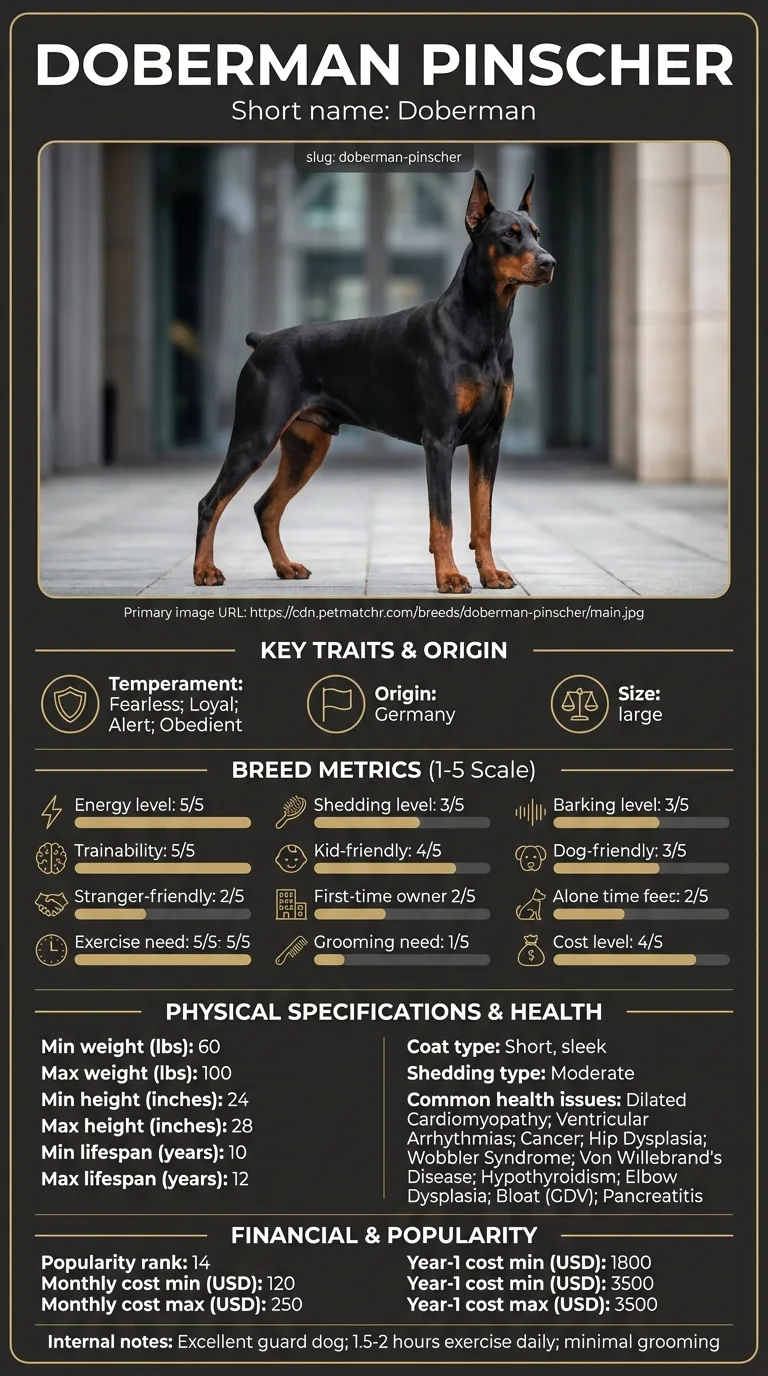
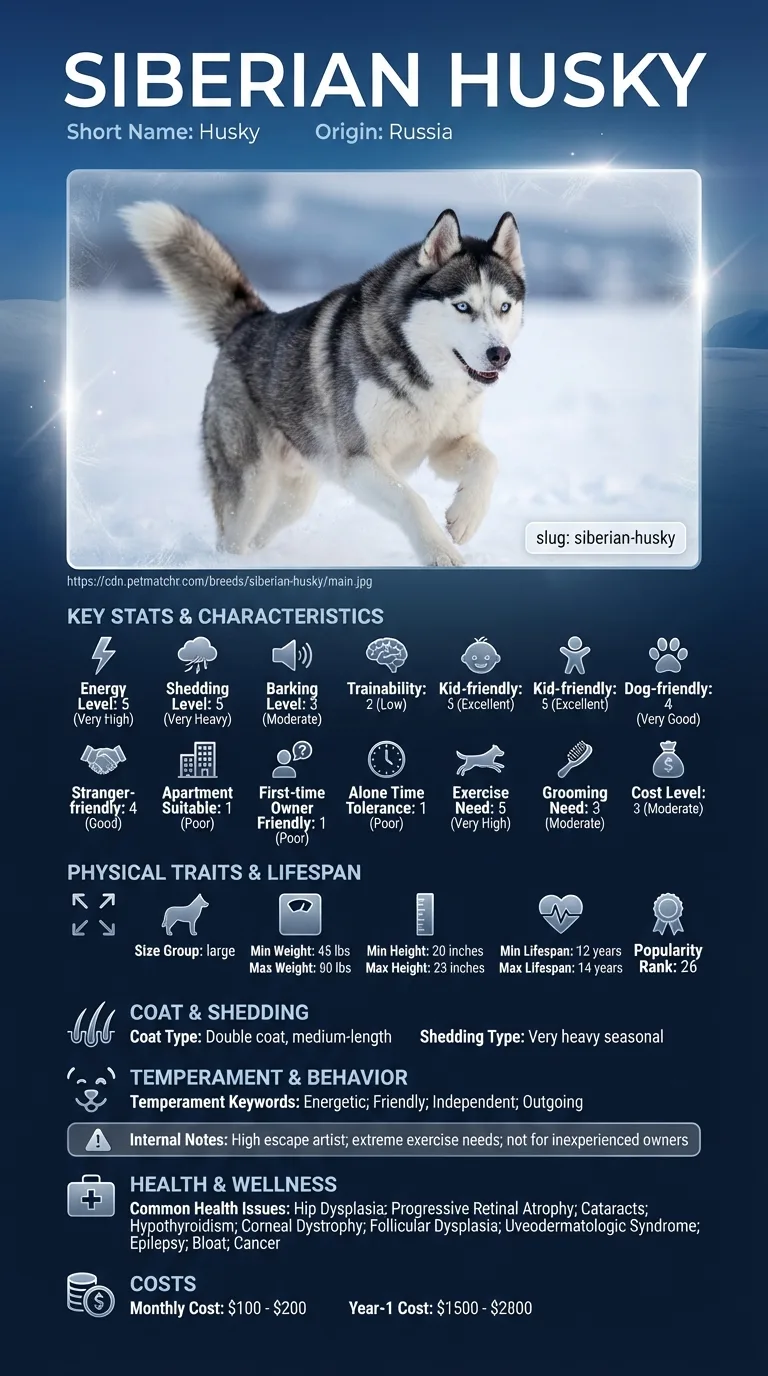
Doberman Pinscher or Siberian Husky? On paper they differ most on trainability, and on the scales Doberman Pinscher is the heavier at 60–100 lbs. Here is how the two compare on everything that shapes an ordinary week.
This is for someone already down to Doberman Pinscher and Siberian Husky and deciding between them. For this pair the decision usually turns on trainability and grooming need, so those are covered first and in most detail. Anyone choosing from a flat has a clear answer here: Doberman Pinscher rates 2/5 against 1/5. It is written for the decision rather than the breed history.
Quick verdict
Between Doberman Pinscher and Siberian Husky, trainability is what separates them, and Doberman Pinscher is the lower-effort dog of the two to keep.
Choose doberman pinscher if...
Choose Doberman Pinscher if you do not want a standing grooming appointment, shedding is a problem in your house and you want a dog that picks up training quickly.
Choose siberian husky if...
Choose Siberian Husky if there are young children at home, you already have another dog and a smaller dog suits your car, your home or your back.
Head-to-head comparison
Feature
doberman pinscher
siberian husky
Winner
Size class
large
large
Equal
Weight
60–100 lbs
45–60 lbs
Equal
Height
24–28 in
20–23 in
Equal
Lifespan
10–12 years
12–14 years
siberian husky
Exercise need
Very high (5/5)
Very high (5/5)
Equal
Grooming need
Very low (1/5)
Moderate (3/5)
doberman pinscher
Shedding
Moderate (3/5)
Very high (5/5)
doberman pinscher
Energy level
Very high (5/5)
Very high (5/5)
Equal
Barking
Moderate (3/5)
Moderate (3/5)
Equal
Apartment suitability
Low (2/5)
Very low (1/5)
doberman pinscher
Good for first-time owners
Low (2/5)
Very low (1/5)
doberman pinscher
Tolerates being alone
Low (2/5)
Very low (1/5)
doberman pinscher
Trainability
Very high (5/5)
Low (2/5)
doberman pinscher
Good with kids
High (4/5)
Very high (5/5)
siberian husky
Good with other dogs
Moderate (3/5)
High (4/5)
siberian husky
Friendly to strangers
Low (2/5)
High (4/5)
siberian husky
Cost level
High (4/5)
Moderate (3/5)
siberian husky
Coat
Short, sleek
Double coat, medium-length
Equal
Origin
Germany
Russia
Equal
Typical monthly cost
$120–$250
$100–$200
Equal
Typical first-year cost
$1,800–$3,500
$1,500–$2,800
Equal
Deep dive
Size and build
The Doberman is the larger of the two — 60 to 100 pounds and up to 28 inches, against the Husky's 45 to 60 pounds and 20 to 23 inches. Both are athletic large breeds built for sustained work, but the Doberman's lean, muscular frame and the Husky's lighter, endurance-built body come from very different jobs: guarding and personal protection versus pulling sleds for hours across snow.
Energy and exercise
This is one of the rare comparisons where the two breeds tie at the top — both rate the maximum 5 out of 5 for exercise need and the same 5 out of 5 for general energy level. Neither breed is remotely suited to a sedentary household. If you're choosing based on activity level alone, this pairing gives you no easy way out; both dogs need serious daily output.
Grooming and shedding
The Husky demands more coat care — a moderate 3 out of 5 for grooming against the Doberman's 1 out of 5 — but the real number to notice is shedding: a very high 5 out of 5 for the Husky, the maximum on this scale, against the Doberman's moderate 3 out of 5. Huskies famously blow their undercoat twice a year, and that seasonal shed is heavier than almost anything else in this comparison set.
Apartment living, noise and time alone
Both breeds struggle in small spaces, but the Husky struggles more — a very low 1 out of 5 for apartment suitability against the Doberman's 2 out of 5. That's driven partly by the Husky's escape-artist reputation and partly by its very low tolerance for being left alone, just 1 out of 5 against the Doberman's 2. Barking ties at a moderate 3 out of 5, though Huskies are known more for howling than barking, which the rating doesn't fully capture.
Training and owner experience
The gap here is significant: the Doberman rates a full 5 out of 5 for trainability, the Husky just 2 out of 5, and that difference carries into first-time-owner suitability too — 2 out of 5 for the Doberman against a very low 1 out of 5 for the Husky. Huskies are independent, bred to make decisions on their own during sled work, and that same independence makes them notoriously resistant to typical obedience training.
Kids, other dogs and visitors
The Husky pulls ahead with kids (5 out of 5 versus 4) and strangers (4 out of 5 versus 2) — its famously friendly, non-guarding temperament works in its favor here, the flip side of the same trait that makes it a poor watchdog. It also edges the Doberman with other dogs, 4 out of 5 against 3.
Health and lifespan
The Husky lives somewhat longer, 12 to 14 years against the Doberman's 10 to 12. Both breeds share hip dysplasia, hypothyroidism, bloat, and cancer on their health lists — a meaningful overlap. The Husky's list otherwise runs toward eye conditions specific to the breed, like corneal dystrophy and uveodermatologic syndrome, which the Doberman's list doesn't include at all.
Cost to keep
The Husky costs somewhat less — a moderate 3 out of 5 rating against the Doberman's high 4 out of 5, $100 to $200 a month against $120 to $250, and $1,500 to $2,800 in the first year against $1,800 to $3,500. That said, a Husky's escape tendencies can add unplanned costs of their own — reinforced fencing isn't optional with this breed.
Doberman Pinscher vs Siberian Husky at a glance
Doberman Pinscher weighs 60–100 lbs and lives 10–12 years; Siberian Husky weighs 45–60 lbs and lives 12–14 years. The two diverge most on trainability, grooming need and shedding and 1 other rated axes. They are level on barking, energy level and exercise need, so those cannot decide it. In the table, a "winner" means easier for an ordinary household — not better. Size, coat and origin are recorded without a verdict. Because both breeds are scored the same way, the gaps are reliable even where the absolute numbers are rough.
Doberman Pinscher vs Siberian Husky: Which Suits Your Home? - Doberman Pinscher vs Siberian Husky at a glance
Frequently asked questions
Which breed needs more exercise, the Doberman or the Husky?
They're tied — both rate the maximum 5 out of 5 for exercise need. This is one of the few Doberman comparisons where activity level doesn't help you decide.
Is a Husky harder to train than a Doberman?
Yes, considerably — the Husky rates just 2 out of 5 for trainability against the Doberman's 5 out of 5, reflecting its independent, sled-dog temperament that doesn't respond well to typical obedience methods.
Which sheds more?
The Husky, by a lot — it rates the maximum 5 out of 5 for shedding, driven by twice-yearly seasonal coat blow, against the Doberman's moderate 3 out of 5.
Is a Husky good for a first-time owner?
No — it rates a very low 1 out of 5, even lower than the Doberman's 2 out of 5. Its independence and escape tendencies make it a demanding breed regardless of experience with dogs generally.
Which costs less to keep?
The Husky — $100 to $200 a month and $1,500 to $2,800 in year one, against $120 to $250 and $1,800 to $3,500 for the Doberman. Factor in fencing costs for the Husky, though, given its escape-artist reputation.
Do these breeds share health risks?
Yes — hip dysplasia, hypothyroidism, bloat, and cancer appear on both lists. The Husky's list also includes several eye conditions specific to the breed that don't show up for the Doberman.
Which breed is friendlier to strangers?
The Husky, by a wide margin — 4 out of 5 against the Doberman's 2 out of 5. Its open, non-guarding temperament is well known, and it's part of why Huskies rarely make effective watchdogs.
Both need serious daily exercise, so pick based on temperament instead. The Husky is friendlier and more sociable but far harder to train and unsuited to apartments; the Doberman trains easily and guards its home but needs an experienced handler.
Costs
What's the monthly cost?
The Husky runs $100 to $200; the Doberman runs $120 to $250.
Living
How much exercise does each need?
The maximum, for both — a tied 5 out of 5. Neither breed fits a low-activity household.
Health
Which lives longer?
The Husky, typically 12 to 14 years against the Doberman's 10 to 12.
Related DogBreedCompass guides
Doberman Pinscher breed guide – Readers comparing the two usually want the full profile of Doberman Pinscher before deciding.
Siberian Husky breed guide – The same for Siberian Husky, so the comparison can be checked against the detail.
Doberman Pinscher vs Weimaraner – Weimaraner is the closest breed to Doberman Pinscher on the measured axes, so it is the natural next comparison.
Health information here is general and is not veterinary advice. If your dog shows pain, sudden behaviour change, or worsening symptoms, consult a licensed veterinarian.
Some links on this site are affiliate links. We may earn a commission at no extra cost to you, and we only suggest products we believe are helpful for dog owners.
We research and check what we publish, but we do not warrant that any figure, date, price, or statement is accurate, complete, or current, and we accept no liability for any loss, cost, injury, or other harm arising from the use of this site. Use it as one reference among several. You remain responsible for your own decisions and for your dog's care - confirm anything that matters with a licensed veterinarian or another qualified professional before you act on it. Full disclaimer.