Chinese Shar-Pei vs Rottweiler Mix: Which Suits Your Home?
Quick answer
Which is the better overall choice?
The Shar-Pei for smaller spaces and calmer daily needs; the Rottweiler mix for owners with room and time who want a more trainable dog, keeping in mind mixed heritage adds size and temperament uncertainty.
Chinese Shar-Pei or Rottweiler Mix? On paper they differ most on exercise need, and on the scales Rottweiler Mix is the heavier at 80–135 lbs. Here is how the two compare on everything that shapes an ordinary week.
This is for someone already down to Chinese Shar-Pei and Rottweiler Mix and deciding between them. For this pair the decision usually turns on exercise need and apartment suitability, so those are covered first and in most detail. Anyone choosing from a flat has a clear answer here: Chinese Shar-Pei rates 4/5 against 2/5. Breed history is left out; what follows is what you will actually live with.
Quick verdict
Between Chinese Shar-Pei and Rottweiler Mix, exercise need is what separates them, and Chinese Shar-Pei is the lower-effort dog of the two to keep.
Choose chinese shar pei if...
Choose Chinese Shar-Pei if you are in a flat or a smaller home, shedding is a problem in your house and your walking routine is modest.
Choose rottweiler secondary if...
Choose Rottweiler Mix if you want a dog that picks up training quickly and you want a dog that can keep up with an active routine.
Head-to-head comparison
Feature
chinese shar pei
rottweiler secondary
Winner
Size class
medium
large
Equal
Weight
45–60 lbs
80–135 lbs
Equal
Height
18–20 in
22–27 in
Equal
Lifespan
8–12 years
9–10 years
chinese shar pei
Exercise need
Low (2/5)
High (4/5)
chinese shar pei
Grooming need
Low (2/5)
Low (2/5)
Equal
Shedding
Low (2/5)
Moderate (3/5)
chinese shar pei
Energy level
Low (2/5)
Moderate (3/5)
Equal
Barking
Low (2/5)
Low (2/5)
Equal
Apartment suitability
High (4/5)
Low (2/5)
chinese shar pei
Good for first-time owners
Low (2/5)
Low (2/5)
Equal
Tolerates being alone
Moderate (3/5)
Moderate (3/5)
Equal
Trainability
Low (2/5)
High (4/5)
rottweiler secondary
Good with kids
Moderate (3/5)
Moderate (3/5)
Equal
Good with other dogs
Low (2/5)
Low (2/5)
Equal
Friendly to strangers
Low (2/5)
Low (2/5)
Equal
Cost level
High (4/5)
High (4/5)
Equal
Coat
Short and harsh
Short, dense double coat
Equal
Origin
Various
Various
Equal
Typical monthly cost
$100–$200
$110–$240
Equal
Typical first-year cost
$1,400–$2,900
$1,700–$3,200
Equal
Deep dive
Size and build
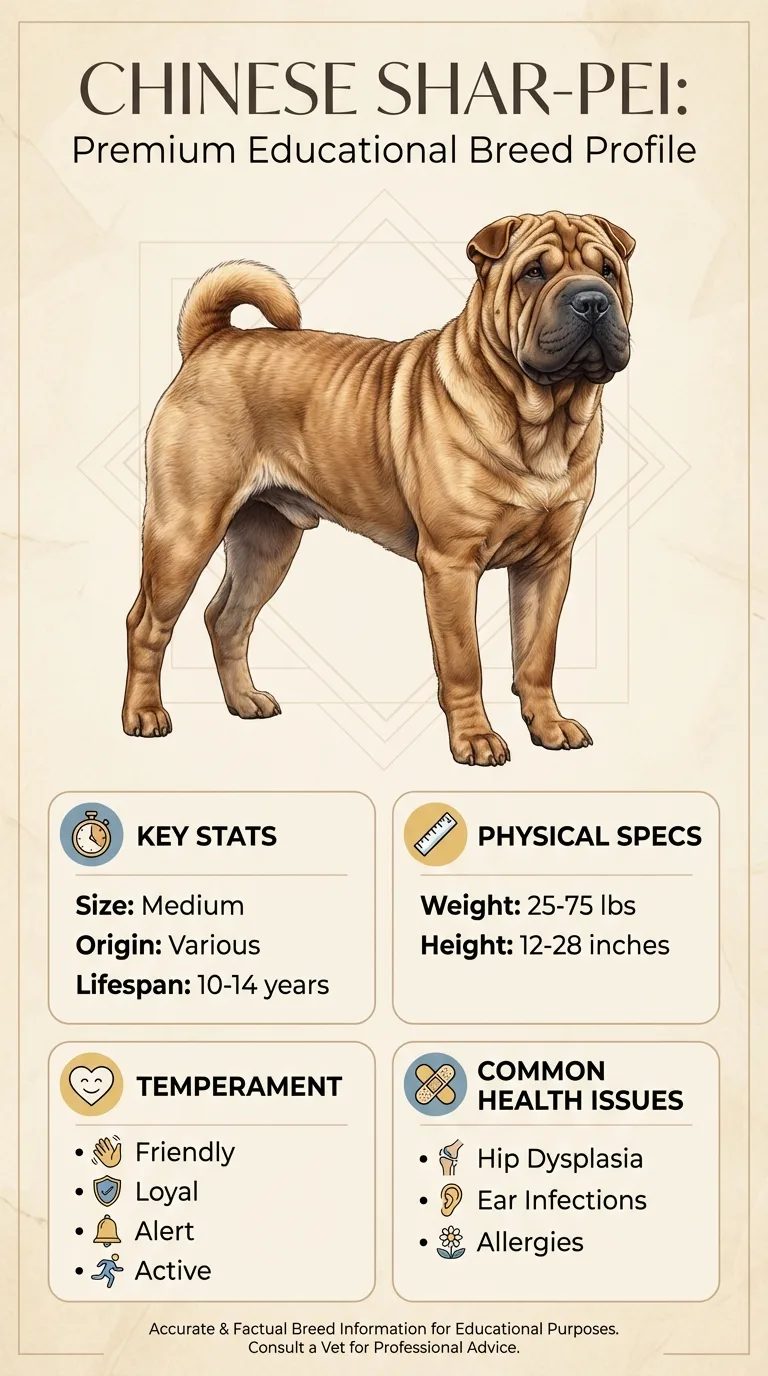
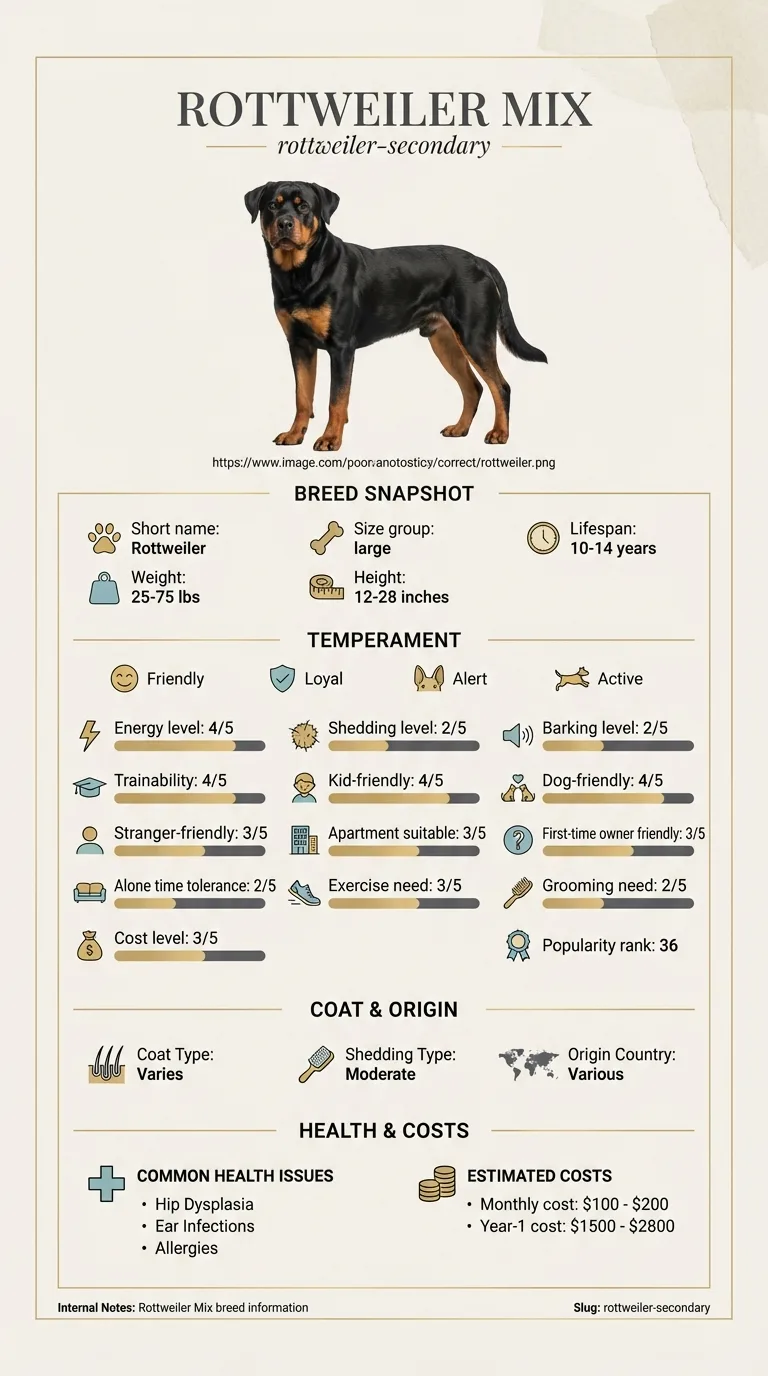
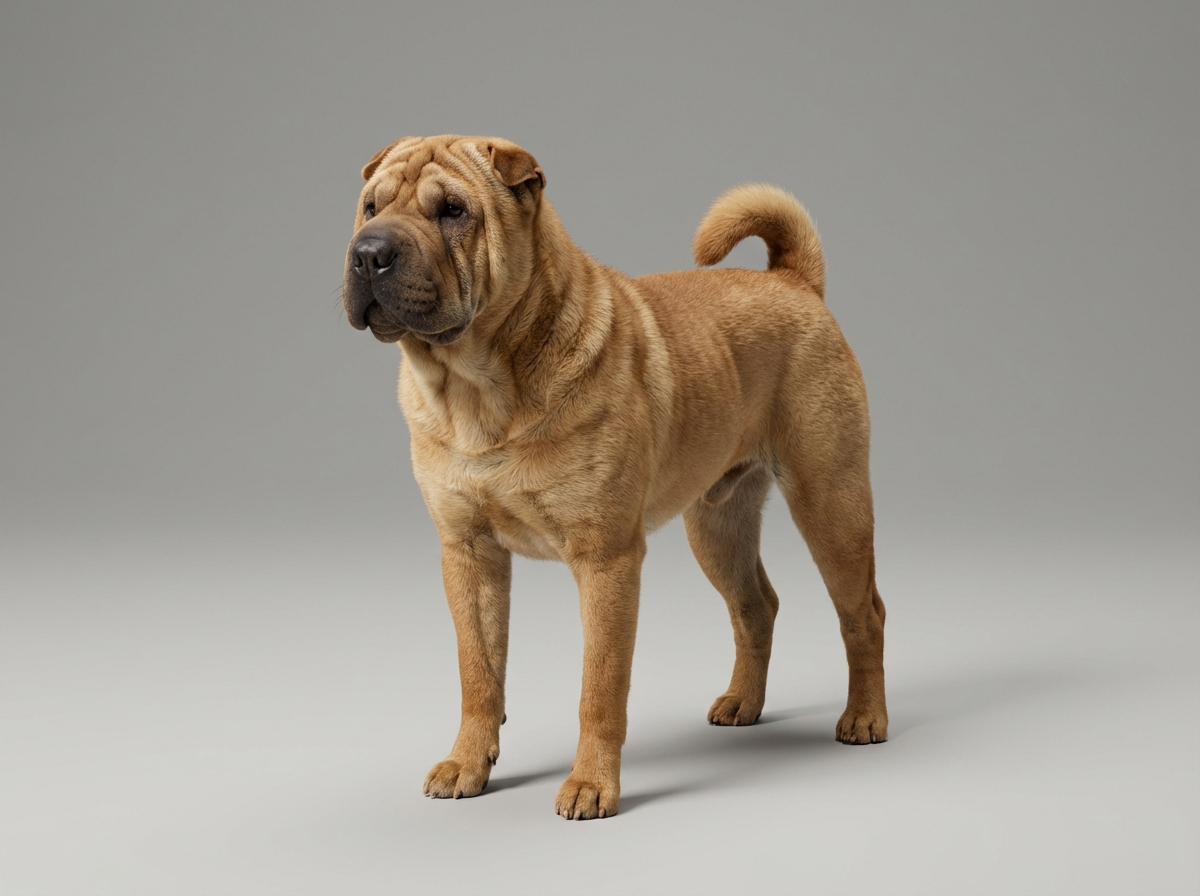
Weight-wise this Rottweiler mix carries the same 80-to-135-pound range listed for the purebred, standing 22 to 27 inches, still dramatically larger than the Shar-Pei's 45-to-60-pound, 18-to-20-inch frame. Keep in mind "mix" means the actual dog in front of you could land anywhere in or even outside that range depending on what else is in the pedigree.
Energy and exercise
Exercise need still favors the Shar-Pei, 2 out of 5 against a higher 4 out of 5 for the Rottweiler mix, though energy level itself ties, a sign that mixed heritage has toned down the purebred's intensity somewhat without changing how much physical activity it actually needs.
Grooming and shedding
Grooming ties at 2 out of 5 for both dogs. Shedding runs moderate for the Rottweiler mix (3/5) rather than the purebred's high rating, landing between the two, still more hair than the Shar-Pei's 2 out of 5, but less of a commitment than a full-blooded Rottweiler.
Apartment living, noise and time alone
Barking ties at a quiet 2 out of 5 for both, but apartment suitability doesn't, the Shar-Pei rates 4 out of 5 against just 2 out of 5 for the Rottweiler mix, driven by size more than temperament. Tolerating time alone is one of the few metrics that ties evenly here, both landing at 3 out of 5.
Training and owner experience
Trainability favors the Rottweiler mix, 4 out of 5 against the Shar-Pei's 2 out of 5, but first-time-owner suitability ties at a low 2 out of 5 for both. A trainable dog isn't automatically an easy first dog, especially one that also needs serious daily exercise and comes with a large, powerful frame.
Kids, other dogs and visitors
Unlike the purebred Rottweiler comparison, several social metrics tie here: good with kids (3/5 both), good with other dogs (2/5 both), friendly to strangers (2/5 both). Mixed heritage seems to have leveled out some of the more pronounced protective instincts, landing this dog closer to the Shar-Pei's own reserved baseline.
Health and lifespan
Lifespan sits close, 8 to 12 years for the Shar-Pei against 9 to 10 for the Rottweiler mix, a narrower gap than you'd see against a purebred Rottweiler, and one where the Shar-Pei's range simply extends further at both ends. The health lists don't overlap at all: the Rottweiler mix carries joint and orthopedic risks (hip and elbow dysplasia, cruciate ligament tears, osteosarcoma) typical of a large-breed frame, while the Shar-Pei's issues stay centered on skin and eyes.
Cost to keep
Monthly cost lands between the two purebred comparisons at $110 to $240 for the Rottweiler mix, against $100 to $200 for the Shar-Pei. First-year costs follow the same pattern, $1,700 to $3,200 versus $1,400 to $2,900, with overall cost level tying at a high 4 out of 5 for both.
Chinese Shar-Pei vs Rottweiler Mix at a glance
Chinese Shar-Pei weighs 45–60 lbs and lives 8–12 years; Rottweiler Mix weighs 80–135 lbs and lives 9–10 years. The two diverge most on exercise need, apartment suitability and trainability. They are level on tolerates being alone, barking and cost level, so those cannot decide it. The comparison marks an easier option only where one exists. Facts like weight and country of origin are not scored. Both dogs are rated from the same dataset, which is what makes the numbers comparable with each other even though any individual dog sits somewhere inside its breed's range.
Chinese Shar-Pei vs Rottweiler Mix: Which Suits Your Home? - Chinese Shar-Pei vs Rottweiler Mix at a glance
Frequently asked questions
Is a Rottweiler mix smaller than a purebred Rottweiler?
Not necessarily on this page, the listed weight range (80-135 lbs) matches the purebred, though an actual mix's size depends heavily on the other breed involved.
How much less does the mix shed than a purebred Rottweiler?
A bit less, moderate (3/5) here against high (4/5) for the purebred, but still more than the Shar-Pei's 2/5.
Is either good for a first-time owner?
No, both tie at a low 2/5.
Which fits an apartment better?
The Shar-Pei, 4/5 versus 2/5, the mix's large frame and exercise needs don't suit small spaces.
What does the mix cost monthly compared to the Shar-Pei?
$110 to $240 versus $100 to $200, a smaller gap than a purebred Rottweiler comparison would show.
Do they share any health risks?
No overlap at all, the mix's risks are orthopedic and heart-related (hip and elbow dysplasia, cruciate tears, subaortic stenosis), the Shar-Pei's are skin and eye related.
Which lives longer?
The Shar-Pei, though the gap is narrow, 8 to 12 years versus 9 to 10 for the mix.
The Shar-Pei for smaller spaces and calmer daily needs; the Rottweiler mix for owners with room and time who want a more trainable dog, keeping in mind mixed heritage adds size and temperament uncertainty.
Costs
What's the monthly cost?
$100 to $200 for the Shar-Pei, $110 to $240 for the Rottweiler mix.
Training
How much exercise?
Shar-Pei 2/5 versus Rottweiler mix 4/5.
Health
Which lives longer?
Close call: Shar-Pei 8-12 years versus the mix's 9-10.
Related DogBreedCompass guides
Chinese Shar-Pei breed guide – Readers comparing the two usually want the full profile of Chinese Shar-Pei before deciding.
Rottweiler Mix breed guide – The same for Rottweiler Mix, so the comparison can be checked against the detail.
Chinese Shar-Pei vs Chow Chow – Chow Chow is the closest breed to Chinese Shar-Pei on the measured axes, so it is the natural next comparison.
Rottweiler Mix vs Rottweiler – Rottweiler sits closest to Rottweiler Mix, which makes it the alternative worth ruling out.
Chinese Shar-Pei vs Rottweiler – Rottweiler is the other breed Rottweiler Mix is most often weighed against.
Rottweiler Mix health problems – The health pages set out what each breed is actually screened for.
Health information here is general and is not veterinary advice. If your dog shows pain, sudden behaviour change, or worsening symptoms, consult a licensed veterinarian.
Some links on this site are affiliate links. We may earn a commission at no extra cost to you, and we only suggest products we believe are helpful for dog owners.
We research and check what we publish, but we do not warrant that any figure, date, price, or statement is accurate, complete, or current, and we accept no liability for any loss, cost, injury, or other harm arising from the use of this site. Use it as one reference among several. You remain responsible for your own decisions and for your dog's care - confirm anything that matters with a licensed veterinarian or another qualified professional before you act on it. Full disclaimer.