Behavior
More energetic breed?
The Pembroke Welsh Corgi, rated High (4/5) exercise need versus the Shar-Pei's Low (2/5).

Quick answer
More energetic breed?
The Pembroke Welsh Corgi, rated High (4/5) exercise need versus the Shar-Pei's Low (2/5).
Chinese Shar-Pei or Pembroke Welsh Corgi? On paper they differ most on exercise need, and on the scales Chinese Shar-Pei is the heavier at 45–60 lbs. Here is how the two compare on everything that shapes an ordinary week.
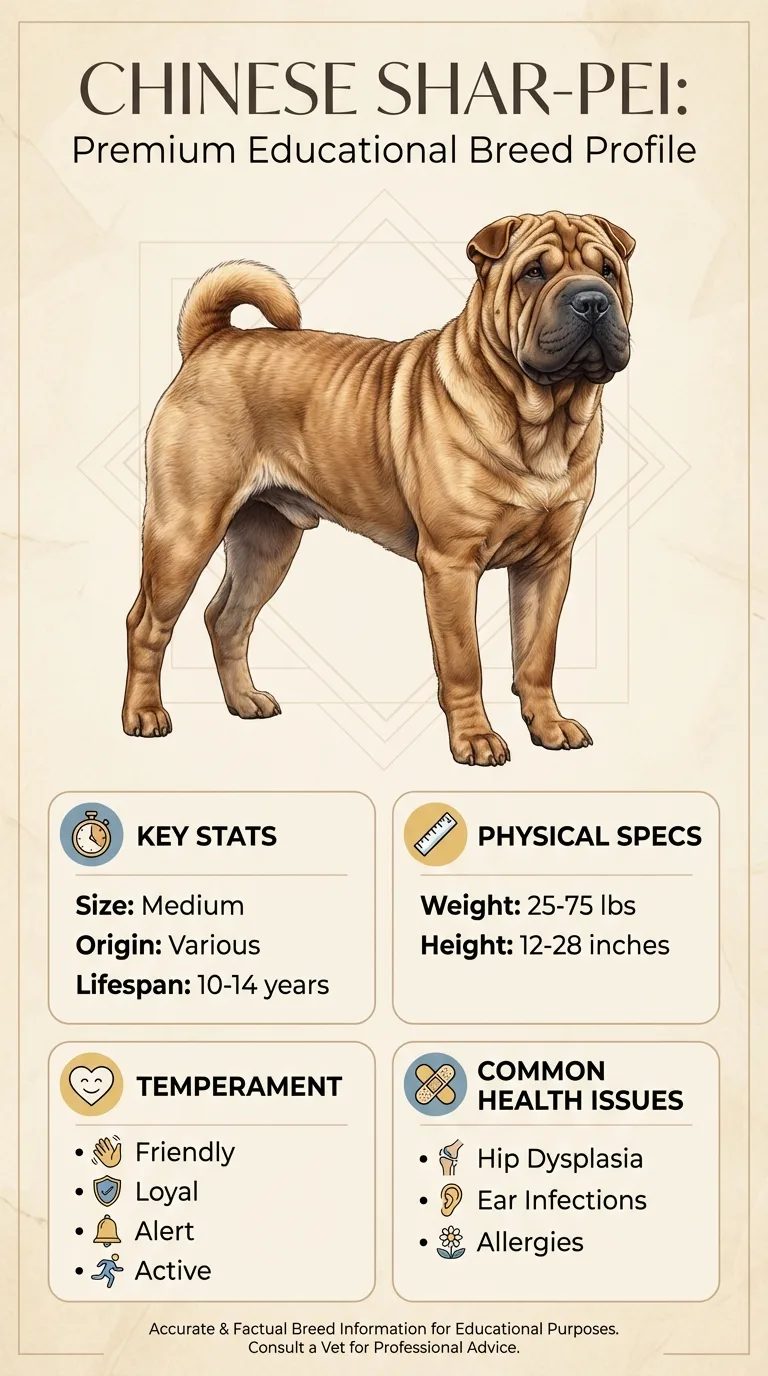
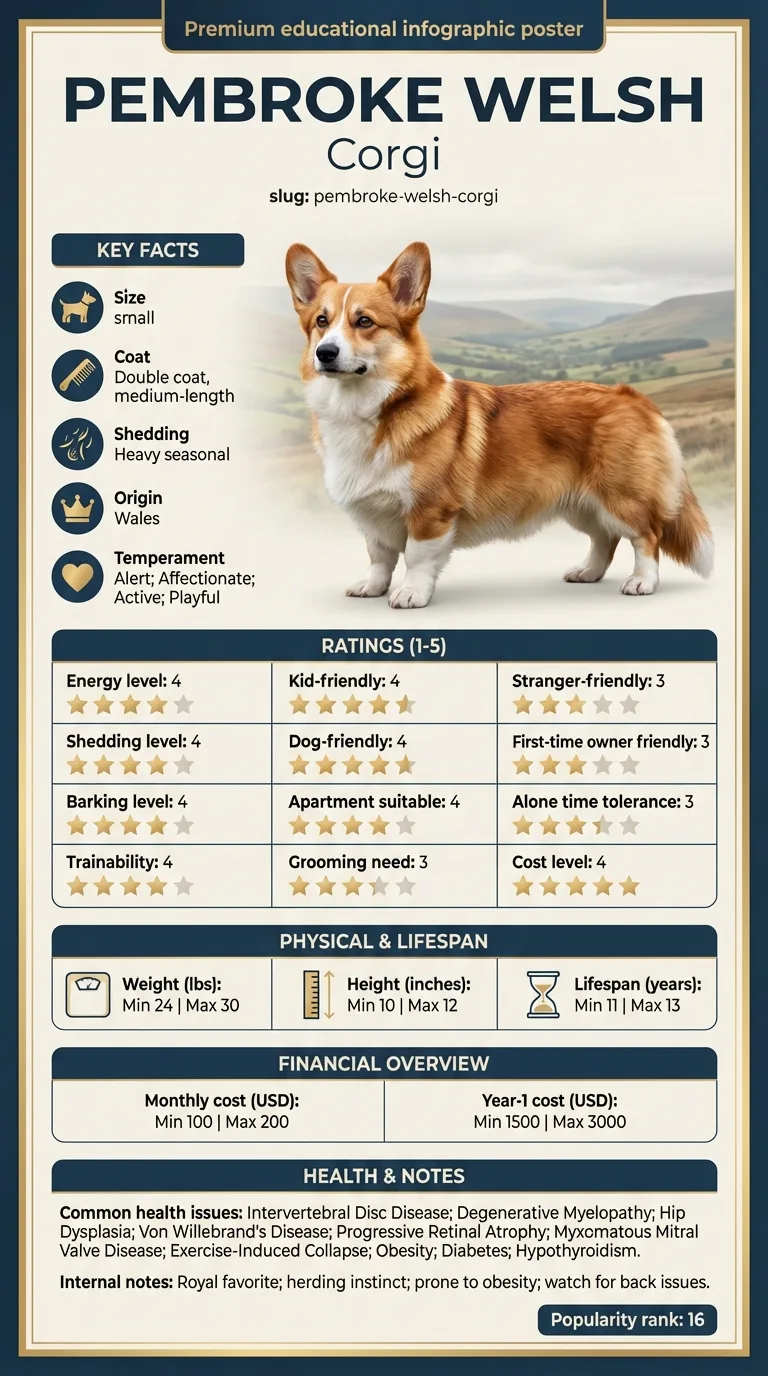
This is for someone already down to Chinese Shar-Pei and Pembroke Welsh Corgi and deciding between them. For this pair the decision usually turns on exercise need and energy level, so those are covered first and in most detail. Both rate 4/5 for flats, so housing does not settle this one. It is written for the decision rather than the breed history.
Between Chinese Shar-Pei and Pembroke Welsh Corgi, exercise need is what separates them, and Chinese Shar-Pei is the lower-effort dog of the two to keep.
Choose Chinese Shar-Pei if you do not want a standing grooming appointment, shedding is a problem in your house and your walking routine is modest.
Choose Pembroke Welsh Corgi if this is your first dog, there are young children at home and you already have another dog.
| Feature | chinese shar pei | pembroke welsh corgi | Winner |
|---|---|---|---|
| Size class | medium | small | Equal |
| Weight | 45–60 lbs | 24–30 lbs | Equal |
| Height | 18–20 in | 10–12 in | Equal |
| Lifespan | 8–12 years | 11–13 years | pembroke welsh corgi |
| Exercise need | Low (2/5) | High (4/5) | chinese shar pei |
| Grooming need | Low (2/5) | Moderate (3/5) | chinese shar pei |
| Shedding | Low (2/5) | High (4/5) | chinese shar pei |
| Energy level | Low (2/5) | High (4/5) | Equal |
| Barking | Low (2/5) | High (4/5) | chinese shar pei |
| Apartment suitability | High (4/5) | High (4/5) | Equal |
| Good for first-time owners | Low (2/5) | Moderate (3/5) | pembroke welsh corgi |
| Tolerates being alone | Moderate (3/5) | Moderate (3/5) | Equal |
| Trainability | Low (2/5) | High (4/5) | pembroke welsh corgi |
| Good with kids | Moderate (3/5) | High (4/5) | pembroke welsh corgi |
| Good with other dogs | Low (2/5) | High (4/5) | pembroke welsh corgi |
| Friendly to strangers | Low (2/5) | Moderate (3/5) | pembroke welsh corgi |
| Cost level | High (4/5) | High (4/5) | Equal |
| Coat | Short and harsh | Double coat, medium-length | Equal |
| Origin | Various | Wales | Equal |
| Typical monthly cost | $100–$200 | $100–$200 | Equal |
| Typical first-year cost | $1,400–$2,900 | $1,500–$3,000 | Equal |
The Pembroke Welsh Corgi is famous for its stubby legs — 10 to 12 inches tall — while carrying a surprisingly solid 24 to 30 pounds, roughly half the Shar-Pei's 45-to-60-pound range but a full 8 inches shorter at the shoulder. That low-slung, long-backed build was bred deliberately for herding cattle by nipping at heels and ducking under kicks, a completely different job from the Shar-Pei's guarding role. Side by side, the Corgi looks almost comically low to the ground next to the Shar-Pei's more upright, compact frame, even though the weight difference between them isn't as dramatic as their silhouettes suggest.
The Pembroke Welsh Corgi needs considerably more to stay satisfied, rating High, 4/5, on exercise need against the Shar-Pei's Low, 2/5. Energy level is listed as tied overall, though the Corgi runs High (4/5) day to day compared with the Shar-Pei's Low (2/5) — a real gap in practice despite the tie designation. Bred to herd cattle across open pasture all day, a Corgi without adequate outlet for that energy tends toward barking and nipping behaviors. A Shar-Pei owner can get by with modest daily walks; a Corgi owner should plan on real exercise time, ideally including some off-leash running.
The Corgi's double coat sheds at a High, 4/5, rate — famously so, with "Corgi fur" becoming something of a running joke among owners — and needs Moderate, 3/5, grooming to manage seasonal blowouts. The Shar-Pei needs far less on both counts, Low, 2/5, for grooming and shedding thanks to its short, harsh coat. Anyone sensitive to dog hair around the house, on clothing, or on furniture should weigh this seriously: a Corgi will leave noticeably more fur behind despite being the smaller dog, while the Shar-Pei stays comparatively tidy year-round.
Apartment suitability ties at High, 4/5, for both breeds, and both tolerate being alone equally at Moderate, 3/5. The clear difference is noise: the Corgi rates High, 4/5, for barking, a trait tied to its herding heritage of vocalizing at livestock, while the Shar-Pei stays much quieter at Low, 2/5. For apartment dwellers with thin walls or close neighbors, that barking gap matters more than the tied suitability scores suggest — a vocal Corgi can become a genuine noise complaint risk in ways a reserved, quiet Shar-Pei generally won't.
The Corgi rates High, 4/5, for trainability against the Shar-Pei's Low, 2/5, reflecting its alert, active temperament and herding-dog intelligence. Its first-time-owner suitability is only Moderate, 3/5, though — a step down from its trainability score, largely because its exercise needs and herding instincts, including a tendency to nip, require some handling know-how. The Shar-Pei rates Low, 2/5, on both measures, consistent with its independent, reserved nature. A first-time owner will likely find the Corgi easier to teach commands to, but should still be ready to manage its energy and herding instincts rather than expecting a passive companion.
The Corgi rates higher with kids, High 4/5 against the Shar-Pei's Moderate 3/5, and with other dogs, High 4/5 against Low 2/5 — though families with young children should know Corgis retain some herding instinct, including a tendency to nip at heels during rough play. Friendliness to strangers is closer, Moderate 3/5 for the Corgi against Low 2/5 for the Shar-Pei, still a clear edge for the Corgi but less dramatic than the other categories. Overall, the playful, active Corgi adapts more easily to a bustling household, while the Shar-Pei's loyal, reserved nature suits a calmer one.
The Corgi's 11-to-13-year lifespan runs a bit longer than the Shar-Pei's 8-to-12, but its health list is twice as long at ten conditions against five. Its long back makes Intervertebral Disc Disease and Degenerative Myelopathy particular concerns — both spinal issues linked to that low-slung build — alongside Hip Dysplasia, Exercise-Induced Collapse, and a tendency toward Obesity if its High exercise needs aren't met. The Shar-Pei's shorter list stays focused on skin: Skin Fold Dermatitis, Entropion, Familial Shar-Pei Fever, plus Hypothyroidism, which both breeds happen to carry. A Corgi owner should be especially mindful of jumping and stairs to protect its spine; a Shar-Pei owner's vigilance goes toward its folds instead.
Overall cost ties at High, 4/5, for both breeds, and monthly costs are identical at $100 to $200. The only real separation shows up in first-year totals: $1,500 to $3,000 for the Corgi against $1,400 to $2,900 for the Shar-Pei, a modest gap likely reflecting the Corgi's longer health-conditions list and the potential for spine-related veterinary care. In practice, these two breeds land in nearly the same cost bracket, so budget shouldn't be the deciding factor — the choice comes down more to exercise needs, shedding tolerance, and household energy level than to dollars and cents.
Chinese Shar-Pei weighs 45–60 lbs and lives 8–12 years; Pembroke Welsh Corgi weighs 24–30 lbs and lives 11–13 years. The two diverge most on exercise need, energy level and shedding and 3 other rated axes. They are level on tolerates being alone, apartment suitability and cost level, so those cannot decide it. In the table, a "winner" means easier for an ordinary household — not better. Size, coat and origin are recorded without a verdict. Because both breeds are scored the same way, the gaps are reliable even where the absolute numbers are rough.

Yes, rated High (4/5) against the Shar-Pei's Low (2/5) — Corgis were bred to herd cattle all day and need a real outlet for that energy.
The Corgi, rated High (4/5) shedding versus the Shar-Pei's Low (2/5), despite being the smaller of the two dogs.
Yes — their long, low build makes Intervertebral Disc Disease and Degenerative Myelopathy notable risks on their health list, concerns the Shar-Pei doesn't share.
The Shar-Pei, rated Low (2/5) barking against the Corgi's High (4/5).
Moderately so — it rates Moderate (3/5), better than the Shar-Pei's Low (2/5), but its energy and herding instincts still require some handling experience.
Nearly identical — both rate High (4/5) overall cost with the same $100-$200 monthly range, though the Corgi's first-year total runs slightly higher at $1,500-$3,000 versus $1,400-$2,900.
The Corgi, rated High (4/5) versus the Shar-Pei's Low (2/5).
The Pembroke Welsh Corgi, rated High (4/5) exercise need versus the Shar-Pei's Low (2/5).
The Shar-Pei, rated Low (2/5) versus the Corgi's High (4/5).
The Shar-Pei, rated Low (2/5) barking versus the Corgi's High (4/5).
The Shar-Pei, standing 18-20 inches versus the Corgi's 10-12 inches.
Secure checkout on Stripe. We never see your card.
7-day money-back guarantee. Instant access.
Health information here is general and is not veterinary advice. If your dog shows pain, sudden behaviour change, or worsening symptoms, consult a licensed veterinarian.
Some links on this site are affiliate links. We may earn a commission at no extra cost to you, and we only suggest products we believe are helpful for dog owners.
We research and check what we publish, but we do not warrant that any figure, date, price, or statement is accurate, complete, or current, and we accept no liability for any loss, cost, injury, or other harm arising from the use of this site. Use it as one reference among several. You remain responsible for your own decisions and for your dog's care - confirm anything that matters with a licensed veterinarian or another qualified professional before you act on it. Full disclaimer.
Match your lifestyle to the right dog.
Take quizNot sure which breed is right for you? Take our 2-minute quiz to find out.
Take the quiz