Living
Which breed should I choose overall?
For apartment living and a longer lifespan, go Griffon; for a friendly, sociable large dog and you have the space, go Bloodhound.

Quick answer
Which breed should I choose overall?
For apartment living and a longer lifespan, go Griffon; for a friendly, sociable large dog and you have the space, go Bloodhound.
Bloodhound or Brussels Griffon? On paper they differ most on apartment suitability, and on the scales Bloodhound is the heavier at 90–110 lbs. Here is how the two compare on everything that shapes an ordinary week.
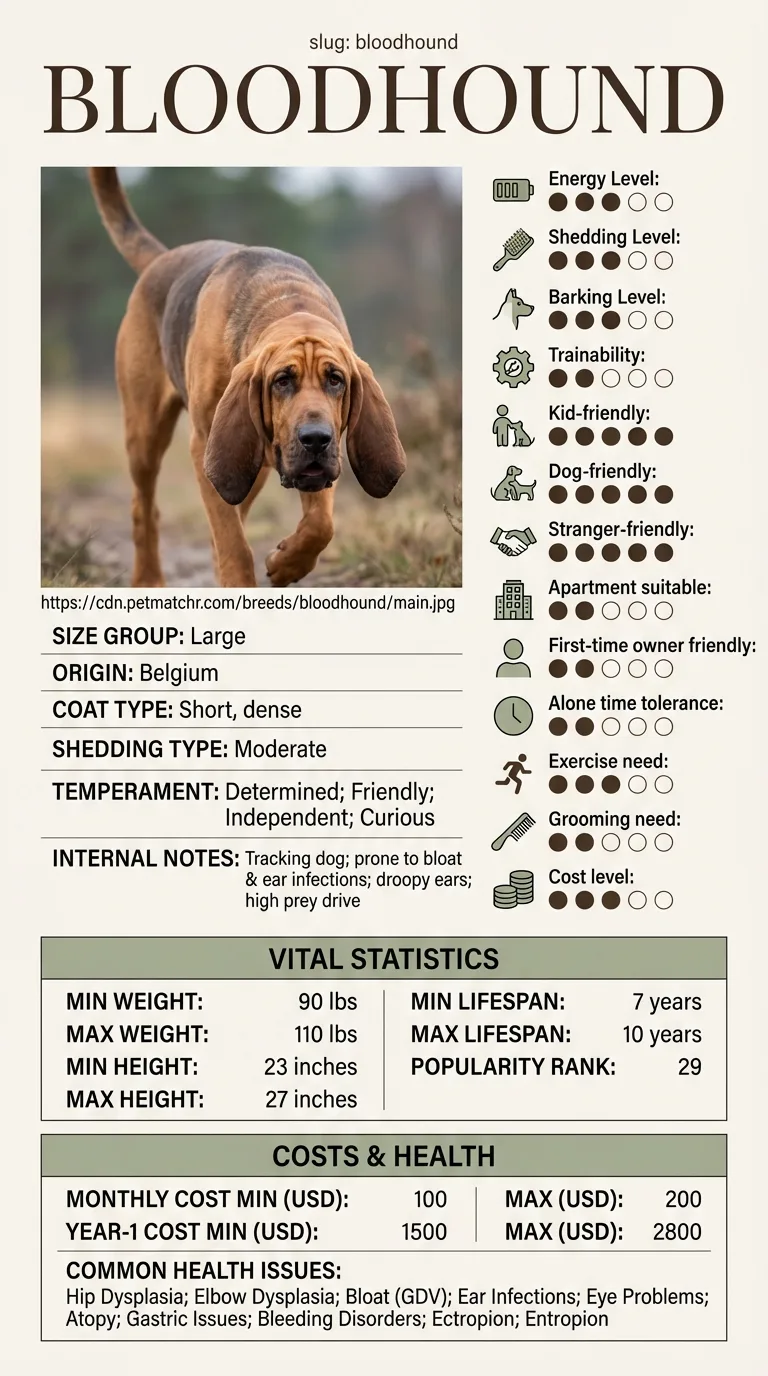
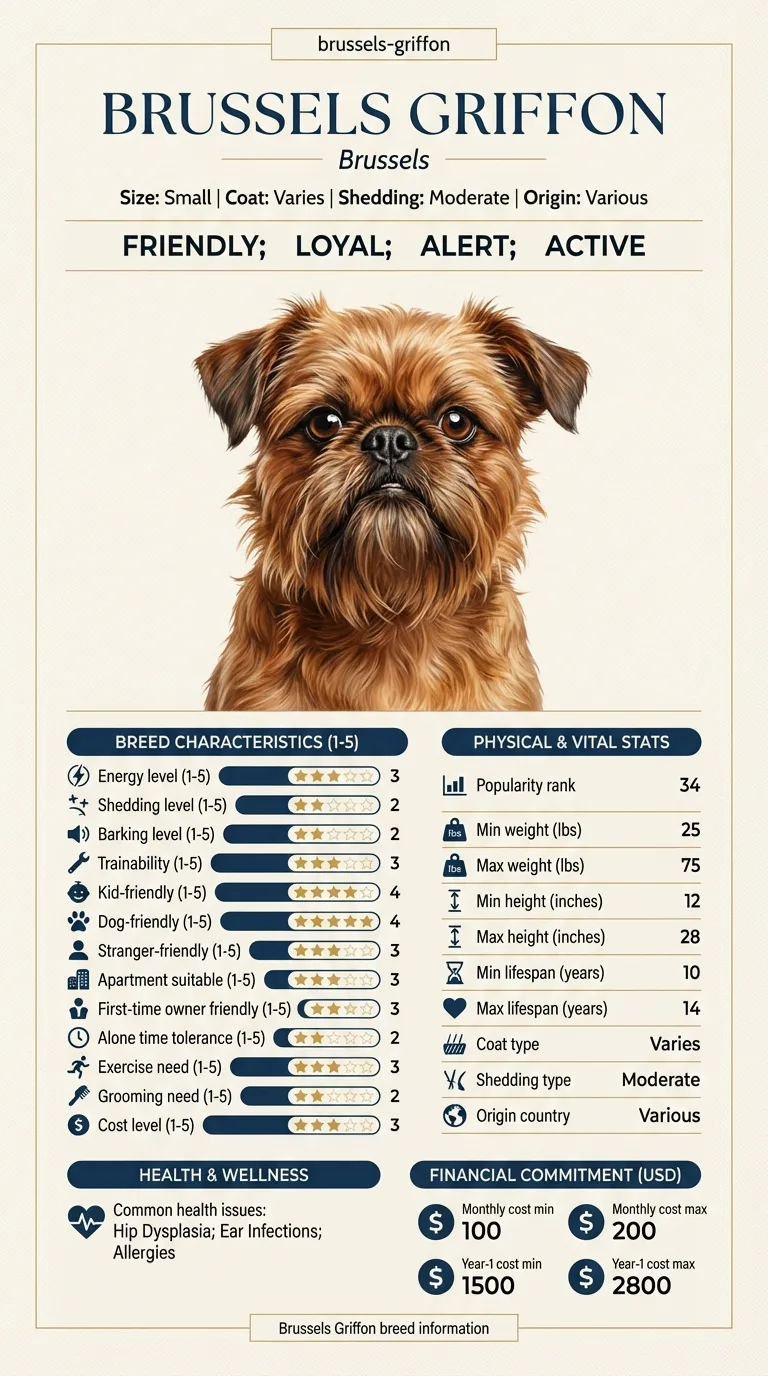
This is for someone already down to Bloodhound and Brussels Griffon and deciding between them. For this pair the decision usually turns on apartment suitability, so those are covered first and in most detail. Anyone choosing from a flat has a clear answer here: Brussels Griffon rates 5/5 against 2/5. Breed history is left out; what follows is what you will actually live with.
Between Bloodhound and Brussels Griffon, apartment suitability is what separates them, and Brussels Griffon is the lower-effort dog of the two to keep.
Choose Bloodhound if you do not want a standing grooming appointment, there are young children at home and you already have another dog.
Choose Brussels Griffon if you are in a flat or a smaller home, this is your first dog and shedding is a problem in your house.
| Feature | bloodhound | brussels griffon | Winner |
|---|---|---|---|
| Size class | large | small | Equal |
| Weight | 90–110 lbs | 8–12 lbs | Equal |
| Height | 23–27 in | 7–10 in | Equal |
| Lifespan | 7–10 years | 12–15 years | brussels griffon |
| Exercise need | Moderate (3/5) | Low (2/5) | brussels griffon |
| Grooming need | Low (2/5) | Moderate (3/5) | bloodhound |
| Shedding | Moderate (3/5) | Low (2/5) | brussels griffon |
| Energy level | Moderate (3/5) | Moderate (3/5) | Equal |
| Barking | Moderate (3/5) | Moderate (3/5) | Equal |
| Apartment suitability | Low (2/5) | Very high (5/5) | brussels griffon |
| Good for first-time owners | Low (2/5) | Moderate (3/5) | brussels griffon |
| Tolerates being alone | Low (2/5) | Low (2/5) | Equal |
| Trainability | Low (2/5) | Moderate (3/5) | brussels griffon |
| Good with kids | High (4/5) | Moderate (3/5) | bloodhound |
| Good with other dogs | High (4/5) | Moderate (3/5) | bloodhound |
| Friendly to strangers | High (4/5) | Moderate (3/5) | bloodhound |
| Cost level | Moderate (3/5) | Moderate (3/5) | Equal |
| Coat | Short, dense | Rough or smooth | Equal |
| Origin | Belgium | Various | Equal |
| Typical monthly cost | $100–$200 | $80–$150 | Equal |
| Typical first-year cost | $1,500–$2,800 | $1,100–$2,300 | Equal |
A Bloodhound is close to ten times heavier than a Brussels Griffon on the high end — 90 to 110 pounds against 8 to 12. The height difference is just as stark: 23 to 27 inches at the shoulder versus 7 to 10. This is not a matter of one breed being a bit bigger; you are looking at a large scent hound built for miles of tracking next to a toy dog that fits in a bag. Furniture, car space, and even the size of dog bed you buy will be decided by this gap alone.
Both breeds sit in the moderate range for energy, but the Bloodhound rates a 3/5 on exercise need against the Griffon's 2/5. In practice a Bloodhound still needs real leash time to work that nose, while a Griffon is satisfied with shorter, lower-intensity walks and some indoor play. Neither dog demands hours of running, but the Bloodhound's exercise sessions need to be longer and more purposeful given its tracking instincts.
Here the size difference flips: the Bloodhound actually grooms easier, rated Low (2/5) against the Griffon's Moderate (3/5), thanks to its short, dense coat that needs little more than a weekly brush. The Griffon, with its rough or smooth coat options, sheds less overall (2/5 versus the Bloodhound's 3/5) but requires more regular coat maintenance, especially the rough-coated variety, which benefits from hand-stripping.
An apartment suitability score of 2/5 for the Bloodhound versus 5/5 for the Griffon tells you most of what you need to know. A Bloodhound's size and moderate exercise needs work against small spaces, and both breeds tolerate being alone poorly (2/5 each), so neither is a good pick if you're out of the house ten hours a day. Barking is tied at moderate for both, so expect some vocal habits either way.
The Bloodhound scores Low (2/5) for both trainability and first-time-owner suitability — its independent streak makes it a dog that follows its nose before your commands. The Griffon does modestly better on both counts, Moderate (3/5), though its sensitive nature means training has to be patient and encouragement-based rather than firm. Neither breed is the easiest starter dog, but the Griffon gives a novice owner a bit more room to learn.
The Bloodhound outscores the Griffon across the board here: High (4/5) for kids, other dogs, and strangers compared to the Griffon's Moderate (3/5) on all three. A Bloodhound's size means supervision matters with small children, but its temperament — friendly, curious — leans sociable. The Griffon's comical, devoted nature suits a calmer household, but its smaller size makes rough play with kids or big dogs riskier for the dog itself.
Lifespan is the biggest single number in this comparison: 7 to 10 years for the Bloodhound against 12 to 15 for the Griffon, a gap of roughly five years. The Bloodhound's health list is longer and includes bloat (GDV), a genuine emergency risk in deep-chested large breeds, plus hip and elbow dysplasia. The Griffon's list is shorter but includes Brachycephalic Airway Syndrome (BOAS), tied to its flat face, and syringomyelia.
Cost level rates as Moderate (3/5) for both breeds, and the dollar ranges overlap closely: $100–$200 a month for the Bloodhound versus $80–$150 for the Griffon, with first-year totals of $1,500–$2,800 and $1,100–$2,300 respectively. The Bloodhound's larger size pushes food and vet-visit costs up, while the Griffon's grooming needs add a smaller but steady expense. Neither breed is a budget outlier in either direction.
Bloodhound weighs 90–110 lbs and lives 7–10 years; Brussels Griffon weighs 8–12 lbs and lives 12–15 years. The two diverge most on apartment suitability. They are level on tolerates being alone, barking and cost level, so those cannot decide it. The comparison marks an easier option only where one exists. Facts like weight and country of origin are not scored. Both dogs are rated from the same dataset, which is what makes the numbers comparable with each other even though any individual dog sits somewhere inside its breed's range.

A lot — the Bloodhound weighs 90 to 110 pounds against the Griffon's 8 to 12, and stands 23 to 27 inches tall versus 7 to 10. You could keep three or four Griffons at the Bloodhound's weight.
The Griffon, rated Low (2/5) for shedding compared to the Bloodhound's Moderate (3/5). Grooming effort tells a different story though — the Griffon's coat actually needs more regular attention.
Not ideally, though the Griffon is the better of the two, rated Moderate (3/5) versus the Bloodhound's Low (2/5) for first-time-owner suitability. Both need an owner willing to work through independent or sensitive temperaments.
Not comfortably — it scores just 2/5 for apartment suitability. The Griffon, at 5/5, is built for exactly this kind of living situation.
The Griffon, modestly — $80–$150 a month versus $100–$200 for the Bloodhound, and about $1,100–$2,300 in the first year against $1,500–$2,800.
Both can develop hip dysplasia and eye problems, but otherwise their risk lists diverge — the Bloodhound toward bloat and bleeding disorders, the Griffon toward BOAS and syringomyelia tied to its skull shape.
Smaller breeds generally outlive giant ones, and the data bears that out here: 12 to 15 years for the Griffon against 7 to 10 for the Bloodhound — a gap larger than most breed comparisons on this site.
For apartment living and a longer lifespan, go Griffon; for a friendly, sociable large dog and you have the space, go Bloodhound.
Expect $100–$200 a month for the Bloodhound, $80–$150 for the Griffon — both land in the moderate cost bracket.
The Bloodhound needs more: Moderate (3/5) exercise built around scent work, versus Low (2/5) for the Griffon, who's content with shorter walks.
The Griffon lives noticeably longer — 12 to 15 years versus 7 to 10 for the Bloodhound.
Secure checkout on Stripe. We never see your card.
7-day money-back guarantee. Instant access.
Health information here is general and is not veterinary advice. If your dog shows pain, sudden behaviour change, or worsening symptoms, consult a licensed veterinarian.
Some links on this site are affiliate links. We may earn a commission at no extra cost to you, and we only suggest products we believe are helpful for dog owners.
We research and check what we publish, but we do not warrant that any figure, date, price, or statement is accurate, complete, or current, and we accept no liability for any loss, cost, injury, or other harm arising from the use of this site. Use it as one reference among several. You remain responsible for your own decisions and for your dog's care - confirm anything that matters with a licensed veterinarian or another qualified professional before you act on it. Full disclaimer.
Match your lifestyle to the right dog.
Take quizNot sure which breed is right for you? Take our 2-minute quiz to find out.
Take the quiz