Bernedoodle vs Welsh Springer Spaniel: Which Suits Your Home?
Quick answer
Which is the better overall choice for most households?
The Bernedoodle rates higher across trainability, sociability, and lifespan, but it also costs more and needs heavier grooming -- for most households its all-around scores make it the safer default pick.
Bernedoodle or Welsh Springer Spaniel? On paper they differ most on grooming need, and on the scales Bernedoodle is the heavier at 20–90 lbs. Here is how the two compare on everything that shapes an ordinary week.
This is for someone already down to Bernedoodle and Welsh Springer Spaniel and deciding between them. Because the two are so evenly matched, the page works through every axis rather than leading with one. Both rate 2/5 for flats, so housing does not settle this one. The focus throughout is on daily consequences rather than breed background.
Quick verdict
Between Bernedoodle and Welsh Springer Spaniel, they are closer than most pairings, and the choice comes down to temperament; neither is the lower-effort dog overall.
Choose bernedoodle if...
Choose Bernedoodle if this is your first dog, shedding is a problem in your house and there are young children at home.
Choose welsh springer spaniel if...
Choose Welsh Springer Spaniel if you do not want a standing grooming appointment, a smaller dog suits your car, your home or your back and you want a dog that is more watchful with visitors.
Head-to-head comparison
Feature
bernedoodle
welsh springer spaniel
Winner
Size class
medium
medium
Equal
Weight
20–90 lbs
35–55 lbs
Equal
Height
12–23 in
17–19 in
Equal
Lifespan
12–18 years
12–15 years
bernedoodle
Exercise need
High (4/5)
High (4/5)
Equal
Grooming need
High (4/5)
Moderate (3/5)
welsh springer spaniel
Shedding
Low (2/5)
Moderate (3/5)
bernedoodle
Energy level
High (4/5)
High (4/5)
Equal
Barking
Low (2/5)
Moderate (3/5)
bernedoodle
Apartment suitability
Low (2/5)
Low (2/5)
Equal
Good for first-time owners
High (4/5)
Moderate (3/5)
bernedoodle
Tolerates being alone
Low (2/5)
Low (2/5)
Equal
Trainability
Very high (5/5)
High (4/5)
bernedoodle
Good with kids
Very high (5/5)
High (4/5)
bernedoodle
Good with other dogs
Very high (5/5)
High (4/5)
bernedoodle
Friendly to strangers
High (4/5)
Moderate (3/5)
bernedoodle
Cost level
High (4/5)
Moderate (3/5)
welsh springer spaniel
Coat
Wavy to curly, hypoallergenic
Medium, straight and water-resistant
Equal
Origin
United States
Various
Equal
Typical monthly cost
$120–$220
$100–$200
Equal
Typical first-year cost
$1,800–$3,200
$1,400–$2,900
Equal
Deep dive
Size and build
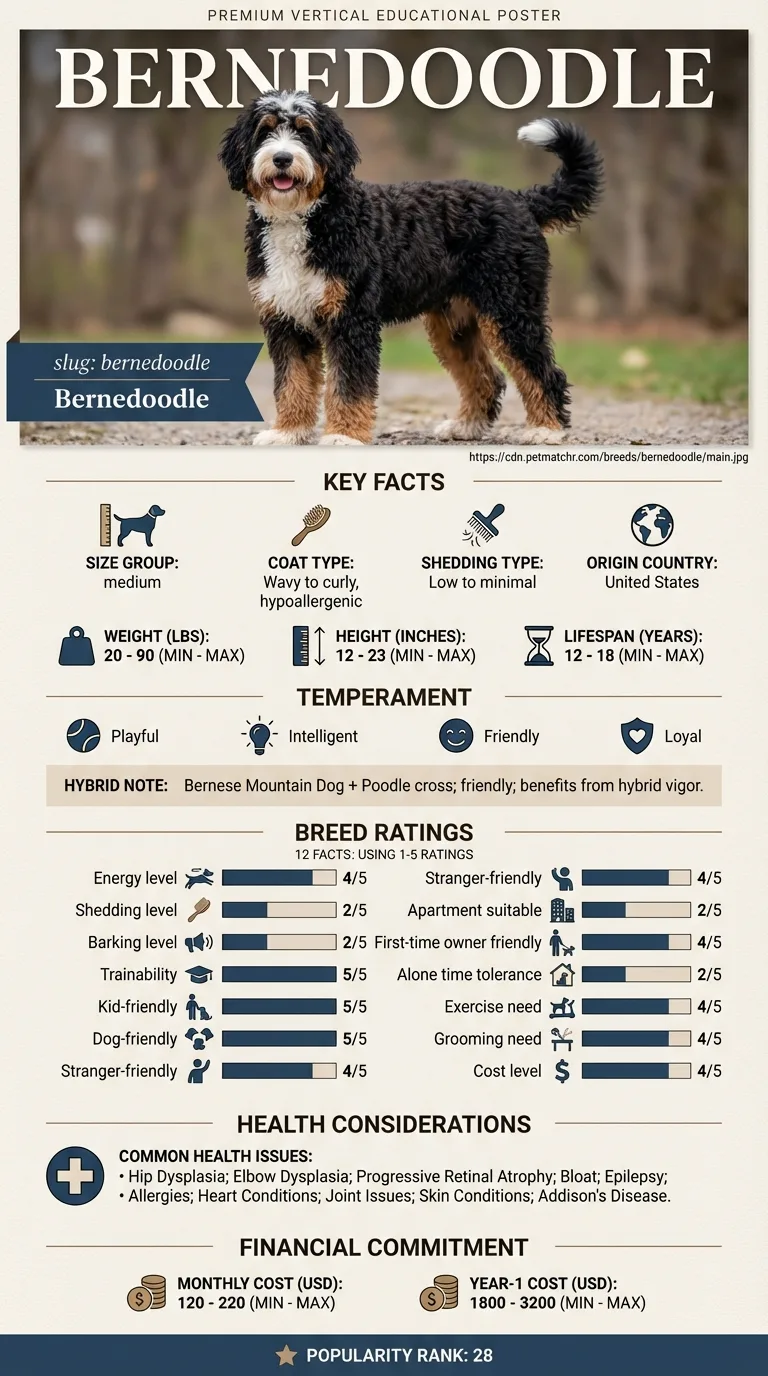
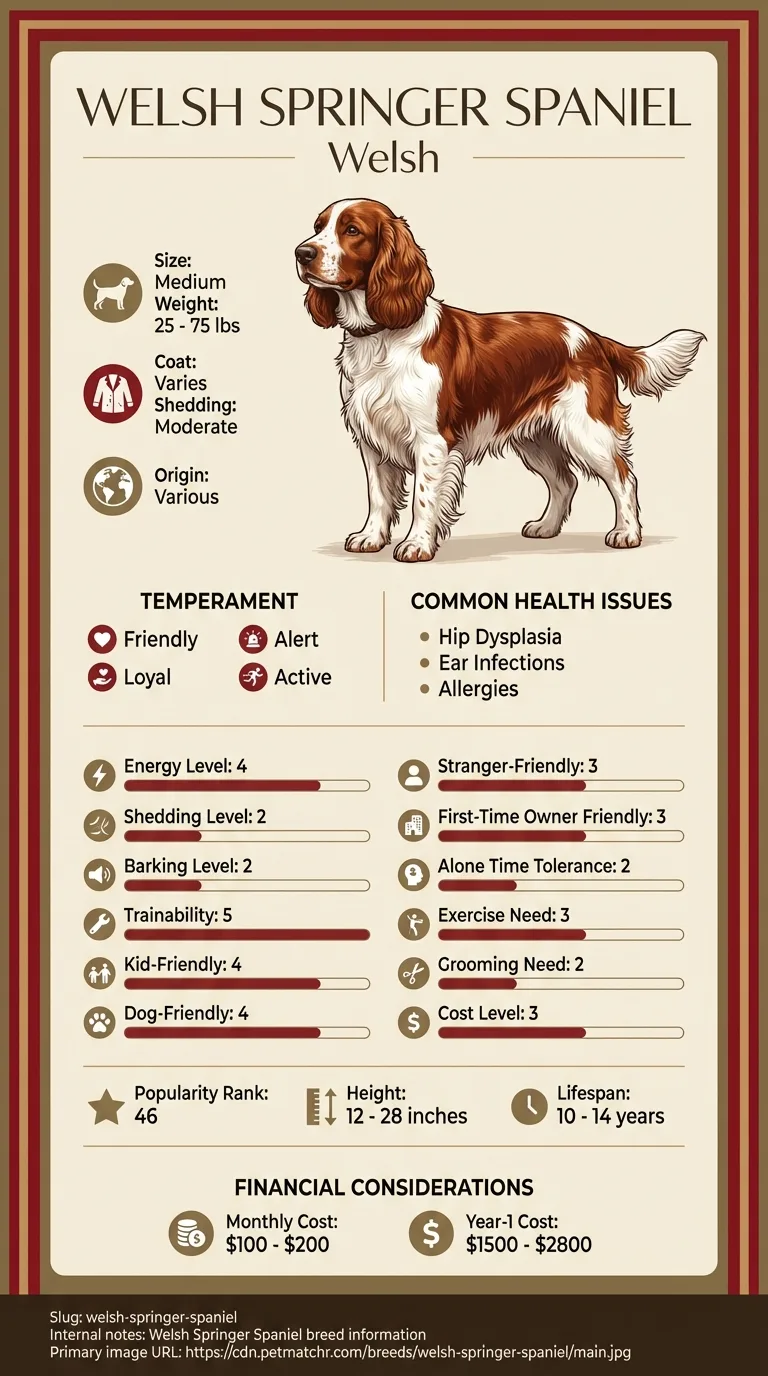
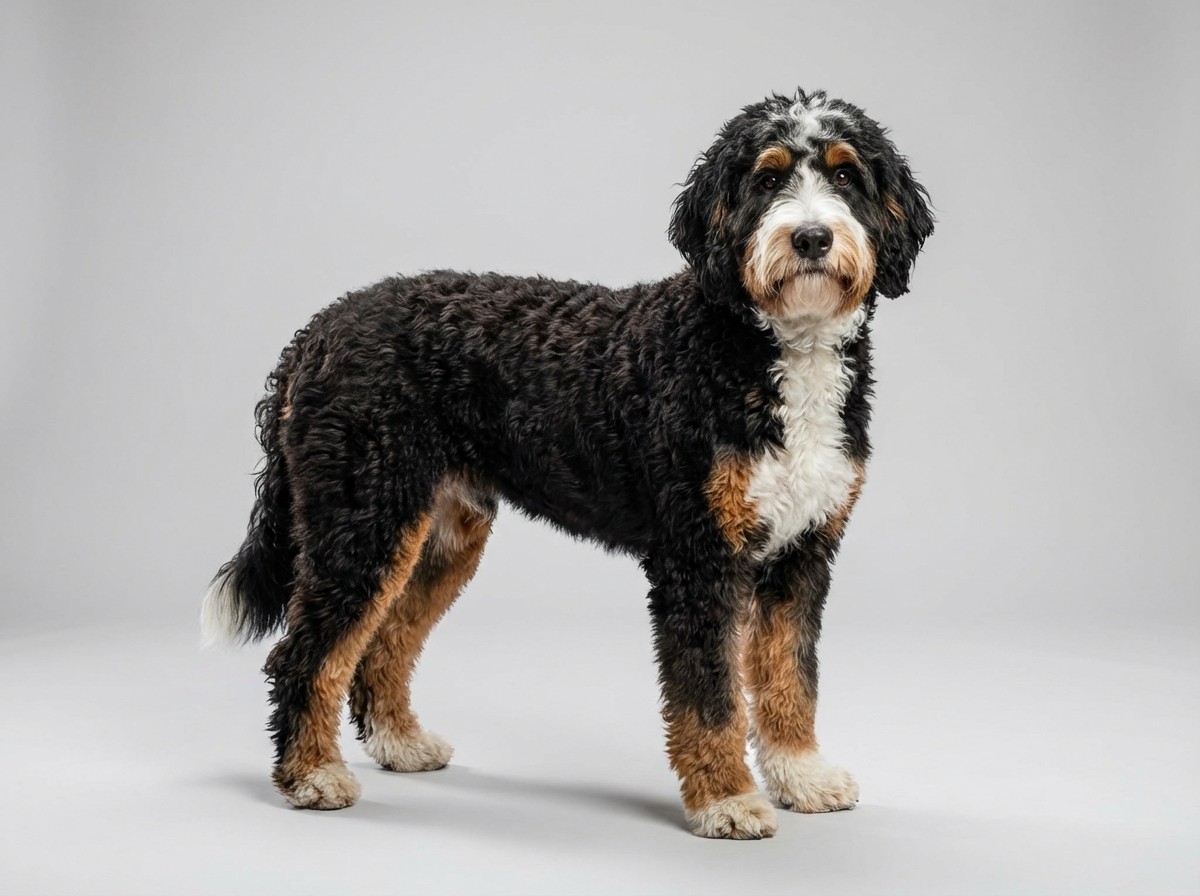
Both land in the medium category, but the numbers hide real variation. Bernedoodles run anywhere from 20 to 90 lbs and 12 to 23 inches -- a range wide enough to cover a standard poodle-sized dog or something twice as heavy -- because breeders cross at different poodle sizes. Welsh Springer Spaniels are far more predictable: 35-55 lbs and 17-19 inches, every time. If you want to know exactly what will show up at 18 months, the Springer is the safer bet on paper size.
Energy and exercise
Both breeds score a 4 out of 5 for exercise and energy, so don't expect a lazy afternoon-nap dog from either one. The Welsh Springer was bred to flush and retrieve birds all day, so its drive tends toward fieldwork-style stamina; the Bernedoodle's energy varies more litter to litter depending on the poodle side. Either way, budget for a real daily outlet -- a walk around the block won't cut it.
Grooming and shedding
Here the two swap places. The Bernedoodle's curly-to-wavy coat needs more upkeep (4/5 grooming) but sheds lightly (2/5) since it leans toward poodle hair. The Welsh Springer's coat is lower-maintenance to brush (3/5) but sheds more (3/5) because it's a straight, water-resistant double coat built for the field, not a hypoallergenic one. If someone in the house has allergies, that difference matters more than the grooming score does.
Apartment living, noise and time alone
Neither dog scores well for apartment living -- both sit at 2 out of 5 -- and both are rated low for tolerating time alone. Where they differ is on the mouth: the Bernedoodle is quieter (2/5 barking) while the Welsh Springer runs a notch louder (3/5). In a shared building, that gap could be the difference between friendly nods from neighbors and a noise complaint.
Training and owner experience
The Bernedoodle edges out the Welsh Springer here -- a 5/5 trainability score against the Springer's still-respectable 4/5, and a 4/5 first-time-owner rating versus 3/5. Both are intelligent dogs that want a job, but the Bernedoodle's poodle ancestry gives it an edge in picking up commands fast, which matters if this is your first dog.
Kids, other dogs and visitors
With kids, other dogs, and strangers, the Bernedoodle rates higher on every measure -- 5/5 with kids and other dogs, 4/5 with strangers, versus the Welsh Springer's 4/5, 4/5, and 3/5. The temperament lists back this up: the Springer is described as reserved with strangers, while the Bernedoodle's list leads with friendly. Neither is a problem dog around people, but the Bernedoodle warms up faster.
Health and lifespan
The Bernedoodle's expected lifespan of 12-18 years beats the Welsh Springer's 12-15, though the Bernedoodle's health list is longer, including bloat, Addison's disease, and heart conditions inherited from its Bernese side, on top of hip and elbow dysplasia. The Springer's list is shorter and more contained: hip dysplasia, ear infections, epilepsy, glaucoma, and hypothyroidism. Ask any breeder for health testing on the parents either way.
Cost to keep
The Bernedoodle costs more to keep -- 4/5 on the cost scale against the Springer's 3/5 -- with a monthly range of $120-220 versus $100-200, and a first-year tag of $1,800-3,200 compared to $1,400-2,900. Grooming is the likely driver: that curly coat needs professional trims the Springer's coat doesn't.
Bernedoodle vs Welsh Springer Spaniel at a glance
Bernedoodle weighs 20–90 lbs and lives 12–18 years; Welsh Springer Spaniel weighs 35–55 lbs and lives 12–15 years. No rated axis separates them by more than a single point, which makes this one of the closer pairings on the site. They are level on tolerates being alone, apartment suitability and energy level, so those cannot decide it. The table below marks a winner only where one breed is genuinely easier for a typical owner; size and origin are facts rather than merits and stay level. Ratings come from one source applied to both breeds, so they are meaningful against each other rather than as absolute scores.
Bernedoodle vs Welsh Springer Spaniel: Which Suits Your Home? - Bernedoodle vs Welsh Springer Spaniel at a glance
Frequently asked questions
How big do these two get?
The Bernedoodle's range is wide -- 20 to 90 lbs depending on the poodle parent's size -- while the Welsh Springer Spaniel is consistently 35-55 lbs. If predictable adult size matters to you, the Springer is the more reliable pick.
Which one sheds less?
The Bernedoodle sheds less (2/5 versus 3/5) thanks to its curly, hypoallergenic-leaning coat, though it needs more grooming work to stay that way. The Welsh Springer sheds a bit more but requires less brushing overall.
Is either one a good first dog?
The Bernedoodle scores 4/5 for first-time owners against the Welsh Springer's 3/5, largely because of its higher trainability score (5/5 vs 4/5). Both need an experienced hand with exercise, though.
Will either one do okay in an apartment?
Not really -- both score just 2/5 for apartment suitability and 2/5 for tolerating time alone. These are dogs bred for space and activity, not small-space living.
What will monthly costs look like?
Expect $120-220 a month for a Bernedoodle and $100-200 for a Welsh Springer Spaniel, with first-year costs of $1,800-3,200 and $1,400-2,900 respectively. The gap comes mostly from grooming.
Do they share any health risks?
Both breeds carry a risk of hip dysplasia and epilepsy. Beyond that their lists diverge -- the Bernedoodle's includes bloat, Addison's disease, and heart conditions, while the Springer's stays limited to ear infections, glaucoma, and hypothyroidism.
Which one barks more?
The Welsh Springer is the noisier of the two at 3/5 versus the Bernedoodle's 2/5. Neither is an excessive barker, but it's worth knowing if thin walls are a concern.
Which is the better overall choice for most households?
The Bernedoodle rates higher across trainability, sociability, and lifespan, but it also costs more and needs heavier grooming -- for most households its all-around scores make it the safer default pick.
Costs
What's the monthly cost difference?
The Bernedoodle runs $120-220 a month against the Welsh Springer's $100-200 -- about $20-40 more, mostly grooming.
Training
How much exercise do they need?
Both need serious daily exercise -- each rated 4/5 on both energy and exercise need, so plan on more than a casual stroll.
Health
How long do they typically live?
The Bernedoodle's 12-18 year range edges out the Welsh Springer's 12-15 years, though the Bernedoodle carries a longer list of possible health conditions.
Related DogBreedCompass guides
Bernedoodle breed guide – Readers comparing the two usually want the full profile of Bernedoodle before deciding.
Health information here is general and is not veterinary advice. If your dog shows pain, sudden behaviour change, or worsening symptoms, consult a licensed veterinarian.
Some links on this site are affiliate links. We may earn a commission at no extra cost to you, and we only suggest products we believe are helpful for dog owners.
We research and check what we publish, but we do not warrant that any figure, date, price, or statement is accurate, complete, or current, and we accept no liability for any loss, cost, injury, or other harm arising from the use of this site. Use it as one reference among several. You remain responsible for your own decisions and for your dog's care - confirm anything that matters with a licensed veterinarian or another qualified professional before you act on it. Full disclaimer.