Behavior
Beagle or German Shorthaired Pointer — which fits better?
The Beagle for smaller homes and first-time owners. The GSP for an experienced, active household with space and time for serious daily exercise.

Quick answer
Beagle or German Shorthaired Pointer — which fits better?
The Beagle for smaller homes and first-time owners. The GSP for an experienced, active household with space and time for serious daily exercise.
Choosing between a Beagle and a German Shorthaired Pointer can be tough. Both breeds have unique traits that cater to different lifestyles. This guide compares their differences to help you decide.
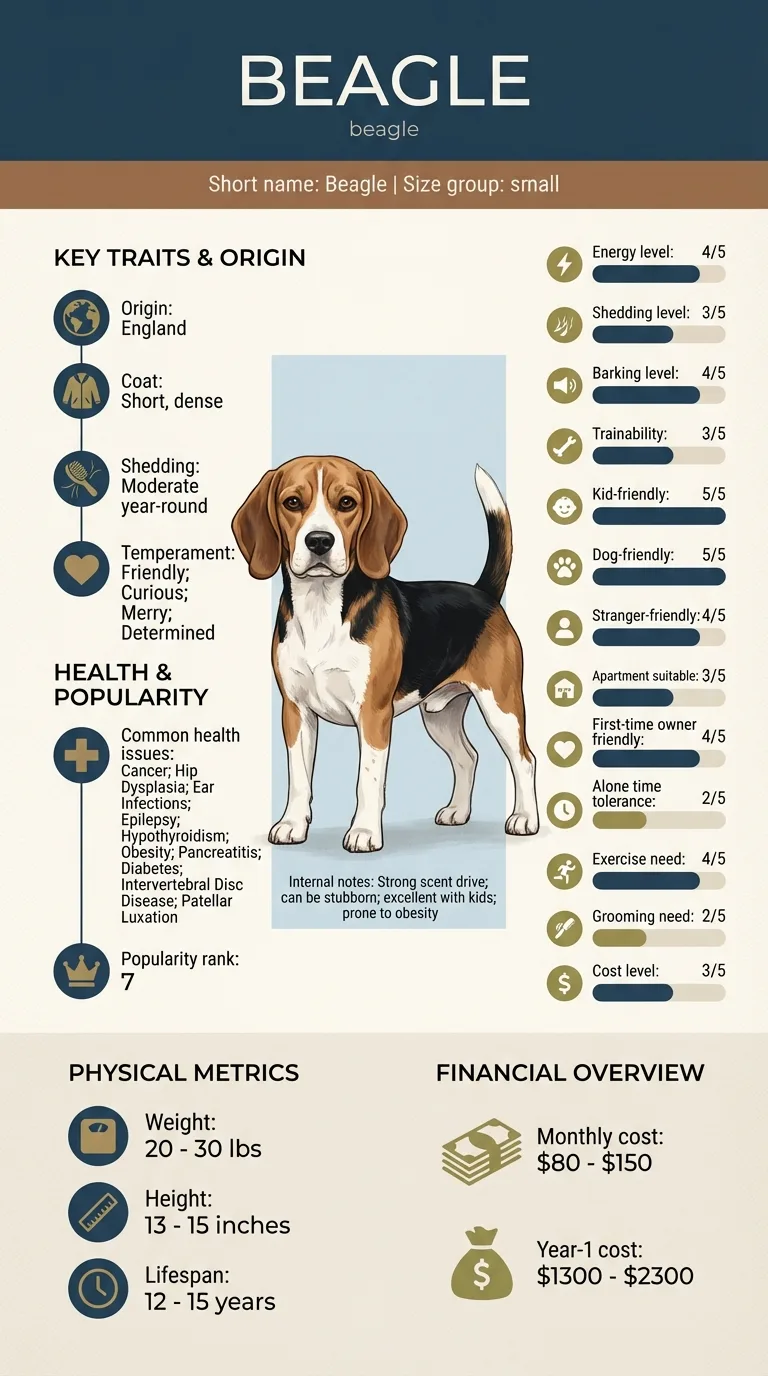
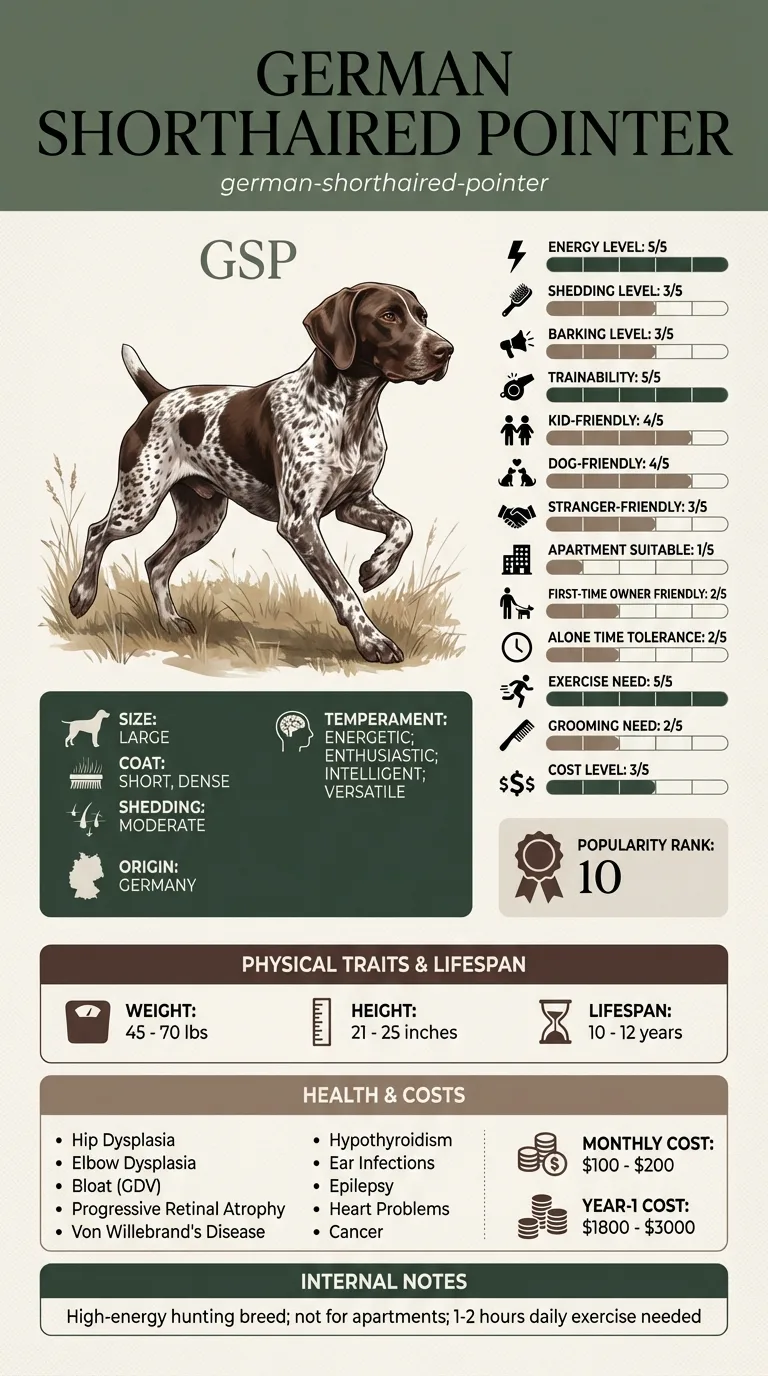
This comparison is perfect for potential dog owners who are torn between adopting a Beagle or a German Shorthaired Pointer. You might be a busy family looking for a friendly and trainable companion or a single person with an active lifestyle needing a high-energy dog. Whether you live in an apartment or a house with a yard, understanding each breed's needs and characteristics will help you choose the right pet.
If you're after a sociable family dog, the Beagle is your best bet, while the German Shorthaired Pointer suits active owners who can provide lots of exercise.
Choose the Beagle if you want a smaller, friendly dog that gets along well with kids and other pets, making them a great choice for families.
Opt for the German Shorthaired Pointer if you lead an active lifestyle and can commit to daily exercise; this breed requires more space and stimulation.
| Feature | beagle | german shorthaired pointer | Winner |
|---|---|---|---|
| Size class | small | large | Equal |
| Weight | 20–30 lbs | 45–70 lbs | Equal |
| Height | 13–15 in | 21–25 in | Equal |
| Lifespan | 12–15 years | 10–12 years | beagle |
| Exercise need | High (4/5) | Very high (5/5) | beagle |
| Grooming need | Low (2/5) | Low (2/5) | Equal |
| Shedding | Moderate (3/5) | Moderate (3/5) | Equal |
| Energy level | High (4/5) | Very high (5/5) | Equal |
| Barking | High (4/5) | Moderate (3/5) | german shorthaired pointer |
| Apartment suitability | Moderate (3/5) | Very low (1/5) | beagle |
| Good for first-time owners | High (4/5) | Low (2/5) | beagle |
| Tolerates being alone | Low (2/5) | Low (2/5) | Equal |
| Trainability | Moderate (3/5) | Very high (5/5) | german shorthaired pointer |
| Good with kids | Very high (5/5) | High (4/5) | beagle |
| Good with other dogs | Very high (5/5) | High (4/5) | beagle |
| Friendly to strangers | High (4/5) | Moderate (3/5) | beagle |
| Cost level | Moderate (3/5) | Moderate (3/5) | Equal |
| Coat | Short, dense | Short, dense | Equal |
| Origin | England | Germany | Equal |
| Typical monthly cost | $80–$150 | $100–$200 | Equal |
| Typical first-year cost | $1,300–$2,300 | $1,800–$3,000 | Equal |
This is a small-versus-large matchup in every sense. The Beagle weighs 20-30 lbs and stands 13-15 inches; the German Shorthaired Pointer weighs 45-70 lbs and stands 21-25 inches, officially in the large size class. At the extremes, a GSP can weigh more than triple what a Beagle does. Expect a completely different scale of dog if you go with the GSP.
The GSP needs a very high 5/5 worth of exercise, against the Beagle's already-substantial 4/5. This is a serious athletic hunting breed built to run all day in the field. If you can't commit to more than an hour of vigorous daily activity, the GSP is likely to become a problem dog through sheer under-exercise, more so than the Beagle would.
Grooming is a genuine tie here — both breeds rate a low 2/5 for grooming need, and both shed at a moderate 3/5. This is one of the few areas in this comparison where size doesn't translate into more upkeep; the GSP's short, dense coat is just as easy to maintain as the Beagle's.
The gap in apartment suitability is stark: the GSP rates a very low 1/5 against the Beagle's moderate 3/5. Between its size and its very high exercise needs, the GSP is genuinely a poor fit for small-space living. It's quieter, though — 3/5 barking versus the Beagle's 4/5 — which doesn't change the space equation much.
The GSP trains fast — a very high 5/5 versus the Beagle's 3/5 — but scores low, 2/5, for first-time owners, well below the Beagle's 4/5. That combination, highly trainable but not beginner-friendly, usually means the dog needs an owner who already knows how to channel a high-drive breed, not necessarily more repetition, just more structure and experience.
The Beagle edges ahead on every social measure: 5/5 with kids versus the GSP's 4/5, 5/5 with other dogs versus 4/5, and 4/5 with strangers versus the GSP's more moderate 3/5. The gaps aren't huge, but they're consistent — the GSP is a fine family dog on paper, just not quite as uniformly social as the Beagle.
The Beagle lives longer — 12-15 years versus the GSP's 10-12. Health overlap is substantial for this pair: hip dysplasia, hypothyroidism, ear infections, epilepsy, and cancer all appear on both lists, five shared conditions. The GSP's list is the longer of the two, adding bloat (GDV), progressive retinal atrophy, Von Willebrand's Disease, and heart problems on top of that shared risk profile.
Monthly costs run a bit higher for the GSP, $100-200 versus the Beagle's $80-150, though both rate a moderate 3/5 overall. The first-year gap is more pronounced: $1,800-3,000 for the GSP against $1,300-2,300 for the Beagle, reflecting the larger dog's higher food, gear, and initial veterinary costs. Build in room for that first-year spike if you're going the GSP route.


Dramatically — 45-70 lbs versus 20-30 lbs, putting the GSP in the large size class against the Beagle's small. It can weigh more than triple a Beagle's low-end weight.
The Beagle, by far. It rates a moderate 3/5 for apartment suitability against the GSP's very low 1/5 — one of the widest apartment gaps in this dataset.
Not really — it scores a low 2/5 for first-time owners against the Beagle's high 4/5, despite training faster (5/5 trainability versus the Beagle's 3/5). It's a dog for someone with prior experience handling high-drive breeds.
The GSP, clearly — a very high 5/5 versus the Beagle's 4/5. Both need real daily activity, but the GSP's requirement is closer to an hour-plus of vigorous work.
The GSP runs $100-200 monthly versus the Beagle's $80-150, and its first-year cost ($1,800-3,000) runs notably higher than the Beagle's ($1,300-2,300).
Yes, substantially — hip dysplasia, hypothyroidism, ear infections, epilepsy, and cancer all appear on both lists. The GSP's list is longer overall, adding bloat, Von Willebrand's Disease, and heart problems.
The Beagle, by two to three years — 12-15 years versus the GSP's 10-12.
The Beagle for smaller homes and first-time owners. The GSP for an experienced, active household with space and time for serious daily exercise.
The GSP, at $100-200 a month versus the Beagle's $80-150, with a bigger gap in first-year costs — $1,800-3,000 versus $1,300-2,300.
The GSP, at a very high 5/5 versus the Beagle's 4/5 — one of the more demanding breeds in this comparison set.
The Beagle, at 12-15 years versus the GSP's 10-12 — a meaningful gap tied partly to the GSP's larger size.
Secure checkout on Stripe. We never see your card.
7-day money-back guarantee. Instant access.
This guide is not medical advice. If your dog shows pain, sudden behavior change, or worsening symptoms, consult a licensed veterinarian.
Some links may be affiliate links. We may earn a commission at no extra cost to you. We only suggest products we believe are helpful for dog owners.
We research and check what we publish, but we do not warrant that any figure, date, price, or statement is accurate, complete, or current, and we accept no liability for any loss, cost, injury, or other harm arising from the use of this site. Use it as one reference among several. You remain responsible for your own decisions and for your dog's care - confirm anything that matters with a licensed veterinarian or another qualified professional before you act on it. Full disclaimer.
Match your lifestyle to the right dog.
Take quizNot sure which breed is right for you? Take our 2-minute quiz to find out.
Take the quiz