Living
Which is easier to house in a small home?
Neither is ideal, but the Beagle rates higher for apartment suitability (3/5 vs. 2/5).

Quick answer
Which is easier to house in a small home?
Neither is ideal, but the Beagle rates higher for apartment suitability (3/5 vs. 2/5).
Beagle or Bloodhound? On paper they differ most on good for first-time owners, and on the scales Bloodhound is the heavier at 90–110 lbs. Here is how the two compare on everything that shapes an ordinary week.
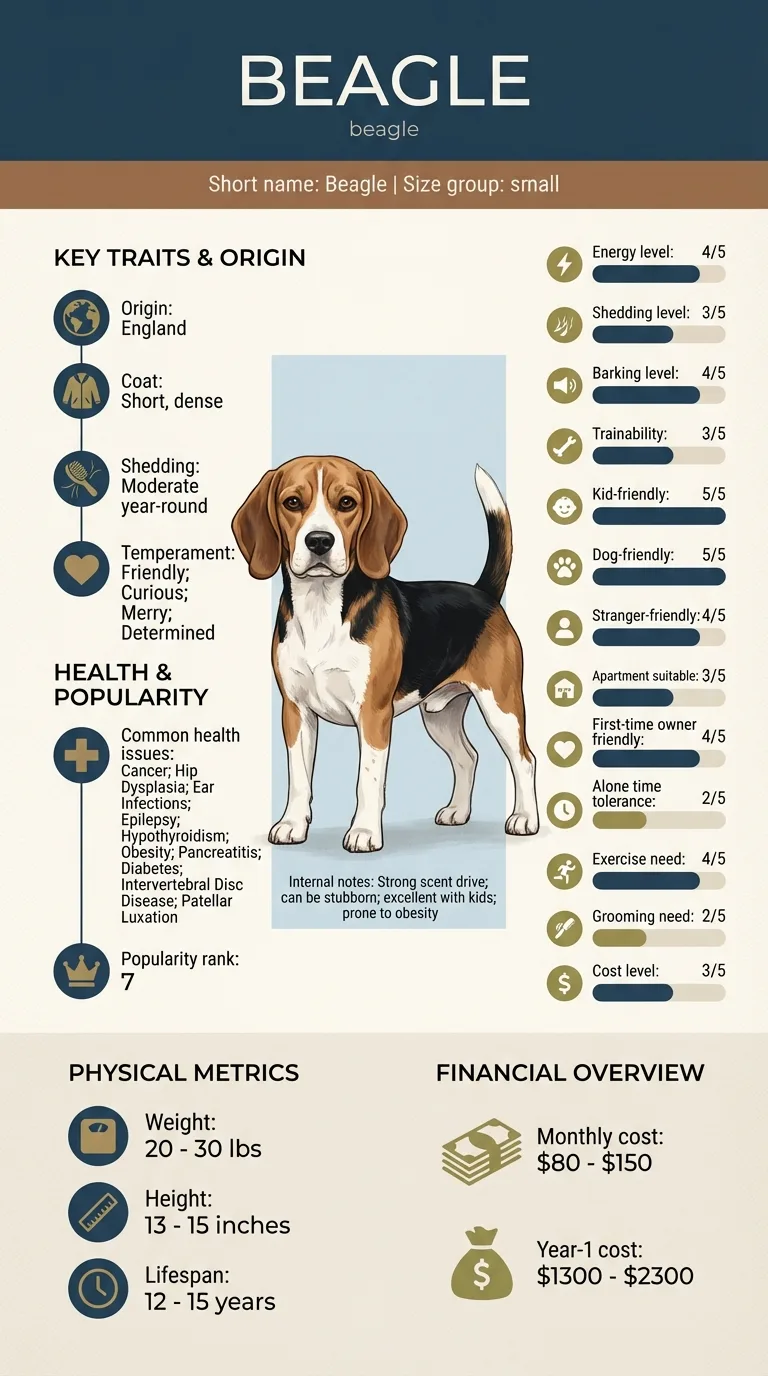
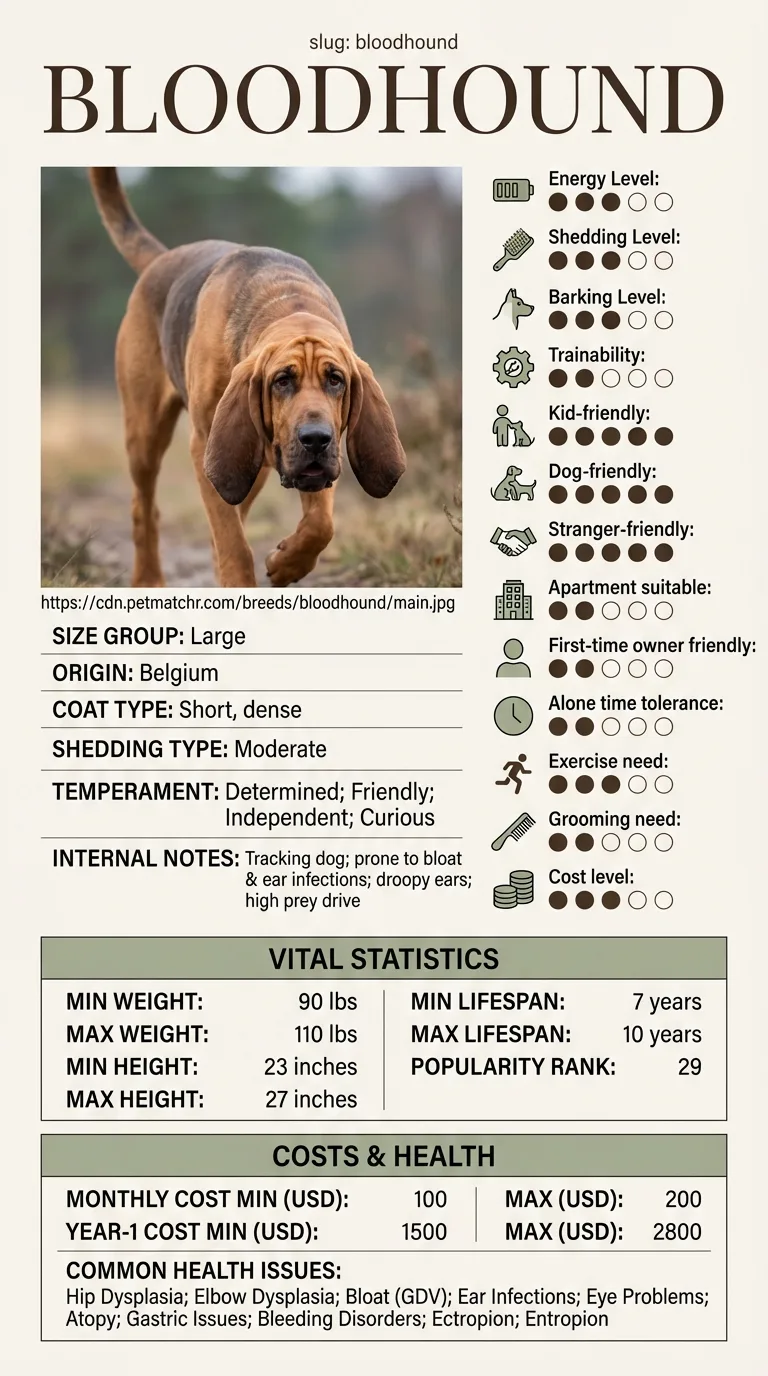
This is for someone already down to Beagle and Bloodhound and deciding between them. For this pair the decision usually turns on good for first-time owners, so those are covered first and in most detail. Anyone choosing from a flat has a clear answer here: Beagle rates 3/5 against 2/5. The focus throughout is on daily consequences rather than breed background.
Between Beagle and Bloodhound, good for first-time owners is what separates them, and Beagle is the lower-effort dog of the two to keep.
Choose Beagle if you are in a flat or a smaller home, this is your first dog and there are young children at home.
Choose Bloodhound if your walking routine is modest.
| Feature | beagle | bloodhound | Winner |
|---|---|---|---|
| Size class | small | large | Equal |
| Weight | 20–30 lbs | 90–110 lbs | Equal |
| Height | 13–15 in | 23–27 in | Equal |
| Lifespan | 12–15 years | 7–10 years | beagle |
| Exercise need | High (4/5) | Moderate (3/5) | bloodhound |
| Grooming need | Low (2/5) | Low (2/5) | Equal |
| Shedding | Moderate (3/5) | Moderate (3/5) | Equal |
| Energy level | High (4/5) | Moderate (3/5) | Equal |
| Barking | High (4/5) | Moderate (3/5) | bloodhound |
| Apartment suitability | Moderate (3/5) | Low (2/5) | beagle |
| Good for first-time owners | High (4/5) | Low (2/5) | beagle |
| Tolerates being alone | Low (2/5) | Low (2/5) | Equal |
| Trainability | Moderate (3/5) | Low (2/5) | beagle |
| Good with kids | Very high (5/5) | High (4/5) | beagle |
| Good with other dogs | Very high (5/5) | High (4/5) | beagle |
| Friendly to strangers | High (4/5) | High (4/5) | Equal |
| Cost level | Moderate (3/5) | Moderate (3/5) | Equal |
| Coat | Short, dense | Short, dense | Equal |
| Origin | England | Belgium | Equal |
| Typical monthly cost | $80–$150 | $100–$200 | Equal |
| Typical first-year cost | $1,300–$2,300 | $1,500–$2,800 | Equal |
Few match-ups in this comparison set show a bigger size gap than this one: the Beagle at 20 to 30 pounds and 13 to 15 inches, the Bloodhound at 90 to 110 pounds and 23 to 27 inches. The Bloodhound can outweigh the Beagle by roughly four times its own body weight. Both are scent hounds by trade, but only one of them was bred to track for miles at a size that intimidates most people on sight.
Despite its size, the Bloodhound actually rates lower for exercise need than the Beagle -- 3/5 against 4/5 -- and lower on energy too (3/5 vs. 4/5). A Bloodhound's stamina is built for long, steady tracking work rather than the more constant activity a Beagle shows day to day. Neither is a couch potato, but the smaller dog is, somewhat counterintuitively, the more physically demanding one to live with.
Coat care is a wash between them -- both rate 2/5 for grooming and 3/5 for shedding, short coats that need routine but not intensive brushing. The Bloodhound's loose, wrinkled skin does need attention to avoid skin fold issues and odor, which the Beagle's tighter coat doesn't require, even though the numeric grooming score doesn't fully capture that difference.
The Beagle rates better for apartment life (3/5 vs. 2/5) but also barks more (4/5 vs. 3/5) -- a trade-off between space efficiency and noise. A Bloodhound's sheer size makes small-space living impractical regardless of its rating; a 100-pound dog needs room to turn around even if it isn't especially loud or hyperactive about using that room.
The Beagle is the more trainable of the two (3/5 vs. 2/5) and rates far better for first-time owners (4/5 vs. 2/5). Bloodhounds are famously independent trackers, more interested in following a scent than following a command, and their size means an untrained adult dog is a genuine handling challenge in a way an untrained Beagle simply isn't.
The Beagle edges ahead with kids and other dogs (5/5 vs. 4/5 in both), while both breeds are equally friendly with strangers (4/5 each). The gap isn't large in either category -- this is one of the more balanced sections of the comparison -- but a Bloodhound's size means even friendly behavior needs more active supervision around small children than a Beagle's does.
The standout number in this whole comparison is lifespan: the Bloodhound lives just 7 to 10 years on average, against the Beagle's considerably longer 12 to 15. That's a gap of roughly five years, one of the widest in this dataset, and it's typical of giant breeds trading size for longevity. Both breeds share hip dysplasia and ear infections on their health lists, with the Bloodhound's remaining risks -- bloat, eye and eyelid problems, bleeding disorders -- tied closely to its large frame.
The Bloodhound costs more to keep: $100-$200 monthly against the Beagle's $80-$150, and $1,500-$2,800 in year one versus $1,300-$2,300. Given its size, that gap is smaller than you might expect -- a 100-pound dog eating and needing more of everything doesn't cost proportionally more, though the shorter lifespan means you're likely to face those costs across fewer years overall.
Beagle weighs 20–30 lbs and lives 12–15 years; Bloodhound weighs 90–110 lbs and lives 7–10 years. The two diverge most on good for first-time owners. They are level on tolerates being alone, cost level and grooming need, so those cannot decide it. The table below marks a winner only where one breed is genuinely easier for a typical owner; size and origin are facts rather than merits and stay level. Ratings come from one source applied to both breeds, so they are meaningful against each other rather than as absolute scores.

Substantially -- 90-110 lbs versus the Beagle's 20-30 lbs, roughly four times the weight.
The Beagle, by a wide margin -- 12-15 years against the Bloodhound's 7-10, one of the largest lifespan gaps in this dataset.
Surprisingly, the Beagle -- it rates 4/5 for exercise need against the Bloodhound's 3/5, despite being the much smaller dog.
Not really -- it rates 2/5 for first-time owners, well below the Beagle's 4/5, due to its independence and handling challenges from sheer size.
The Bloodhound runs $100-$200 monthly versus the Beagle's $80-$150, a modest gap given the size difference.
Yes -- hip dysplasia and ear infections appear on both lists.
The Beagle, rating 4/5 against the Bloodhound's 3/5.
Neither is ideal, but the Beagle rates higher for apartment suitability (3/5 vs. 2/5).
About $20-$50 more for the Bloodhound -- $100-$200 versus the Beagle's $80-$150.
Lifespan -- the Bloodhound lives just 7-10 years versus the Beagle's 12-15.
The Beagle, rating 3/5 versus the Bloodhound's 2/5, and it rates far better for first-time owners overall.
Secure checkout on Stripe. We never see your card.
7-day money-back guarantee. Instant access.

Health information here is general and is not veterinary advice. If your dog shows pain, sudden behaviour change, or worsening symptoms, consult a licensed veterinarian.
Some links on this site are affiliate links. We may earn a commission at no extra cost to you, and we only suggest products we believe are helpful for dog owners.
We research and check what we publish, but we do not warrant that any figure, date, price, or statement is accurate, complete, or current, and we accept no liability for any loss, cost, injury, or other harm arising from the use of this site. Use it as one reference among several. You remain responsible for your own decisions and for your dog's care - confirm anything that matters with a licensed veterinarian or another qualified professional before you act on it. Full disclaimer.
Match your lifestyle to the right dog.
Take quizNot sure which breed is right for you? Take our 2-minute quiz to find out.
Take the quiz