Living
Which suits most households?
The Sheltie for easier training and lower cost, provided the barking is tolerable; the AmStaff if you want a quieter dog and don't mind its grooming-free coat trade-off.

Quick answer
Which suits most households?
The Sheltie for easier training and lower cost, provided the barking is tolerable; the AmStaff if you want a quieter dog and don't mind its grooming-free coat trade-off.
American Staffordshire Terrier or Shetland Sheepdog? On paper they differ most on grooming need, and on the scales American Staffordshire Terrier is the heavier at 40–70 lbs. Here is how the two compare on everything that shapes an ordinary week.
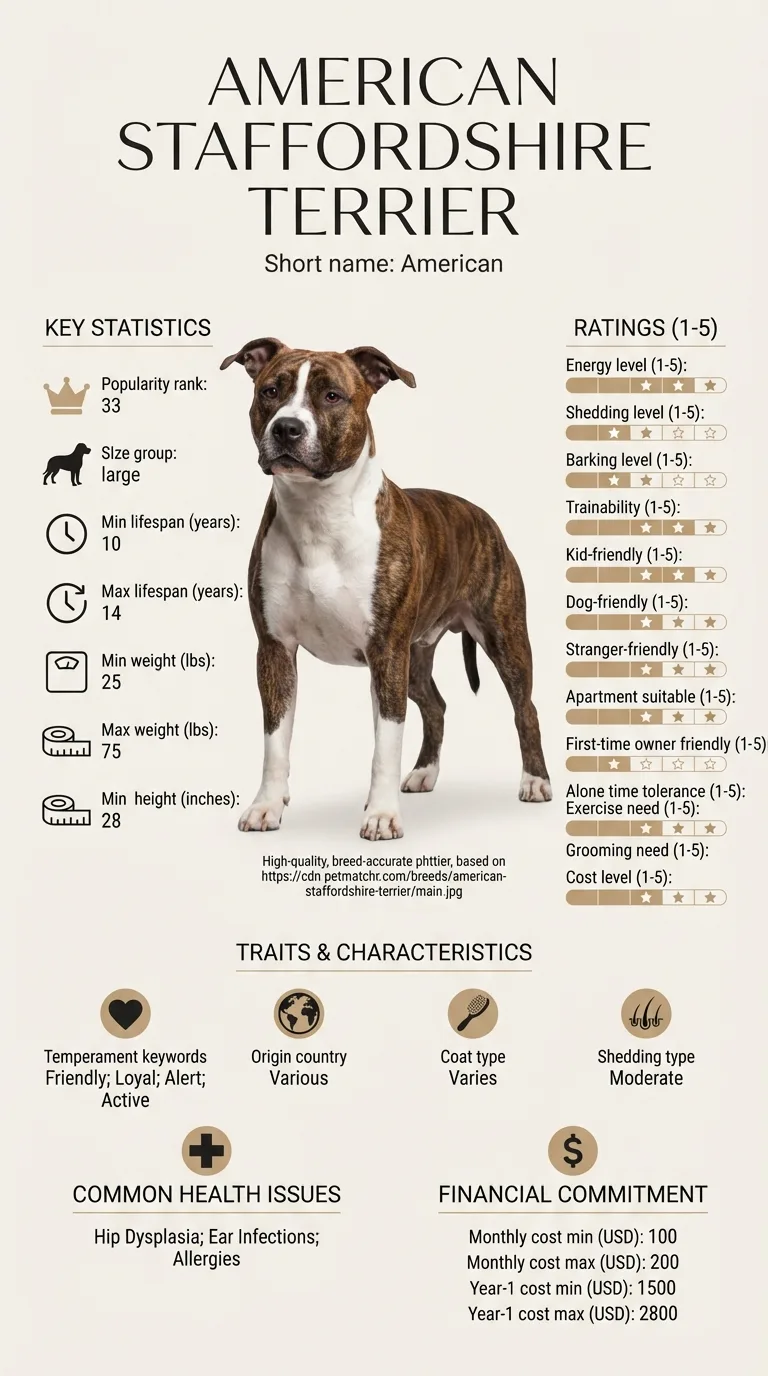
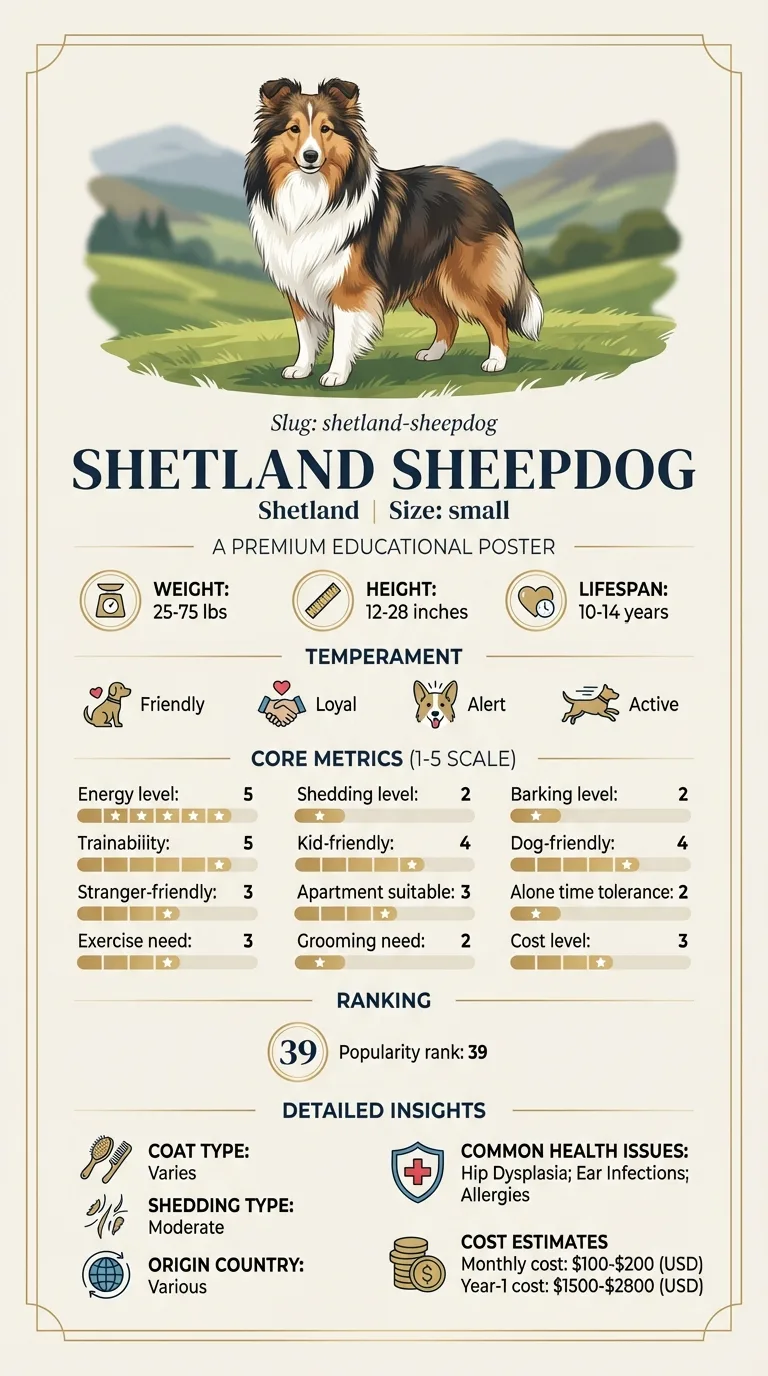
This is for someone already down to American Staffordshire Terrier and Shetland Sheepdog and deciding between them. For this pair the decision usually turns on grooming need and barking, so those are covered first and in most detail. Both rate 3/5 for flats, so housing does not settle this one. The focus throughout is on daily consequences rather than breed background.
Between American Staffordshire Terrier and Shetland Sheepdog, grooming need is what separates them, and American Staffordshire Terrier is the lower-effort dog of the two to keep.
Choose American Staffordshire Terrier if you do not want a standing grooming appointment, shedding is a problem in your house and the dog will be alone during the working day.
Choose Shetland Sheepdog if this is your first dog, you already have another dog and you want a dog that picks up training quickly.
| Feature | american staffordshire terrier | shetland sheepdog | Winner |
|---|---|---|---|
| Size class | medium | small | Equal |
| Weight | 40–70 lbs | 15–25 lbs | Equal |
| Height | 17–19 in | 13–16 in | Equal |
| Lifespan | 12–16 years | 12–14 years | american staffordshire terrier |
| Exercise need | High (4/5) | High (4/5) | Equal |
| Grooming need | Very low (1/5) | High (4/5) | american staffordshire terrier |
| Shedding | Moderate (3/5) | High (4/5) | american staffordshire terrier |
| Energy level | High (4/5) | High (4/5) | Equal |
| Barking | Low (2/5) | Very high (5/5) | american staffordshire terrier |
| Apartment suitability | Moderate (3/5) | Moderate (3/5) | Equal |
| Good for first-time owners | Moderate (3/5) | High (4/5) | shetland sheepdog |
| Tolerates being alone | Moderate (3/5) | Low (2/5) | american staffordshire terrier |
| Trainability | High (4/5) | Very high (5/5) | shetland sheepdog |
| Good with kids | High (4/5) | High (4/5) | Equal |
| Good with other dogs | Low (2/5) | High (4/5) | shetland sheepdog |
| Friendly to strangers | High (4/5) | Low (2/5) | american staffordshire terrier |
| Cost level | Moderate (3/5) | Moderate (3/5) | Equal |
| Coat | Short, stiff and glossy | Long, dense double coat | Equal |
| Origin | Various | Various | Equal |
| Typical monthly cost | $100–$200 | $80–$150 | Equal |
| Typical first-year cost | $1,400–$2,900 | $1,100–$2,300 | Equal |
Both breeds are compact next to a Great Dane, but not next to each other -- the AmStaff's 40-70 pounds and 17-19 inches dwarfs the Sheltie's 15-25 pounds and 13-16 inches. The Sheltie looks like a scaled-down collie because it essentially is one; the AmStaff carries far more muscle mass per inch of height.
Exercise need and energy level tie at high (4/5) for both, which surprises people who picture the Sheltie as a lap dog because of its size. It isn't -- this is a herding breed built for long working days, and it needs the activity to match.
The Sheltie demands real grooming commitment: high (4/5) against the AmStaff's near-zero 1 out of 5, thanks to that long, dense double coat. Shedding follows the same pattern, high (4/5) for the Sheltie against moderate (3/5) for the AmStaff. Combined, that's a lot more hair and brushing time than the AmStaff's short coat ever asks for.
Here's the number that should decide things for apartment dwellers: the Sheltie rates very high (5/5) for barking against the AmStaff's low (2/5), one of the widest gaps on this site. Apartment suitability itself ties at moderate (3/5) for both, but that barking gap means daily life with a Sheltie in close quarters looks very different from life with an AmStaff.
Trainability favors the Sheltie, very high (5/5) against the AmStaff's already-strong high (4/5) -- Shelties are famously quick studies, bred to take direction at a distance while herding. First-time-owner suitability leans Sheltie too, high (4/5) against the AmStaff's moderate (3/5), assuming the barking is manageable for your living situation.
Good with kids ties at high (4/5). Good with other dogs favors the Sheltie clearly, high (4/5) against the AmStaff's low (2/5), making it the easier pick for multi-dog households. Strangers flip the other way -- the AmStaff rates high (4/5) friendliness against the Sheltie's low (2/5), reflecting a herding breed's natural wariness of unfamiliar people.
Lifespan slightly favors the AmStaff, 12 to 16 years against the Sheltie's 12 to 14 -- a narrow gap, mostly at the top of the range. The Sheltie's health list is breed-specific in a way the AmStaff's isn't: collie eye anomaly and MDR1 drug sensitivity are conditions tied directly to its herding-dog ancestry, alongside dermatomyositis, hypothyroidism and patellar luxation.
Cost level ties at moderate (3/5), and the Sheltie actually runs cheaper on paper -- $80-$150 a month and $1,100-$2,300 in year one, against the AmStaff's $100-$200 and $1,400-$2,900. Its smaller size keeps food and medication costs down, though grooming supplies or professional grooming for that coat should be factored in separately.
American Staffordshire Terrier weighs 40–70 lbs and lives 12–16 years; Shetland Sheepdog weighs 15–25 lbs and lives 12–14 years. The two diverge most on grooming need, barking and good with other dogs and 1 other rated axes. They are level on apartment suitability, cost level and energy level, so those cannot decide it. The table below marks a winner only where one breed is genuinely easier for a typical owner; size and origin are facts rather than merits and stay level. Ratings come from one source applied to both breeds, so they are meaningful against each other rather than as absolute scores.

Substantially -- 15-25 pounds and 13-16 inches against the AmStaff's 40-70 pounds and 17-19 inches. The Sheltie is a small breed; the AmStaff is medium.
The Sheltie, by a wide margin -- very high (5/5) against the AmStaff's low (2/5). If you have close neighbors, this is likely the single most important number in this comparison.
Yes, rated high (4/5) against the AmStaff's moderate (3/5) -- assuming you can manage or tolerate its vocal tendencies, it's an easier breed for a newcomer to handle.
They tie at moderate (3/5) for raw apartment suitability, but the Sheltie's very-high barking rating makes noise the real deciding factor for shared-wall living.
The Sheltie -- $80-$150 a month against the AmStaff's $100-$200, and roughly $1,100-$2,300 versus $1,400-$2,900 in the first year, mostly reflecting its smaller size.
Not directly -- none of the five conditions on either list match exactly. The Sheltie's risks (collie eye anomaly, MDR1 sensitivity, dermatomyositis) are herding-breed-specific, while the AmStaff's run to hips, heart and skin.
The AmStaff, clearly -- high (4/5) against the Sheltie's low (2/5). Shelties tend to be reserved or wary with unfamiliar people, a trait common in herding breeds.
The Sheltie for easier training and lower cost, provided the barking is tolerable; the AmStaff if you want a quieter dog and don't mind its grooming-free coat trade-off.
The Sheltie, at $80-$150 against the AmStaff's $100-$200 -- its smaller size keeps routine costs down.
As much as the AmStaff -- both tie at high (4/5) exercise need, despite the Sheltie's much smaller frame.
Close to a tie, with the AmStaff's 12-16 year range edging just past the Sheltie's 12-14 at the top end.
Secure checkout on Stripe. We never see your card.
7-day money-back guarantee. Instant access.
Health information here is general and is not veterinary advice. If your dog shows pain, sudden behaviour change, or worsening symptoms, consult a licensed veterinarian.
Some links on this site are affiliate links. We may earn a commission at no extra cost to you, and we only suggest products we believe are helpful for dog owners.
We research and check what we publish, but we do not warrant that any figure, date, price, or statement is accurate, complete, or current, and we accept no liability for any loss, cost, injury, or other harm arising from the use of this site. Use it as one reference among several. You remain responsible for your own decisions and for your dog's care - confirm anything that matters with a licensed veterinarian or another qualified professional before you act on it. Full disclaimer.
Match your lifestyle to the right dog.
Take quizNot sure which breed is right for you? Take our 2-minute quiz to find out.
Take the quiz