Living
Which should I choose overall?
Pick the Pug for low-maintenance apartment life with kids and other pets; pick the AmStaff if you can provide daily vigorous exercise and want a dog that's easier on the grooming budget.

Quick answer
Which should I choose overall?
Pick the Pug for low-maintenance apartment life with kids and other pets; pick the AmStaff if you can provide daily vigorous exercise and want a dog that's easier on the grooming budget.
American Staffordshire Terrier or Pug? On paper they differ most on exercise need, and on the scales American Staffordshire Terrier is the heavier at 40–70 lbs. Here is how the two compare on everything that shapes an ordinary week.
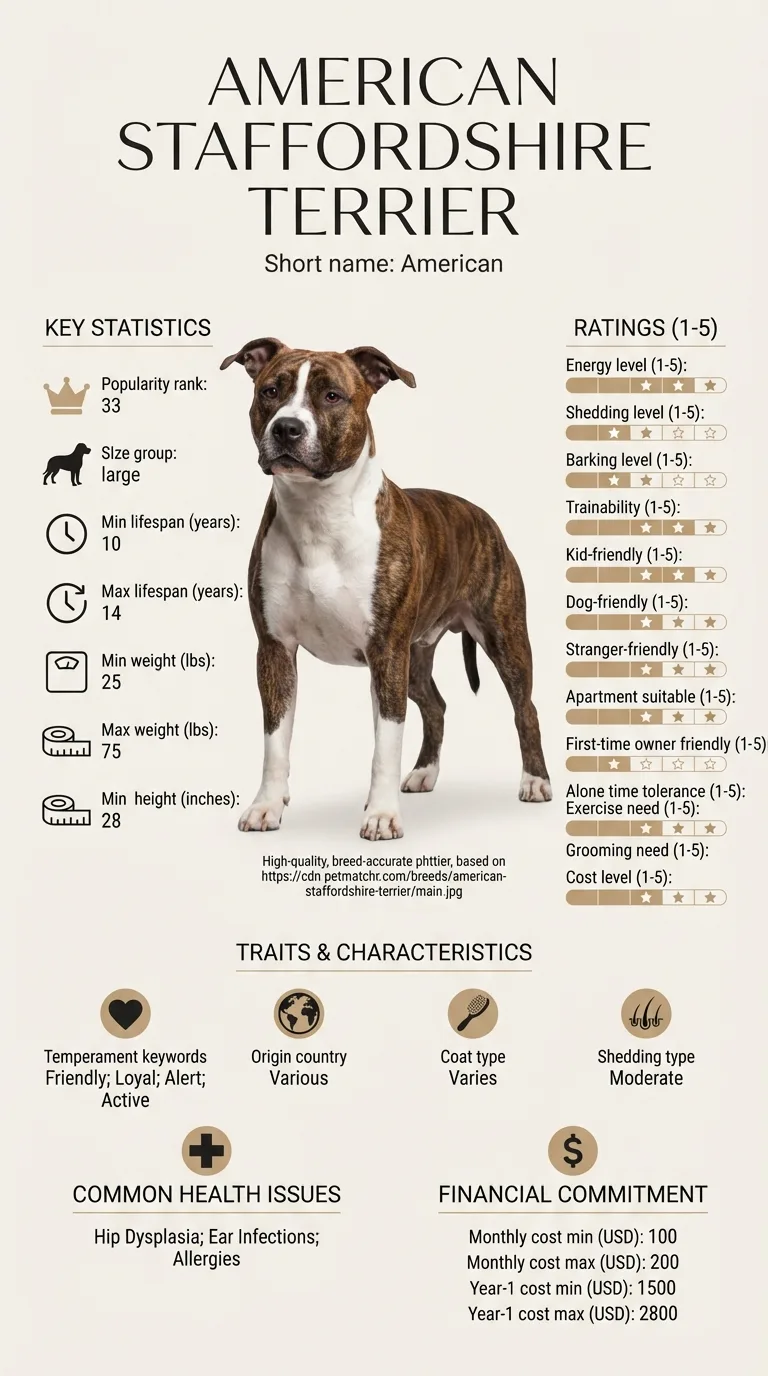
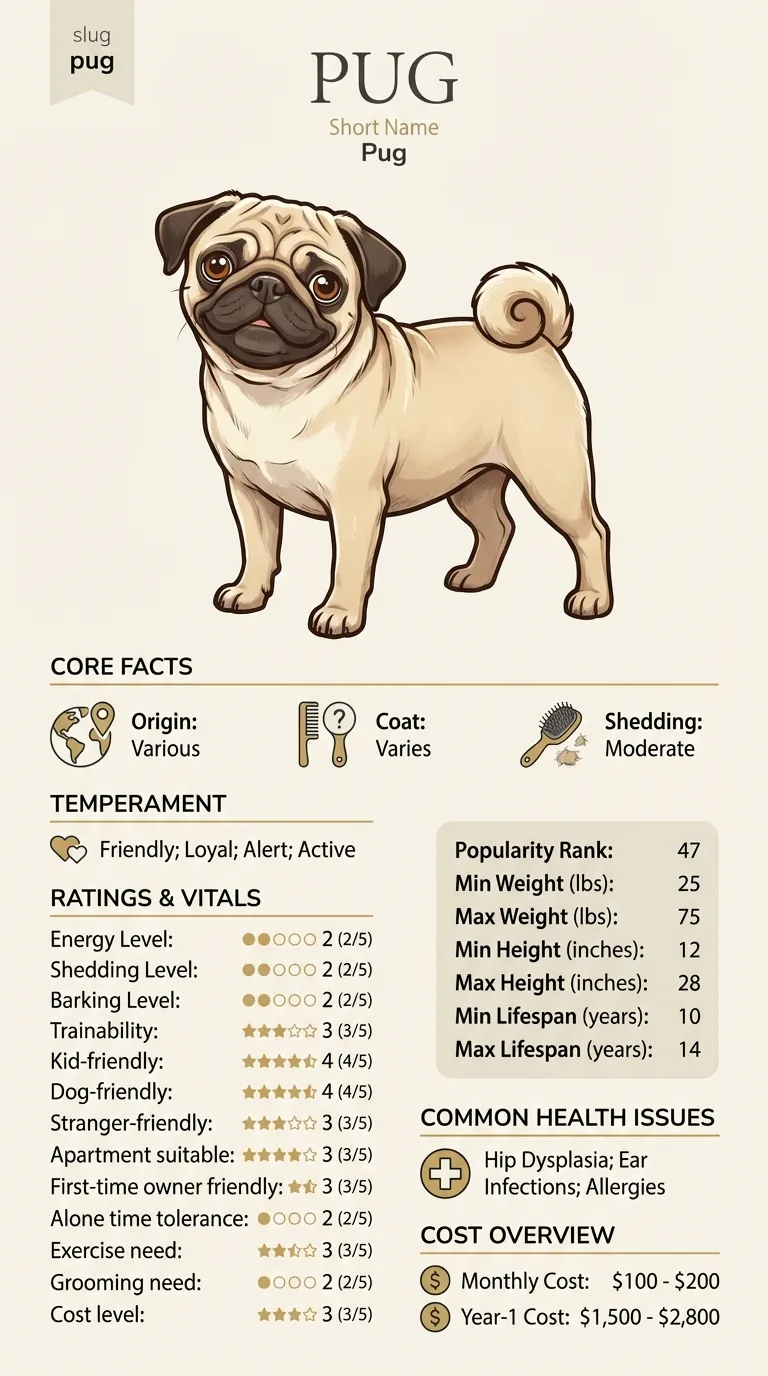
This is for someone already down to American Staffordshire Terrier and Pug and deciding between them. For this pair the decision usually turns on exercise need and energy level, so those are covered first and in most detail. Anyone choosing from a flat has a clear answer here: Pug rates 5/5 against 3/5. It is written for the decision rather than the breed history.
Between American Staffordshire Terrier and Pug, exercise need is what separates them, and Pug is the lower-effort dog of the two to keep.
Choose American Staffordshire Terrier if you do not want a standing grooming appointment, shedding is a problem in your house and the dog will be alone during the working day.
Choose Pug if you are in a flat or a smaller home, this is your first dog and your walking routine is modest.
| Feature | american staffordshire terrier | pug | Winner |
|---|---|---|---|
| Size class | medium | small | Equal |
| Weight | 40–70 lbs | 14–18 lbs | Equal |
| Height | 17–19 in | 10–13 in | Equal |
| Lifespan | 12–16 years | 13–15 years | Equal |
| Exercise need | High (4/5) | Low (2/5) | pug |
| Grooming need | Very low (1/5) | Low (2/5) | american staffordshire terrier |
| Shedding | Moderate (3/5) | High (4/5) | american staffordshire terrier |
| Energy level | High (4/5) | Low (2/5) | Equal |
| Barking | Low (2/5) | Low (2/5) | Equal |
| Apartment suitability | Moderate (3/5) | Very high (5/5) | pug |
| Good for first-time owners | Moderate (3/5) | Very high (5/5) | pug |
| Tolerates being alone | Moderate (3/5) | Low (2/5) | american staffordshire terrier |
| Trainability | High (4/5) | Moderate (3/5) | american staffordshire terrier |
| Good with kids | High (4/5) | Very high (5/5) | pug |
| Good with other dogs | Low (2/5) | High (4/5) | pug |
| Friendly to strangers | High (4/5) | Very high (5/5) | pug |
| Cost level | Moderate (3/5) | Moderate (3/5) | Equal |
| Coat | Short, stiff and glossy | Short, smooth double coat | Equal |
| Origin | Various | Various | Equal |
| Typical monthly cost | $100–$200 | $80–$150 | Equal |
| Typical first-year cost | $1,400–$2,900 | $1,100–$2,300 | Equal |
Forty to seventy pounds against fourteen to eighteen. That's the gap between these two, and it shows up in more than the bathroom scale -- the AmStaff stands 17 to 19 inches at the shoulder, built dense and muscular, while the Pug tops out around 13 inches and carries a compact, cobby frame. Anyone picking the Pug for portability is right to; anyone expecting the AmStaff to fit under an airline seat is not.
The AmStaff rates high energy and a 4 out of 5 exercise need -- this is a dog bred for sustained physical work, and a short leash walk won't cut it. The Pug sits at 2 out of 5 on both counts, content with a couple of short strolls a day. If your idea of exercise is a 20-minute loop around the block, the Pug will thank you and the AmStaff will start finding its own entertainment, which is rarely good news for your furniture.
Grooming favors the AmStaff outright -- a 1 out of 5 need against the Pug's 2 out of 5, since that short stiff coat needs almost nothing beyond an occasional wipe-down. Shedding flips the comparison though: the AmStaff sheds moderately (3/5) while the Pug sheds heavily (4/5) despite its short coat. Pug owners tend to be surprised by how much hair a small dog can distribute across a dark couch.
Both breeds bark low (2/5), so neither will get you a noise complaint on that front. Apartment suitability is where they split hard: the Pug scores a full 5 out of 5, the AmStaff a middling 3, mostly because of that exercise requirement rather than temperament. On being left alone, though, the AmStaff actually holds up better -- moderate (3/5) tolerance versus the Pug's low (2/5).
Trainability leans AmStaff, 4 out of 5 against the Pug's 3, and the breed's temperament -- confident, good-natured, courageous -- tends to make training sessions productive once you have its attention. Where the numbers really diverge is first-time-owner suitability: the Pug rates very high (5/5), the AmStaff only moderate (3/5), reflecting the extra exercise, structure and dog-to-dog management a Staffordshire Terrier tends to need.
With kids, both score well, but the Pug edges ahead at very high (5/5) versus the AmStaff's high (4/5). The bigger gap is with other dogs: the Pug rates high (4/5) sociability while the AmStaff sits at low (2/5), so dog parks and multi-dog households need more planning with the Staffordshire Terrier. Strangers get a similarly warm reception from both, though the Pug edges out the AmStaff slightly.
Lifespans land close -- 12 to 16 years for the AmStaff, 13 to 15 for the Pug. The health profiles diverge more sharply by type of problem. The AmStaff's list runs to joints and skin: hip dysplasia, cerebellar ataxia, skin allergies, heart disease, cruciate ligament tears. The Pug's list is dominated by its flat face -- brachycephalic airway syndrome, corneal ulcers, pug dog encephalitis -- plus a real tendency toward obesity given how little exercise the breed wants.
Cost level ties at moderate (3/5) for both, but the dollar ranges still favor the Pug slightly: $80 to $150 a month against the AmStaff's $100 to $200, and $1,100 to $2,300 in year one versus $1,400 to $2,900. Neither is a budget breed, but the AmStaff's larger size pushes up food and medication costs, while the Pug's brachycephalic issues can mean higher one-off vet bills.
American Staffordshire Terrier weighs 40–70 lbs and lives 12–16 years; Pug weighs 14–18 lbs and lives 13–15 years. The two diverge most on exercise need, energy level and apartment suitability and 2 other rated axes. They are level on barking and cost level, so those cannot decide it. In the table, a "winner" means easier for an ordinary household — not better. Size, coat and origin are recorded without a verdict. Because both breeds are scored the same way, the gaps are reliable even where the absolute numbers are rough.

The AmStaff, by a wide margin -- 40 to 70 pounds and 17 to 19 inches tall, compared to the Pug's 14 to 18 pounds and 10 to 13 inches. You're looking at a medium-sized athletic dog against a small, compact one.
The Pug, despite its short coat -- it rates 4 out of 5 for shedding against the AmStaff's 3 out of 5. Grooming effort still favors the AmStaff overall since its coat needs almost no maintenance.
The Pug is rated very high (5/5) for first-time owners, the AmStaff only moderate (3/5). The AmStaff's higher exercise needs and its low rating with other dogs (2/5) mean it rewards someone with prior dog-handling experience.
The Pug, rated very high (5/5) for apartment suitability against the AmStaff's moderate (3/5). The AmStaff can adapt to apartment life but needs daily exercise the Pug simply doesn't.
Budget $100-$200 a month for the AmStaff and $80-$150 for the Pug, or roughly $1,400-$2,900 versus $1,100-$2,300 in the first year. Both rate a moderate 3 out of 5 on overall cost level.
Not much. The AmStaff's concerns center on hips, heart and skin; the Pug's center on its flat face and spine -- airway syndrome, corneal ulcers, hemivertebrae. Obesity is a Pug-specific watch item given its low exercise drive.
The AmStaff, moderate (3/5) versus the Pug's low (2/5). It's a detail that surprises people expecting the smaller, calmer dog to handle solitude better.
Pick the Pug for low-maintenance apartment life with kids and other pets; pick the AmStaff if you can provide daily vigorous exercise and want a dog that's easier on the grooming budget.
The AmStaff runs $100-$200 a month, the Pug $80-$150 -- both moderate, but the AmStaff's larger size adds up over a year.
The AmStaff rates 4 out of 5 for exercise need, the Pug just 2 out of 5. A Pug is satisfied with short daily walks; the AmStaff needs real physical output.
The Pug's range (13-15 years) sits inside the AmStaff's wider range (12-16 years) -- practically a toss-up, though the AmStaff has more upside at the long end.
See every pug comparison.
Secure checkout on Stripe. We never see your card.
7-day money-back guarantee. Instant access.
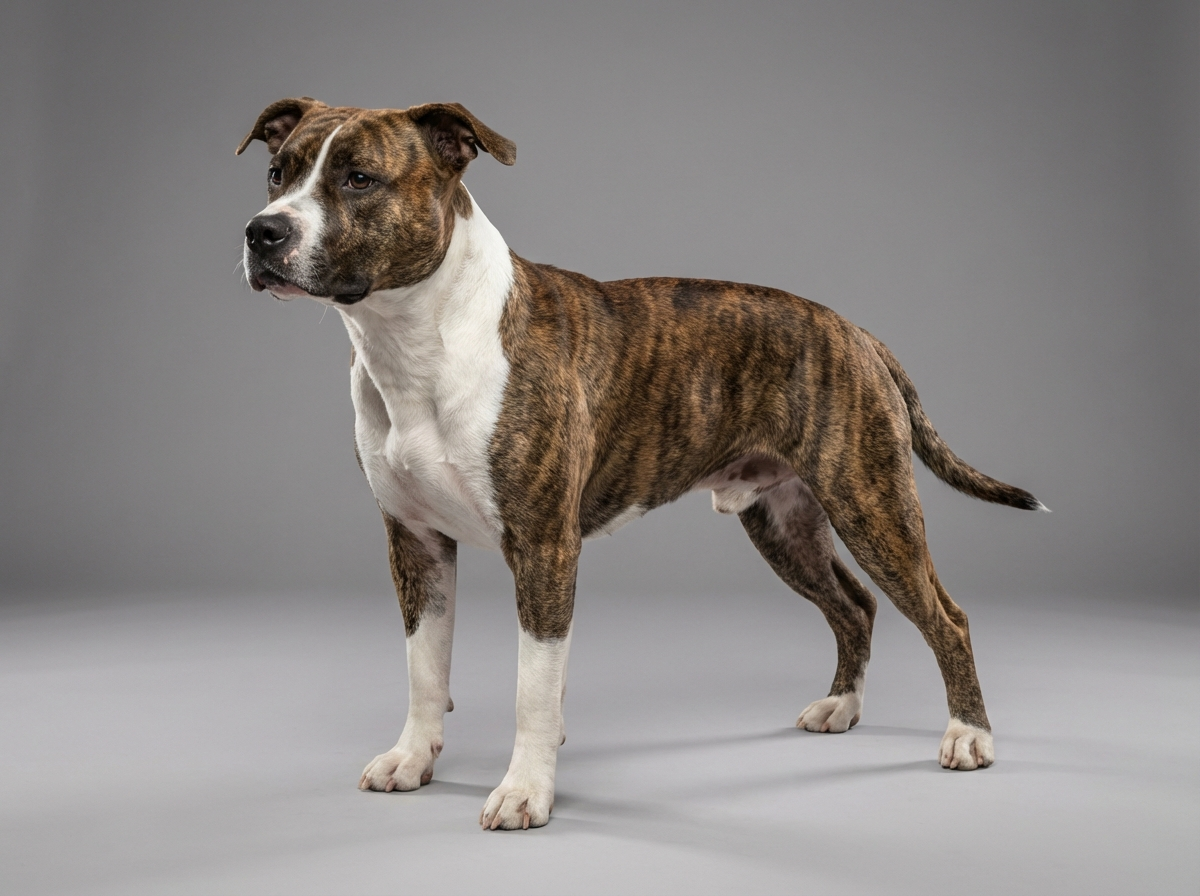
Health information here is general and is not veterinary advice. If your dog shows pain, sudden behaviour change, or worsening symptoms, consult a licensed veterinarian.
Some links on this site are affiliate links. We may earn a commission at no extra cost to you, and we only suggest products we believe are helpful for dog owners.
We research and check what we publish, but we do not warrant that any figure, date, price, or statement is accurate, complete, or current, and we accept no liability for any loss, cost, injury, or other harm arising from the use of this site. Use it as one reference among several. You remain responsible for your own decisions and for your dog's care - confirm anything that matters with a licensed veterinarian or another qualified professional before you act on it. Full disclaimer.
Match your lifestyle to the right dog.
Take quizNot sure which breed is right for you? Take our 2-minute quiz to find out.
Take the quiz