Living
Which fits a smaller home better?
The French Spaniel wants more exercise and more space; the AmStaff is the marginally better fit for a smaller home.

Quick answer
Which fits a smaller home better?
The French Spaniel wants more exercise and more space; the AmStaff is the marginally better fit for a smaller home.
American Staffordshire Terrier or French Spaniel? On paper they differ most on grooming need, and on the scales American Staffordshire Terrier is the heavier at 40–70 lbs. Here is how the two compare on everything that shapes an ordinary week.
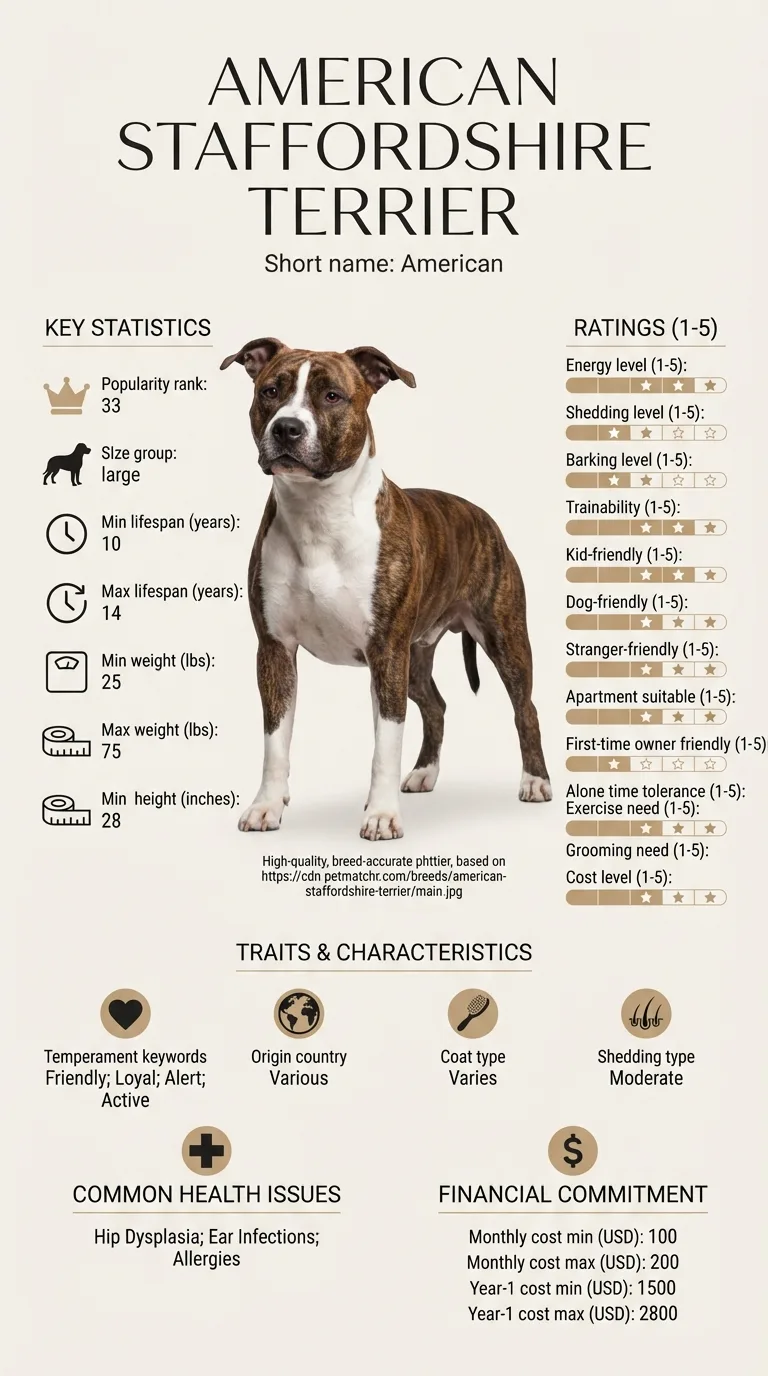
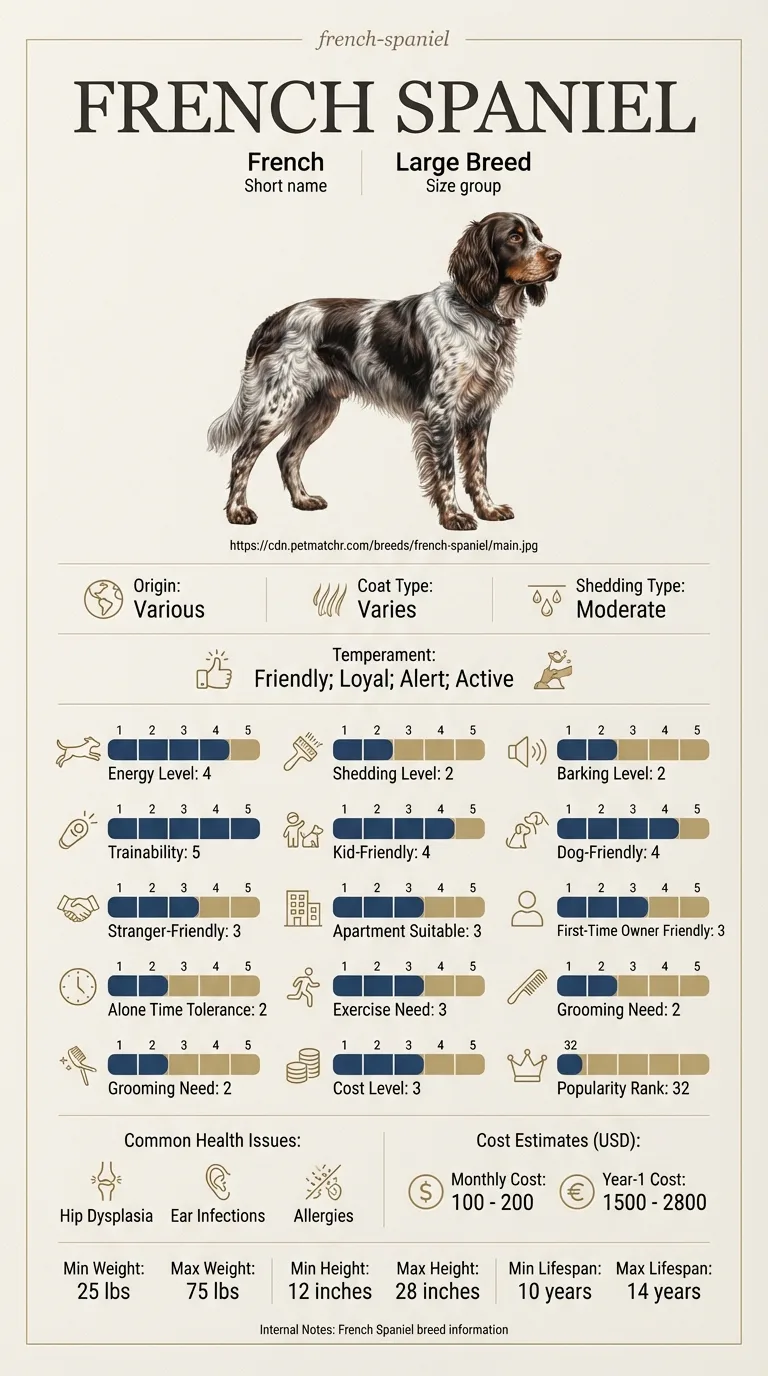
This is for someone already down to American Staffordshire Terrier and French Spaniel and deciding between them. For this pair the decision usually turns on grooming need and good with other dogs, so those are covered first and in most detail. Anyone choosing from a flat has a clear answer here: American Staffordshire Terrier rates 3/5 against 2/5. The focus throughout is on daily consequences rather than breed background.
Between American Staffordshire Terrier and French Spaniel, grooming need is what separates them, and American Staffordshire Terrier is the lower-effort dog of the two to keep.
Choose American Staffordshire Terrier if you are in a flat or a smaller home, you do not want a standing grooming appointment and your walking routine is modest.
Choose French Spaniel if you already have another dog, a smaller dog suits your car, your home or your back and you want a dog that can keep up with an active routine.
| Feature | american staffordshire terrier | french spaniel | Winner |
|---|---|---|---|
| Size class | medium | medium | Equal |
| Weight | 40–70 lbs | 45–60 lbs | Equal |
| Height | 17–19 in | 21–24 in | Equal |
| Lifespan | 12–16 years | 10–12 years | american staffordshire terrier |
| Exercise need | High (4/5) | Very high (5/5) | american staffordshire terrier |
| Grooming need | Very low (1/5) | Moderate (3/5) | american staffordshire terrier |
| Shedding | Moderate (3/5) | Moderate (3/5) | Equal |
| Energy level | High (4/5) | High (4/5) | Equal |
| Barking | Low (2/5) | Low (2/5) | Equal |
| Apartment suitability | Moderate (3/5) | Low (2/5) | american staffordshire terrier |
| Good for first-time owners | Moderate (3/5) | Moderate (3/5) | Equal |
| Tolerates being alone | Moderate (3/5) | Low (2/5) | american staffordshire terrier |
| Trainability | High (4/5) | High (4/5) | Equal |
| Good with kids | High (4/5) | High (4/5) | Equal |
| Good with other dogs | Low (2/5) | High (4/5) | french spaniel |
| Friendly to strangers | High (4/5) | High (4/5) | Equal |
| Cost level | Moderate (3/5) | Moderate (3/5) | Equal |
| Coat | Short, stiff and glossy | Medium, flat and feathered | Equal |
| Origin | Various | Various | Equal |
| Typical monthly cost | $100–$200 | $100–$200 | Equal |
| Typical first-year cost | $1,400–$2,900 | $1,400–$2,900 | Equal |
The French Spaniel is a less familiar name than most of the breeds on this site, but the numbers place it as a fairly large dog, 45 to 60 pounds and 21 to 24 inches, taller than the AmStaff's 17 to 19 inches even though the weight ranges sit closer together, 40 to 70 versus 45 to 60. In practice that means the French Spaniel usually reads as the taller, rangier dog of the two despite a comparable weight on the scale.
Exercise need runs slightly higher for the French Spaniel, a 5 out of 5 against the AmStaff's 4, though general energy level ties at 4 for both. As a hunting breed bred to work fields for hours, the French Spaniel's exercise ceiling is a genuine 5, not a rounded-up 4. Expect to pair daily exercise with some kind of mental or scent work if you want a French Spaniel to settle indoors afterward.
Grooming sits at a moderate 3 out of 5 for the French Spaniel, thanks to its medium, flat, feathered coat, against a minimal 1 for the AmStaff. Shedding ties at moderate for both, so the difference again comes down to upkeep time rather than fur volume. A weekly brushing session is usually enough to keep the French Spaniel's feathering free of tangles without turning into a major time commitment.
Apartment suitability favors the AmStaff, 3 against the French Spaniel's 2, and the AmStaff also tolerates being alone a bit better, 3 to 2. Barking ties low for both at 2 out of 5. Between the higher exercise need and the lower apartment score, the French Spaniel reads as more of a house-with-yard breed than a city-apartment one. That's less about noise and more about the daily exercise a small space simply can't provide on its own.
Trainability and first-time-owner suitability both tie, at 4 and 3 respectively, so there's no meaningful gap to lean on here. Neither breed is a walk in the park for a total beginner, and neither is especially difficult either. Both breeds respond well to positive, consistent methods, and neither has the kind of stubborn streak that turns basic obedience into a real project.
Kids and strangers both tie at 4 out of 5 for the two breeds. Other dogs is where they split: the French Spaniel rates a 4, the AmStaff a 2, making the Spaniel the safer pick if you already have dogs at home or spend time at the dog park. Kids and strangers aren't where you'll find a meaningful gap between these two, so factor other dogs in more heavily if that applies to your household.
The AmStaff's 12 to 16 year lifespan beats the French Spaniel's 10 to 12 by several years. Hip dysplasia sits on both lists. The French Spaniel's remaining risks include epilepsy, ear infections, general eye conditions, and acral mutilation syndrome, a rare inherited nerve condition specific enough to be worth asking a breeder about directly. That condition is rare enough that most owners never encounter it, but reputable breeders should be able to speak to it directly.
Cost comes out identical on paper for both breeds, $100 to $200 a month, $1,400 to $2,900 in the first year, a moderate cost rating either way. The French Spaniel's field-dog background means actual spend could lean toward training classes or fenced-yard setup rather than grooming or vet bills. A field-bred dog like this one also tends to do better with structured activities like scent work or agility, which come with their own modest costs.
American Staffordshire Terrier weighs 40–70 lbs and lives 12–16 years; French Spaniel weighs 45–60 lbs and lives 10–12 years. The two diverge most on grooming need and good with other dogs. They are level on barking, cost level and energy level, so those cannot decide it. The table below marks a winner only where one breed is genuinely easier for a typical owner; size and origin are facts rather than merits and stay level. Ratings come from one source applied to both breeds, so they are meaningful against each other rather than as absolute scores.

A medium-to-large hunting breed, 45 to 60 pounds and 21 to 24 inches, with a gentle, sociable temperament and a moderate grooming coat.
The French Spaniel edges it, 5 out of 5 versus the AmStaff's 4, reflecting its field-dog background.
The French Spaniel's feathered coat rates 3 out of 5 versus the AmStaff's 1.
They tie at 3 out of 5, a moderate fit either way.
Identical ranges, $100 to $200 a month and $1,400 to $2,900 in the first year.
Hip dysplasia appears on both lists; the French Spaniel also carries epilepsy and a rare nerve condition, acral mutilation syndrome.
The French Spaniel, 4 out of 5 versus the AmStaff's 2.
The French Spaniel wants more exercise and more space; the AmStaff is the marginally better fit for a smaller home.
Identical on paper, $100 to $200 a month and $1,400 to $2,900 in year one for either breed.
The French Spaniel's exercise need hits 5 out of 5, a point above the AmStaff's 4.
The AmStaff's 12-16 year lifespan runs longer than the French Spaniel's 10-12.
Secure checkout on Stripe. We never see your card.
7-day money-back guarantee. Instant access.
Health information here is general and is not veterinary advice. If your dog shows pain, sudden behaviour change, or worsening symptoms, consult a licensed veterinarian.
Some links on this site are affiliate links. We may earn a commission at no extra cost to you, and we only suggest products we believe are helpful for dog owners.
We research and check what we publish, but we do not warrant that any figure, date, price, or statement is accurate, complete, or current, and we accept no liability for any loss, cost, injury, or other harm arising from the use of this site. Use it as one reference among several. You remain responsible for your own decisions and for your dog's care - confirm anything that matters with a licensed veterinarian or another qualified professional before you act on it. Full disclaimer.
Match your lifestyle to the right dog.
Take quizNot sure which breed is right for you? Take our 2-minute quiz to find out.
Take the quiz