Living
Which fits apartment life better?
Neither scores well - both sit at 2/5 for apartment suitability, so this comparison doesn't hand you an easy winner for small spaces.

Quick answer
Which fits apartment life better?
Neither scores well - both sit at 2/5 for apartment suitability, so this comparison doesn't hand you an easy winner for small spaces.
American Pit Bull Terrier or Doberman Pinscher? On paper they differ most on cost level, and on the scales Doberman Pinscher is the heavier at 60–100 lbs. Here is how the two compare on everything that shapes an ordinary week.
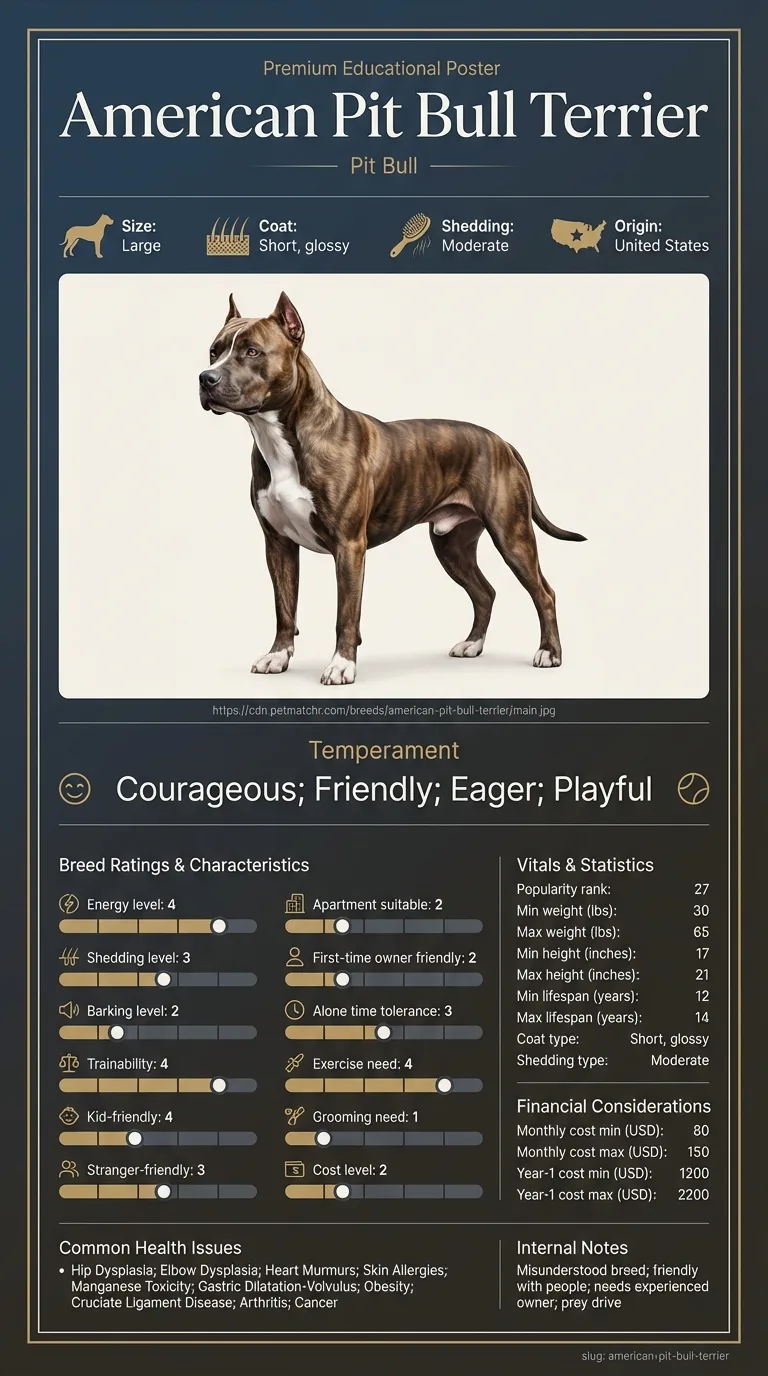
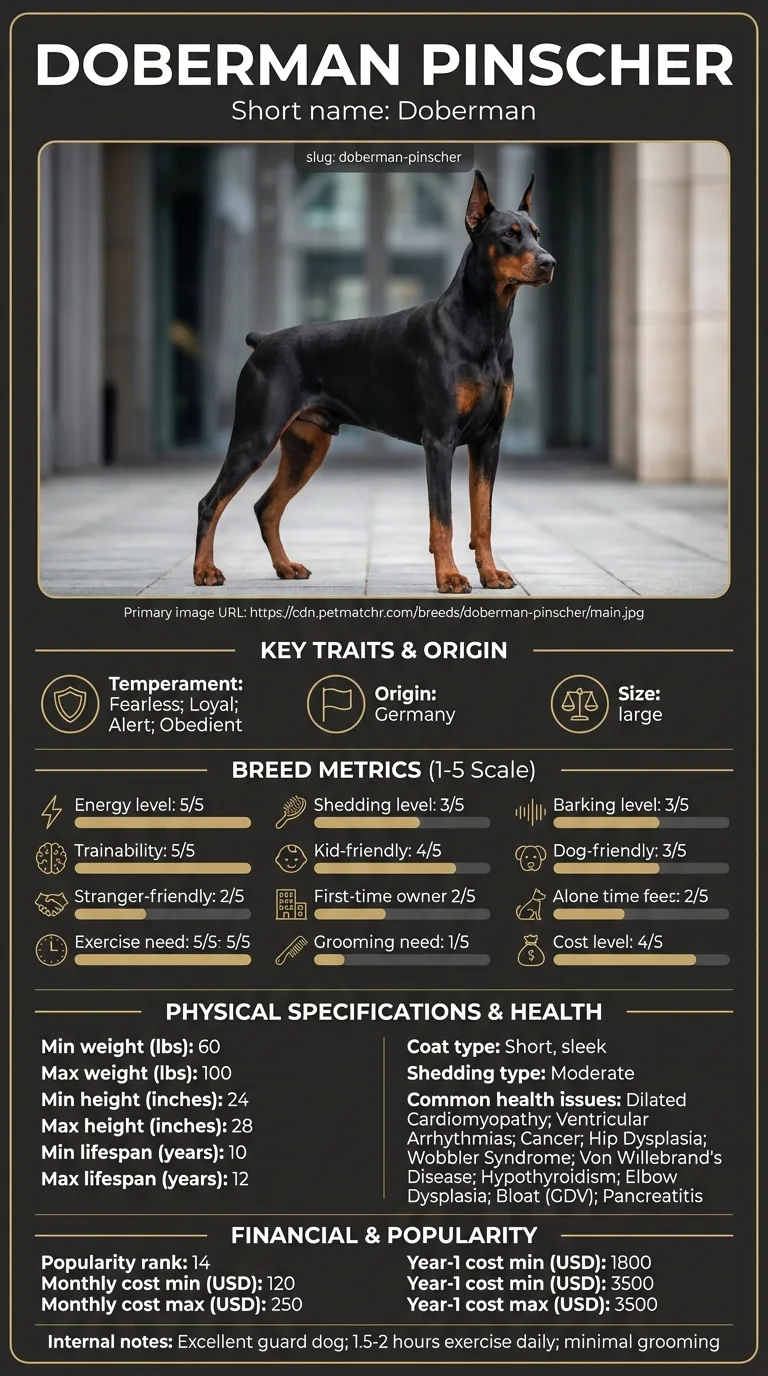
This is for someone already down to American Pit Bull Terrier and Doberman Pinscher and deciding between them. For this pair the decision usually turns on cost level, so those are covered first and in most detail. Both rate 2/5 for flats, so housing does not settle this one. Breed history is left out; what follows is what you will actually live with.
Between American Pit Bull Terrier and Doberman Pinscher, cost level is what separates them, and American Pit Bull Terrier is the lower-effort dog of the two to keep.
Choose American Pit Bull Terrier if your walking routine is modest, the dog will be alone during the working day and a smaller dog suits your car, your home or your back.
Choose Doberman Pinscher if you already have another dog, you want a dog that picks up training quickly and you want a dog that can keep up with an active routine.
| Feature | american pit bull terrier | doberman pinscher | Winner |
|---|---|---|---|
| Size class | large | large | Equal |
| Weight | 30–65 lbs | 60–100 lbs | Equal |
| Height | 17–21 in | 24–28 in | Equal |
| Lifespan | 12–14 years | 10–12 years | american pit bull terrier |
| Exercise need | High (4/5) | Very high (5/5) | american pit bull terrier |
| Grooming need | Very low (1/5) | Very low (1/5) | Equal |
| Shedding | Moderate (3/5) | Moderate (3/5) | Equal |
| Energy level | High (4/5) | Very high (5/5) | Equal |
| Barking | Low (2/5) | Moderate (3/5) | american pit bull terrier |
| Apartment suitability | Low (2/5) | Low (2/5) | Equal |
| Good for first-time owners | Low (2/5) | Low (2/5) | Equal |
| Tolerates being alone | Moderate (3/5) | Low (2/5) | american pit bull terrier |
| Trainability | High (4/5) | Very high (5/5) | doberman pinscher |
| Good with kids | High (4/5) | High (4/5) | Equal |
| Good with other dogs | Low (2/5) | Moderate (3/5) | doberman pinscher |
| Friendly to strangers | Moderate (3/5) | Low (2/5) | american pit bull terrier |
| Cost level | Low (2/5) | High (4/5) | american pit bull terrier |
| Coat | Short, glossy | Short, sleek | Equal |
| Origin | United States | Germany | Equal |
| Typical monthly cost | $80–$150 | $120–$250 | Equal |
| Typical first-year cost | $1,200–$2,200 | $1,800–$3,500 | Equal |
Both are large dogs, but the Doberman is built taller and heavier - 60-100 lbs and 24-28 inches at the shoulder against the Pit Bull's 30-65 lbs and 17-21 inches. Stand them side by side and the Doberman looks like the athlete, all long legs and lean muscle, while the Pit Bull is the shorter, blockier dog. Neither is small, but you're looking at potentially 35 extra pounds and half a foot of height with the Doberman.
The Doberman edges out the Pit Bull here, rating very high (5/5) exercise need against the Pit Bull's high (4/5). Both want real daily work - running, structured training, a job to do - rather than a slow stroll around the block. The Doberman's working-guard-dog background means it often channels unused energy into restlessness faster than the Pit Bull does, so if your schedule is unpredictable, that extra point on the exercise scale is worth taking seriously.
Coat care is close to a wash between these two - both score 1/5 for grooming need and 3/5 for shedding. Short, sleek coats mean no brushing marathons and no professional grooming bills for either breed, just a quick wipe-down and regular nail trims to keep things tidy. This is one category in the whole comparison where the breed choice genuinely doesn't matter much, so let other factors drive the decision instead.
Neither breed is an apartment natural - both score 2/5 for apartment suitability. Barking tips slightly toward the Doberman (3/5 versus the Pit Bull's 2/5), and being alone favors the Pit Bull, which tolerates solitude at 3/5 against the Doberman's 2/5. If close-quarters living is non-negotiable, this comparison doesn't give you an easy winner - both want space and both want you around.
The Doberman rates very high (5/5) for trainability, the Pit Bull high (4/5) - both are quick, willing learners, with the Doberman having a slight edge thanks to its long history as a working and guard dog bred to take direction precisely. First-time-owner scores are identical and low (2/5 each), so neither breed is forgiving of an inexperienced handler who skips structured training early on, regardless of which one technically learns faster.
Kids scores tie at 4/5, so both breeds do well with children given proper socialization. Other dogs favors the Doberman at 3/5 versus the Pit Bull's 2/5, while strangers flips back toward the Pit Bull at 3/5 against the Doberman's 2/5 - meaning the Doberman is the more reserved, watchful dog with people it doesn't know, and the Pit Bull the more standoffish one with other dogs.
The Pit Bull outlives the Doberman on average, 12-14 years against 10-12, and that gap tracks with the Doberman's cardiac risks - dilated cardiomyopathy and ventricular arrhythmias are specific concerns that don't appear on the Pit Bull's list. Both share hip dysplasia, elbow dysplasia, and cancer risk. The Doberman's list also includes Wobbler syndrome and bloat, conditions worth discussing with a vet before committing to the breed.
This is a real gap: the Doberman rates high (4/5) for overall cost against the Pit Bull's low (2/5), and the numbers back it up - $120-250 a month versus $80-150, and $1,800-3,500 in year one versus $1,200-2,200. Larger dogs simply eat more and often carry higher vet bills, and the Doberman's cardiac screening needs, tied to its risk for dilated cardiomyopathy, likely add a recurring cost the Pit Bull owner won't face.
American Pit Bull Terrier weighs 30–65 lbs and lives 12–14 years; Doberman Pinscher weighs 60–100 lbs and lives 10–12 years. The two diverge most on cost level. They are level on apartment suitability, good for first-time owners and grooming need, so those cannot decide it. The comparison marks an easier option only where one exists. Facts like weight and country of origin are not scored. Both dogs are rated from the same dataset, which is what makes the numbers comparable with each other even though any individual dog sits somewhere inside its breed's range.

Yes, noticeably - 60-100 lbs and up to 28 inches tall versus the Pit Bull's 30-65 lbs and 21-inch max height. Expect the Doberman to be the taller, leaner dog in the room.
They're tied - both shed moderately (3/5) and both need almost no grooming (1/5 each). Coat care isn't a deciding factor between these two.
No - both score a low 2/5 for first-time owners. These are breeds that reward experienced handlers who commit to consistent training from day one.
Significant. The Doberman runs $120-250 a month against the Pit Bull's $80-150, and the first-year gap is over $1,000 at the high end ($3,500 vs $2,200).
Some - hip dysplasia, elbow dysplasia, and cancer show up on both lists. The Doberman carries additional cardiac risks (DCM, ventricular arrhythmias) that aren't on the Pit Bull's list.
The Pit Bull, at 3/5 versus the Doberman's 2/5. Neither loves solitude, but the Doberman's attachment to its people runs a bit deeper.
The Doberman, rated very high (5/5) against the Pit Bull's high (4/5) - though both are well above average and take well to structured work.
Neither scores well - both sit at 2/5 for apartment suitability, so this comparison doesn't hand you an easy winner for small spaces.
Roughly 50% more monthly ($120-250 vs $80-150) and well over $1,000 more in year one.
The Pit Bull, 12-14 years against the Doberman's 10-12, partly tied to the Doberman's cardiac risks.
The Doberman edges it out at 5/5 trainability versus the Pit Bull's 4/5, though both take well to consistent work.
Secure checkout on Stripe. We never see your card.
7-day money-back guarantee. Instant access.
Health information here is general and is not veterinary advice. If your dog shows pain, sudden behaviour change, or worsening symptoms, consult a licensed veterinarian.
Some links on this site are affiliate links. We may earn a commission at no extra cost to you, and we only suggest products we believe are helpful for dog owners.
We research and check what we publish, but we do not warrant that any figure, date, price, or statement is accurate, complete, or current, and we accept no liability for any loss, cost, injury, or other harm arising from the use of this site. Use it as one reference among several. You remain responsible for your own decisions and for your dog's care - confirm anything that matters with a licensed veterinarian or another qualified professional before you act on it. Full disclaimer.
Match your lifestyle to the right dog.
Take quizNot sure which breed is right for you? Take our 2-minute quiz to find out.
Take the quiz