DogBreedCompass

Pit Bull or Boxer: Nearly the Same Dog, Half the Lifespan

Seven ratings are identical here — energy, shedding, grooming, trainability, strangers, apartments and time alone. Then the lifespans diverge by four to seven years, and the reason is on the Boxer's health list.

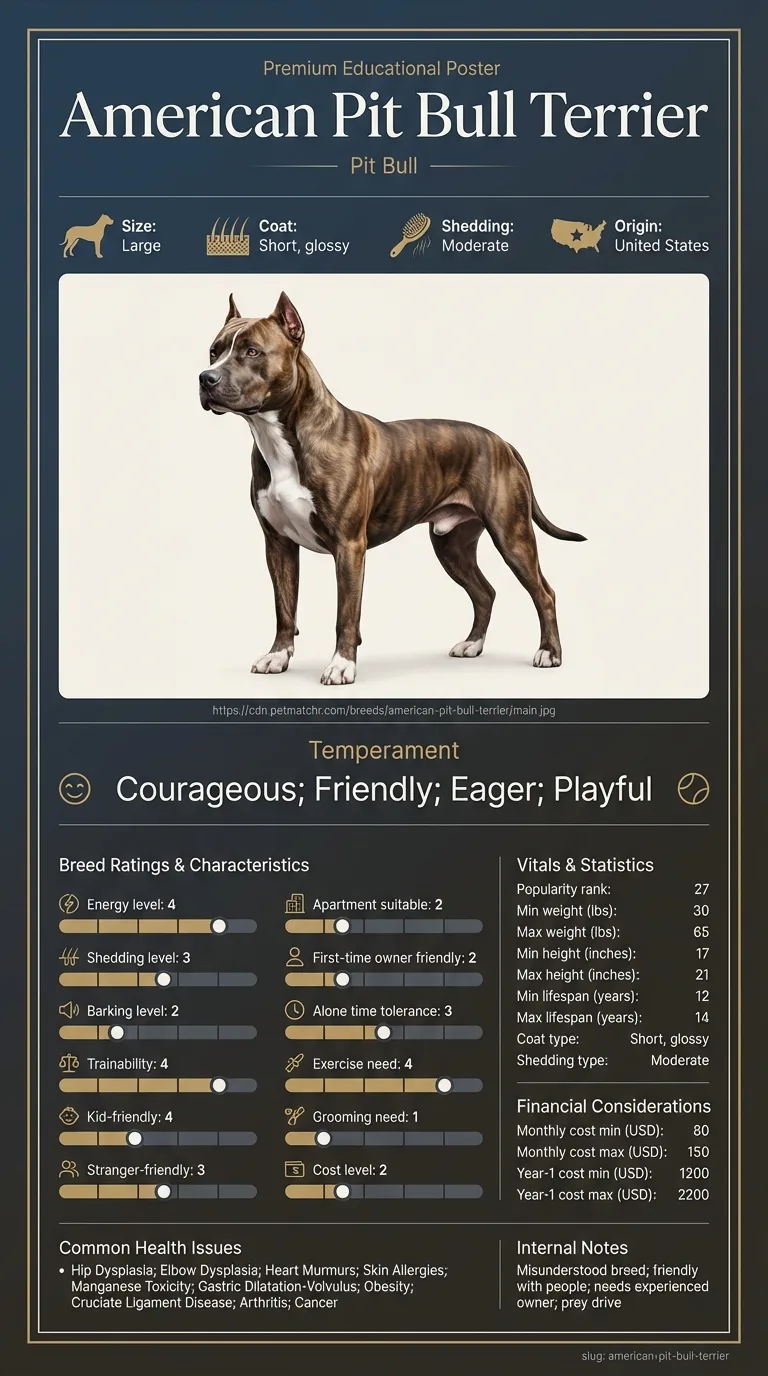
american pit bull terrier infographic
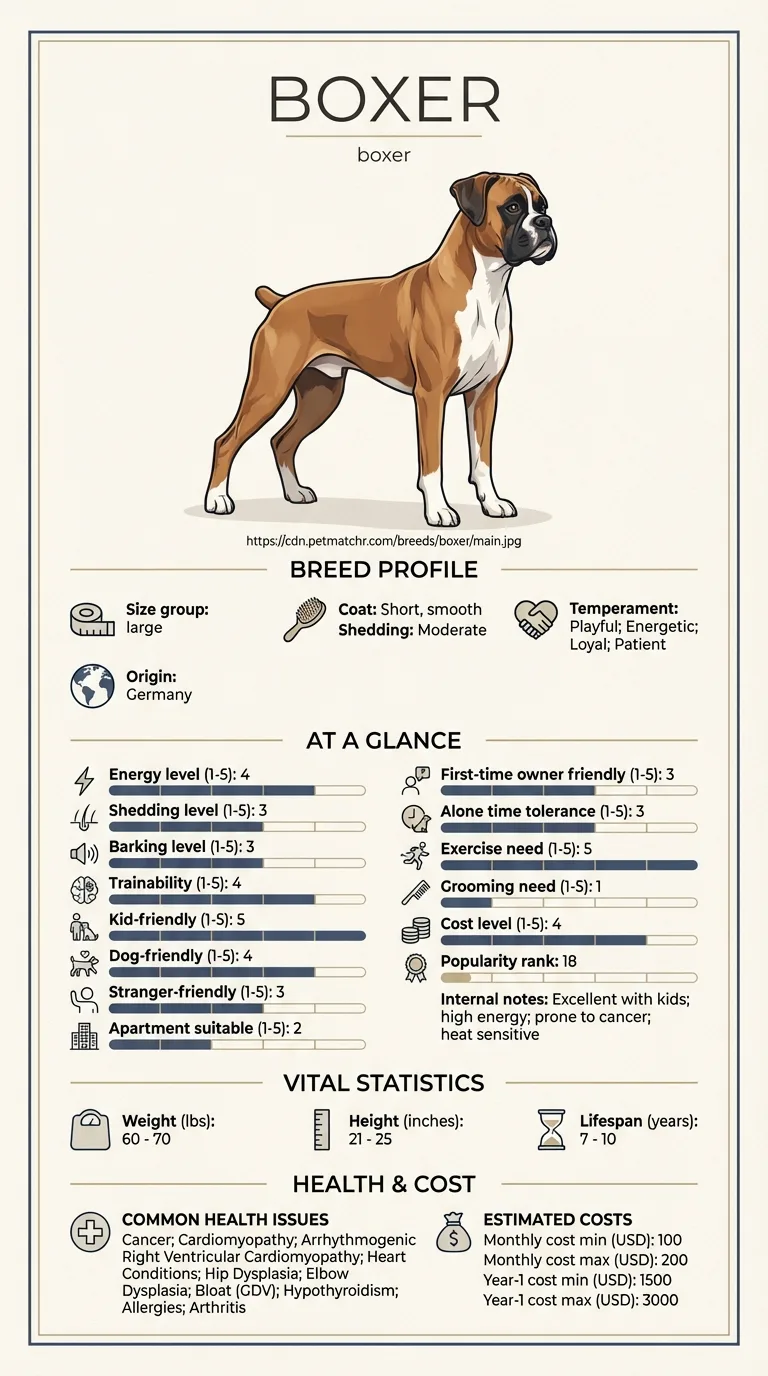
boxer infographic

This page is for someone weighing two similar bull-type breeds and wanting to know what separates them once you get past the appearance — which is mostly the heart, the cancer risk and the price.

Quick verdict

The Boxer is friendlier with other dogs, better with children and easier for a beginner, and it costs twice as much to keep and is likely to give you four to seven years fewer.

Choose american pit bull terrier if...

Choose the American Pit Bull Terrier if longevity and running cost matter, you want an athletic low-maintenance dog, and you can manage careful introductions to other dogs and check local restrictions on bully-type breeds.

Choose boxer if...

Choose the Boxer if you want a highly sociable family dog that is easy with other dogs and children, you can supply an hour or more of daily exercise, and you go in knowing the cardiac and cancer picture.

Head-to-head comparison

Featureamerican pit bull terrierboxerWinner
Weight30–65 lbs60–70 lbsEqual
Height17–21 in21–25 inEqual
Lifespan12–14 years7–10 yearsamerican pit bull terrier
CoatShort, glossyShort, smoothEqual
Grooming need1/51/5Equal
Shedding3/5 — moderate3/5 — moderateEqual
Energy level4/54/5Equal
Exercise need4/55/5american pit bull terrier
Trainability4/54/5Equal
Barking2/53/5american pit bull terrier
Good with kids4/55/5boxer
Good with other dogs2/54/5boxer
Friendly to strangers3/53/5Equal
Apartment suitability2/52/5Equal
Good for first-time owners2/53/5boxer
Tolerates being alone3/53/5Equal
Typical monthly cost$80–150$100–200american pit bull terrier
Typical first-year cost$1,200–2,200$1,500–3,000american pit bull terrier

Deep dive

Boxer cardiomyopathy and the test that finds it

The Boxer's health list names cardiomyopathy, arrhythmogenic right ventricular cardiomyopathy and heart conditions as three separate entries, and that repetition reflects how central cardiac disease is to the breed.

Arrhythmogenic right ventricular cardiomyopathy — usually called Boxer cardiomyopathy — is an inherited disease in which normal heart muscle is progressively replaced by fat and fibrous tissue, disrupting the heart's electrical signalling. The consequence is arrhythmia, and the presentation is often sudden: fainting or collapse during or just after exercise or excitement, weakness, exercise intolerance, or, in the worst cases, sudden death in a dog that appeared entirely well.

The important thing for an owner is that it is detectable before it announces itself. A single stethoscope check is not enough, because the arrhythmia is intermittent — a dog can have a completely normal examination and a serious problem. The screening tool is a Holter monitor, a portable ECG worn for twenty-four hours that counts abnormal beats across a full day and night. Breeders who take the condition seriously Holter their breeding stock annually, and a variant in the striatin gene has been identified with DNA testing available, although it does not explain every case.

So the breeder question is specific: have both parents been Holter monitored, when, and what were the results. A breeder who does this is telling you a great deal about their programme.

As an owner, treat any fainting, collapse or unexplained weakness in a Boxer as a cardiac investigation rather than a curiosity, at any age.

Dilated cardiomyopathy also appears on the list, and the two together are a large part of why the breed's expectancy sits at 7 to 10 years.

The Pit Bull's cardiac entry is heart murmurs, which is a much lighter burden — worth a check at an early vaccination appointment and rarely more than that.

A cancer burden that shapes the lifespan

Cancer heads the Boxer's list and the breed's own notes flag it directly. Alongside the cardiac disease, it is the main reason a 60 to 70 pound athletic dog is expected to live 7 to 10 years when similar-sized breeds reach eleven or twelve.

The pattern in the breed is well recognised. Mast cell tumours are common and often appear as skin lumps that change in size — sometimes swelling and shrinking, sometimes becoming red and itchy. Lymphoma is the other frequent presentation, and it gives a sign owners can check for themselves: firm, painless, symmetrical swellings of the lymph nodes, most easily felt under the jaw, in front of the shoulders and behind the knees.

The practical advice follows from that. Learn where the lymph nodes are and check them occasionally. Treat any new skin lump on a Boxer as something to have looked at rather than watched — a fine needle aspirate is quick, cheap and often definitive, and mast cell tumours in particular are far more treatable when small. Do not wait to see whether a lump grows.

White Boxers deserve a note. The colour is associated with congenital deafness, which is testable by BAER, and unpigmented skin sunburns and carries a higher skin cancer risk, so sun protection matters.

Hip and elbow dysplasia, bloat, hypothyroidism, allergies and arthritis complete the list.

The Pit Bull's list also includes cancer, but without the same dominance: hip and elbow dysplasia, skin allergies, heart murmurs, bloat, obesity, cruciate ligament disease and arthritis alongside it. Its 12 to 14 years reflects a broad but flatter risk profile — no single condition carries the breed off the way cardiac disease and cancer do in Boxers.

Two people-dogs, one social difference

Both breeds are warm, physical and comic, and both rate 3/5 with strangers and 4/5 for trainability. The Boxer edges ahead where it matters most for families: 5/5 with children against 4/5, and 4/5 with other dogs against 2/5.

The Boxer's reputation with children is deserved. It is patient, tolerant, playful well into old age, and its own notes lead with excellent with kids. The caveat is physical: a Boxer is a bouncing, body-checking, front-paws-on-your-shoulders dog through a long adolescence that runs to about three years, and it will flatten a toddler in enthusiasm rather than malice. Teaching four-on-the-floor early is worth the effort.

The Pit Bull is equally people-oriented — courageous, friendly, eager and playful — and its 2/5 with other dogs is the defining management task of ownership: no dog parks, no on-lead greetings with unknown dogs, careful neutral-ground introductions with a handler at each end, and awareness that tolerance can decline at social maturity between eighteen months and three years.

Alongside that sits the administrative difference. Breed restrictions in tenancy agreements, housing rules and insurance policies commonly cover bully-type dogs and rarely cover Boxers, and enforcement often works from appearance rather than pedigree. Check yours in writing before committing.

Both tolerate a working day at 3/5, both rate 2/5 for apartments, and both are 1/5 for grooming — a curry mitt once a week and nothing else, with 3/5 shedding of short stiff hairs that work into fabric.

One shared physical limitation: both are heat-sensitive, the Boxer notably so because of its shortened muzzle. Summer exercise belongs at the cool ends of the day for either dog, and a harness rather than a collar suits both.

5/5 against 4/5 and a very long adolescence

The Boxer is the more demanding of the two on exercise, at 5/5 against 4/5, and its energy is famously durable — this is a breed that plays like a puppy at seven.

What satisfies it is an hour and a half of varied activity: walking, off-lead running where safe, play with other dogs, and training. At 4/5 trainability it does well in obedience, agility and scent work, and the mental component genuinely helps because an under-occupied Boxer is a bouncing, mouthy, demanding presence in a house.

The shortened muzzle limits it, though. Boxers overheat faster than a normally muzzled dog and cannot be run hard in warm weather. That combination — high exercise need and low heat tolerance — means summer routines have to shift substantially.

The Pit Bull's 4/5 is an hour to ninety minutes of largely physical work — a brisk walk plus a flirt pole, spring pole, tug or a training session — and it settles hard afterwards. It also tolerates warmth better.

Both breeds need their exercise built up gradually through the first eighteen months, since hip and elbow dysplasia sit on both lists and forced running, stairs and repetitive jumping on a growing joint are avoidable risks.

On cost the Pit Bull is the cheaper dog at cost level 2/5 against 4/5, $80–150 a month against $100–200, and $1,200–2,200 in the first year against $1,500–3,000. The Boxer's premium is partly size and partly the veterinary profile — cardiac workups, Holter monitoring, oncology and the higher insurance premiums that follow from both.

The Pit Bull's own hidden cost is insurance of a different kind: availability rather than price, since bully-type breeds are frequently excluded outright.

What you are actually trading

Stripped down, the choice is unusually clean because so much else is identical.

The Boxer gives you a dog that is easier with other dogs, better with children, more forgiving for a beginner, and just as low-maintenance in coat. It asks for more exercise, more money, more heat management, and a real acceptance that the breed's cardiac and cancer risks are not theoretical — many Boxer owners lose their dog at eight, and often suddenly.

The Pit Bull gives you four to seven more years, half the running cost, better heat tolerance and the same affectionate, physical, people-oriented temperament. It asks for lifelong management around other dogs, and for navigating a legal and insurance landscape that Boxers never encounter.

For a family with young children and a garden full of visiting dogs, the Boxer's social ratings are worth a great deal and the lifespan is the price. For someone who walks at quiet times, wants a long-lived athletic companion, and lives somewhere without breed restrictions, the Pit Bull is the more practical animal by a distance.

A final piece of advice that applies to both: keep the dog lean. It is free, it is the single largest lever an owner has, and it protects the joints, the cruciate ligaments and the heart in both breeds.

And for the Boxer specifically, ask for the Holter results before you look at the puppies. It is the one question that separates a serious breeder from a casual one, and in this breed it matters more than anything else on the list.

American Pit Bull Terrier vs Boxer at a glance

Seven ratings are identical between these two: energy, shedding, grooming, trainability, strangers, apartments, and time alone. Then the lifespans diverge sharply, by four to seven years, and the reason sits squarely on the Boxer's health list.

The Boxer is friendlier with other dogs, better with children, and easier for a beginner than the Pit Bull. It also costs roughly twice as much to keep and, because of its cardiac and cancer risk, is likely to give an owner four to seven fewer years.

Choose the American Pit Bull Terrier if longevity and running cost matter, you want an athletic low-maintenance dog, and you can manage careful introductions to other dogs and check local restrictions on bully-type breeds. Choose the Boxer if you want a highly sociable family dog that is easy with other dogs and children, and you go in knowing the cardiac and cancer picture.

Frequently asked questions

Why do Boxers live so much less than Pit Bulls?

Cardiac disease and cancer. Arrhythmogenic right ventricular cardiomyopathy and dilated cardiomyopathy sit alongside a heavy cancer burden including mast cell tumours and lymphoma, holding the breed's expectancy at 7 to 10 years.

What is a Holter monitor and why does it matter for Boxers?

A portable ECG worn for twenty-four hours that counts abnormal beats across a full day. Boxer cardiomyopathy causes intermittent arrhythmias that a single stethoscope check can miss entirely, so serious breeders Holter their breeding stock annually.

What should I do about a new lump on a Boxer?

Have it looked at rather than watched. Mast cell tumours are common in the breed, a fine needle aspirate is quick and often definitive, and small tumours are far more treatable than large ones.

Which is better with other dogs?

The Boxer at 4/5 against 2/5. The Pit Bull needs planned introductions on neutral ground, avoids dog parks, and can become less tolerant at social maturity between eighteen months and three years.

Which needs more exercise?

The Boxer at 5/5 against 4/5, and it stays playful well into old age. The complication is heat — a shortened muzzle means it cannot be worked hard in warm weather, so summer routines have to move to dawn and dusk.

Are white Boxers different?

The colour is associated with congenital deafness, which is testable by BAER, and unpigmented skin sunburns and carries a higher skin cancer risk. Sun protection and a hearing test are the practical responses.

Which is cheaper to keep?

The Pit Bull at $80–150 a month against $100–200, at cost level 2/5 against 4/5. The Boxer's premium reflects size plus cardiac and oncology costs, and higher insurance.

Quick answers

View more answers
Living

Pit Bull or Boxer: which should I choose?

The Boxer for a family that meets lots of dogs and children and can absorb the cost and the shorter life. The Pit Bull if longevity and running cost matter and you can manage careful introductions to other dogs.

Costs

Which is more expensive?

The Boxer at $100–200 a month against $80–150, at cost level 4/5 against 2/5, and $1,500–3,000 in the first year against $1,200–2,200.

Health

What is the single most important Boxer breeder question?

Whether both parents have been Holter monitored for cardiomyopathy, when, and what the results were. In this breed it separates a serious programme from a casual one more clearly than anything else.

Behavior

Are Boxers good with children?

Very — 5/5, and patient well into old age. The practical caveat is physical enthusiasm through an adolescence that runs to about three years, so teaching four paws on the floor early is worth the effort.

Related DogBreedCompass guides

  • American Pit Bull Terrier breed guideThe Pit Bull profile covers temperament, exercise and the practical realities of ownership.
  • Boxer breed guideThe Boxer profile covers the breed's energy, heat sensitivity and health testing.
  • cancer in BoxersCancer heads the Boxer's list and is one of the two reasons its lifespan is so short.
  • heart disease in BoxersCardiac disease is the other, and it is detectable in advance with the right screening.
  • hip dysplasia in Pit Bull TerriersHip dysplasia sits on both lists and is the shared screening question for either breeder.
  • American Pit Bull Terrier vs Cane CorsoBuyers comparing bull breeds usually want the heavier guardian option assessed as well.

Related guides

Important reminder

Health information here is general and is not veterinary advice. Cardiac screening, lumps and any collapse episode should be discussed with your own veterinarian.

Some links on this site are affiliate links. We may earn a commission if you buy through them, at no additional cost to you.

Find Your Perfect Breed

Match your lifestyle to the right dog.

Take quiz

Find your match

Not sure which breed is right for you? Take our 2-minute quiz to find out.

Take the quiz