DogBreedCompass

Pit Bull or Bernedoodle: What a Crossbreed Can and Cannot Fix

The Bernedoodle's recorded lifespan is 12 to 18 years. Its Bernese Mountain Dog parent lives 7 to 10. That gap is the most interesting thing on this page, and it deserves a closer look than most doodle marketing gives it.

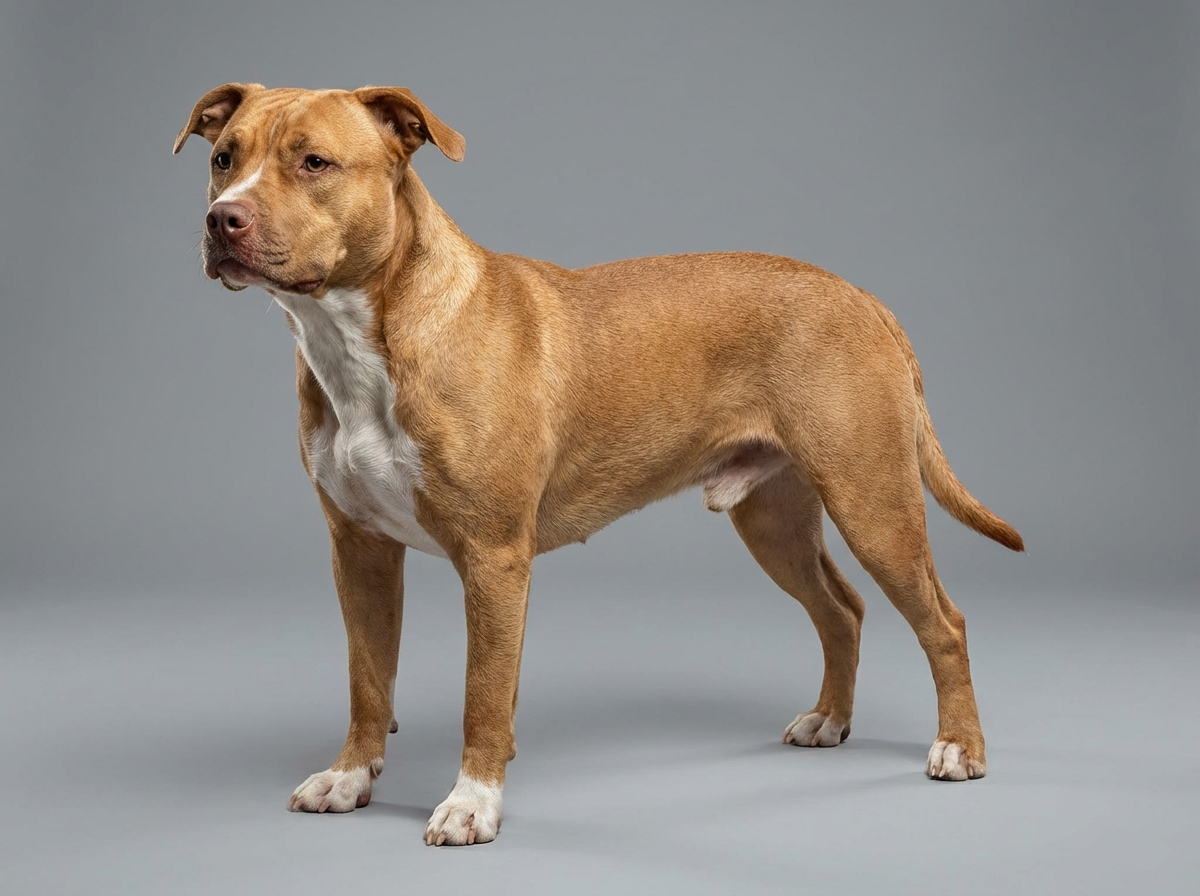
american pit bull terrier infographic
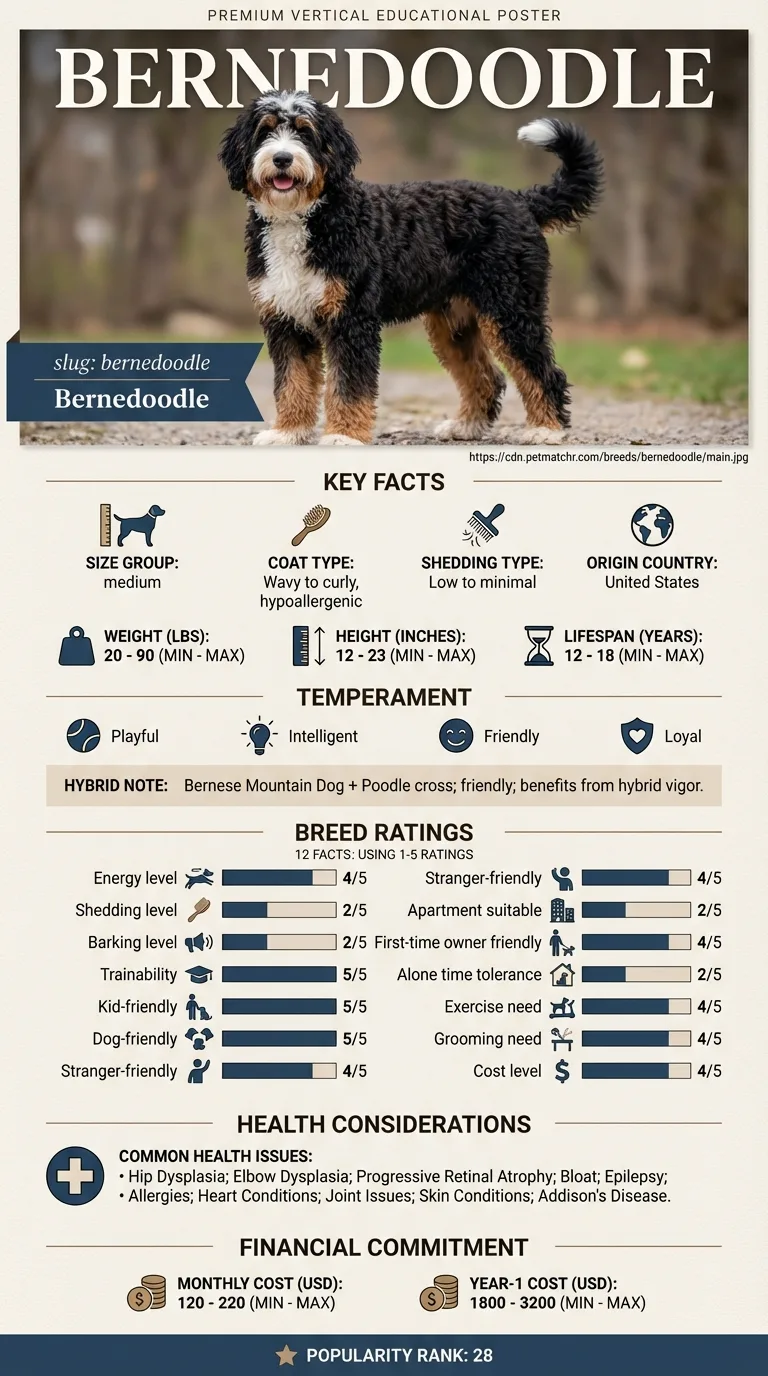
bernedoodle infographic

This page is for someone weighing a friendly low-shedding family crossbreed against a fixed working breed, and wanting the hybrid vigour claim examined rather than repeated.

Quick verdict

The Bernedoodle is the better fit for most family homes on temperament alone — 5/5 with children and other dogs, 5/5 trainability — but it costs roughly twice as much to keep and its size, coat and lifespan are all genuinely uncertain in advance.

Choose american pit bull terrier if...

Choose the American Pit Bull Terrier if you want a predictable adult dog, near-zero grooming and the lowest running costs here, and you can manage dog-dog introductions and check the local rules that apply to bully-type dogs.

Choose bernedoodle if...

Choose the Bernedoodle if minimal shedding and easy sociability matter most, you will research the specific cross carefully rather than trusting the label, and you can carry a professional groom every six to eight weeks for the dog's life.

Head-to-head comparison

Featureamerican pit bull terrierbernedoodleWinner
Weight30–65 lbs20–90 lbs (varies by size)american pit bull terrier
Height17–21 in12–23 inamerican pit bull terrier
Lifespan12–14 years12–18 yearsbernedoodle
CoatShort, glossyWavy to curly, low-shedEqual
Grooming need1/54/5american pit bull terrier
Shedding3/5 — moderate2/5 — low to minimalbernedoodle
Energy level4/54/5Equal
Exercise need4/54/5Equal
Trainability4/55/5bernedoodle
Barking2/52/5Equal
Good with kids4/55/5bernedoodle
Good with other dogs2/55/5bernedoodle
Friendly to strangers3/54/5bernedoodle
Apartment suitability2/52/5Equal
Good for first-time owners2/54/5bernedoodle
Tolerates being alone3/52/5american pit bull terrier
Typical monthly cost$80–150$120–220american pit bull terrier
Typical first-year cost$1,200–2,200$1,800–3,200american pit bull terrier

Deep dive

Hybrid vigour: what it does and what it does not do

The claim behind every doodle cross is heterosis, usually called hybrid vigour, and it is worth being precise about because the truth sits between the marketing and the cynicism.

What crossing genuinely helps with is recessive conditions. A recessive disorder needs two copies of a variant to cause disease, and if a variant is common in one breed and rare or absent in the other, a first-generation cross is unlikely to inherit two copies. That is a real benefit and it applies to a number of the single-gene problems that concentrate in closed pedigrees.

What crossing does not help with is anything common to both parents, anything driven by conformation, or anything with complex inheritance. Hip dysplasia, elbow dysplasia, bloat, allergies, epilepsy and cancer are all in the second category, and every one of them appears on the Bernedoodle's own health list. So does Addison's disease, which comes from the Poodle side, and progressive retinal atrophy, which appears in both parent breeds.

The Bernese contribution is the one to think about hardest. Bernese Mountain Dogs have one of the shortest lifespans of any breed at 7 to 10 years, largely because of a high cancer burden including histiocytic sarcoma. A cross does not delete that ancestry; it dilutes it, by an amount that depends on the generation and on which lines are behind the dog.

That is the honest frame for the 12 to 18 year figure. The upper end reflects small, Poodle-dominant, multigenerational dogs. A large Standard-based first-generation Bernedoodle with a lot of Bernese in it is a different animal, and expecting eighteen years from one is optimistic.

The questions that actually reduce uncertainty: which generation is the litter, what did both parents weigh, and what health testing did each parent have to the standard of its own breed.

Twenty to ninety pounds: a label covering several different dogs

The recorded range is 20 to 90 pounds and 12 to 23 inches. That is not measurement noise — it reflects a cross that can be built on a Toy, Miniature or Standard Poodle and can be first generation, a backcross, or several generations removed from either founding breed.

A mini Bernedoodle at 25 pounds and a standard at 80 are different propositions in every practical sense: exercise, food cost, car space, grooming price, joint risk and expected lifespan. The ratings on this page describe the cross as a whole, which means they fit the middle of that range and misdescribe both ends.

Coat is equally variable. Some Bernedoodles inherit a wavy fleece that is easy to manage; some a tight wool coat that mats quickly; and some a straighter, more Bernese-like coat that sheds noticeably and undercuts the main reason people choose the cross. The adult coat arrives at around nine to twelve months, which is when a great many owners discover which one they bought.

Colour is a further variable that occasionally matters. The tricolour pattern buyers usually want is not guaranteed, and it is worth noting that a breeder charging a premium for markings is selling you appearance rather than health.

None of this is an argument against the cross. It is an argument for buying from someone who can answer specific questions and against buying from a label. The market producing these dogs is unregulated, prices are high, and the difference between a well-planned multigenerational litter from health-tested parents and an opportunistic first-generation pairing is invisible in a photograph.

The Pit Bull's advantage here is straightforward predictability: 30 to 65 pounds, a short glossy coat, a known temperament profile, and an adult that will not surprise an informed owner.

Grooming 4/5 against 1/5: the widest maintenance gap here

The Bernedoodle sheds at 2/5 and grooms at 4/5, and those two numbers are the same fact stated twice.

A low-shedding coat keeps its dead hair rather than dropping it, and that trapped hair felts into the live coat close to the skin. On a wavy or curly coat it happens fastest behind the ears, under the collar and harness, in the armpits, between the back legs and around the tail. Prevention is line-brushing — parting the coat and working from the skin outwards — most days, not a brush skimmed over the surface while a pelt forms underneath.

On top of that sits a professional groom every six to eight weeks for a full clip, feet, face and sanitary trim. Over a twelve to eighteen year life that is one of the largest recurring costs of ownership, and it is the line most often missing from a new owner's budget. A coat that has already matted cannot be brushed out humanely, so the groomer shaves it.

The Pit Bull's 1/5 is the opposite extreme and about as low as dog maintenance goes: a rubber curry mitt once a week, a bath when needed, no matting, no appointment, no equipment. It sheds more at 3/5, and the short stiff hairs work into fabric, so it is not a hair-free dog — but the time and money cost is essentially zero.

That difference is most of why the two monthly figures diverge. The Bernedoodle runs $120–220 a month at cost level 4/5; the Pit Bull runs $80–150 at 2/5, one of the cheapest here. First years are $1,800–3,200 against $1,200–2,200.

The Pit Bull's hidden cost is the reverse of a grooming bill: insurance and housing. Bully-type dogs are frequently surcharged, excluded or prohibited in tenancy agreements and policies, and that should be checked in writing before committing.

5/5 with children and other dogs against 4/5 and 2/5

The Bernedoodle's social ratings are as good as this site records: 5/5 with children, 5/5 with other dogs, 4/5 with strangers, 5/5 trainability, 4/5 for first-time owners.

They are honestly earned. Both parent breeds are people-focused and non-confrontational — the Bernese calm and gentle, the Poodle biddable and quick — and the cross reliably produces a dog that likes everybody and learns fast. For a family with young children and other pets, that combination is hard to beat.

The Pit Bull's profile is warm with people at 4/5 with children and 3/5 with strangers, and its 2/5 with other dogs is the defining management task: no dog parks, no on-lead greetings with strange dogs, introductions done slowly on neutral ground, and awareness that tolerance can decline at social maturity between eighteen months and three years. That is workable and it is permanent.

Where the ratings reverse is solitude. The Pit Bull's 3/5 is better than the Bernedoodle's 2/5, and doodle separation problems are among the most common complaints in the whole category — a predictable outcome of crossing two intensely people-oriented breeds. Owners frequently assume that a dog which is easy in every other respect will also be easy to leave, and a large proportion are not.

Exercise ties at 4/5 and energy at 4/5, so the daily commitment is comparable: an hour to ninety minutes. The Bernedoodle's can be partly met with mental work, which is a real advantage on a bad-weather day. The Pit Bull's is more purely physical — a brisk walk plus a flirt pole, tug or training session — but it settles hard afterwards.

Both rate 2/5 for apartments and 2/5 barking, so noise is not a differentiator either way.

Two health lists and where the money actually goes

The Bernedoodle's list is long: hip dysplasia, elbow dysplasia, progressive retinal atrophy, bloat, epilepsy, allergies, heart conditions, joint issues, skin conditions and Addison's disease.

Addison's is the one most worth recognising, because it hides. It is a failure of the adrenal glands to produce enough cortisol, it comes from the Poodle side, and its signs are vague and intermittent — episodes of lethargy, poor appetite, vomiting or diarrhoea, a dog that seems unwell and then seems fine. Untreated it can end in collapse. An ACTH stimulation test diagnoses it and lifelong medication manages it well. If a Bernedoodle has recurring unexplained illness, ask about adrenal testing specifically.

Bloat matters for the larger dogs in the range, given a Bernese-derived deep chest. Split meals, quiet time around eating, and a known out-of-hours route.

The screening questions for a litter are concrete: hip and elbow scores on both parents, progressive retinal atrophy DNA status on the Poodle side, cardiac examination, and honest information about longevity and cause of death in the Bernese lines behind the cross.

The Pit Bull's list runs hip and elbow dysplasia, skin allergies, heart murmurs, bloat, obesity, cruciate ligament disease, arthritis and cancer. Skin allergies are its most frequent day-to-day complaint — itching, chewed paws, recurrent ear trouble — and cruciate disease its most likely orthopaedic emergency, heavily driven by body weight.

Keeping either dog lean is the single most valuable habit available, and it is free.

On balance: the Bernedoodle asks for more money and more research, and gives back easier sociability and a possibly longer life. The Pit Bull asks for management and paperwork, and gives back predictability and the lowest running cost on this page.

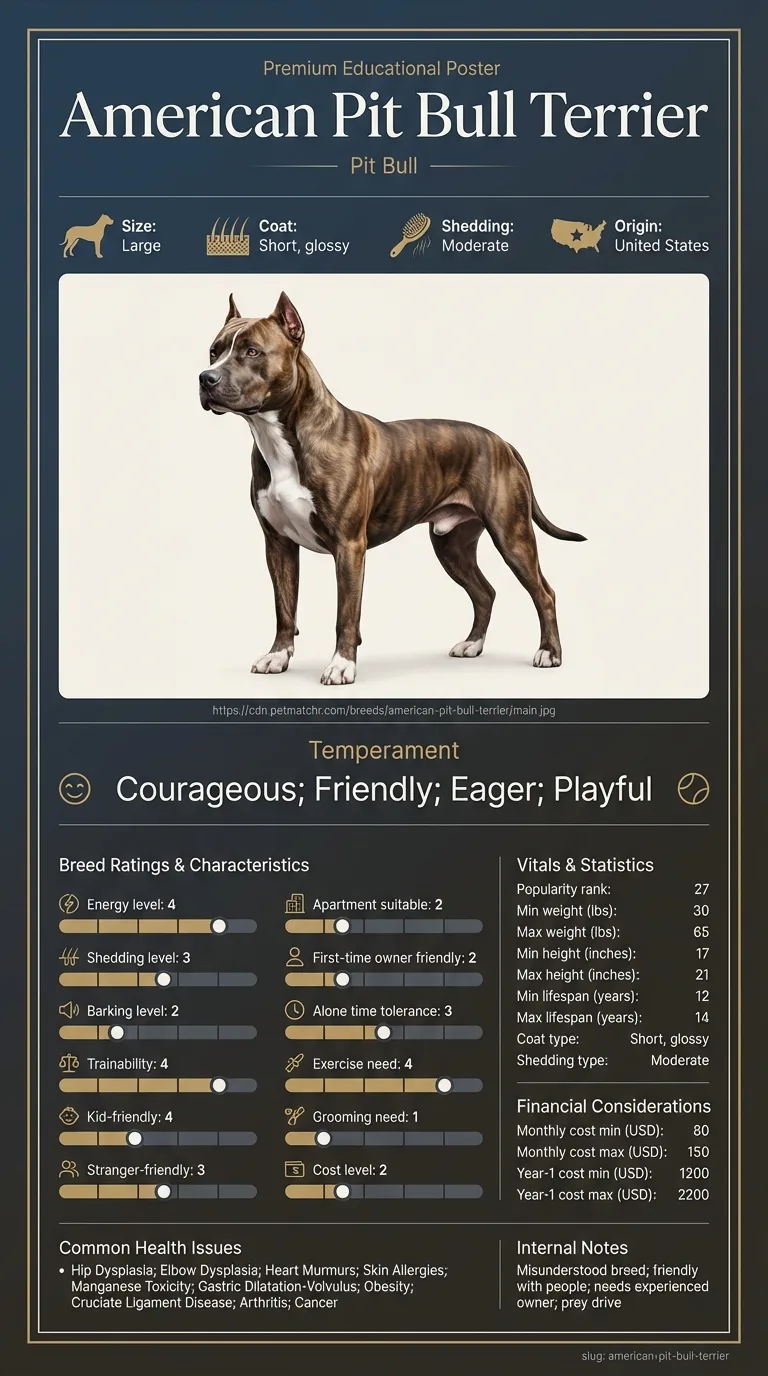
American Pit Bull Terrier vs Bernedoodle at a glance

The Bernedoodle's recorded lifespan runs 12 to 18 years. Its Bernese Mountain Dog parent lives just 7 to 10. That gap is the most interesting thing on this page, and it deserves more attention than most doodle marketing gives it.

The Bernedoodle is the better fit for most family homes on temperament alone — 5/5 with children and other dogs, 5/5 trainability — but it costs roughly twice as much to keep as the Pit Bull, and its size, coat, and lifespan are all genuinely uncertain in advance since they depend on which generation and parentage produced the litter.

Choose the American Pit Bull Terrier if you want a predictable adult dog, near-zero grooming, and the lowest running costs here, and you can manage dog-dog introductions and check local rules around bully-type dogs. Choose the Bernedoodle if minimal shedding and easy sociability matter most and you can carry a professional groom every six to eight weeks for the dog's life.

Frequently asked questions

Is hybrid vigour real in a Bernedoodle?

Partly. Crossing reduces the odds of inheriting two copies of a rare recessive variant. It does not help with anything common to both parents or complex in inheritance — hips, elbows, bloat, allergies, epilepsy and cancer all remain on the list.

Will a Bernedoodle really live eighteen years?

The upper end of that range reflects small, Poodle-dominant, multigenerational dogs. The Bernese parent breed lives 7 to 10 years with a heavy cancer burden, so a large first-generation Bernedoodle is a different proposition.

How big will a Bernedoodle get?

Anywhere from 20 to 90 pounds, depending on which size of Poodle sits behind it and which generation the dog belongs to. Both parents' weights are the only reliable guide.

Why does a low-shedding dog rate 4/5 for grooming?

Because the dead hair stays in the coat and felts into a mat against the skin. Preventing that needs line-brushing most days plus a professional clip every six to eight weeks for the whole of the dog's life.

Which is better with other dogs?

The Bernedoodle at 5/5 against 2/5. The Pit Bull needs planned introductions on neutral ground, avoids dog parks, and can become less tolerant at social maturity even if it was easy as an adolescent.

Which is cheaper to keep?

The Pit Bull, at $80–150 a month against $120–220, and $1,200–2,200 in the first year against $1,800–3,200. Cost level 2/5 against 4/5, with grooming accounting for most of the gap.

Can either be left alone during a workday?

The Pit Bull manages better at 3/5 against 2/5. Separation problems are one of the most common complaints across doodle crosses, since both parent breeds are strongly people-focused.

Quick answers

View more answers
Living

Pit Bull or Bernedoodle: which should I choose?

The Bernedoodle for a family that wants easy sociability and minimal shedding and can afford the grooming. The Pit Bull if you want a predictable adult, the lowest running costs here, and can manage dog-dog introductions and local restrictions.

Costs

Which costs more to keep?

The Bernedoodle at $120–220 a month against $80–150, at cost level 4/5 against 2/5. A groom every six to eight weeks across a long life is the largest single line.

Health

What should I ask a Bernedoodle breeder?

Which generation the litter is, what both parents weighed, hip and elbow scores, PRA DNA status, cardiac testing, and longevity and cause of death in the Bernese lines behind the cross.

Training

Which is easier to train?

The Bernedoodle at 5/5 against 4/5, though both are genuinely trainable. The Pit Bull's 4/5 is a real asset because trainability is the main tool for managing its dog-dog reactivity.

Related DogBreedCompass guides

  • American Pit Bull Terrier breed guideThe Pit Bull profile covers temperament, exercise and the practical realities of ownership.
  • Bernedoodle breed guideThe Bernedoodle profile covers coat types, size variation across generations and grooming schedules.
  • hip dysplasia in BernedoodlesHip dysplasia comes from both parent breeds and is the first screening question for any litter.
  • bloat in BernedoodlesThe larger dogs in the range inherit a deep chest, so bloat planning applies to them.
  • allergies in Pit Bull TerriersAllergies are the Pit Bull's most frequent day-to-day complaint and are managed rather than cured.
  • American Pit Bull Terrier vs Bernese Mountain DogHalf the cross's ancestry comes from the Bernese, which is worth reading about on its own terms.

Related guides

Important reminder

Health information here is general and is not veterinary advice. Crossbreed risk depends on both parent lines — discuss screening and any specific concern with your own veterinarian.

Some links on this site are affiliate links. We may earn a commission if you buy through them, at no additional cost to you.

Find Your Perfect Breed

Match your lifestyle to the right dog.

Take quiz

Find your match

Not sure which breed is right for you? Take our 2-minute quiz to find out.

Take the quiz