Living
Border Collie or Shetland Sheepdog?
Pick the Sheltie for a smaller, more forgiving first dog with lower running costs; pick the Collie only if you can match its exercise needs and don't mind its poor apartment fit.

Quick answer
Border Collie or Shetland Sheepdog?
Pick the Sheltie for a smaller, more forgiving first dog with lower running costs; pick the Collie only if you can match its exercise needs and don't mind its poor apartment fit.
Border Collie or Shetland Sheepdog? On paper they differ most on good for first-time owners, and on the scales Border Collie is the heavier at 30–55 lbs. Here is how the two compare on everything that shapes an ordinary week.
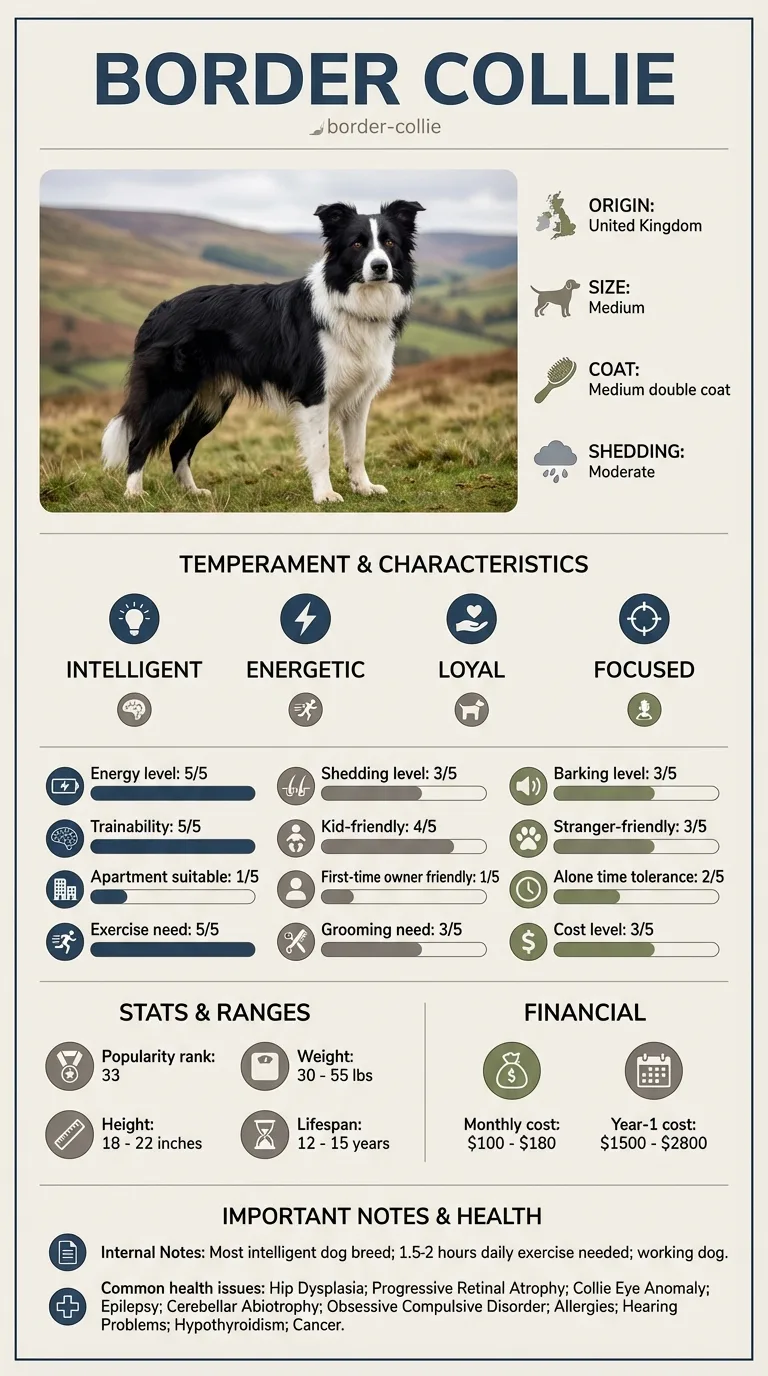
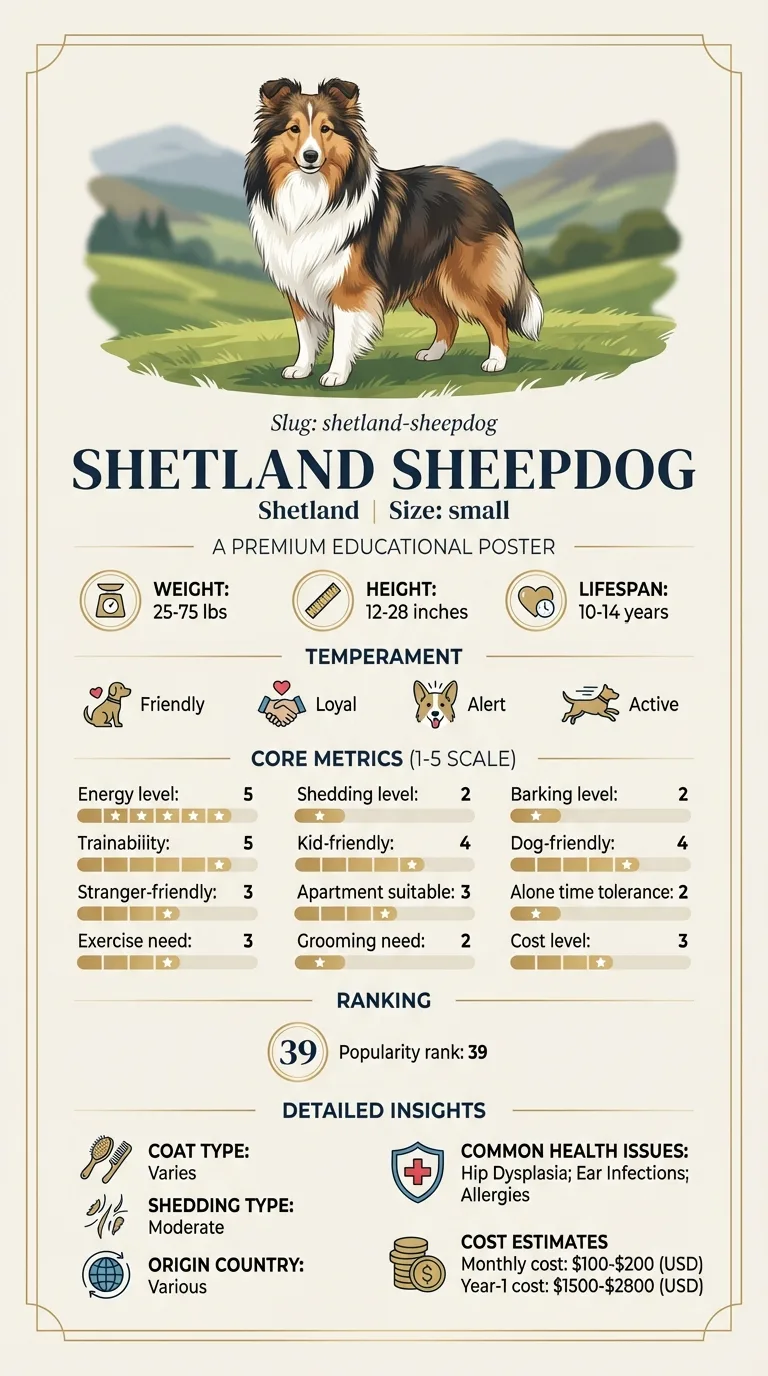
This is for someone already down to Border Collie and Shetland Sheepdog and deciding between them. For this pair the decision usually turns on good for first-time owners and apartment suitability, so those are covered first and in most detail. Anyone choosing from a flat has a clear answer here: Shetland Sheepdog rates 3/5 against 1/5. The focus throughout is on daily consequences rather than breed background.
Between Border Collie and Shetland Sheepdog, good for first-time owners is what separates them, and Shetland Sheepdog is the lower-effort dog of the two to keep.
Choose Border Collie if you do not want a standing grooming appointment, shedding is a problem in your house and you want a dog that can keep up with an active routine.
Choose Shetland Sheepdog if you are in a flat or a smaller home, this is your first dog and your walking routine is modest.
| Feature | border collie | shetland sheepdog | Winner |
|---|---|---|---|
| Size class | medium | small | Equal |
| Weight | 30–55 lbs | 15–25 lbs | Equal |
| Height | 18–22 in | 13–16 in | Equal |
| Lifespan | 12–15 years | 12–14 years | border collie |
| Exercise need | Very high (5/5) | High (4/5) | shetland sheepdog |
| Grooming need | Moderate (3/5) | High (4/5) | border collie |
| Shedding | Moderate (3/5) | High (4/5) | border collie |
| Energy level | Very high (5/5) | High (4/5) | Equal |
| Barking | Moderate (3/5) | Very high (5/5) | border collie |
| Apartment suitability | Very low (1/5) | Moderate (3/5) | shetland sheepdog |
| Good for first-time owners | Very low (1/5) | High (4/5) | shetland sheepdog |
| Tolerates being alone | Low (2/5) | Low (2/5) | Equal |
| Trainability | Very high (5/5) | Very high (5/5) | Equal |
| Good with kids | High (4/5) | High (4/5) | Equal |
| Good with other dogs | High (4/5) | High (4/5) | Equal |
| Friendly to strangers | Moderate (3/5) | Low (2/5) | border collie |
| Cost level | Moderate (3/5) | Moderate (3/5) | Equal |
| Coat | Medium double coat | Long, dense double coat | Equal |
| Origin | United Kingdom | Various | Equal |
| Typical monthly cost | $100–$180 | $80–$150 | Equal |
| Typical first-year cost | $1,500–$2,800 | $1,100–$2,300 | Equal |
Size is where this pairing actually separates: the Border Collie is medium at 30-55 lbs and 18-22 inches, while the Shetland Sheepdog is small at just 15-25 lbs and 13-16 inches -- roughly half the weight. Both are built lean and athletic for herding work, but if floor space or lifting a dog into the car matters to you, the Sheltie is the far more compact option.
The Collie's exercise need rates a full 5/5, the Sheltie a still-serious 4/5. Neither is satisfied with a short leash walk -- both were bred to work livestock all day -- but the Sheltie's smaller frame means its exercise can come in shorter, more frequent bursts rather than the sustained running a Collie tends to demand.
The Sheltie asks more on both fronts: grooming rates 4/5 against the Collie's 3/5, and shedding hits 4/5 versus the Collie's 3/5. That long, dense double coat needs brushing several times a week to avoid matting, especially through seasonal coat blows. The Collie's medium double coat is comparatively low-maintenance, though still not shed-free.
Barking is the number to watch with the Sheltie -- it rates 5/5, the highest score in this whole comparison, against the Collie's moderate 3/5. That vocal habit can offset the Sheltie's better apartment suitability (3/5 versus the Collie's 1/5) if you have neighbors on the other side of a wall. Noise training early is worth the effort with either dog, but essential with the Sheltie.
Both breeds train at the same top level, 5/5 for trainability -- this isn't a smart-dog-versus-less-smart-dog comparison. What differs is forgiveness for a newer owner: the Sheltie rates 4/5 for first-time suitability, the Collie just 1/5. A Sheltie will accept a less experienced handler's routine; a Collie tends to expose the gaps in one.
With kids and other dogs the two are evenly matched, both at 4/5. The Collie is slightly friendlier with strangers (3/5 versus the Sheltie's 2/5) -- Shelties tend to be more reserved, sometimes vocal, around unfamiliar faces. Neither breed tolerates being left alone well, both scoring a low 2/5, so long solo hours are a problem regardless of which you choose.
The Collie edges the Sheltie slightly on lifespan, 12-15 years against 12-14. Health-wise the Sheltie's list is notably shorter -- five named conditions against the Collie's ten -- though MDR1 drug sensitivity is worth flagging specifically, since it affects how the breed metabolizes common medications. The two share collie eye anomaly and hypothyroidism, a reminder both trace back to shared herding-dog ancestry.
The Sheltie is the cheaper dog to keep on paper: $80-150 a month against the Collie's $100-180, and $1,100-2,300 in year one versus $1,500-2,800. Smaller body size generally means less food and lower medication dosing, which shows up across the board even though both rate a moderate 3/5 on overall cost level.
Border Collie weighs 30–55 lbs and lives 12–15 years; Shetland Sheepdog weighs 15–25 lbs and lives 12–14 years. The two diverge most on good for first-time owners, apartment suitability and barking. They are level on tolerates being alone, cost level and good with other dogs, so those cannot decide it. The table below marks a winner only where one breed is genuinely easier for a typical owner; size and origin are facts rather than merits and stay level. Ratings come from one source applied to both breeds, so they are meaningful against each other rather than as absolute scores.

Meaningfully smaller -- 15-25 lbs and 13-16 inches for the Sheltie against 30-55 lbs and 18-22 inches for the Collie. Think of the Sheltie as roughly Collie-shaped but scaled down by close to half.
The Sheltie, by a wide margin -- it scores a maximum 5/5 for barking against the Collie's moderate 3/5. Shelties are known for being vocal watchdogs, so noise is a real factor in tight living situations.
Yes. The Sheltie rates 4/5 for first-time-owner suitability against the Collie's very low 1/5, even though both are equally trainable at 5/5. The Collie just needs more structured daily work than most new owners can provide.
The Sheltie, rated 3/5 versus the Collie's 1/5. It's still not an ideal apartment dog given its barking tendency, but it's far more workable than a Collie, which really wants room to run.
The Sheltie runs cheaper: about $80-150 monthly and $1,100-2,300 in the first year, against $100-180 and $1,500-2,800 for the Collie. Smaller size tends to mean lower food and vet-dosing costs.
Some. Both can develop collie eye anomaly and hypothyroidism. Beyond that their risk lists diverge -- the Collie's is longer and includes epilepsy and cancer, while the Sheltie's shorter list includes MDR1 drug sensitivity, a metabolic quirk worth telling your vet about.
Neither, really -- both score a low 2/5 for tolerating solo time. If you're out of the house most of the day, plan on a dog walker or daycare no matter which breed you pick.
Pick the Sheltie for a smaller, more forgiving first dog with lower running costs; pick the Collie only if you can match its exercise needs and don't mind its poor apartment fit.
The Sheltie runs $80-150 a month against the Collie's $100-180 -- roughly 20-25% cheaper on average.
Both are demanding -- 5/5 for the Collie, 4/5 for the Sheltie -- but the Sheltie's smaller size makes shorter, more frequent sessions workable.
The Border Collie, typically 12-15 years versus the Sheltie's 12-14 -- a small edge, not a decisive one.
Secure checkout on Stripe. We never see your card.
7-day money-back guarantee. Instant access.
Health information here is general and is not veterinary advice. If your dog shows pain, sudden behaviour change, or worsening symptoms, consult a licensed veterinarian.
Some links on this site are affiliate links. We may earn a commission at no extra cost to you, and we only suggest products we believe are helpful for dog owners.
We research and check what we publish, but we do not warrant that any figure, date, price, or statement is accurate, complete, or current, and we accept no liability for any loss, cost, injury, or other harm arising from the use of this site. Use it as one reference among several. You remain responsible for your own decisions and for your dog's care - confirm anything that matters with a licensed veterinarian or another qualified professional before you act on it. Full disclaimer.
Match your lifestyle to the right dog.
Take quizNot sure which breed is right for you? Take our 2-minute quiz to find out.
Take the quiz