Health
Is Legg-Calve-Perthes disease common in giant breeds?
No, it's documented mainly in small and toy breeds and is an atypical finding in a giant breed like the Saint Bernard.

Quick answer
Is Legg-Calve-Perthes disease common in giant breeds?
No, it's documented mainly in small and toy breeds and is an atypical finding in a giant breed like the Saint Bernard.
If a vet mentions Legg-Calve-Perthes disease for a Saint Bernard, it's worth knowing this is an atypical diagnosis for the breed, and that far more common giant-breed hip problems, especially hip dysplasia, usually deserve a closer look first.
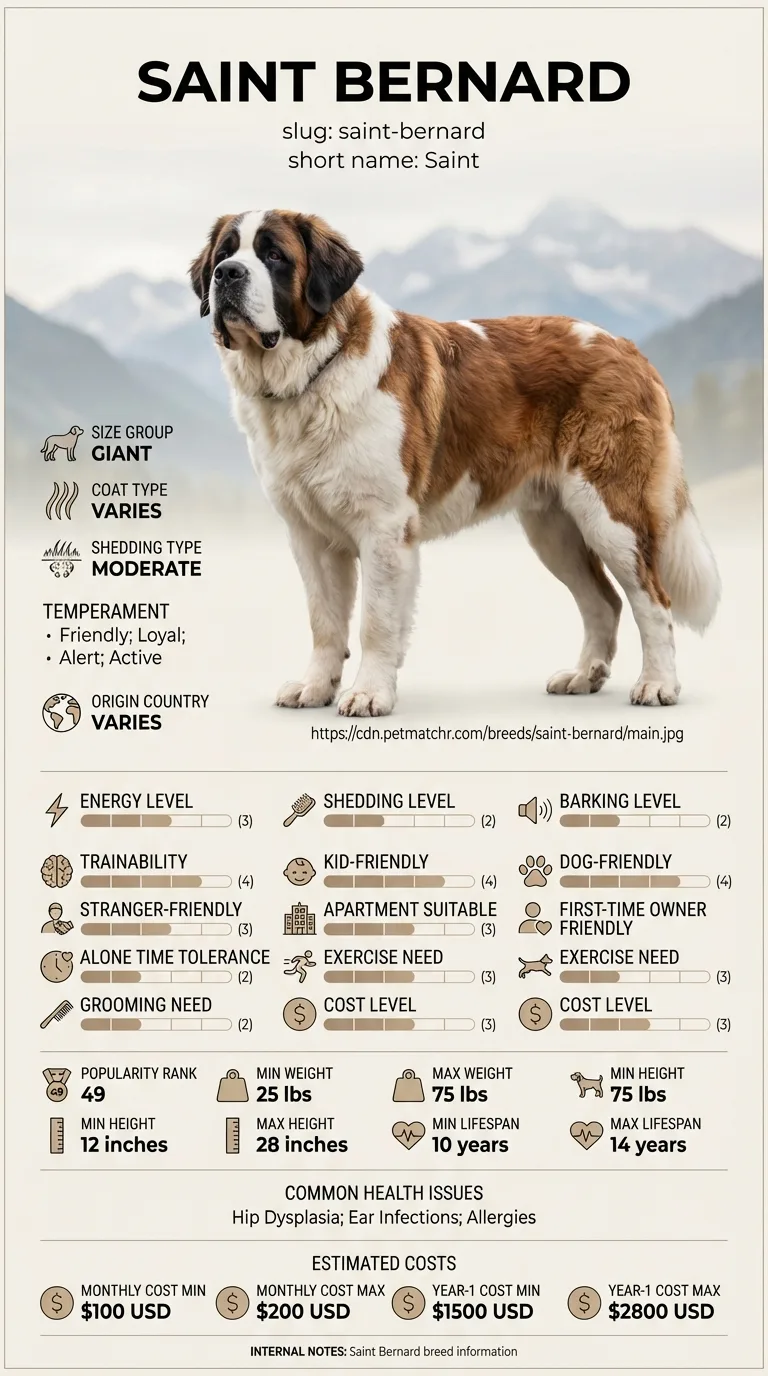
This mostly comes up for owners who've read about hip pain in dogs generally and stumbled on Legg-Calve-Perthes disease online, without realizing how strongly it skews toward small-breed dogs rather than giants.
This guide is not medical advice. If your dog shows pain, sudden behavior change, or worsening symptoms, consult a licensed veterinarian.
Some links may be affiliate links. We may earn a commission at no extra cost to you. We only suggest products we believe are helpful for dog owners.
Check this first
Regardless of the exact diagnosis, a Saint Bernard suddenly unable to bear weight on a hind leg, crying out in pain, or showing visible muscle wasting alongside lameness needs a prompt vet visit for proper diagnosis, since several different conditions, most commonly hip dysplasia in this breed, can produce similar-looking symptoms.
Gradual, mild lameness that comes and goes is usually not an emergency and can be scheduled as a routine appointment, though it still deserves investigation rather than being written off, since orthopedic problems in giant breeds tend to progress and are easier to manage when caught early.
What matters most for a Saint Bernard specifically is getting an accurate diagnosis rather than assuming a specific rare condition applies. A vet's exam and X-rays will typically point toward the far more common explanations in this breed, hip dysplasia, elbow dysplasia, or a soft tissue injury, before Legg-Calve-Perthes disease would even be considered.
If any of these apply, call your vet or an emergency clinic now. The rest of this page is for the cases that are not an emergency.
Legg-Calve-Perthes disease involves a disruption of blood flow to the head of the femur bone, causing that tissue to die and the hip joint to lose its normal shape. It is documented predominantly in small and toy breeds, which makes it an atypical diagnosis in a giant breed like the Saint Bernard, where hip lameness is far more often explained by hip dysplasia or another growth-related orthopedic condition instead.
This condition is rare in giant breeds overall, and a Saint Bernard showing hip lameness is statistically far more likely to have hip dysplasia or another common giant-breed orthopedic issue than true Legg-Calve-Perthes disease.
The documented genetic and physiological risk factors for Legg-Calve-Perthes disease are concentrated in small and toy breeds, and there isn't strong evidence supporting the same mechanism as a primary driver of hip problems in giant breeds like the Saint Bernard, where hip dysplasia's growth-related joint laxity is the far more established cause of similar symptoms.
Because this condition is rare and not well documented as breed-typical in giant dogs, environmental drivers specific to Saint Bernards developing true Legg-Calve-Perthes disease aren't well established; environmental factors relevant to this breed's hip lameness more typically relate to growth rate and body weight, which are the known drivers of hip dysplasia instead.
Talk to your vet about any hind-limb lameness, muscle loss in a leg, or pain when the hip is touched or moved, so an accurate diagnosis can be made through exam and imaging. Sudden inability to bear weight, crying out in pain, or collapse are more urgent and should be seen the same day.
Because this condition is genuinely rare in giant breeds, the mistakes here are mostly about misdiagnosis and misdirected worry.
See all Saint Bernard health problems, which breeds are prone to legg calv perthes disease, or the full Saint Bernard breed guide for temperament, exercise needs and ownership costs.
Diagnosis, once appropriate imaging is done, is typically straightforward and quick. Whatever the confirmed condition turns out to be, giant-breed hip issues generally require ongoing, long-term management rather than a short, defined treatment course.
Success means getting an accurate diagnosis first, so treatment targets what's actually happening in your dog's hip, rather than assuming a rare small-breed condition applies without imaging to confirm it.
Simone read online that hip lameness in dogs could be Legg-Calve-Perthes disease and worried this applied to her one-year-old Saint Bernard, Rocky, who had started limping after play. Her vet explained that this condition is rare in giant breeds and ordered hip X-rays instead. The imaging confirmed hip dysplasia, the far more likely explanation, and Rocky started a weight-management and controlled-exercise plan. Within a few months, his gait had noticeably improved with conservative management.
Key takeaway: Getting proper imaging rather than assuming the rare diagnosis applied meant Rocky started the right treatment plan immediately instead of chasing an unlikely condition.
It's a condition where blood supply to the head of the femur bone is disrupted, causing the bone tissue to die and the joint surface to collapse, leading to pain and lameness, most commonly in the hip.
No, it is documented overwhelmingly in small and toy breeds. In a giant breed like the Saint Bernard, hip dysplasia is a far more likely cause of similar hip lameness symptoms, and a vet's exam and imaging are needed to tell the two apart.
Progressive hind-limb lameness, muscle wasting in the affected leg, and pain when the hip joint is manipulated are typical signs, generally starting in young, still-growing dogs.
X-rays of the hip joint typically show the characteristic bone changes, and a vet will use the imaging alongside the dog's age, breed, and symptom pattern to reach a diagnosis.
Treatment usually involves surgical removal of the damaged portion of the femoral head, followed by rehabilitation, and most dogs regain good function afterward, particularly smaller dogs where this surgery is most commonly performed and studied.
Ask specifically what imaging findings support the diagnosis, and whether hip dysplasia or another giant-breed-typical condition has been ruled out, since Legg-Calve-Perthes disease is an unusual finding for this breed.
Hip dysplasia is by far the more common explanation for hip-related lameness in this breed, along with elbow dysplasia or soft tissue injuries affecting gait.
No, it's documented mainly in small and toy breeds and is an atypical finding in a giant breed like the Saint Bernard.
Hip dysplasia is by far the more common cause of hip-related lameness in this breed.
X-rays of the hip joint reveal the characteristic bone changes associated with the condition.
Ask what imaging confirms it and whether more common giant-breed conditions have been ruled out first.
Yes, surgical removal of the affected bone tissue generally leads to good functional recovery.
A one-page prep sheet for this condition: the signs, the questions to ask, what to get priced. Unlocks here.
You get: Vet visit prep sheet
No spam. One-click unsubscribe. See our privacy policy.
Preview page 1 before you decide.