Costs
Weimaraner cost in Minneapolis
About $110–$240 a month and $1,700–$3,200 for year one at national-average pricing — with skijoring and canicross turning the long winter from this breed's most expensive season into its most productive one.

See Weimaraner price across all cities →
Quick answer
Weimaraner cost in Minneapolis
About $110–$240 a month and $1,700–$3,200 for year one at national-average pricing — with skijoring and canicross turning the long winter from this breed's most expensive season into its most productive one.
A Weimaraner in Minneapolis costs about $110 to $240 a month, with year one between $1,700 and $3,200 — almost exactly national norms. The interesting local question is what a household does with five months of winter when the dog in front of them is scored at the maximum for both energy and exercise need, and Minnesota happens to be one of the few places in the country with a real answer.
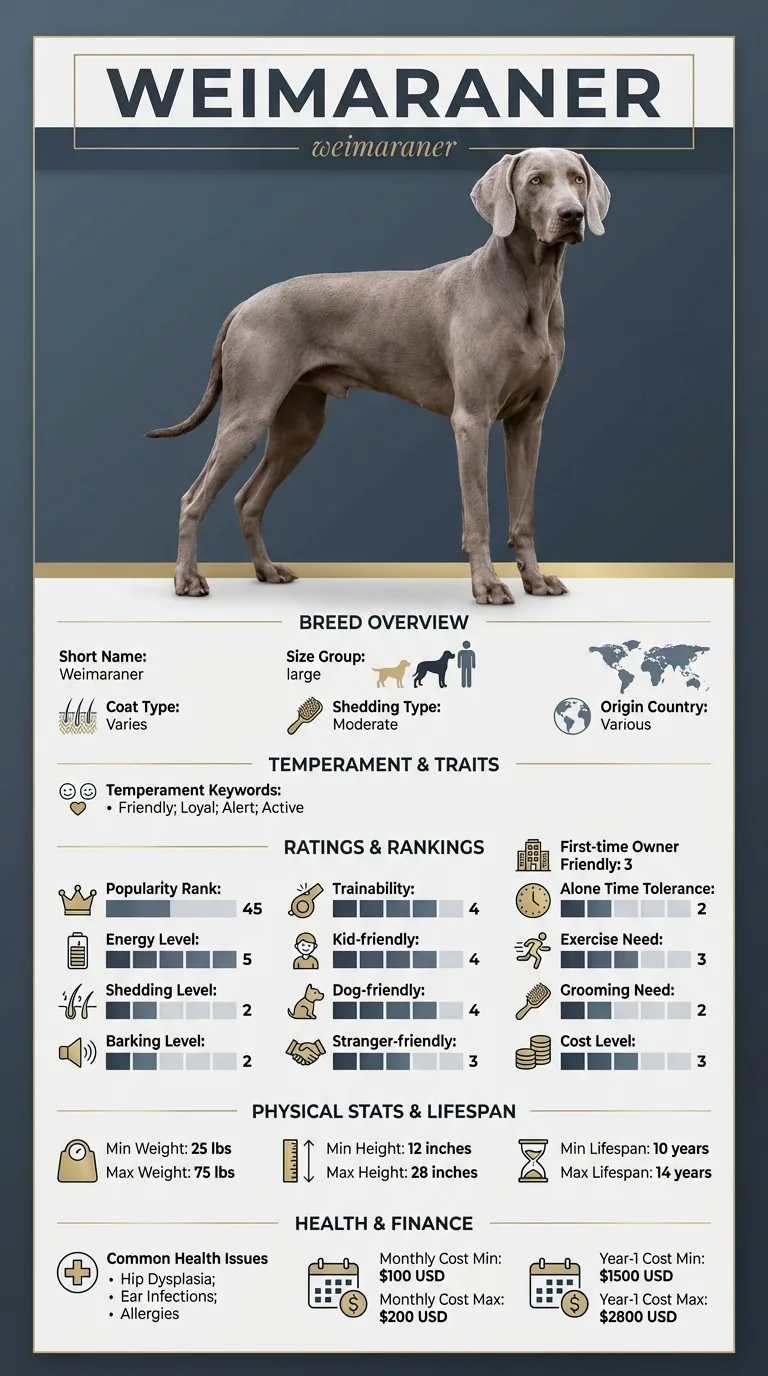
Bloat (GDV) is this breed's headline surgical emergency, with Hip Dysplasia, Hypertrophic Osteodystrophy and Von Willebrand Disease completing a documented health list. Separation Anxiety is the entry most likely to become recurring monthly spending, and it is aggravated by exactly the under-exercise a long winter can cause.
Minneapolis prices sit at national norms, with a short prevention season on the credit side and winter equipment on the debit side.
Estimate · source: estimation · confidence: medium · updated 2026-09-06 · not a quote
| Item | Cost range |
|---|---|
Skijoring and canicross kit, plus a few lessons Harness, bungee line and belt, with club or instructor time to teach a headstrong dog to pull and steer. | $150 - $500 |
One-time setup: exam, spay or neuter, crate, gear and winter coat Large-breed sizing throughout, including the insulation this breed's coat does not supply. | $480 - $800 |
| Item | Cost range |
|---|---|
Food for a 55-to-90-pound sporting dog Priced at national-average retail; a dog working in harness through winter eats toward the top of the bracket. | $55 - $95 |
Each range starts from a national baseline for this breed's size class and is then adjusted for local cost of living and veterinary pricing. The baselines, and the source each one came from, are listed on our sources page (dataset 2026.09). Two inputs, the purchase price and the emergency reserve, have no published national figure we could verify, so we leave them to you rather than invent them.
These are planning estimates, not quotes. Your own numbers will move with the individual dog, your vet and your insurer. Build a budget with your own figures.
An athletic winter is good for the dog and worth acknowledging in a policy decision, since orthopedic history is the thing insurers price hardest.
Quote it before the first winter season, while the record carries no joint findings at all.
A household holding the suggested reserve untouched can reasonably self-insure and spend the premium on equipment instead.
The cheapest Minneapolis households are the ones that use the winter rather than waiting it out indoors.
Most cold-city budgets for this breed contain a hidden winter line. Outdoor time collapses, the dog gets under-worked, and the household starts paying for daycare, indoor facilities or behaviour help to absorb the difference. It is a predictable pattern and it is expensive.
Minneapolis offers a way around it that very few metros can. Skijoring is established here, with clubs to learn from and trails where it is permitted, and the equipment involved — a pulling harness, a bungee line, a hip belt — is a one-time purchase in the low hundreds. The same harness and line do canicross for the rest of the year, so nothing sits idle.
It is not automatic. A dog has to be taught to pull into a harness, and a headstrong breed has to learn to take direction while doing it, which is where a club or a few lessons earn their keep. But the arithmetic is clearly favourable: a few hundred dollars once, against several months a year of paid alternatives, for a breed that is physically well suited to the work.
Minnesota's winters cut the flea-and-tick window to around six months, among the shortest on this list. On weight-dosed preventives for a 55-to-90-pound dog that is a straightforward saving, and it is the main reason a metro priced at national norms still comes out reasonable on the annual vet line.
The warm half of the year needs no invention. The Chain of Lakes and the Grand Rounds parkway system give the city an unusually continuous network of connected green space, which for a dog that wants distance rather than a fenced square is exactly the right shape of infrastructure — and it is free.
The coat is the one place this breed is under-equipped for the location. Documented as short and sleek, it costs nothing at a groomer and provides nothing at fifteen below. An insulated coat, and paw protection for salt and ice, are the price of using the winter rather than hiding from it.

A household in southwest Minneapolis spent their first winter with a Weimaraner paying for four days a week of daycare, purely because twenty-minute walks in January were not touching the dog. The following autumn a neighbour introduced them to a local skijoring group. A harness, a line and a few sessions later, they were doing forty-minute runs on groomed trails twice a week. Daycare dropped to occasional, the dog slept properly for the first winter of its life, and the equipment cost less than one month of what they had been spending.
Key takeaway: In Minneapolis this breed's most expensive season is optional — the equipment that converts winter into working time costs a fraction of the services that otherwise absorb it.
About $110 to $240, essentially at national norms, with a short prevention season helping the annual figures.
Roughly $1,700 to $3,200, covering the first exam, vaccine series, spay or neuter if chosen, and large-breed crate, gear and a winter coat.
It suits the breed well — a strong, athletic sporting dog with good trainability — provided it is taught properly to pull into a harness and take direction. Local clubs are the usual route in.
A pulling harness, bungee line and belt are a one-time purchase in the low hundreds, and the same kit does canicross through the warmer months.
Worth quoting while the dog is young, particularly if the plan involves an athletic winter — orthopedic notes on a record narrow later cover.
Around $840, sized against a single overnight surgical emergency rather than against routine care.
About $110–$240 a month and $1,700–$3,200 for year one at national-average pricing — with skijoring and canicross turning the long winter from this breed's most expensive season into its most productive one.
This guide is not medical advice. If your dog shows pain, sudden behavior change, or worsening symptoms, consult a licensed veterinarian.
Some links may be affiliate links. We may earn a commission at no extra cost to you. We only suggest products we believe are helpful for dog owners.
We research and check what we publish, but we do not warrant that any figure, date, price, or statement is accurate, complete, or current, and we accept no liability for any loss, cost, injury, or other harm arising from the use of this site. Use it as one reference among several. You remain responsible for your own decisions and for your dog's care - confirm anything that matters with a licensed veterinarian or another qualified professional before you act on it. Full disclaimer.
One sheet with every line item, the emergency fund and when insurance pays off - unlocks on this page.
You get: 12-month budget sheet
No spam. One-click unsubscribe. See our privacy policy.
Preview page 1 before you decide.