Costs
Weimaraner cost in Manchester
About $113–$247 a month and $1,751–$3,296 for year one, helped by no state sales tax — with a regional tick burden that makes the nominal seven-month prevention window worth questioning.

See Weimaraner price across all cities →
Quick answer
Weimaraner cost in Manchester
About $113–$247 a month and $1,751–$3,296 for year one, helped by no state sales tax — with a regional tick burden that makes the nominal seven-month prevention window worth questioning.
A Weimaraner in Manchester runs about $113 to $247 a month, with year one between $1,751 and $3,296. New Hampshire charges no state sales tax, which takes a small, real edge off everything you buy for a large dog. The local factor worth more attention than the tax is underfoot: this is one of the highest tick-burden regions in the country, and a seven-month prevention window on a spreadsheet is not the same thing as seven months of actual exposure.
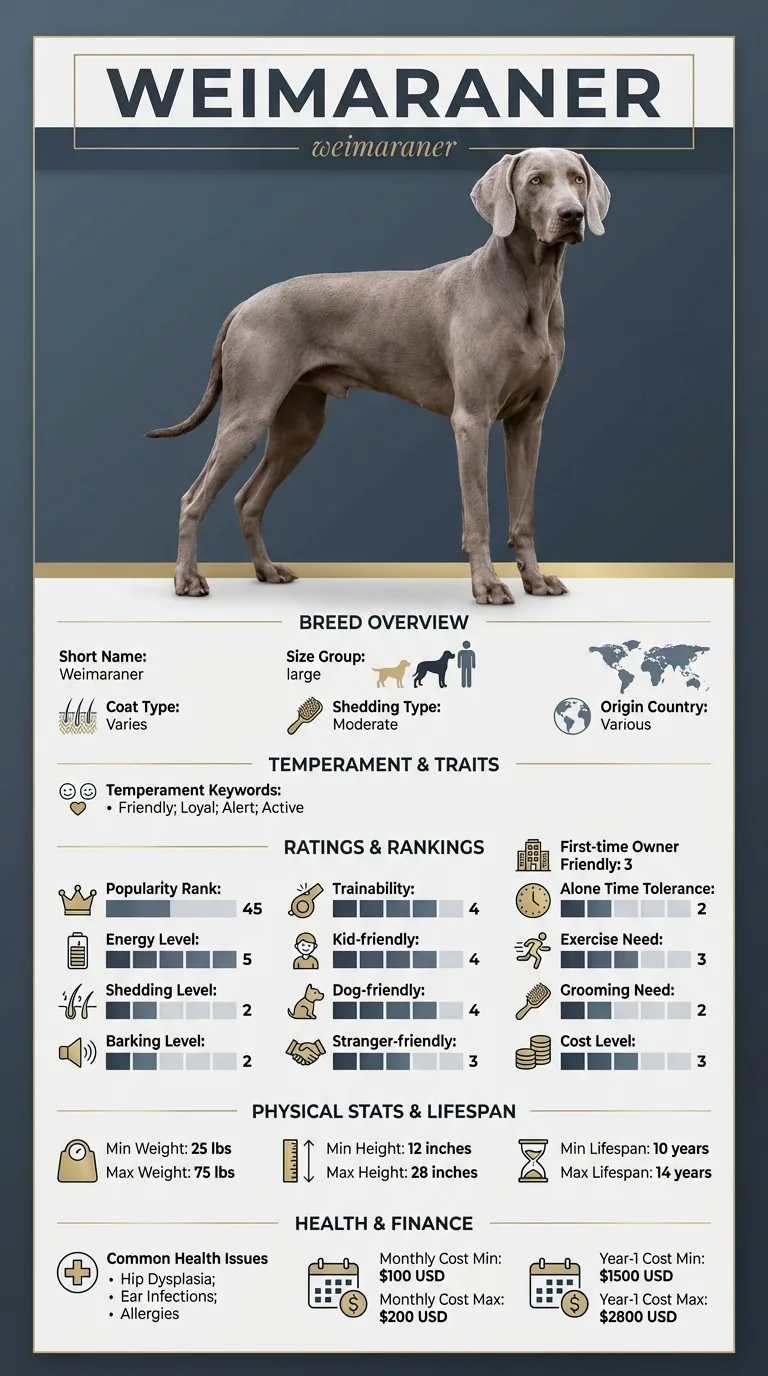
Bloat (GDV) is the surgical emergency this breed is best known for, with Hip Dysplasia, Hypertrophic Osteodystrophy and Von Willebrand Disease on the same documented list. Separation Anxiety is the entry most likely to become a recurring monthly cost rather than a single bill.
Manchester's costs sit a little above national norms with no sales tax to soften them, and prevention is the line most worth spending properly on here.
Estimate · source: estimation · confidence: medium · updated 2026-09-06 · not a quote
| Item | Cost range |
|---|---|
One-time setup: exam, spay or neuter, crate, gear and winter coat Large-breed sizing throughout, including insulation this breed's short coat cannot supply itself. | $494 - $824 |
| Item | Cost range |
|---|---|
Food for a 55-to-90-pound sporting dog Priced at local retail with no sales tax added, for an athletic dog at this weight. | $57 - $98 |
Each range starts from a national baseline for this breed's size class and is then adjusted for local cost of living and veterinary pricing. The baselines, and the source each one came from, are listed on our sources page (dataset 2026.09). Two inputs, the purchase price and the emergency reserve, have no published national figure we could verify, so we leave them to you rather than invent them.
These are planning estimates, not quotes. Your own numbers will move with the individual dog, your vet and your insurer. Build a budget with your own figures.
Prevention and insurance solve different problems here — one manages an ongoing regional exposure, the other covers a single expensive night.
Quote it while the dog is young, before any orthopedic or gastrointestinal note appears and narrows what is covered.
A household holding the suggested reserve untouched can self-insure and put the premium toward the longer prevention schedule instead.
In this region the cheapest mistake to avoid is under-covering a dog that spends its exercise hours in exactly the habitat ticks prefer.
Regional prevention windows are useful for budgeting and misleading for biology. Southern New Hampshire's flea-and-tick season is conventionally counted at around seven months, but the ticks that matter most here become active whenever the ground thaws, including mild stretches in late autumn and early spring that fall outside anyone's default schedule.
That matters more for this breed than for a dog that walks pavement. A Weimaraner needs distance and cover, and the places that provide it are exactly the places ticks live. The practical questions to put to a local vet are which months you genuinely need to cover, and whether the Lyme vaccine makes sense for a dog with this exercise profile. Both answers are cheap; getting them wrong is not.
The breed does hand back one genuine advantage. The coat is documented as short and sleek, so a thorough tick check after a walk takes a couple of minutes and actually finds things. On a long-coated dog in the same woods it is a far harder job. That is not a saving you can put in a spreadsheet, but in this region it is the most useful physical trait this dog has.
New Hampshire's lack of a sales tax is a small, steady discount on everything from a crate to a bag of food, and Manchester's position near the Massachusetts line means plenty of households already shop with that in mind. Against a general cost base sitting just above national norms, it takes the edge off rather than transforming the budget.
Winter is the offsetting cost, and it is not optional for this breed. The documented short coat has essentially no insulating layer behind it, and a Merrimack Valley January will find that out quickly. An insulated coat, and paw protection for salted sidewalks, are equipment rather than accessories.
Grooming, by contrast, never becomes a line at all. Documented low to moderate shedding on a short coat means a rubber curry brush and no professional appointments across the life of the dog — one of the few places this breed is genuinely cheap.

A Manchester household ran their Weimaraner's tick prevention from April to October, which matched every seasonal guide they had read. After a mild November of long walks in the woods behind the house, they pulled two ticks off the dog in a single week. Their vet extended the schedule and talked through the Lyme vaccine for a dog with this exercise profile. The extra months cost a modest amount annually. The short coat is what made the ticks findable in the first place.
Key takeaway: In southern New Hampshire the prevention calendar for a dog that works in cover should be set by your vet and your walking habits, not by the region's average season length.
About $113 to $247, slightly above national norms, though New Hampshire's lack of sales tax takes a small edge off purchases.
Roughly $1,751 to $3,296, including the first exam, vaccine series, spay or neuter if chosen, and large-breed crate, gear and a winter coat.
That is a question for your vet. New Hampshire has one of the country's highest Lyme burdens and the ticks involved are active on any thawed day, so a dog that works in cover may need a longer schedule than the seasonal average suggests.
Genuinely, yes. A documented short, sleek coat makes a post-walk check quick and effective, which matters for a breed that spends its exercise time in brush rather than on pavement.
Worth quoting while the dog is young. Bloat is a documented surgical emergency in this breed and New England vet pricing sits above the national middle.
Around $860, sized against an overnight surgical emergency rather than against routine care.
About $113–$247 a month and $1,751–$3,296 for year one, helped by no state sales tax — with a regional tick burden that makes the nominal seven-month prevention window worth questioning.
This guide is not medical advice. If your dog shows pain, sudden behavior change, or worsening symptoms, consult a licensed veterinarian.
Some links may be affiliate links. We may earn a commission at no extra cost to you. We only suggest products we believe are helpful for dog owners.
We research and check what we publish, but we do not warrant that any figure, date, price, or statement is accurate, complete, or current, and we accept no liability for any loss, cost, injury, or other harm arising from the use of this site. Use it as one reference among several. You remain responsible for your own decisions and for your dog's care - confirm anything that matters with a licensed veterinarian or another qualified professional before you act on it. Full disclaimer.
One sheet with every line item, the emergency fund and when insurance pays off - unlocks on this page.
You get: 12-month budget sheet
No spam. One-click unsubscribe. See our privacy policy.
Preview page 1 before you decide.