Living
Which is the better overall choice?
The Bernedoodle fits a wider range of households, especially ones away from home for stretches; the Weimaraner suits an active owner who's around most of the day and wants minimal grooming.

Quick answer
Which is the better overall choice?
The Bernedoodle fits a wider range of households, especially ones away from home for stretches; the Weimaraner suits an active owner who's around most of the day and wants minimal grooming.
Bernedoodle or Weimaraner? On paper they differ most on grooming need, and on the scales Weimaraner is the heavier at 55–90 lbs. Here is how the two compare on everything that shapes an ordinary week.
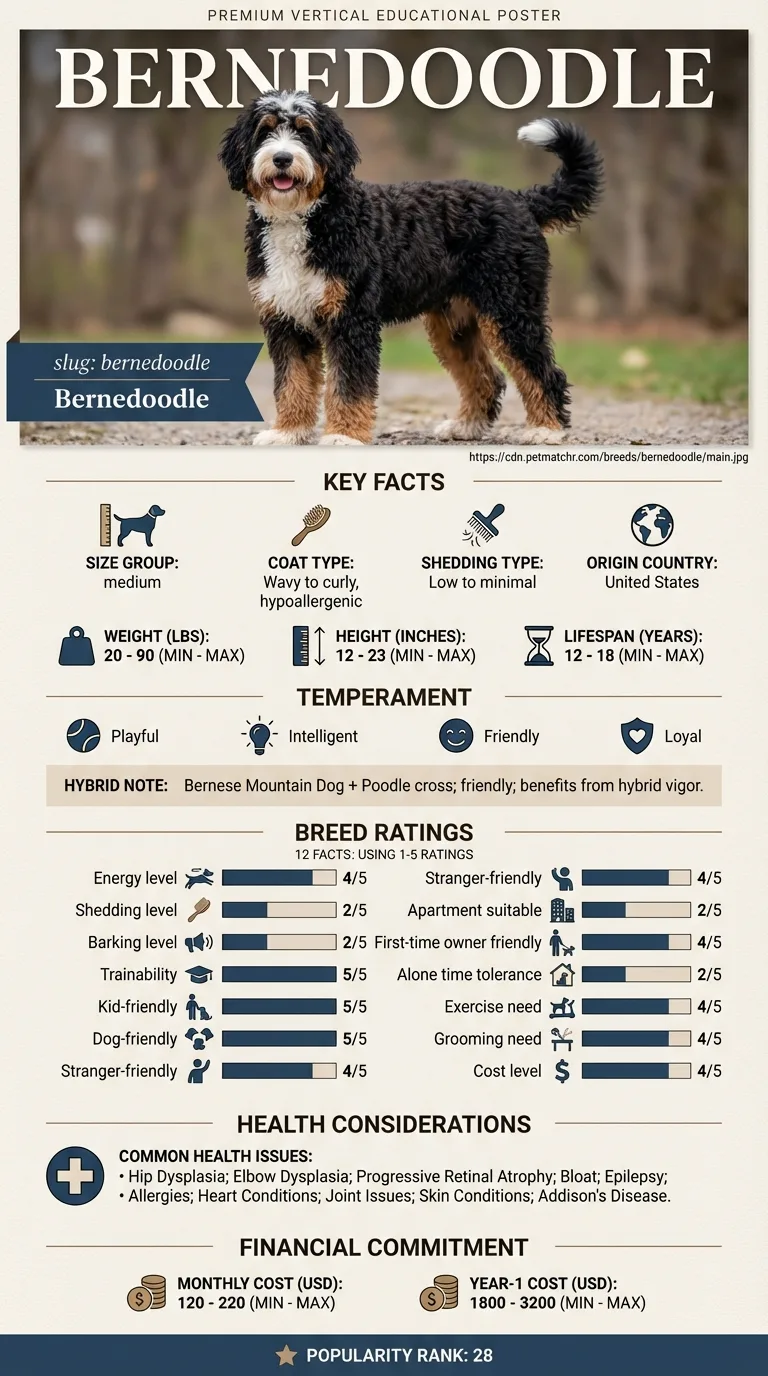
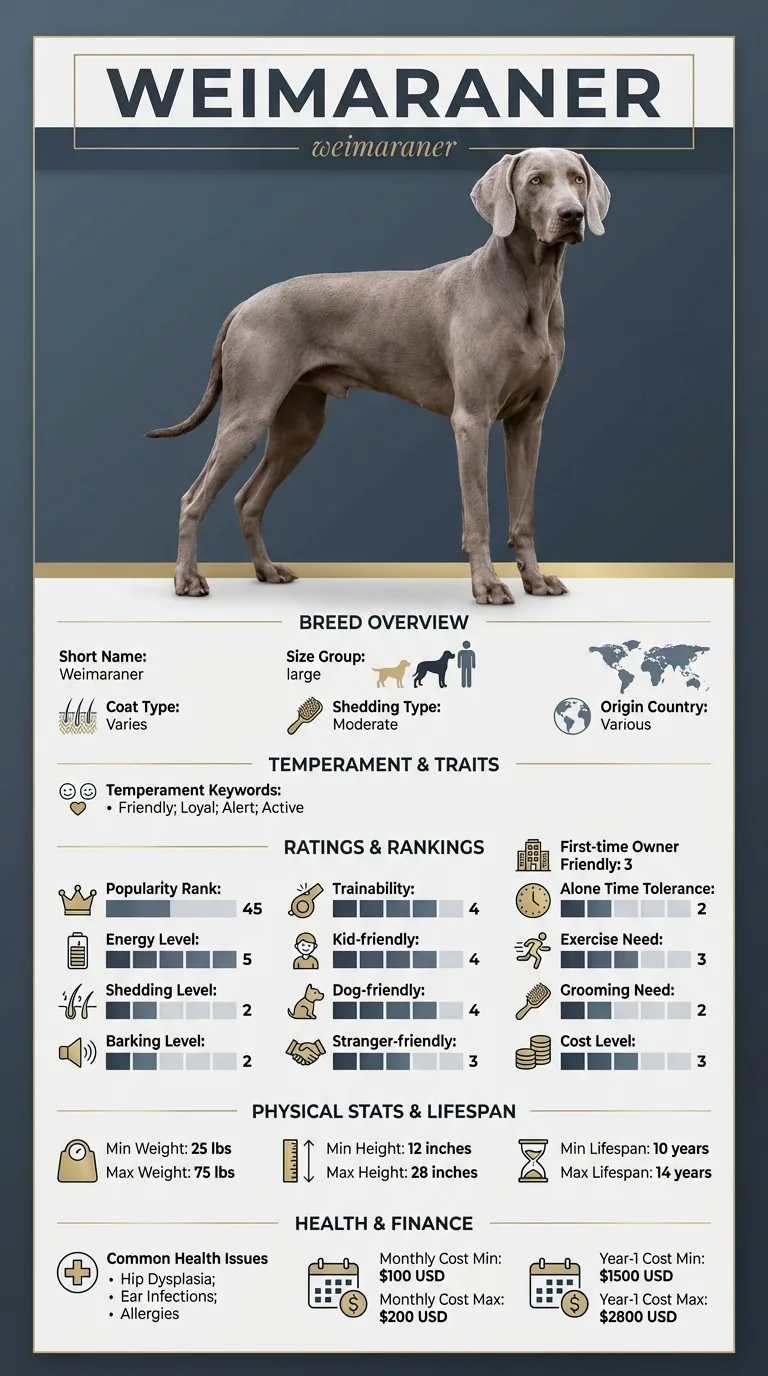
This is for someone already down to Bernedoodle and Weimaraner and deciding between them. For this pair the decision usually turns on grooming need and good for first-time owners, so those are covered first and in most detail. Anyone choosing from a flat has a clear answer here: Bernedoodle rates 2/5 against 1/5. There is no origin story here — only what changes about your week.
Between Bernedoodle and Weimaraner, grooming need is what separates them, and Bernedoodle is the lower-effort dog of the two to keep.
Choose Bernedoodle if this is your first dog, your walking routine is modest and there are young children at home.
Choose Weimaraner if you do not want a standing grooming appointment, you want a dog that can keep up with an active routine and you want a dog that is more watchful with visitors.
| Feature | bernedoodle | weimaraner | Winner |
|---|---|---|---|
| Size class | medium | large | Equal |
| Weight | 20–90 lbs | 55–90 lbs | Equal |
| Height | 12–23 in | 23–27 in | Equal |
| Lifespan | 12–18 years | 10–13 years | bernedoodle |
| Exercise need | High (4/5) | Very high (5/5) | bernedoodle |
| Grooming need | High (4/5) | Very low (1/5) | weimaraner |
| Shedding | Low (2/5) | Low (2/5) | Equal |
| Energy level | High (4/5) | Very high (5/5) | Equal |
| Barking | Low (2/5) | Moderate (3/5) | bernedoodle |
| Apartment suitability | Low (2/5) | Very low (1/5) | bernedoodle |
| Good for first-time owners | High (4/5) | Low (2/5) | bernedoodle |
| Tolerates being alone | Low (2/5) | Very low (1/5) | bernedoodle |
| Trainability | Very high (5/5) | High (4/5) | bernedoodle |
| Good with kids | Very high (5/5) | High (4/5) | bernedoodle |
| Good with other dogs | Very high (5/5) | Moderate (3/5) | bernedoodle |
| Friendly to strangers | High (4/5) | Moderate (3/5) | bernedoodle |
| Cost level | High (4/5) | Moderate (3/5) | weimaraner |
| Coat | Wavy to curly, hypoallergenic | Short and sleek | Equal |
| Origin | United States | Various | Equal |
| Typical monthly cost | $120–$220 | $110–$240 | Equal |
| Typical first-year cost | $1,800–$3,200 | $1,700–$3,200 | Equal |
A Weimaraner stands 23-27 inches and weighs 55-90 lbs, built as a lean, athletic large breed — noticeably taller and heavier on average than a Bernedoodle's 20-90 lb, 12-23 inch range, even though their weight ranges technically overlap at the top end. A large Bernedoodle can match a Weimaraner in weight, but it won't carry the same greyhound-like build or ground-covering stride.
The Weimaraner rates a very high 5/5 for exercise, a full point above the Bernedoodle's 4/5, and that number reflects a breed built for hunting stamina rather than casual walks. Plan on serious daily running or off-leash work, not just a stroll around the block, if a Weimaraner is on your shortlist.
Coat maintenance drops sharply with the Weimaraner — a 1/5 grooming need against the Bernedoodle's 4/5, thanks to its short, sleek coat that needs little more than an occasional wipe-down. Shedding ties at a low 2/5 for both breeds, so the time savings are really about brushing and trims rather than vacuuming.
The Weimaraner is a poor apartment fit even relative to the Bernedoodle's already-low score — 1/5 versus 2/5 — and it tolerates being alone just as poorly, at 1/5 against the Bernedoodle's 2/5. Separation anxiety is common enough in the breed that it actually appears on the Weimaraner's own health-risk list, not just as a temperament note.
The Bernedoodle is the easier dog for a new owner to start with, rated 4/5 for first-timers against the Weimaraner's low 2/5, and it edges ahead on trainability too (5/5 vs 4/5). The Weimaraner is still highly trainable in absolute terms — its 4/5 score isn't low — but its intensity and independent streak ask more of a first-time handler.
The Bernedoodle scores higher with kids (5/5 vs 4/5), other dogs (5/5 vs a moderate 3/5), and strangers (4/5 vs 3/5), making it the more broadly sociable dog of the two on paper. The Weimaraner isn't unfriendly — it's rated "devoted" and "alert" in temperament — it just tends to reserve its warmth for its own household rather than everyone it meets.
Lifespan favors the Bernedoodle clearly — 12-18 years against 10-13 for the Weimaraner. What stands out on the Weimaraner's health list is that separation anxiety is named directly alongside physical conditions like bloat, hip dysplasia, hypertrophic osteodystrophy, and Von Willebrand disease, underscoring how central that behavioral trait is to owning the breed responsibly.
Costs run close, with the Weimaraner rated slightly cheaper overall (3/5 vs the Bernedoodle's 4/5). Monthly ranges of $110-240 versus $120-220 and first-year totals of $1,700-3,200 versus $1,800-3,200 overlap enough that grooming bills and vet-visit frequency will likely decide the actual number more than the breed itself. A large, active dog like the Weimaraner also eats more per meal, which can eat into the savings from skipping the groomer.
Bernedoodle weighs 20–90 lbs and lives 12–18 years; Weimaraner weighs 55–90 lbs and lives 10–13 years. The two diverge most on grooming need, good for first-time owners and good with other dogs. Almost every rated axis separates them at least slightly. Where the table declares a winner it means less work for the owner, nothing more; descriptive rows are left as ties on purpose. The value here is in the differences between the two columns; treat any single score as approximate.

Larger on average — 55-90 lbs and 23-27 inches, against the Bernedoodle's 20-90 lbs and up to 23 inches, though the ranges overlap at the top.
Yes — a very high 5/5, above the Bernedoodle's already-substantial 4/5. This is a breed built for hunting stamina.
Common enough that it's listed directly on the breed's health-risk list alongside physical conditions like bloat and hip dysplasia — worth taking seriously before committing to one.
No — it ties the Bernedoodle at a low 2/5, and its short coat needs very little brushing (1/5 grooming need).
Not generally recommended — 2/5, against the Bernedoodle's 4/5.
Close — $110-240 monthly and $1,700-3,200 in year one for the Weimaraner, against $120-220 and $1,800-3,200 for the Bernedoodle.
The Bernedoodle, 12-18 years versus 10-13 for the Weimaraner.
The Bernedoodle fits a wider range of households, especially ones away from home for stretches; the Weimaraner suits an active owner who's around most of the day and wants minimal grooming.
$110-240 for the Weimaraner, $120-220 for the Bernedoodle.
The Weimaraner, rated a very high 5/5 against the Bernedoodle's 4/5.
The Bernedoodle, at 12-18 years versus 10-13 for the Weimaraner.
Secure checkout on Stripe. We never see your card.
7-day money-back guarantee. Instant access.

Health information here is general and is not veterinary advice. If your dog shows pain, sudden behaviour change, or worsening symptoms, consult a licensed veterinarian.
Some links on this site are affiliate links. We may earn a commission at no extra cost to you, and we only suggest products we believe are helpful for dog owners.
We research and check what we publish, but we do not warrant that any figure, date, price, or statement is accurate, complete, or current, and we accept no liability for any loss, cost, injury, or other harm arising from the use of this site. Use it as one reference among several. You remain responsible for your own decisions and for your dog's care - confirm anything that matters with a licensed veterinarian or another qualified professional before you act on it. Full disclaimer.
Match your lifestyle to the right dog.
Take quizNot sure which breed is right for you? Take our 2-minute quiz to find out.
Take the quiz