Living
Which is bigger?
The Shiba Inu, at 17–23 lbs versus the Shih Tzu's 9–16 lbs.

Quick answer
Which is bigger?
The Shiba Inu, at 17–23 lbs versus the Shih Tzu's 9–16 lbs.
Shiba Inu or Shih Tzu? On paper they differ most on shedding, and on the scales Shiba Inu is the heavier at 17–23 lbs. Here is how the two compare on everything that shapes an ordinary week.
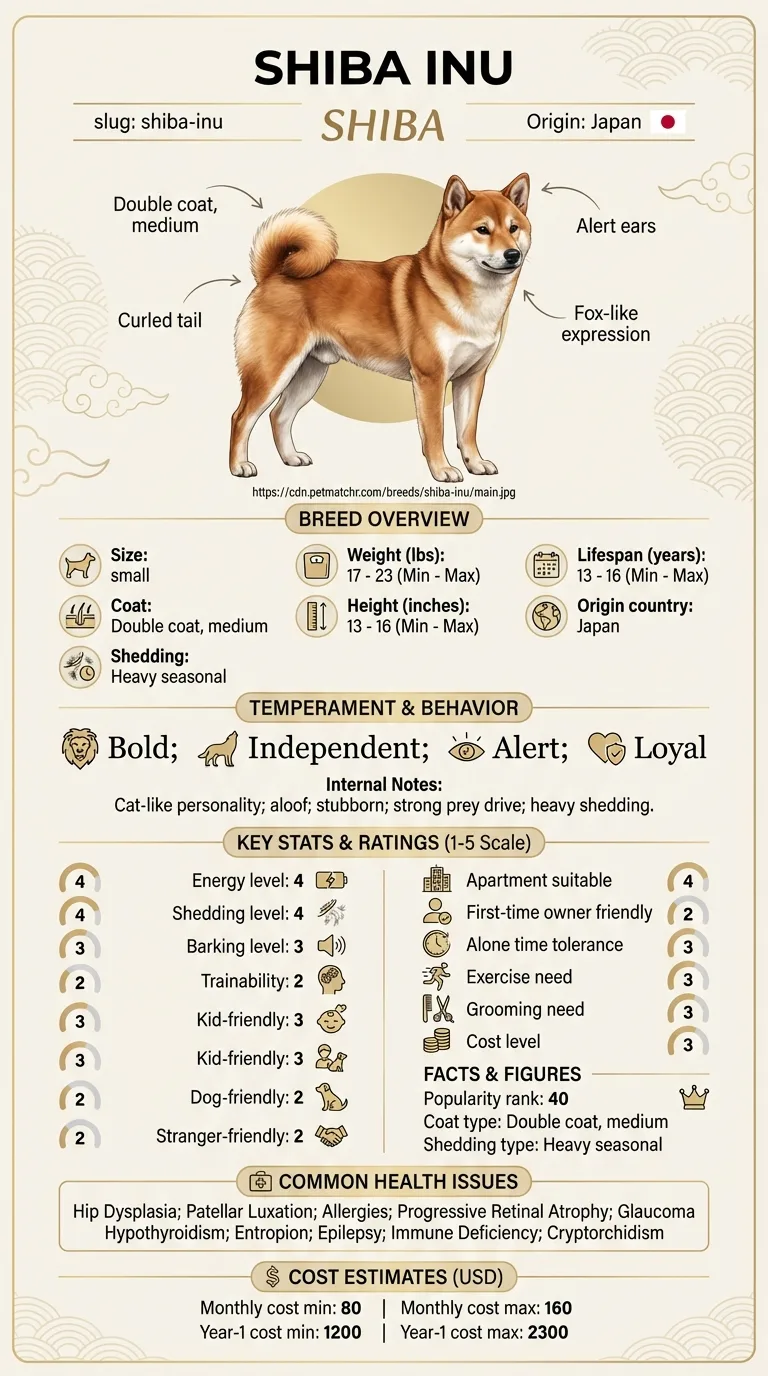
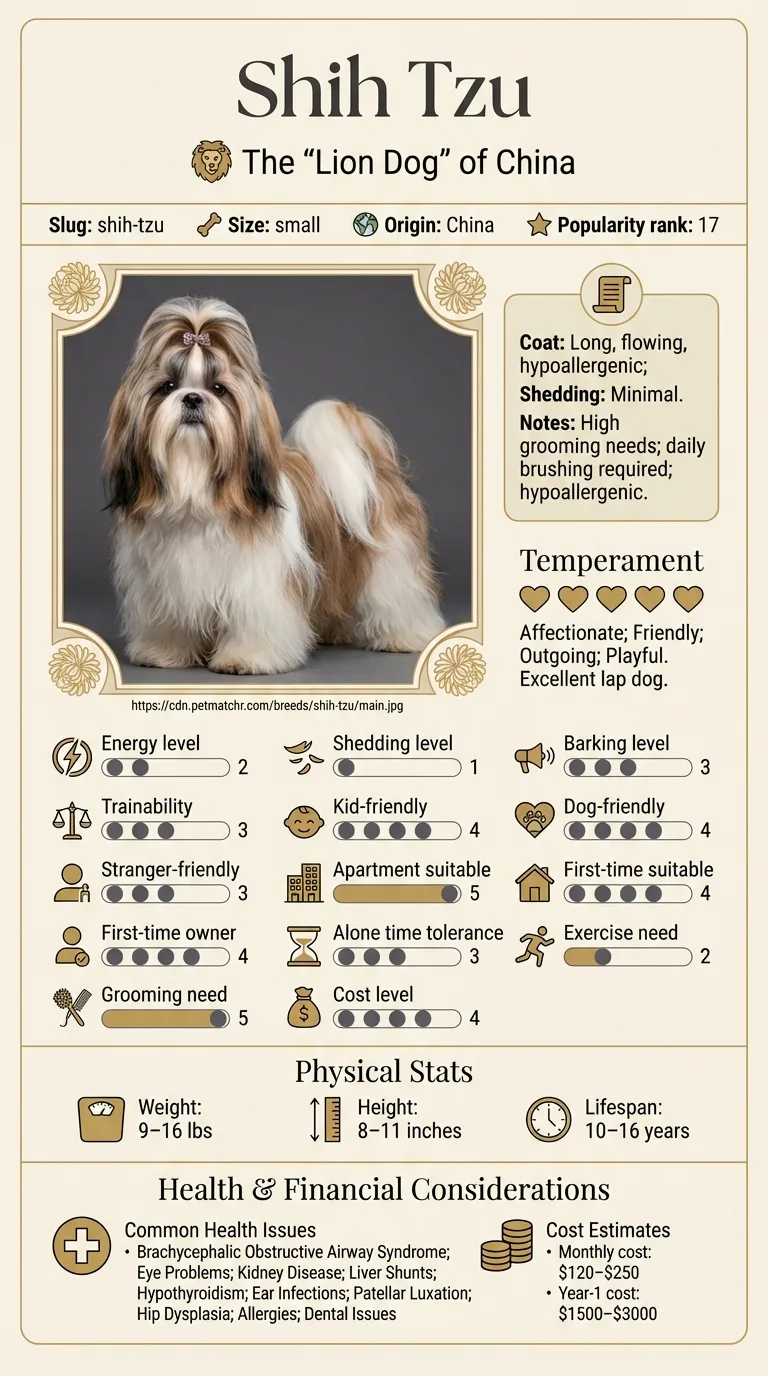
This is for someone already down to Shiba Inu and Shih Tzu and deciding between them. For this pair the decision usually turns on shedding and grooming need, so those are covered first and in most detail. Anyone choosing from a flat has a clear answer here: Shih Tzu rates 5/5 against 4/5. The focus throughout is on daily consequences rather than breed background.
Between Shiba Inu and Shih Tzu, shedding is what separates them, and Shih Tzu is the lower-effort dog of the two to keep.
Choose Shiba Inu if you do not want a standing grooming appointment, you want a dog that can keep up with an active routine and you want a dog that is more watchful with visitors.
Choose Shih Tzu if you are in a flat or a smaller home, this is your first dog and shedding is a problem in your house.
| Feature | shiba inu | shih tzu | Winner |
|---|---|---|---|
| Size class | small | small | Equal |
| Weight | 17–23 lbs | 9–16 lbs | Equal |
| Height | 13–16 in | 8–11 in | Equal |
| Lifespan | 13–16 years | 10–16 years | shiba inu |
| Exercise need | Moderate (3/5) | Low (2/5) | shih tzu |
| Grooming need | Moderate (3/5) | Very high (5/5) | shiba inu |
| Shedding | High (4/5) | Very low (1/5) | shih tzu |
| Energy level | High (4/5) | Low (2/5) | Equal |
| Barking | Moderate (3/5) | Moderate (3/5) | Equal |
| Apartment suitability | High (4/5) | Very high (5/5) | shih tzu |
| Good for first-time owners | Low (2/5) | High (4/5) | shih tzu |
| Tolerates being alone | Moderate (3/5) | Moderate (3/5) | Equal |
| Trainability | Low (2/5) | Moderate (3/5) | shih tzu |
| Good with kids | Moderate (3/5) | High (4/5) | shih tzu |
| Good with other dogs | Low (2/5) | High (4/5) | shih tzu |
| Friendly to strangers | Low (2/5) | Moderate (3/5) | shih tzu |
| Cost level | Moderate (3/5) | High (4/5) | shiba inu |
| Coat | Double coat, medium | Long, flowing, hypoallergenic | Equal |
| Origin | Japan | China | Equal |
| Typical monthly cost | $80–$160 | $120–$250 | Equal |
| Typical first-year cost | $1,200–$2,300 | $1,500–$3,000 | Equal |
Both breeds sit in the small size class, but the Shiba Inu is noticeably the sturdier of the two at 17–23 lbs and 13–16 inches, compared to the Shih Tzu's 9–16 lbs and just 8–11 inches tall. The Shiba's fox-like, athletic build with a medium double coat contrasts with the Shih Tzu's low-slung, long-coated frame originally bred as a palace lapdog. Despite the size gap, neither breed is delicate — the Shiba is a genuinely agile, muscular little dog, while the Shih Tzu, though compact, is sturdier underfoot than its glamorous coat suggests. Anyone picking by handleable size alone will find the Shih Tzu the easier lift.
The Shiba Inu wants more from its owner physically, rated Moderate (3/5) for exercise need and High (4/5) energy level, against the Shih Tzu's Low (2/5) exercise need. That said, the Shiba's exercise needs are moderate rather than extreme — a couple of solid walks a day generally covers it, it just needs to actually happen, since an under-exercised Shiba with Low (2/5) trainability can become a handful. The Shih Tzu, true to its companion-breed roots, is genuinely satisfied with short walks and indoor play, making it the far lower-commitment choice for owners without much time or interest in structured daily exercise.
This category inverts sharply. The Shih Tzu's long, flowing, hypoallergenic coat demands Very High (5/5) grooming — daily brushing and regular professional trims are close to non-negotiable to prevent matting — while its shedding is rated Very Low (1/5), a real plus for allergy-sensitive households. The Shiba Inu is the opposite: Moderate (3/5) grooming but High (4/5) shedding from its dense double coat, meaning less brushing overall but noticeably more loose hair, especially during its twice-yearly coat blow. Owners choosing based on allergies should lean Shih Tzu; owners who dislike frequent grooming appointments but can tolerate more vacuuming should lean Shiba.
Both breeds handle apartment living reasonably well, but the Shih Tzu comes out ahead at Very High (5/5) apartment suitability versus the Shiba Inu's still-solid High (4/5), largely a function of the Shih Tzu's lower exercise needs. Barking is tied at Moderate (3/5) for both, so neither stands out as unusually quiet or loud. Where they diverge more is alone-time tolerance: the Shiba rates Moderate (3/5) while the Shih Tzu also sits at Moderate (3/5), so both need some transition training before being left solo for long stretches, but neither is flagged as a severe separation-anxiety risk the way some breeds are.
This is one of the widest gaps on the page. The Shih Tzu is rated High (4/5) for first-time owners with Moderate (3/5) trainability, while the Shiba Inu scores Low (2/5) on both first-time suitability and trainability — its temperament, described as Bold, Independent, and Alert, is famously cat-like and resistant to repetitive obedience work. Shiba owners often describe the breed as needing to be convinced rather than commanded. The Shih Tzu's Affectionate, Friendly, Outgoing, Playful temperament makes it far more eager to please, which shows up directly in how much easier it is for a novice to get consistent results.
The Shih Tzu is the stronger family and social dog across the board: High (4/5) with kids, High (4/5) with other dogs, and Moderate (3/5) with strangers, versus the Shiba Inu's Moderate (3/5) with kids, Low (2/5) with other dogs, and Low (2/5) with strangers. The Shiba's Independent, Alert nature makes it more selective about who it bonds with and less tolerant of rough play or unfamiliar dogs at the park, which matters for households with young children or a multi-dog home. Families that want a dog that welcomes chaos and new faces will find the Shih Tzu the more forgiving pick.
The Shiba Inu edges ahead on longevity, 13–16 years against the Shih Tzu's 10–16, though both carry lengthy health lists. Shiba owners should watch for Hip Dysplasia, Patellar Luxation, Allergies, Progressive Retinal Atrophy, Glaucoma, and immune-related issues like Immune Deficiency. The Shih Tzu's list includes Brachycephalic Obstructive Airway Syndrome — a direct consequence of its flat face and a genuine breathing concern in heat — plus Kidney Disease, Liver Shunts, and Dental Issues, alongside shared conditions like Hip Dysplasia and Allergies. The Shih Tzu's brachycephalic status means owners need to be more careful about exercise intensity and heat exposure than Shiba owners typically do.
The Shiba Inu is the cheaper of the two to keep, rated Moderate (3/5) against the Shih Tzu's High (4/5), with monthly costs of $80–$160 versus $120–$250 and first-year costs of $1,200–$2,300 versus $1,500–$3,000. Much of that gap traces back to grooming — the Shih Tzu's Very High grooming need typically means recurring professional appointments that a Shiba's twice-yearly shed-out doesn't require. The Shih Tzu's brachycephalic health risks can also mean more specialized (and pricier) vet visits over its lifetime, adding to the cost differential beyond what the base cost rating alone suggests.
Shiba Inu weighs 17–23 lbs and lives 13–16 years; Shih Tzu weighs 9–16 lbs and lives 10–16 years. The two diverge most on shedding, grooming need and energy level and 2 other rated axes. They are level on tolerates being alone and barking, so those cannot decide it. The table below marks a winner only where one breed is genuinely easier for a typical owner; size and origin are facts rather than merits and stay level. Ratings come from one source applied to both breeds, so they are meaningful against each other rather than as absolute scores.

The Shih Tzu, clearly — it rates Moderate (3/5) trainability and High (4/5) for first-time owners, while the Shiba Inu rates Low (2/5) on both, reflecting its famously independent streak.
The Shiba Inu, rated High (4/5) for shedding versus the Shih Tzu's Very Low (1/5) — the Shih Tzu's hypoallergenic coat sheds far less.
Yes — it rates High (4/5) with other dogs, well above the Shiba Inu's Low (2/5), which tends to be more selective about canine company.
The Shiba Inu, rated Moderate (3/5) versus the Shih Tzu's Very High (5/5) — though the trade-off is more shedding for the Shiba.
Both do reasonably well, but the Shih Tzu edges ahead at Very High (5/5) apartment suitability versus the Shiba Inu's High (4/5).
Brachycephalic Obstructive Airway Syndrome, a breathing condition tied to its flat face, which the Shiba Inu — with a normal muzzle length — isn't prone to.
The Shiba Inu has the edge with a 13–16 year range, versus the Shih Tzu's wider 10–16 year range.
The Shiba Inu, at 17–23 lbs versus the Shih Tzu's 9–16 lbs.
The Shiba Inu, described as Bold and Independent versus the Shih Tzu's Affectionate, Friendly temperament.
The Shiba Inu, at $80–$160 versus the Shih Tzu's $120–$250.
The Shih Tzu, rated Low (2/5) versus the Shiba Inu's Moderate (3/5).
Secure checkout on Stripe. We never see your card.
7-day money-back guarantee. Instant access.
Health information here is general and is not veterinary advice. If your dog shows pain, sudden behaviour change, or worsening symptoms, consult a licensed veterinarian.
Some links on this site are affiliate links. We may earn a commission at no extra cost to you, and we only suggest products we believe are helpful for dog owners.
We research and check what we publish, but we do not warrant that any figure, date, price, or statement is accurate, complete, or current, and we accept no liability for any loss, cost, injury, or other harm arising from the use of this site. Use it as one reference among several. You remain responsible for your own decisions and for your dog's care - confirm anything that matters with a licensed veterinarian or another qualified professional before you act on it. Full disclaimer.
Match your lifestyle to the right dog.
Take quizNot sure which breed is right for you? Take our 2-minute quiz to find out.
Take the quiz