Poodle (Miniature) vs Siberian Husky: Which Suits Your Home?
Quick answer
Poodle (Mini) or Husky — which should most people pick?
Go with the Mini Poodle unless you specifically want a high-energy, independent dog and can meet its exercise needs. The Poodle trains faster, sheds less, and suits far more living situations.
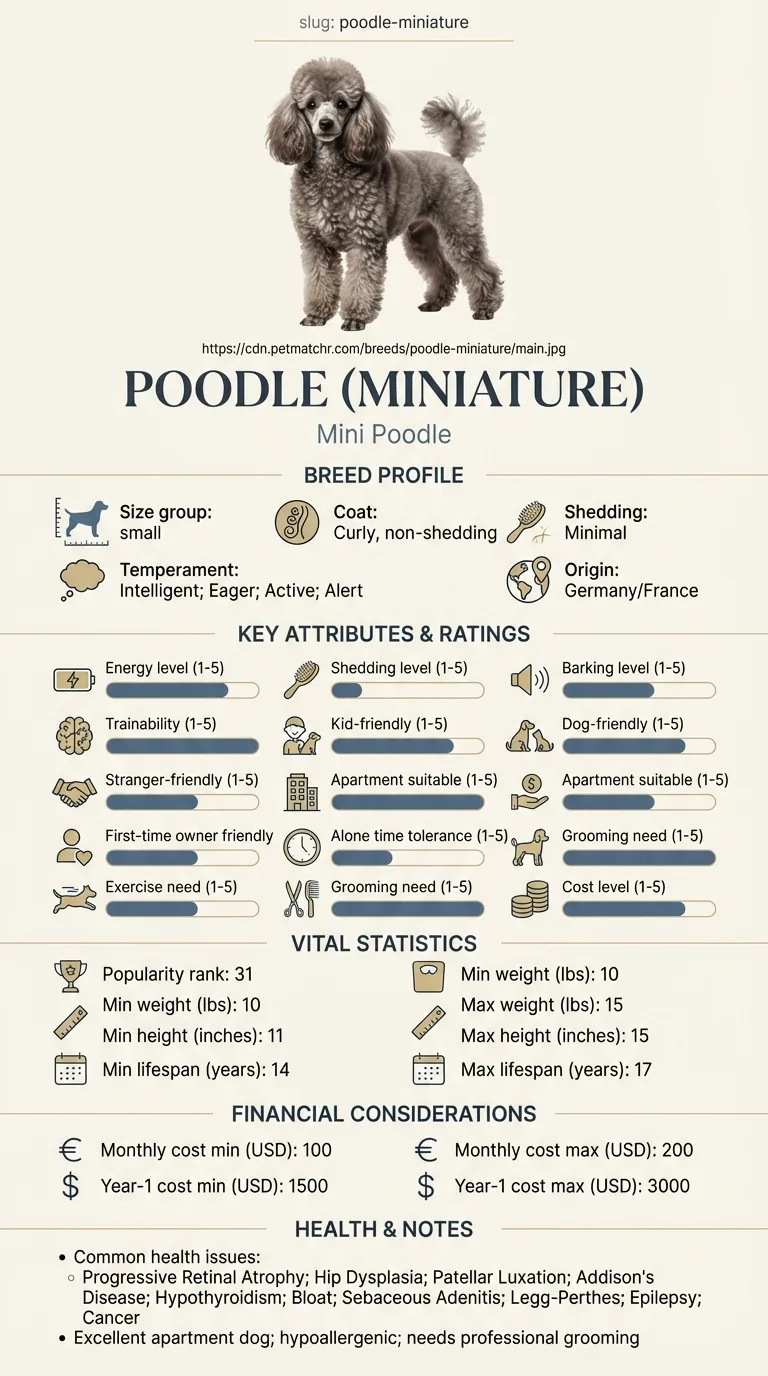
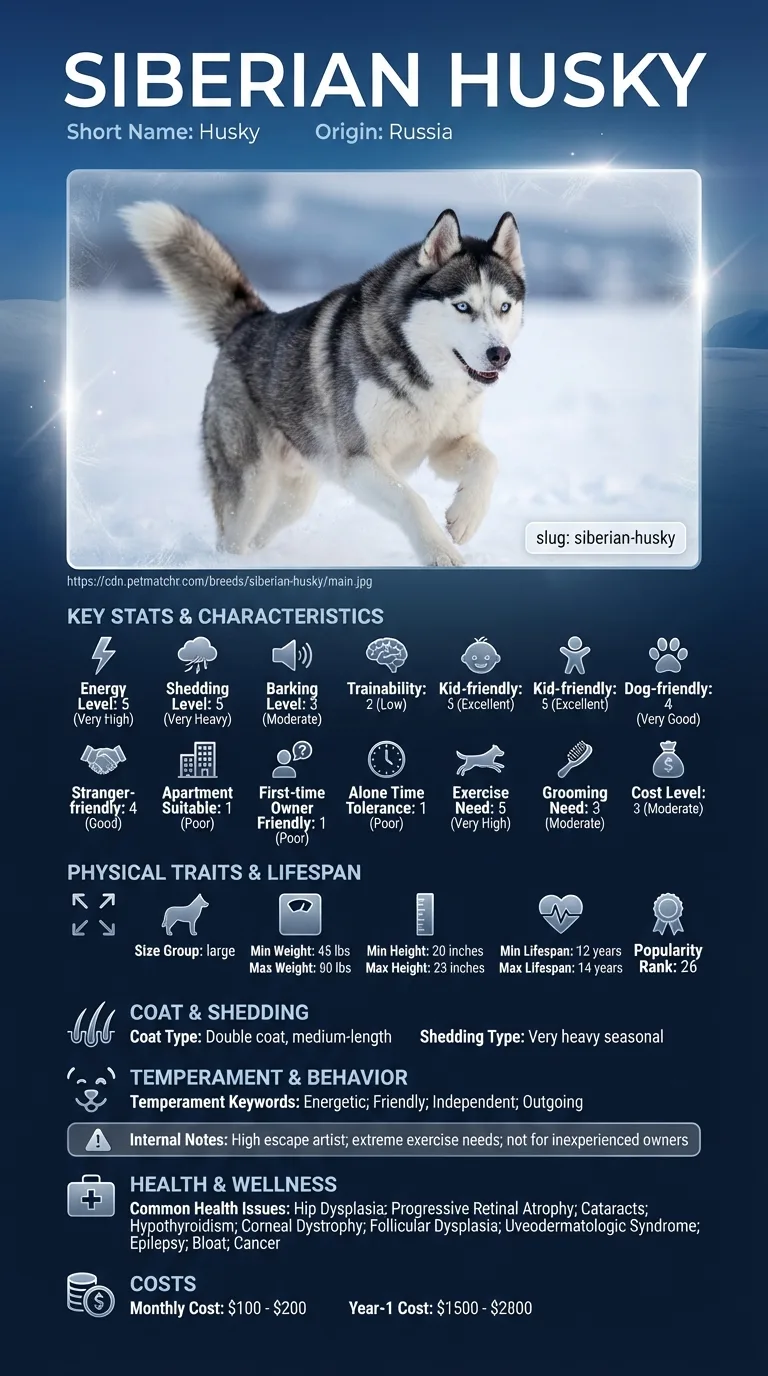
Poodle (Miniature) or Siberian Husky? On paper they differ most on apartment suitability, and on the scales Siberian Husky is the heavier at 45–60 lbs. Here is how the two compare on everything that shapes an ordinary week.
This is for someone already down to Poodle (Miniature) and Siberian Husky and deciding between them. For this pair the decision usually turns on apartment suitability and shedding, so those are covered first and in most detail. Anyone choosing from a flat has a clear answer here: Poodle (Miniature) rates 5/5 against 1/5. There is no origin story here — only what changes about your week.
Quick verdict
Between Poodle (Miniature) and Siberian Husky, apartment suitability is what separates them, and Poodle (Miniature) is the lower-effort dog of the two to keep.
Choose poodle miniature if...
Choose Poodle (Miniature) if you are in a flat or a smaller home, this is your first dog and shedding is a problem in your house.
Choose siberian husky if...
Choose Siberian Husky if you do not want a standing grooming appointment, there are young children at home and you want a dog that can keep up with an active routine.
Head-to-head comparison
Feature
poodle miniature
siberian husky
Winner
Size class
small
large
Equal
Weight
10–15 lbs
45–60 lbs
Equal
Height
11–15 in
20–23 in
Equal
Lifespan
14–17 years
12–14 years
poodle miniature
Exercise need
Moderate (3/5)
Very high (5/5)
poodle miniature
Grooming need
Very high (5/5)
Moderate (3/5)
siberian husky
Shedding
Very low (1/5)
Very high (5/5)
poodle miniature
Energy level
High (4/5)
Very high (5/5)
Equal
Barking
Moderate (3/5)
Moderate (3/5)
Equal
Apartment suitability
Very high (5/5)
Very low (1/5)
poodle miniature
Good for first-time owners
Moderate (3/5)
Very low (1/5)
poodle miniature
Tolerates being alone
Low (2/5)
Very low (1/5)
poodle miniature
Trainability
Very high (5/5)
Low (2/5)
poodle miniature
Good with kids
High (4/5)
Very high (5/5)
siberian husky
Good with other dogs
High (4/5)
High (4/5)
Equal
Friendly to strangers
Moderate (3/5)
High (4/5)
siberian husky
Cost level
High (4/5)
Moderate (3/5)
siberian husky
Coat
Curly, non-shedding
Double coat, medium-length
Equal
Origin
Germany/France
Russia
Equal
Typical monthly cost
$100–$200
$100–$200
Equal
Typical first-year cost
$1,500–$3,000
$1,500–$2,800
Equal
Deep dive
Size and build
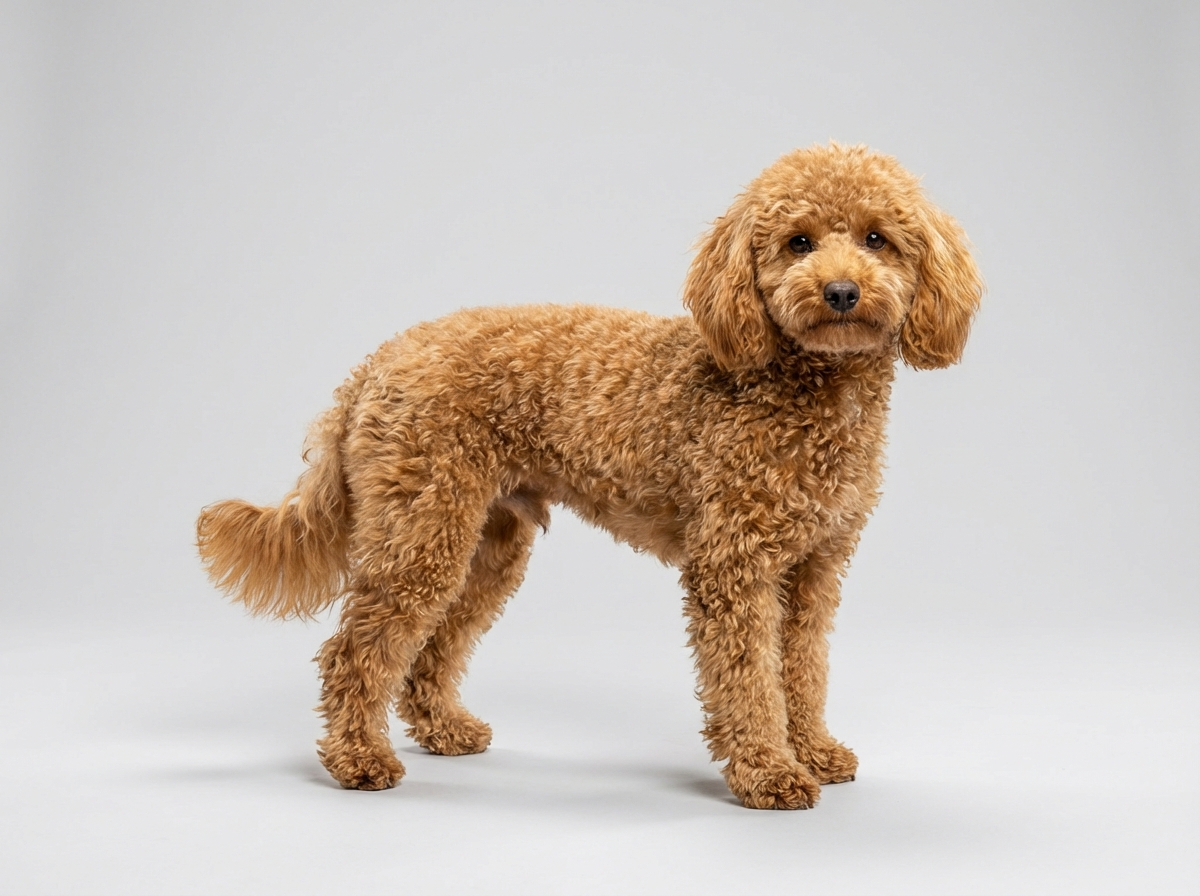
Ten to fifteen pounds against forty-five to sixty: this is not a close matchup on size. The Miniature Poodle tops out around 15 inches at the shoulder, the Husky runs 20 to 23 inches and carries a dense double coat built for cold-weather work. Pick up a Mini Poodle one-handed; you will not do that with a Husky. If living space or the ability to physically control the dog on leash matters to you, the size gap is the first thing to plan around, not an afterthought.
Energy and exercise
The Husky rates a full 5/5 on exercise need, the Mini Poodle a 3/5. Huskies were bred to pull sleds for miles in harness; a walk around the block does not touch that instinct, and an under-exercised Husky will dig, howl, or try to escape to burn the energy off itself. The Poodle still needs real daily activity, but a couple of brisk walks and some mental work covers it. If your week doesn't have room for an hour-plus of hard exercise most days, the Husky is the one to worry about.
Grooming and shedding
This is where the numbers flip. The Poodle's grooming need is rated 5/5, its shedding just 1/5, thanks to a curly coat that grows instead of falling out and needs a groomer every four to six weeks. The Husky sits at 3/5 for grooming but 5/5 for shedding: brushing is easy, but the coat blows out twice a year in clumps that will cover your floors and furniture. One breed costs you in salon visits, the other in a vacuum cleaner.
Apartment living, noise and time alone
Apartment suitability lands at 5/5 for the Mini Poodle and 1/5 for the Husky, and that one number tells most of the story. Barking is a tie at moderate (3/5) for both, but Huskies are also known for howling, and a Husky with pent-up energy in a small space is a management problem, not a personality quirk. Both breeds tolerate being alone poorly (2/5 and 1/5), so neither suits long solo workdays, but the Husky's need for space and output makes an apartment a much harder sell.
Training and owner experience
Trainability splits sharply: 5/5 for the Poodle, 2/5 for the Husky. Poodles were bred to work closely with people and pick up commands fast. Huskies were bred to run in a pack toward a destination without needing to check in with a handler, and that independence shows up at training time as selective hearing. First-time-owner suitability reflects the gap too, 3/5 against 1/5. A Husky is workable for an experienced owner who accepts recall will always be a work in progress, but it is not a forgiving first dog.
Kids, other dogs and visitors
Both breeds score well with kids, though the Husky edges it at 5/5 against the Poodle's 4/5 — Huskies have a reputation as patient, tolerant family dogs. Both are good with other dogs (4/5 each). Strangers are where they differ: the Husky is more outgoing at 4/5 against the Poodle's 3/5, which lines up with the Husky's low value as a guard dog — it tends to be friendly to nearly everyone, family included, rather than watchful.
Health and lifespan
The Poodle's expected lifespan runs 14-17 years, noticeably longer than the Husky's 12-14. Both breeds carry hip dysplasia, progressive retinal atrophy, hypothyroidism, epilepsy, bloat, and cancer risk on their lists, so ask about health screening for those regardless of which dog you choose. Beyond the overlap, the Poodle adds Addison's disease, patellar luxation, and sebaceous adenitis, while the Husky carries eye conditions like cataracts and corneal dystrophy plus uveodermatologic syndrome, a rarer autoimmune skin condition.
Cost to keep
Monthly costs land in the same $100-$200 band for both dogs, and first-year costs are close too — $1,500-$3,000 for the Poodle against $1,500-$2,800 for the Husky. The Poodle rates a higher overall cost level (4/5 versus 3/5), which tracks with recurring grooming bills rather than food or vet costs. Budget for a groomer every month or two with the Poodle; budget for a good vacuum and a securely fenced yard with the Husky.
Poodle (Miniature) vs Siberian Husky at a glance
Poodle (Miniature) weighs 10–15 lbs and lives 14–17 years; Siberian Husky weighs 45–60 lbs and lives 12–14 years. The two diverge most on apartment suitability, shedding and trainability and 3 other rated axes. They are level on barking and good with other dogs, so those cannot decide it. Where the table declares a winner it means less work for the owner, nothing more; descriptive rows are left as ties on purpose. The value here is in the differences between the two columns; treat any single score as approximate.
Poodle (Miniature) vs Siberian Husky: Which Suits Your Home? - Poodle (Miniature) vs Siberian Husky at a glance
Frequently asked questions
How much bigger is a Husky than a Miniature Poodle?
A Miniature Poodle weighs 10-15 lbs and stands up to 15 inches. A Siberian Husky weighs 45-60 lbs and stands 20-23 inches — three to five times the Poodle's weight, depending where each dog falls in its range.
Which one sheds more?
The Husky, by a wide margin. It rates 5/5 on shedding and blows its undercoat seasonally in heavy clumps. The Poodle rates 1/5 — its curly coat sheds so little it's a common pick for allergy-sensitive households, though it needs professional grooming to stay manageable.
Is either good for a first-time owner?
The Poodle is the safer choice, rated 3/5 for first-time owners against the Husky's 1/5. Huskies combine high exercise needs with low trainability (2/5), a combination that trips up a lot of new owners who expected a friendly sled-dog-shaped pet.
Which fits an apartment better?
The Poodle, clearly — 5/5 apartment suitability against the Husky's 1/5. A Husky's exercise needs and tendency to howl make small spaces genuinely difficult, not just less ideal.
What will each cost me monthly?
Both land in the same $100-$200 monthly range. The Poodle's costs lean toward grooming, the Husky's toward food volume and secure fencing, but the totals come out similar.
Do they share any health risks?
Yes — both breeds are prone to hip dysplasia, progressive retinal atrophy, hypothyroidism, epilepsy, bloat, and cancer. Ask any breeder about health testing for these regardless of which dog you go with.
Which one lives longer?
The Poodle, typically — 14 to 17 years against the Husky's 12 to 14. That three-year gap is worth weighing if longevity matters to your decision.
Poodle (Mini) or Husky — which should most people pick?
Go with the Mini Poodle unless you specifically want a high-energy, independent dog and can meet its exercise needs. The Poodle trains faster, sheds less, and suits far more living situations.
Costs
What will this cost me monthly?
Both run about $100-$200 a month. The Poodle's spending skews toward grooming; the Husky's toward food and yard security.
Training
How much exercise does each need?
The Husky needs far more: a 5/5 rating against the Poodle's 3/5. Expect to give a Husky an hour or more of vigorous activity most days.
Health
Which one lives longer?
The Poodle typically lives 14-17 years, the Husky 12-14. Both share several of the same major health risks.
Related DogBreedCompass guides
Poodle (Miniature) breed guide – Readers comparing the two usually want the full profile of Poodle (Miniature) before deciding.
Siberian Husky breed guide – The same for Siberian Husky, so the comparison can be checked against the detail.
Poodle (Miniature) vs Poodle (All Sizes) – Poodle (All Sizes) is the closest breed to Poodle (Miniature) on the measured axes, so it is the natural next comparison.
Health information here is general and is not veterinary advice. If your dog shows pain, sudden behaviour change, or worsening symptoms, consult a licensed veterinarian.
Some links on this site are affiliate links. We may earn a commission at no extra cost to you, and we only suggest products we believe are helpful for dog owners.
We research and check what we publish, but we do not warrant that any figure, date, price, or statement is accurate, complete, or current, and we accept no liability for any loss, cost, injury, or other harm arising from the use of this site. Use it as one reference among several. You remain responsible for your own decisions and for your dog's care - confirm anything that matters with a licensed veterinarian or another qualified professional before you act on it. Full disclaimer.